
High Quality Backlinks: Which Links Are Worth Earning?
Vincent
13/07/2023
11
High quality backlinks are references from relevant pages that give readers a credible reason to continue. They can support search visibility when the referring content is genuinely useful and the destination page answers the reader’s next question.
A strong backlink is more than a high score in an SEO tool. It should appear in content with a clear purpose, reach an audience that fits your business, and lead to a page worth citing. This is the foundation of off-page optimization, rather than a process focused only on increasing link volume.
What makes a backlink high quality?
A backlink becomes high quality when it improves the experience of someone reading the source page. The publisher gains a useful reference. Your website receives a relevant mention that can bring qualified visitors.
Search engines do not publish a fixed formula for backlink quality. A practical review should therefore look at the full placement instead of relying on one score.
A useful backlink gives readers a clear next step
Start with a simple question: why would a reader need this link?
A strong editorial reference may support a claim. It may lead to original data. In other cases, it can help someone complete a task with a template or tool. The link feels natural because it makes the source page more useful.
This is why the role of backlinks in organic growth depends on more than a referring domain’s size. A large publication with no topical connection can be less valuable than a smaller specialist site with the right audience.
Use a backlink opportunity scorecard
A consistent scorecard helps teams qualify opportunities before outreach begins.
|
Signal |
Question to ask |
Why it matters |
|
Page relevance |
Does the referring page cover a related subject? |
A relevant setting gives the link stronger context |
|
Editorial reason |
Does the source page improve because of this reference? |
Helps separate useful citations from forced placements |
|
Audience overlap |
Does the publisher reach people you want to reach? |
Supports qualified referral traffic |
|
Placement |
Will the link appear in useful main content? |
Readers can see the link and understand its purpose |
|
Surrounding context |
Do nearby words explain why the link belongs there? |
Gives the destination clearer meaning |
|
Destination fit |
Does your page answer the reader’s next question? |
Prevents irrelevant clicks |
|
Source quality |
Is the website maintained and useful? |
Helps avoid low-value placements |
|
Relationship type |
Is the placement editorial, sponsored, user-generated, or reciprocal? |
Supports disclosure and risk control |
A high metric can support this review, while it should not decide the outcome alone. The referring page still needs manual evaluation.
Relevance comes before raw authority
Authority scores can be useful when comparing several outreach prospects. They do not explain whether the source page has a relevant audience or whether the placement serves an editorial purpose.
Website authority benchmarks can help compare domains inside the same tool. The referring page still deserves closer review because topic fit, placement, and referral potential reveal more about the value of a specific backlink.
Consider these opportunities:
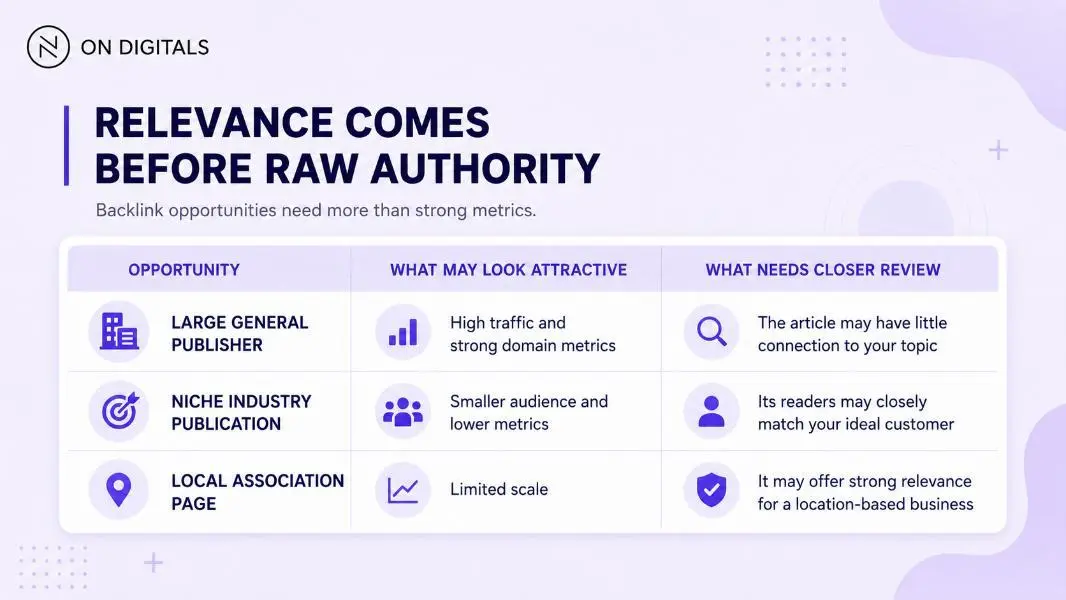 A relevant niche or local reference can create more value than a high-authority placement with little connection to the target audience.
A niche reference can create more commercial value when it sends qualified visitors or strengthens credibility in the right market.
Placement and surrounding context matter
A backlink inside the main body of a relevant article usually carries more value than a footer mention or a crowded sidebar link. Readers can understand why the resource was included. The surrounding sentence gives the destination a clear role.
Anchor text should describe the page naturally. “Backlink opportunity checklist” is more useful than “click here.” Repeated keyword-heavy anchors across unrelated sites can look forced and offer little reader value.
Google’s guidance on crawlable links and descriptive anchor text follows the same principle: users and search engines should be able to understand a destination before the click.
Where should high quality backlinks point?
The target page matters as much as the source. Some URLs naturally attract references, while others need stronger context before they are worth promoting.
|
Target page type |
When it fits |
Example |
|
Homepage |
Brand mentions or company coverage |
A partnership announcement |
|
Linkable asset |
Research, templates, tools, or data |
An industry benchmark |
|
Pillar guide |
Educational citations |
A detailed topic guide |
|
Commercial page |
Direct product or service context |
An expert comparison page |
|
Local landing page |
Community resources or local partnerships |
A location-specific service guide |
Informational assets are often easier to earn links to because publishers can cite them without making their content feel promotional. A useful guide can then direct readers internally toward a service page or product page where appropriate.
This approach also prevents every external link from pointing to the homepage. Priority guides, original tools, and commercial pages may all need support when they play different roles in the wider content strategy.
Linkable assets make outreach easier
A page becomes easier to cite when it reduces research effort for the publisher. Original data, calculators, templates, and clear comparison resources can all create a stronger reason to link.
For example, a general article about email marketing may be useful. A benchmark that shows how B2B teams use email automation across sectors gives writers a more specific source to reference.
Before outreach begins, check whether the target page can stand on its own as a useful resource. Improve the asset first when the answer feels uncertain.
How to earn high quality backlinks
Effective link earning starts with the opportunity that fits your current resources. A newer brand may benefit from reclaiming existing mentions. A business with specialist knowledge may be better positioned to publish research or provide expert commentary.
Reclaim relevant unlinked mentions
Unlinked mentions are a practical starting point because the publisher already knows your brand, product, or resource.
Search for articles that name your business without linking to the original source. Then assess whether a link would help readers find more detail, evidence, or a useful tool.
Keep the request specific. Explain which page adds missing context and why it improves the article. A generic request for “a backlink” gives the publisher little reason to act.
Help publishers update outdated resources
Older articles may link to discontinued tools, outdated statistics, or pages that no longer answer the original question. Those pages can create useful outreach opportunities when your resource is a genuine replacement.
A simple process looks like this:
- Find relevant pages with outdated references or broken links.
- Review the original topic before contacting the publisher.
- Confirm that your page gives a stronger current answer.
- Identify the issue clearly.
- Explain how the replacement helps the reader.
The opportunity becomes stronger when the original article already has editorial value. Replacing a broken link with loosely related content rarely helps the publisher.
Create assets people want to cite
Some content is designed to answer a search query. Other content supports wider research, reporting, or decision-making.
Citation-worthy assets may include:
- Original surveys
- Industry benchmarks
- Templates
- Calculators
- Comparison tools
- Expert commentary
- Visual explainers
The format should match a genuine information gap. A niche calculator can outperform a long article when it solves a repeated problem quickly. Original research may create more value when journalists or industry writers need a credible source.
Become a useful source for industry writers
Writers, journalists, and newsletter editors often need specialist viewpoints. Businesses can earn relevant mentions by making expertise easy to access.
Prepare short proof points before outreach:
- Topics where your team has direct experience
- Research findings that others can cite
- Examples that explain a complex issue
- A named expert who can provide a useful quote
The strongest pitch fits the publication’s existing coverage. Rather than offering a generic guest article, show how your insight supports a current discussion or helps answer a question for its audience.
Build partnerships around shared audiences
Partnerships can produce useful links when both sides create something worth sharing. A co-written report, webinar, interview, or event page can lead to natural mentions across relevant audiences.
Audience fit matters more than reach alone. A smaller organisation with a closely aligned community can create stronger referral value than a broad publisher with little connection to your market.
Choose tactics based on what you already have
|
Current asset or situation |
Best next approach |
|
Your brand receives mentions |
Reclaim relevant unlinked references |
|
You have expert knowledge |
Contribute commentary or data |
|
You publish research |
Pitch journalists and specialist publications |
|
Older content has useful links |
Refresh the page and promote the improved version |
|
Your audience repeats the same question |
Create a tool, template, or comparison page |
|
You have complementary partners |
Build a co-created resource |
How to avoid low-value link building
A backlink should create more value than a metric increase. Shortcuts can produce placements with little referral potential and may raise policy concerns.
Treat paid and sponsored placements transparently
Paid content can still have legitimate advertising value. When a link is part of a paid relationship, the source site should qualify it appropriately. Google recommends rel=”sponsored” for paid links, while rel=”ugc” can identify user-generated links such as forum posts or comments.
Its guidance on qualifying outbound links explains these attributes in more detail.
A paid link created mainly to influence rankings can create risk. The same concern applies to automated links, scaled exchanges, and placements built around weak content. Google’s Spam Policies for Web Search describe these patterns.
Be selective with directories and reciprocal links
A relevant industry directory or local association listing can help users discover your business. Large collections of weak listings are less likely to offer meaningful value.
Reciprocal links can also fit when two resources genuinely help the same audience. The placement becomes weaker when exchanging links is the main purpose of the relationship.
One question can help: would this reference still make sense if search engines did not exist? A clear “yes” usually signals a healthier opportunity. The same test helps teams identify private blog network risks, especially when a placement exists mainly to influence rankings rather than help a real audience.
How to monitor backlink quality after publication
Winning a backlink is only part of the process. The next step is checking whether the placement remains live, useful, and aligned with your goals.
|
Timeframe |
What to review |
|
First week |
Confirm that the link works and points to the correct URL |
|
First month |
Review referral sessions and engagement |
|
Quarterly |
Check whether the linked page gains visibility for relevant queries |
|
Quarterly |
Review new referring domains and anchor patterns |
|
Quarterly |
Compare lead quality or assisted conversions where measurable |
Referral traffic can reveal value that an authority score cannot. A backlink from a smaller website may still become a strong result when visitors spend time on the page, explore related content, or submit an enquiry.
Review suspicious patterns before taking action
Most websites collect some low-quality links over time. A few weak references do not automatically require removal or disavow.
Google describes the disavow tool as an advanced feature. It is generally relevant when a website has a considerable pattern of spammy or artificial links combined with a manual action, or a clear risk of one. Review Google’s disavow guidance before submitting a file.
A structured review should come first. Check the source pages, the anchor pattern, the target URLs, and the timing before treating a backlink profile as a problem.
High quality backlink checklist
Use this checklist before moving a prospect into outreach:
- The referring page covers a related topic.
- The publisher reaches a relevant audience.
- The link has a clear editorial reason.
- The placement fits naturally inside useful content.
- The anchor text is descriptive.
- The destination page solves the reader’s next question.
- The source shows real editorial value.
- Sponsored placements use the correct disclosure.
- The link could send qualified visitors.
A placement that meets most of these checks is more likely to create durable value than one chosen only for a metric.
FAQs about high quality backlinks
Are high-authority backlinks always high quality?
No. Authority metrics can help compare possible sources, while they cannot confirm that a page is relevant or editorially useful. A smaller niche website may create more value when its audience closely matches your target market.
Do nofollow backlinks still have value?
Nofollow links can still drive referral traffic, improve visibility, and introduce your content to people who may later mention it elsewhere. Their direct effect on ranking signals can vary, so source context remains important.
How many high quality backlinks does a page need?
There is no fixed number. A focused page may compete with a small set of strong editorial references, while a highly competitive topic may need more authority and stronger content support.
Should backlinks point to a homepage or a service page?
It depends on the source context. Brand coverage often fits the homepage. Educational citations usually fit a guide or tool. A commercial page can work when the source article directly evaluates the product or service.
Are directory backlinks still useful?
Relevant, maintained directories can support discovery, especially for local businesses or specialist industries. Avoid directory placements that exist only to create links and offer little value to users.
Can paid backlinks hurt SEO?
Paid placements used to manipulate rankings can create risk under Google’s spam policies. Advertising links can still be useful when they are disclosed properly and qualified with the appropriate attribute.
Should I disavow low-quality backlinks?
Most low-quality links do not require a disavow file. Begin with a manual review, then check Search Console for manual-action messages. Disavow becomes more relevant when there is strong evidence of a significant artificial-link pattern.
Conclusion
High quality backlinks are built on relevance, editorial purpose, and a destination page that helps readers continue their journey. One strong reference from the right source can create more useful value than a large batch of unrelated placements.
On Digitals helps businesses assess backlink opportunities through content relevance, audience fit, and long-term search visibility. This approach keeps off-page SEO connected to real business outcomes instead of chasing link volume alone.

NEWEST POSTS
- Advertising Industry In Vietnam: The 2026 Trends, Channels and Market-Entry Strategy
- Best SEO Company in Vietnam: Latest Shortlist For Businesses
- How To Leverage Social Media For Customer Service Like A Pro?
- Social Media Post Tips – 8 Ways To Boost Engagement
- How To Use Social Media for Sales – In-depth Beginner Guide
Read more