
Keyword Prominence and Where Keywords Should Appear
Vincent
13/07/2023
48
Keyword prominence is the visibility of a target keyword in important parts of a page, such as the title tag, H1, first paragraph etc. In a deeper keyword research process, prominence becomes useful after the team has chosen the right target term for the page. From there, placement should help users recognize the topic quickly without making the copy feel repetitive.
What is keyword prominence?
Keyword prominence refers to how early and visibly a keyword appears on a webpage. A keyword has higher prominence when it appears in places users notice quickly, such as the page title, main heading, opening paragraph, URL slug, or key section headings.
The target term should come from a clear keyword research process before the team decides where to place it. For new topics, seed keywords can help define the broader theme first, then the final page target can be chosen from more specific keyword opportunities.
For example, a page about “keyword prominence” should make that topic clear near the beginning. If the article waits several paragraphs before mentioning the main term, users may need more effort to confirm whether the page matches their search.
Keyword prominence should be understood as a clarity signal. It helps the page communicate its topic, while the rest of the content still needs to answer the search intent properly. Google’s SEO Starter Guide explains SEO as helping search engines understand content while helping users decide whether they should visit a site through Search.
Keyword prominence vs keyword density and proximity
Keyword prominence is often confused with other keyword concepts. The table below shows the difference.
|
Concept |
Meaning |
Practical SEO use |
|
Keyword prominence |
Where the keyword appears on the page |
Place the main topic in visible page areas |
|
Keyword density |
How often the keyword appears |
Avoid excessive repetition |
|
Keyword proximity |
How close related words appear |
Keep phrase meaning clear |
|
Keyword consistency |
How naturally related terms support the topic |
Reinforce topical clarity |
Keyword prominence is about placement, not repetition. A keyword used naturally in the title, H1, and first paragraph can be clearer than a keyword repeated many times across weak content.
Is keyword prominence important for SEO?
Keyword prominence can support SEO because it helps users and search systems identify the page topic quickly. It should be treated as part of on-page clarity rather than a standalone ranking shortcut.
Google’s title-link documentation says Google may use several page signals to generate title links, including the <title> element, main visual title, heading elements, large prominent text etc. This does not mean every visible keyword placement creates a direct ranking boost. It does show that prominent text can help Google understand how a page presents its main topic.
For users, prominence also affects scanning. A searcher who clicks a result wants fast confirmation that the page matches the query. When the title, H1, and opening paragraph all point to the same topic, the page feels easier to trust.
Keyword prominence should avoid keyword stuffing
Keyword prominence becomes harmful when it turns into forced repetition. Google defines keyword stuffing as filling a page with keywords or numbers to manipulate rankings, often through unnatural wording or out-of-context placements.
A better approach is simple: make the topic visible early, then write naturally. Use close variations when they help the sentence. Add supporting terms when they clarify the topic. Remove repeated keywords when they make the paragraph sound robotic.
Where keyword prominence matters on a page
Keyword prominence works best when the main keyword appears in places that shape the user’s first impression. Each element has a different role.
Title tag
The title tag is one of the most important places for keyword prominence because it can influence how the page is understood in search results and browser tabs. Google recommends making title text clear and distinctive, while its systems may use title elements and other page sources to generate title links.
Weak title:
A Complete Guide for Better SEO Results
Stronger title:
Keyword Prominence: How to Use Keywords Early
The stronger version tells users the exact topic before they open the page. It also avoids a vague promise that could apply to any SEO article.
H1 heading
The H1 should confirm the topic users expected after clicking. It does not need to copy the title tag exactly, but it should support the same intent.
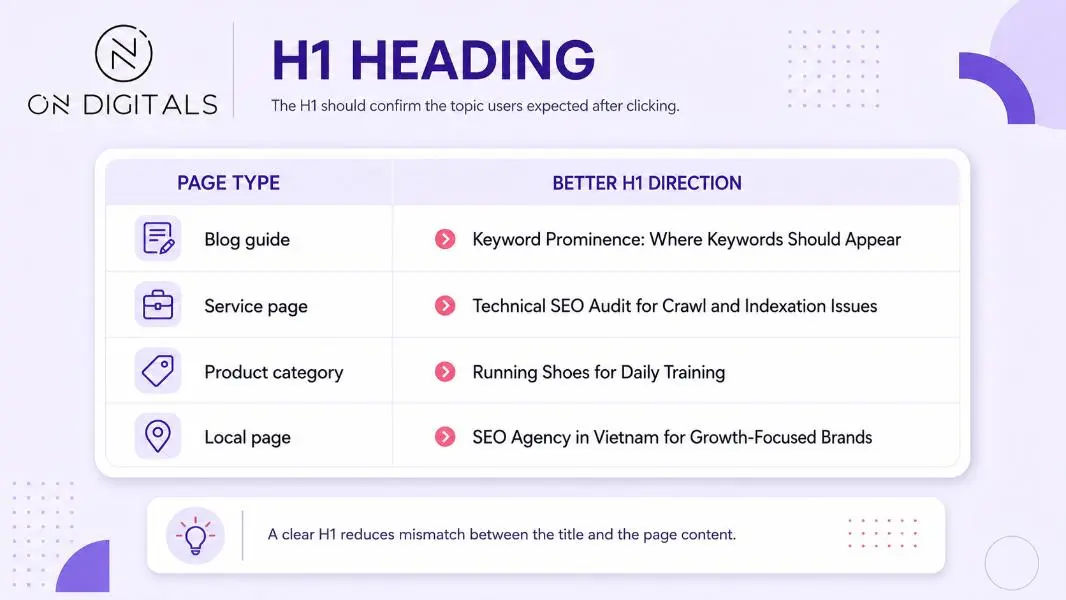 Clear H1 headings help match page content with user expectations across blog guides, service pages, product categories, and local pages.
A clear H1 reduces mismatch. If the title promises keyword prominence but the H1 says “SEO Tips for Beginners,” users may wonder whether they landed on the right page.
First paragraph
The first paragraph should answer the query quickly. For definition-based topics, the target keyword or close variation should appear early with a direct explanation.
Weak intro:
SEO includes many different factors that affect how a website performs in search engines.
Stronger intro:
Keyword prominence shows how visible a target keyword is in important parts of a page, including the title, H1, intro etc.
The stronger version gives users an immediate answer. It also helps the rest of the page stay focused.
Headings
Headings guide readers through the page. They also help search engines and assistive technologies understand the structure of the content.
Good heading prominence does not mean putting the exact keyword into every H2. Instead, each heading should make the section’s role clear.
Weak heading:
Important SEO Tips
Stronger heading:
How keyword prominence affects page clarity
Another strong heading:
Common keyword prominence mistakes
Both examples support the topic without sounding repetitive.
Meta description
The meta description is not a direct ranking lever in the same way as page content, but it can help users understand the result before they click. A useful description should include the topic naturally and explain why the page is worth opening.
Weak meta description:
Learn useful SEO tips that can improve your content and website results.
Stronger meta description:
Learn what keyword prominence means, where keywords should appear on a page, and how to improve on-page clarity without keyword stuffing.
The stronger version clarifies the article’s scope. It also sets better expectations for the reader.
URL slug
A clean URL slug can reinforce the page topic. It should stay short, readable, and stable.
Example:
/keyword-prominence/
This slug is clear because it matches the main topic. Avoid changing existing slugs only for small keyword tweaks because URL changes can create redirect work and potential tracking confusion.
Image alt text
Image alt text should describe the image. It can include the keyword when the image genuinely supports the topic, but it should not be used as a hidden keyword list.
Useful alt text:
Keyword prominence map showing title, H1, and intro placement
Weak alt text:
keyword prominence SEO keyword prominence keyword ranking
The useful version describes the image clearly. The weak version creates a poor accessibility and quality signal.
Keyword prominence examples
Keyword prominence becomes easier to understand when you compare weak and stronger versions.
|
Element |
Weak example |
Stronger example |
|
Title |
A Complete Guide for Better Rankings |
Keyword Prominence: Where Keywords Should Appear |
|
H1 |
Useful SEO Tips for Content |
Keyword Prominence and On-Page Keyword Placement |
|
Intro |
SEO has many important parts. |
Keyword prominence shows where your main keyword appears on a page. |
|
Heading |
Content Writing Advice |
How to improve keyword prominence without stuffing |
|
URL |
/seo-guide-2026/ |
/keyword-prominence/ |
The stronger examples work because they help users identify the topic faster. They also keep the wording natural instead of repeating the exact phrase everywhere.
How to utilize keyword prominence for SEO
Keyword prominence should be applied during content briefs, on-page reviews, and refresh projects. For existing pages, the easiest workflow is to check the most visible page elements first.
Start with the search intent
Before placing the keyword, decide what the page needs to do. Definition articles should answer the term quickly, while service pages need to clarify the offer and user problem. For category pages, keyword placement should help visitors understand the collection before they compare options.
Once the intent is clear, keyword placement becomes easier. The title, H1, and first paragraph can all support the same promise without becoming repetitive.
Use a page-level checklist
Use this checklist when reviewing an existing page:
- The title tag includes the target keyword or a close variation.
- The H1 confirms the same page topic.
- The first paragraph answers the main query quickly.
- Key H2s support the search intent.
- The URL slug reflects the topic clearly.
- Image alt text describes relevant visuals.
- Internal anchor text points to the page naturally.
- The copy avoids forced keyword repetition.
This checklist works best when paired with actual page performance. If a page has impressions but weak clicks, the title and meta description may need attention. If users leave quickly, the opening section may not confirm the search intent clearly enough.
Adapt prominence by page type
Different templates need different placement priorities.
|
Page type |
Where prominence matters most |
Example |
|
Blog guide |
Title, H1, intro, H2s |
Define the topic early |
|
Service page |
Title, H1, intro, service scope |
Show the offer clearly |
|
Product category |
Category title, intro, filters |
Help users compare items |
|
Local page |
Title, H1, location intro |
Match service and location intent |
For a service page targeting “technical SEO audit,” the keyword or close variation should appear in the title tag, H1, first paragraph, and at least one relevant H2. The service scope can then explain crawlability, indexation, Core Web Vitals etc. without repeating the exact phrase in every section.
Use variations when they sound natural
Exact-match keywords can help, but close variations often make the page easier to read. For pages targeting long-tail keywords, the full phrase should appear where it feels natural, while shorter variations can support headings, examples, and internal links.
The main topic should remain obvious. Supporting phrases can add context without making the copy feel mechanical.
Common keyword prominence mistakes
Keyword prominence mistakes usually happen when teams optimize for placement without checking readability.
|
Mistake |
Why it hurts |
Better approach |
|
Repeating the keyword in every heading |
The page sounds forced |
Use natural section labels |
|
Hiding keywords in alt text |
Accessibility suffers |
Describe the image honestly |
|
Using a vague title |
Users cannot confirm relevance |
Put the main topic near the front |
|
Ignoring the first paragraph |
The answer feels delayed |
Define or frame the topic early |
|
Optimizing one element only |
Signals feel inconsistent |
Align title, H1, intro etc. |
|
Treating prominence as a shortcut |
Content quality suffers |
Match intent and write clearly |
A strong page makes the topic clear without making the reader feel like they are seeing the same phrase over and over.
Keyword prominence FAQ
Is keyword prominence a Google ranking factor?
Keyword prominence can support SEO because it helps clarify the page topic. It should not be treated as a guaranteed ranking factor by itself. Content quality, intent alignment, technical accessibility, and relevance still matter.
Where should I place my target keyword?
Start with the title tag, H1, and first paragraph. Then use the keyword or close variations in relevant headings, URL slugs, image alt text etc. only where the placement feels natural.
Is keyword prominence the same as keyword density?
Keyword prominence is about where the keyword appears. Keyword density is about how often it appears. A page can have strong prominence with low repetition.
Can keyword prominence cause keyword stuffing?
Yes, when the keyword is forced into too many places. Strong prominence should make the topic clear early, while keyword stuffing makes the page repetitive or unnatural.
Should the exact keyword appear in every heading?
Each heading should describe the section clearly. Use the exact keyword when it fits, then use natural variations when they make the heading easier to read.
Final thoughts
Keyword prominence helps a page show its main topic in the places users notice first, from the title and H1 to the opening paragraph and key headings. When those elements support the same intent, the page becomes easier to scan, easier to understand, and less dependent on repeated keyword use.
If your important pages have impressions but weak clicks, unclear openings, or headings that do not fully match search intent, On Digitals can help review keyword placement as part of a wider on-page SEO audit. Our team checks titles, headings, introductions, internal links etc. so each update improves page clarity instead of simply adding more keywords.

NEWEST POSTS
- Advertising Industry In Vietnam: The 2026 Trends, Channels and Market-Entry Strategy
- Best SEO Company in Vietnam: Latest Shortlist For Businesses
- How To Leverage Social Media For Customer Service Like A Pro?
- Social Media Post Tips – 8 Ways To Boost Engagement
- How To Use Social Media for Sales – In-depth Beginner Guide
Read more