
What Is Search Engine Marketing? A Strategy Guide for AI Search
Vincent
15/04/2023
26
Search engine marketing is the discipline of earning visibility on search results through paid ads, organic search support, AI-ready content, and conversion tracking. Currently, effective SEM connects Google Ads, Performance Max, AI Overviews, SEO data, and GA4 revenue measurement for businesses that need qualified leads or sales.
Search is no longer a simple page of blue links with ads on top. Google now serves other types of results far more than pages in one search journey. This shift changes how marketers should think about search engine marketing. A basic “SEM means PPC” definition is not enough to plan a modern campaign. The better question is what is SEO, paid search, and AI search’s visibility working together to create revenue.
What is search engine marketing?
Search engine marketing (SEM) is the practice of making a business visible when people search for products, services, or answers. In current marketing usage, SEM usually means paid search advertising, especially PPC through platforms such as Google Ads. A modern SEM program also uses SEO, landing pages, tracking, and AI search visibility to improve traffic quality.
Older definitions treated SEM as an umbrella term for paid and organic search. Many current sources now use SEM almost exclusively for paid search or PPC, although the historical overlap with SEO still matters.
Use the narrow definition when naming campaigns: SEM usually means paid search. Use the broader definition when planning growth: search visibility depends on paid media, organic content, tracking, and conversion rate optimization.
A practical SEM strategy answers four questions:
- Which search intents are worth paying for?
- Which queries should SEO capture instead?
- Which landing pages convert paid traffic?
- Which metrics prove business impact?
That is why SEM in 2026 should not live inside a media-buying spreadsheet alone. It needs input from SEO, analytics, sales, and website teams.
SEM vs SEO
SEM buys visibility through paid placements, while SEO earns visibility through organic rankings, content quality, technical health, and authority. The two channels work best as one search system because paid data can reveal converting intent, while SEO can reduce long-term dependence on expensive clicks.
The old “SEM vs SEO” framing makes teams choose too early. For most businesses, the smarter move is to define the job of each channel.
| Decision point | Use SEM when | Use SEO when | Use both when |
| Timeline | You need traffic now | You can build over months | Launch needs short and long-term demand |
| Intent | Query is high commercial value | Query is informational or research-heavy | Buyer journey spans education and purchase |
| Budget | You can fund testing | You can invest in content and technical work | You need visibility and efficiency |
| Learning | You need fast keyword feedback | You need topical authority | Paid search can validate SEO priorities |
| SERP risk | Organic space is crowded | Ads are too costly | AI Overviews or aggregators reduce clicks |
In practice, SEM and SEO share the same raw material, which is search intent. Paid search focuses more on immediately conversion, while SEO turns those learnings into organic and sustainable visibility.
The reverse also works. SEO data from Google Search Console can show rising query patterns before a paid campaign is built. Those queries can become ad groups, negative keywords, or landing page angles.
How SEM works?
SEM works through an ad auction that decides the ads appearance and cost of the click. Google Ads uses Ad Rank to consider bid, ad quality, search context, competitiveness, thresholds, and assets. Quality Score is a diagnostic signal, instead of the full auction formula.
When someone searches, Google does not simply give the highest bidder the top slot. It runs auctions for eligible ad locations, then calculates Ad Rank for each eligible advertiser. Google says Ad Rank is based on factors such as bid, ad and landing page quality, auction competitiveness, search context, thresholds, and ad assets.
A simplified search ad flow looks like this:
- A user searches for a query.
- Google matches the query to eligible ads.
- The ad auction calculates Ad Rank.
- Ads appear above, below, or inside certain search experiences.
- The advertiser pays when the user clicks.
- Conversion tracking records the post-click action.
Quality Score should not be treated as the only optimization target. Google describes Quality Score as a 1-10 diagnostic tool based on expected CTR and landing page experience. Google also notes that it is not a key performance indicator and is not an input in the ad auction itself.
The practical lesson is simple: A higher bid may buy reach, but weak relevance will waste your budget.
SEM in the AI search era
AI search changes SEM because the search result is becoming more conversational, more visual, and more automated. Ads can appear around or within AI Overviews, while campaign systems use Smart Bidding, broad match, Performance Max, Demand Gen, and AI Max to match broader user intent.
Google says ads are eligible above or below AI Overviews in markets where AI Overviews are available. Text and Shopping ads from existing Search, Shopping, and Performance Max campaigns can also be eligible inside AI Overviews in selected English markets.
That creates three practical changes.
1. Intent matters more than exact keywords
Exact-match keyword lists still have a role, especially for control. But modern search behavior is more varied. Google’s broad match documentation says broad match identifies related queries, uses additional signals, and gives Smart Bidding more data and flexibility.
This does not mean advertisers should abandon structure. It means keyword research should become intent research. A B2B software campaign, for example, should separate “pricing,” “alternative,” “implementation,” and “demo” intent before choosing match types.
2. Campaign types are more automated
Performance Max is a goal-based campaign type that can access Google inventory from one campaign, including Search, YouTube, Display, Discover, Gmail, and Maps. Google says Performance Max uses Google AI across bidding, budgets, audiences, creatives, attribution, and more.
AI Max for Search is another signal of this shift. Google describes it as an optimization layer for existing Search campaigns, not a new campaign type. It can expand search term matching, tailor creative, optimize landing pages, and provide enhanced reporting.
Demand Gen also matters for SEM planning because Google Display Ads are moving toward Demand Gen. Google states that eligible advertisers can begin voluntary migration in June 2026, and that Demand Gen reaches across YouTube, Shorts, Discover, Gmail, Maps, and the Google Display Network.
3. Visibility is no longer equal to clicks
AI Overviews can change click behavior. A Search Engine Land summary of Seer data reported lower CTR for queries with AI Overviews, including a drop in organic CTR from 1.76% to 0.61% and paid CTR from 19.7% to 6.34% in the studied dataset. The same report noted that cited brands earned more organic and paid clicks than non-cited brands.
Treat those numbers as directional, not universal. The dataset covered informational queries across participating organizations, so each business still needs its own Search Console and Google Ads data.
The strategic lesson is clear. SEM teams should measure search visibility, citation presence, paid click quality, and revenue together. A click-only dashboard misses how AI search changes discovery.
Building a modern SEM campaign
A modern SEM campaign starts with business goals, then turns search intent into campaign structure, ad copy, landing pages, bidding, and measurement. The best campaigns do not begin with a keyword dump. They begin with one clear action, such as a qualified lead, purchase, booking, or offline sales event.
Use this condensed playbook instead of a long list of disconnected tips.
Step 1: Define the conversion that matters
Choose the action that should guide optimization. For ecommerce, that may be purchase value. For B2B, it may be demo requests, qualified form submissions, or CRM-stage conversions.
Do not optimize only for cheap leads if sales quality matters. A low CPL campaign can still fail when sales rejects most contacts.
Step 2: Map intent before keywords
Group queries by decision stage:
- Problem-aware: “how to reduce logistics costs”
- Solution-aware: “warehouse management software”
- Vendor-aware: “best WMS provider Vietnam”
- Action-ready: “book WMS demo”
This structure helps you decide whether to use Search, SEO, Performance Max, or remarketing.
Step 3: Build focused campaign architecture
Use standard Search campaigns for high-control, high-intent terms. Use Performance Max when you have enough conversion data, strong assets, and a clear conversion goal. Use Demand Gen when you need visual discovery and mid-funnel demand creation.
Keep brand, competitor, generic, and remarketing intent separate where reporting clarity matters.
Step 4: Write ads for relevance and proof
Responsive Search Ads need varied headlines and descriptions, not random synonyms. Google says headlines and descriptions may appear in any order, so the first three headlines should work together and at least one headline should include a relevant keyword.
Write around the user’s job to be done. A strong ad should state the offer, audience, differentiator, and next step without overclaiming.
Step 5: Match landing pages to intent
A pricing query should not land on a generic homepage. A comparison query should not land on a form-only page with no proof.
Landing pages should include the search promise, offer details, trust signals, FAQs, and a clear conversion path. For B2B, include enough context for both the marketer and the decision-maker.
Step 6: Use negative keywords and query reviews
Automation expands reach, but it still needs guardrails. Review search terms, exclude irrelevant queries, and monitor whether broad match or AI-driven expansion is finding useful demand.
Negative keyword hygiene is especially important when budgets are small or lead quality is uneven.
Measuring SEM from clicks to revenue
SEM measurement should connect ad spend to business outcomes, not only clicks. A reliable setup includes Google Ads conversion tracking, GA4 events, Google Search Console data, CRM status, offline conversion imports, and KPI reporting across CTR, CPC, CPA, ROAS, conversion rate, and revenue.
Google Ads conversion measurement tracks specific actions users take after interacting with an ad. Google’s setup flow supports direct Google tag measurement and Google Analytics 4 web data sources, which helps advertisers connect ad activity to website behavior.
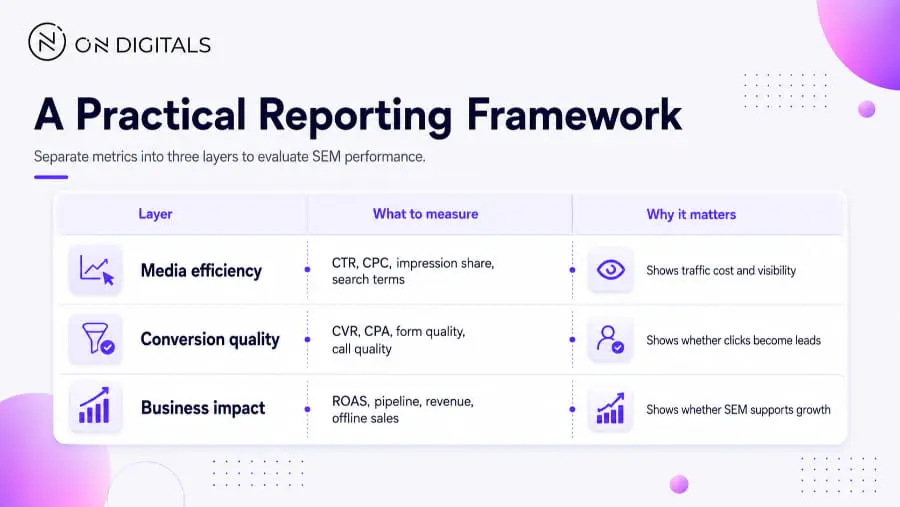
Attribution also needs context. Last-click reporting can undercount Demand Gen, YouTube, or upper-funnel search activity. Data-driven attribution can help, but the real improvement comes from matching platform data with CRM outcomes.
For B2B, import offline conversion stages where possible. A campaign that drives fewer leads may still be better when those leads become sales-qualified opportunities.
How to choose the most effective one?
Choose SEM when the business needs fast visibility, clear commercial intent, and measurable short-term demand. Choose SEO when the topic needs authority, education, and durable organic coverage. Use both when the buyer journey starts with research and ends with a high-value commercial action.
Here is a simple decision matrix for planning.
| Scenario | Recommended approach | Reason |
| New product launch | SEM first, SEO in parallel | Paid search captures demand while content builds |
| High CPC category | SEO + selective SEM | Organic coverage reduces dependence on costly clicks |
| Local service leads | SEM + local SEO | Paid captures urgent demand; local SEO builds trust |
| B2B long sales cycle | SEO + SEM + remarketing | Search behavior spans research and vendor comparison |
| Ecommerce promotion | SEM + Shopping/PMax | Time-sensitive offers need immediate reach |
| Low-budget education topic | SEO first | Paid clicks may not justify early spend |
Budget is not the only constraint. Timeline, intent, margin, sales cycle, and tracking maturity matter just as much.
A business with no conversion tracking should fix measurement before scaling SEM. A business with weak landing pages should improve conversion rate before increasing bids.
How much does SEM cost?
SEM cost depends on industry, location, competition, conversion rate, landing page quality, bidding strategy, and sales value. CPC is only the entry cost. The more important numbers are CPA, ROAS, qualified lead rate, and revenue per conversion.
WordStream’s 2026 PPC benchmarks analyzed more than 13,000 US-based campaigns from April 2025 through March 2026. The reported overall averages were 6.64% CTR, $5.42 CPC, 8.18% conversion rate, and $66.69 cost per lead.
Use benchmarks as a starting point, not a target. A legal, SaaS, ecommerce, healthcare, and local service campaign will not share the same economics.
A basic budgeting method looks like this:
- Set the target number of conversions.
- Estimate expected conversion rate.
- Estimate likely CPC range.
- Calculate required clicks.
- Convert clicks into media budget.
- Add testing buffer for learning.
- Compare expected CPA with gross margin or lead value.
Example: if a B2B company needs 40 qualified leads and expects a 4% landing page conversion rate, it needs about 1,000 clicks. At $5 per click, the media budget is about $5,000 before management, creative, or tracking costs.
The real budget question is not “How cheap can SEM be?” It is “What can we pay for a qualified conversion and still grow profitably?”
Frequently Asked Questions (FAQs)
Is SEM the same as PPC?
SEM and PPC overlap, but they are not always identical. In current marketing usage, SEM usually refers to paid search advertising, while PPC describes the payment model where advertisers pay per click. PPC can also appear outside search, such as display, social, or marketplace ads.
Is SEO part of SEM?
Historically, SEM included both SEO and paid search. Today, most commercial marketing teams use SEM to mean paid search, while SEO refers to organic visibility. Strategically, they should still work together because both channels depend on search intent, landing page quality, and measurable demand.
How long does SEM take to work?
SEM can start generating traffic as soon as campaigns are approved and budget is active. Meaningful optimization usually takes longer because bidding systems need conversion data, search terms need review, and landing pages need testing. For many accounts, the first month should focus on signal quality and waste reduction.
Does AI search make SEM less useful?
AI search makes weak SEM less useful, but it makes strong SEM more strategic. Ads can appear around or inside AI Overviews in supported contexts, and Google’s campaign systems increasingly use AI for targeting, bidding, and creative matching. Businesses need better intent mapping, not less search marketing.
What should a business prepare before launching SEM?
Prepare a conversion goal, landing page, tracking setup, keyword or intent map, negative keyword plan, ad copy, budget range, and reporting structure. For B2B, also define what counts as a qualified lead. Without that definition, the campaign may optimize for cheap forms instead of sales opportunities.
Final thoughts
Search engine marketing in the AI era is not just buying clicks on Google. It is a search growth system that connects paid visibility, organic insight, AI search presence, landing page experience, and revenue measurement.
The strongest SEM programs do three things well. They target intent instead of chasing every keyword, thus, give automation clean inputs instead of letting it run unchecked, and measure business outcomes instead of stopping at CTR or CPC.
For On Digitals, this is where paid advertising, SEO, AIO/AEO, analytics, and website optimization should meet. If your team is running Google Ads but cannot explain which queries create qualified leads, the next step should be a cleaner SEM strategy.

NEWEST POSTS
- Advertising Industry In Vietnam: The 2026 Trends, Channels and Market-Entry Strategy
- Best SEO Company in Vietnam: Latest Shortlist For Businesses
- How To Leverage Social Media For Customer Service Like A Pro?
- Social Media Post Tips – 8 Ways To Boost Engagement
- How To Use Social Media for Sales – In-depth Beginner Guide
Read more