
Seed Keywords: Meaning, Examples, and SEO Research Use
Vincent
22/05/2024
12
Seed keywords are broad starting terms used to begin keyword research. In a more advanced keyword research workflow, they help SEO teams discover long-tail keywords, build topic clusters, and decide which pages should target related search demand. A useful seed keyword should match the business, reflect user language, and create enough relevant ideas for content planning.
What are seed keywords?
Seed keywords are short, broad terms that describe a main topic, product, service, or audience need. They are called “seed” keywords because they help generate more specific keyword ideas during research.
For example, “keyword research” can be a seed keyword. From that starting point, a team may discover terms such as “advanced keyword research,” “keyword research tools,” “how to do keyword research,” or “keyword research for SEO.” The seed term starts the process, while the expanded terms help shape real content opportunities.
Seed keywords are usually too broad to be the final target for every SEO page. A term like “shoes” may be useful for research, but a page targeting “best running shoes for beginners” has a clearer user need. This is why seed keywords should be treated as the beginning of research rather than the finished keyword plan.
Seed keywords vs short-tail and long-tail keywords
These keyword types often overlap, but they do different jobs in SEO planning.
|
Keyword type |
Meaning |
SEO role |
|
Seed keyword |
Broad starting term for research |
Opens the topic |
|
Short-tail keyword |
Short, broad keyword with wide demand |
Shows main market language |
|
Long-tail keyword |
More specific phrase with clearer intent |
Helps define page topics |
A seed keyword can be a short-tail keyword, but the term “seed” describes its function in research. The same word becomes useful when it helps the team uncover related searches, subtopics, and content paths.
Seed keyword examples
Seed keyword examples usually come from the main topics a business wants to be known for.
For an SEO agency, possible seed keywords include:
- keyword research
- technical SEO
- content strategy
- SEO audit
- local SEO
For an ecommerce site selling outdoor products, useful seeds may include:
- hiking backpack
- camping tent
- trail shoes
- rain jacket
- outdoor gear
For a local service business, seed keywords often start with the core service:
- dental clinic
- plumbing repair
- wedding photography
- house cleaning
- fitness coach
These seeds should be expanded before a page is created. The expansion process reveals whether users want a guide, product category, local landing page, comparison article etc.
Why seed keywords matter for SEO
Seed keywords matter because they shape the direction of keyword research. When the starting terms are weak, the entire keyword list can become unfocused. When the seeds are relevant and clear, the team can build better clusters, briefs, and page priorities.
They start keyword research with real topics
Keyword research needs a starting point. Seed keywords provide that first direction before tools, SERP checks, or competitor reviews enter the workflow.
A team that starts with “marketing” may find too many unrelated ideas. A team that starts with “content marketing strategy” can research with more focus. The second seed is still broad enough to expand, but it gives the research a clearer path.
They help discover long-tail keywords
Long-tail keywords often come from seed keyword expansion. A broad seed such as “CRM software” can lead to searches around pricing, alternatives, integrations, use cases etc.
This matters because long-tail keywords usually show clearer intent. Someone searching “CRM software” may still be exploring. A search like “CRM software for small business with email automation” reveals a more specific need.
They support topic clusters
Seed keywords can help build topic clusters when the team groups related searches around one main theme.
For example, the seed keyword “keyword research” may lead to several connected content pieces:
- keyword research basics
- keyword research importance
- keyword search intent
- advanced keyword research
- long-tail keyword research
- keyword strategy
Together, these pages can support a stronger topic cluster if each URL has a clear role. Some pages explain beginner concepts, while others guide deeper workflows or commercial decisions.
They prevent weak keyword direction
A vague seed can create a vague content plan. If a business chooses “digital” as a seed keyword, the research may branch into too many unrelated topics. A more focused seed such as “digital marketing strategy” gives the team a better chance to find useful searches.
Good seed keywords also help prevent keyword overlap. When a team understands the main topic early, it becomes easier to decide which page should own the cluster and which pages should support it.
What makes a good seed keyword?
A good seed keyword should be broad enough to expand but focused enough to stay useful. It should describe a real business area, user problem, product category, or service theme.
Use this checklist before adding a term to your seed list.
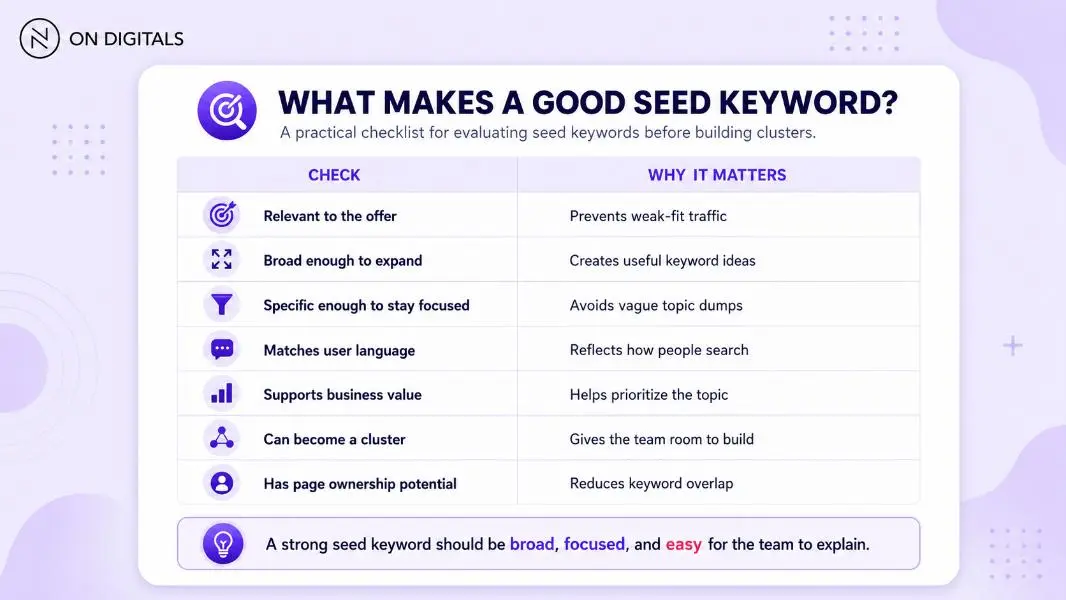 A good seed keyword should be relevant, expandable, easy to understand, and strong enough to support future keyword clusters.
A seed keyword should also be easy to explain. If the content team cannot describe what the seed means or why it matters, the keyword may be too vague for planning.
How to find seed keywords
Seed keywords can come from several sources. Tools are useful, but the best process starts with business context and user language.
Start with products, services, and audience needs
Begin with what the business actually offers. Write down the main services, product categories, audience problems, and recurring questions from customers.
For a service business, the first seed terms may come from core offers. For an ecommerce site, category names often become strong seed ideas. For a content publisher, seed keywords may come from audience pain points or education themes.
Useful prompts include:
- What do we sell?
- What problem does the user want to solve?
- Which service pages matter most?
- Which product categories drive revenue?
- What topics do sales or support teams hear often?
These prompts keep the seed list tied to real business value.
Use Google Keyword Planner carefully
Google Keyword Planner can help discover keyword ideas and search estimate data. It is built for Google Ads, so SEO teams should use it as a discovery source rather than a final ranking decision tool.
Start with a broad seed, then review suggested terms for relevance. Remove ideas that do not match the offer, audience, or content direction. After that, group the remaining terms by intent.
For example, a seed such as “SEO audit” may produce terms around checklists, tools, services, pricing etc. Each group may need a different page type.
Review Google Search Console queries
For websites with existing traffic, Google Search Console can reveal queries that already bring impressions or clicks. This is useful because the data comes from your own verified property.
Look for broad queries that appear across several pages. Those terms can become seeds for refresh work, internal linking, or cluster planning.
Pay attention to:
- queries with many impressions
- pages with weak click-through rate
- terms appearing across several URLs
- old pages ranking for new subtopics
- questions that could become supporting content
Search Console should be used for your own site data. It does not show competitor query data for websites you do not own.
Study competitor pages and categories
Competitor websites can reveal how others organize topics. Their navigation, blog categories, service pages, and resource hubs can all suggest seed keyword ideas. For faster competitor checks, SEO teams can also use Google advanced search operators such as site:, quotes, intitle: etc. to find topic pages, category structures, and content examples across a specific domain.
For ecommerce research, category names are especially useful. A store selling backpacks may use category terms like “hiking backpack,” “travel backpack,” or “laptop backpack.” Each category can become a seed, then long-tail expansion can identify product filters, buyer questions, and comparison topics.
For service businesses, competitor service pages can show which offers deserve separate keyword clusters. The team should still validate the terms before copying the structure.
Check Google autocomplete, PAA, and related searches
Google autocomplete can show how users extend a seed keyword. People Also Ask can reveal questions around the same topic. Related searches often show adjacent terms that users explore next.
For the seed keyword “keyword research,” autocomplete may suggest tool-related, beginner, or SEO-specific searches. PAA results can reveal questions about process, importance, frequency, or examples.
These SERP sources are useful because they reflect real search behavior. Use them to expand ideas, then validate the best terms with tool data and manual SERP review.
Review forums, communities, and customer feedback
Users often describe problems differently in communities than they do in formal search queries. Forums, reviews, support tickets, sales notes, and customer interviews can uncover seed terms that tools may not surface clearly.
For example, a software company may describe a feature as “workflow automation,” while users complain about “manual reporting” or “repetitive admin tasks.” Those phrases can become better seed ideas because they reflect pain points in natural language.
This source is especially useful for niche markets, new products, or topics where keyword tools show limited data.
Use SEO tools to validate and expand
SEO tools can expand seed keywords into related terms, questions, phrase matches, and competitor keyword ideas. The tool does not replace judgment, but it helps the team check whether a seed has enough search demand and topic depth.
When reviewing tool results, filter for:
- relevance
- intent
- long-tail potential
- keyword difficulty
- SERP format
- business value
A seed keyword is stronger when it produces relevant variations across several intent levels. If every suggestion feels unrelated, the seed may need to be replaced or narrowed.
How to turn seed keywords into keyword clusters
Seed keywords become useful when they lead to organized keyword clusters. A cluster groups related searches around one topic and gives each page a clear role.
Use this workflow:
Seed keyword
↓
SERP and tool expansion
↓
Long-tail keyword ideas
↓
Intent grouping
↓
Keyword cluster
↓
Target URL
↓
Content brief or refresh task
Expand the seed into long-tail ideas
tart with one seed and collect specific variations. These may include questions, comparisons, local modifiers, product features, price-related searches etc. This step is where long-tail keyword research becomes useful because the team can move from a broad topic into phrases with clearer intent.
For the seed “hiking backpack,” long-tail ideas may include:
- lightweight hiking backpack
- waterproof hiking backpack
- hiking backpack for women
- hiking backpack for day trips
- hiking backpack with laptop compartment
Some of these terms fit product categories. Others may work better as blog guides or buying guides.
Group keywords by intent
After expansion, group the keywords by what users want to do. Informational keywords need explanations. Commercial keywords need comparison support. Transactional terms should connect to product, service, or landing pages.
Intent grouping prevents the team from forcing unrelated searches into one page. It also helps writers understand what the content should do before drafting begins.
Assign a target page or cluster
Each cluster needs a page owner. The owner may be an existing URL or a new page.
If the site already has a relevant page, the keyword research can support a refresh. If no existing URL matches the intent, the team may need a new page. For larger topics, a pillar page with supporting articles may work better than one long article.
Seed keyword examples by business type
Seed keyword planning becomes easier when it is tied to a business model.
For an SEO agency, “keyword research” can expand into “advanced keyword research,” “keyword strategy,” “keyword search intent” etc. Some terms may become blog guides, while commercial terms may support service pages.
For ecommerce, “hiking backpack” can lead to category pages, product filters, buying guides, and comparison content. The seed is useful because it connects product demand with content opportunities.
For local services, “dental clinic” may expand into emergency, pricing, location, and family-service searches. These branches can shape local landing pages or FAQ content.
For SaaS, “CRM software” can lead to use-case pages, alternative pages, integration guides, pricing content, and comparison articles. The seed helps the team map the buyer journey from awareness to evaluation.
Common seed keyword mistakes
Seed keyword mistakes usually happen when teams choose starting terms too quickly. The table below shows common issues and better fixes.
|
Mistake |
Why it hurts |
Better fix |
|
Choosing terms that are too broad |
Research becomes unfocused |
Narrow the seed around a real topic |
|
Treating seed keywords as final targets |
Pages may target vague demand |
Expand into intent-based terms |
|
Ignoring customer language |
Keywords may sound internal |
Review reviews, calls, support notes etc. |
|
Using only tools |
Useful language may be missed |
Combine tools with SERP and customer sources |
|
Creating clusters without ownership |
Pages may overlap |
Assign one target URL per cluster |
|
Skipping validation |
Weak seeds waste research time |
Check intent, relevance, and business value |
Strong seed keywords should help the team make better decisions. If a seed only creates unrelated ideas, it should be replaced.
What to do after finding seed keywords
After building a seed keyword list, organize it before creating content. The next step is not to publish one page for every term.
Start by removing weak-fit seeds. Then expand the stronger terms into long-tail ideas. Group those ideas by intent and assign target pages. If an existing URL already fits the cluster, refresh it instead of creating another page.
A practical output should include:
- approved seed keywords
- related long-tail ideas
- intent groups
- target URLs
- page type decisions
- content brief notes
- internal link opportunities
- refresh tasks
This turns seed keyword research into a real SEO plan. It also helps prevent content overlap when several writers work on the same topic cluster.
Seed keyword FAQ
How many seed keywords should I start with?
Most small projects can start with 5 to 10 strong seed keywords. Larger websites may need more, but quality matters more than volume. Each seed should connect to a real business topic.
Are seed keywords the same as short-tail keywords?
They can overlap. Many seed keywords are short-tail terms, but “seed keyword” refers to the role the term plays in research. It starts the expansion process.
Can a seed keyword be a long-tail keyword?
Yes, a long-tail phrase can work as a seed when the topic is niche. For example, “YouTube keyword research” may be specific, but it can still generate related subtopics.
How do seed keywords help find long-tail keywords?
A seed keyword gives the research tool, SERP review, or brainstorming process a starting point. From there, the team can discover questions, modifiers, comparisons, and more specific phrases.
Should I optimize a page for a seed keyword?
Sometimes, but broad seed keywords are often too competitive or vague. Many pages perform better when they target a clearer long-tail keyword or cluster built from the seed.
What should I do after finding seed keywords?
Expand the seeds into related terms, group them by intent, assign target pages, and create content briefs. Existing pages should be reviewed before new pages are planned.
Final thoughts
Seed keywords are the starting point for stronger keyword research. They help teams move from broad topics to long-tail ideas, keyword clusters, and page plans that match real user needs.
If your team has seed keywords but still struggles to turn them into focused clusters, content briefs, or target pages, On Digitals can help build a clearer SEO research workflow. We review search intent, business value, existing URLs, and content gaps so each seed keyword leads to a practical next step instead of another disconnected keyword list.

NEWEST POSTS
- Advertising Industry In Vietnam: The 2026 Trends, Channels and Market-Entry Strategy
- Best SEO Company in Vietnam: Latest Shortlist For Businesses
- How To Leverage Social Media For Customer Service Like A Pro?
- Social Media Post Tips – 8 Ways To Boost Engagement
- How To Use Social Media for Sales – In-depth Beginner Guide
Read more