
Google Advanced Image Search: Find Better Visuals for SEO
Vincent
14/04/2023
43
Google Advanced Image Search helps users narrow image results with filters for size, format, usage rights, etc. For teams planning SEO content assets, the tool makes image SERP review, competitor visual research, usage-rights checks, etc. more structured before publishing.
What is Google Advanced Image Search?
Google Advanced Image Search is a dedicated search tool for narrowing image results with more control than a normal Google Images search. Instead of typing a broad query and scrolling through mixed results, users can filter images by keyword match, file format, usage rights, image type, etc.
Google’s official Advanced Image Search page includes fields for exact phrases, excluded words, image size, aspect ratio, color, region, site or domain, file type, and usage rights. This makes it useful when the content team already knows what kind of visual the page needs.
The tool is especially useful when the visual requirement is specific. A content team may need a wide 16:9 image for a blog hero, a transparent PNG for a guide, or a reusable image with a license that can be checked before publishing.
Google Advanced Image Search should stay separate from Google Advanced Search. The broader tool is built for searching webpages with operators and filters, while Google Advanced Image Search is more useful for finding image references, checking usage rights, and researching visual SERP patterns.
How to use Google Advanced Image Search
Google Advanced Image Search works best when the search starts with a clear visual need. Before using the tool, decide what the image should show, where it will be used, and whether the asset needs a specific format or license.
A simple workflow helps:
- Open Google Advanced Image Search.
- Enter the topic, exact phrase, or words to exclude.
- Choose filters based on layout, format, region, site, usage rights, etc.
- Review the image results.
- Open the original source page.
- Verify the license or usage terms.
- Prepare the image for publishing.
The last step matters. An image found through search is not automatically ready for a website. Before publishing, the team should rename the file, compress the asset, write alt text, check image quality, and make sure the visual supports the page topic.
Google Advanced Image Search filters and when to use them
The strongest part of Google Advanced Image Search is the filter system. These filters help users move from broad image browsing to targeted visual research.
|
Filter |
Best use |
SEO or content task |
|
Exact phrase |
Find images tied to one specific topic |
Review image SERP for a target keyword |
|
Any of these words |
Explore related visual themes |
Compare image angles before briefing design |
|
Exclude words |
Remove irrelevant meanings |
Clean research for ambiguous topics |
|
Image size |
Find higher-resolution assets |
Plan hero images or banners |
|
Aspect ratio |
Match layout requirements |
Find horizontal or vertical image references |
|
Color |
Match brand direction |
Build visual consistency |
|
Type |
Choose photos, clip art, line drawings, etc. |
Match visual style to content format |
|
Region |
Review local visual results |
Research local image intent |
|
Site or domain |
Search images from one website |
Analyze competitor visuals |
|
File type |
Find PNG, SVG, JPG, etc. |
Source the right technical format |
|
Usage rights |
Start license filtering |
Shortlist reusable images for manual review |
This table is the practical difference between normal Google Images and Advanced Image Search. Normal search is useful for quick browsing, while advanced filters help content teams make decisions faster.
Search by words or phrases
The keyword fields let users control how closely image results match the search. Use this carefully because image search can return broad results when the query is vague.
Use exact phrase search when the image must match a specific topic. For example, a query like "technical SEO audit checklist" can show how other websites visualize that concept.
Use exclude words when the query has multiple meanings. A search for “jaguar speed” may show cars or animals, so excluding one meaning can clean the result set.
Use broader word matching when the team is still exploring. This works well for early-stage visual direction, mood board research, or competitor image theme discovery.
Search by image size or aspect ratio
Size and aspect ratio filters are useful when the image has a fixed placement on the website. A blog banner may need a horizontal frame, while a product guide may need a square or vertical image.
For SEO content, this filter helps reduce production time. Instead of collecting references that do not fit the layout, the team can search with the final placement in mind.
Common use cases include:
- Blog hero images
- Service page visuals
- Social preview images
- Infographic references
- Thumbnail planning
For On Digitals-style blog images, a 16:9 layout often works better than a tall crop because it fits featured image placements and article previews more cleanly.
Search by color or image type
Color filters can help when the article needs to match brand direction. This does not replace design work, but it helps content teams find visual references that feel closer to the final style.
Image type filters are useful when the final visual needs a specific format. Tutorials often work better with screenshots, while concept-led content may need diagrams to explain the idea faster. For research-heavy topics, charts or documentary-style visuals can make the page feel more credible.
For SEO teams, this is useful during content briefs. Instead of telling designers to “find a good image,” the brief can specify the visual type, layout, and intended role.
Search by site or domain
The site or domain filter is useful for competitor visual research. It lets SEO teams review how a specific website uses images around a topic.
For example, a team updating an article about image SEO can search one competitor domain to see whether they use screenshots, diagrams, tool interface images, or simple stock visuals.
This does not mean copying the competitor. The point is to understand the visual standard that users already see in the SERP. From there, the team can decide whether the page needs a clearer screenshot, a better table, or a more useful diagram.
Search by file type
File type filtering helps when the final asset needs a specific format. A transparent UI element may need PNG. A vector icon may need SVG. A normal blog visual may work better as WebP after compression.
This filter is also useful for auditing competitor assets. If a competitor ranks with diagrams, SVGs, or original charts, that may reveal an information format gap in your own article.
How to verify usage rights before publishing
Usage rights filters can help narrow image results, but they should be treated as a starting point. Google explains that usage rights information depends on license details provided by the image host or image provider. Google also recommends checking the original source page before reuse.
A safer workflow is:
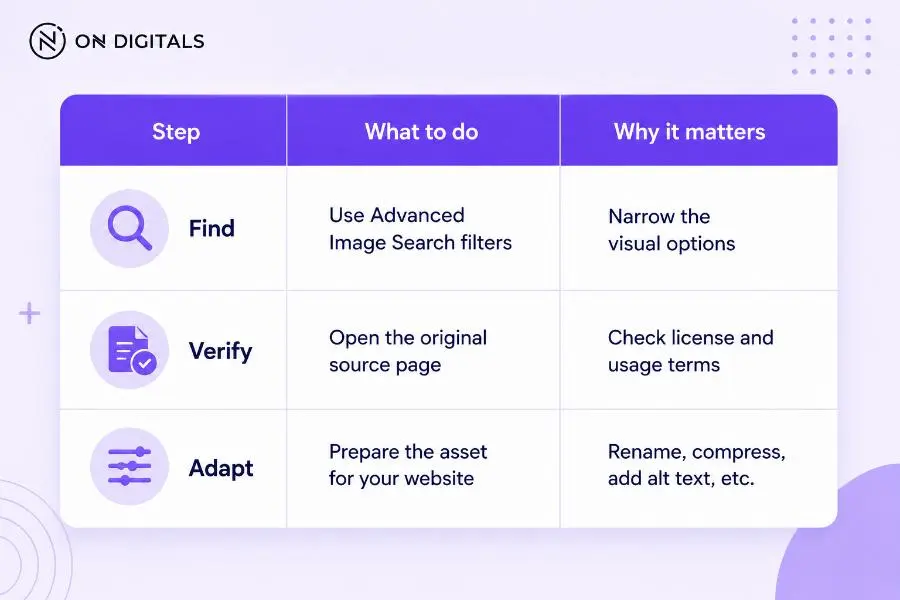 A safer image reuse workflow starts with narrowing visual options, then checking the original source page before adapting the asset for your website.
The source page may include attribution rules, commercial-use limits, or license restrictions that do not appear clearly in image results.
For business websites, avoid downloading images directly from the results page without checking the original source. This is especially important for paid campaigns, client work, case studies, ecommerce pages, and any page that represents a brand publicly.
How Google Advanced Image Search supports SEO research
Google Advanced Image Search is useful for SEO when it helps the team understand what images users expect for a topic. It should support content decisions, not replace image optimization.
Review image SERP intent
Image SERPs can show the visual intent behind a keyword. Some topics return product photos. Others return diagrams, screenshots, charts, or before-and-after comparisons.
For example, a query about “technical SEO audit” may show checklists, crawler screenshots, and dashboard-style visuals. A query about “local SEO” may show maps, location pins, storefronts, or Google Business Profile screenshots.
This helps the content team decide what type of visual would actually support the searcher.
Find competitor visual patterns
Advanced Image Search can reveal how competitors structure visual content. Use the site or domain filter to review one domain at a time, then compare the visual patterns across ranking pages.
Look for:
- Screenshot usage
- Diagrams or charts
- Original visuals
- Stock-photo patterns
- Product image angles
- Visual explanations in tables
This supports content gap analysis. If competitors use practical screenshots and your article uses generic graphics, the visual gap may affect trust and usability.
Plan better image descriptions
Image research can also support alt text planning. Google’s image SEO best practices explain that page content, captions, image titles, filenames, and alt text help Google understand images. The same documentation describes filenames as “very light clues,” so image descriptions should match what the image actually shows and how it supports the page.
For example, an image showing a Search Console report should not use vague alt text like “SEO image.” A more useful version would explain the interface or insight shown in the screenshot.
The same logic applies to filenames. Before upload, follow a clear file naming workflow so the image supports the page topic instead of entering the media library as IMG_2048.jpg.
For location-specific assets, visual context needs extra care. A real storefront, office, or project image may also connect with local image metadata practices when the photo is genuinely tied to a place.
Support content refresh decisions
Advanced Image Search can help during content refreshes. If an old article ranks poorly and competitors have stronger visuals, the issue may not be text alone.
Use image search to check whether the page needs:
- A clearer hero image
- A screenshot of the tool being explained
- A comparison table
- A process diagram
- Updated visual examples
- Better source attribution
This is useful for SEO articles, SaaS tutorials, product guides, local SEO pages, etc.
A visual update should also match the overall search content production workflow. The team should decide whether the image supports search intent, improves clarity, and gives users a better reason to stay on the page.
Google Advanced Image Search vs reverse image search
Google Advanced Image Search and reverse image search solve different problems. They are often confused because both involve images, but the workflow is different.
|
Tool type |
Main purpose |
Best use |
|
Google Advanced Image Search |
Search for images using filters |
Find visual references or source options |
|
Reverse image search |
Search using an image |
Check origin, reuse, or similar visuals |
|
Google Lens |
Identify objects or visual matches |
Explore products, places, or objects |
Use Advanced Image Search when you know what kind of image you need. Use reverse image search when you already have an image and need to find where it came from, whether it appears elsewhere, or whether similar visuals exist.
For SEO teams, reverse image search can help with originality checks or source verification. Advanced Image Search is better for planning content visuals before the page is published.
What should SEO teams avoid?
Advanced Image Search is useful, but it can create problems when used carelessly. The biggest risk is assuming that search results are automatically safe to use.
Avoid these mistakes:
- Using an image without opening the source page
- Treating usage rights filters as legal confirmation
- Copying competitor visuals too closely
- Uploading private client images into third-party apps
- Using generic stock images for trust-heavy pages
- Publishing images without compression or alt text
- Ignoring the page context around the image
A visual should help the article explain something. If it only fills space, it may weaken the page rather than improve it. This is where image research connects back to stronger website content, not just image selection.
Too many similar visuals can also create clutter. If a page already repeats the same point with several images, the issue may be thin visual value instead of missing visual assets.
Repeated visuals can hide a deeper SEO issue as well. When several pages use the same image angles, captions, and keyword themes, review the pages for keyword overlap across URLs before adding more assets.
Checklist before using an image from Advanced Image Search
Use this checklist before adding an image to a website:
- The image matches the page intent.
- The source page has been opened.
- Usage rights have been checked.
- Attribution rules are clear.
- The image is high enough quality.
- The file format fits the page.
- The filename has been rewritten.
- Alt text describes the image accurately.
- The image is compressed before upload.
- The image appears near relevant copy.
For important pages, one strong image is usually better than several weak ones. A good visual should clarify the topic, support the reader’s decision, or add proof.
FAQs about Google Advanced Image Search
Is Google Advanced Image Search free?
Yes. Google Advanced Image Search is free to use. Users can access the tool through Google’s advanced image search page and apply filters for size, color, type, region, site, file type, usage rights, etc.
Can I use images from Google Advanced Image Search commercially?
Possibly, but the usage rights filter does not replace manual license review. Open the original source page and check the license terms before using an image commercially. Some images require attribution, limit commercial use, or have source-specific restrictions.
What is the difference between Google Advanced Image Search and Google Lens?
Google Advanced Image Search helps users find images by typing keywords and applying filters. Google Lens starts with an image or camera input, then identifies visual matches, objects, products, places, etc. Advanced Image Search is better for content research, while Lens is better for visual identification.
How do I search images from one website only?
Use the site or domain field inside Google Advanced Image Search. Enter the domain you want to review, then combine it with a keyword or phrase. This helps SEO teams study how one website uses visuals around a topic.
Can Google Advanced Image Search help image SEO?
Yes, when used as a research tool. It can help teams understand image SERP intent, review competitor visuals, choose better formats, and plan stronger image descriptions. The final SEO value still depends on image quality, page context, filename, alt text, loading speed, and relevance.
Which file type should I filter for?
Choose the file type based on the final use. JPG works for standard photos, PNG is useful for screenshots or transparent elements, SVG fits simple vector graphics, and WebP is often useful for compressed web images after export. The right format depends on quality, page speed, and layout needs.
Final thoughts
Google Advanced Image Search is most useful when it turns image research into a cleaner publishing decision. The filters help users find better visual options, but the real value comes from checking the source, confirming usage rights, and adapting the image for the page.
For SEO teams, the tool works best as part of a practical workflow: review visual intent, compare competitor image patterns, verify usage rights, then publish images with clear filenames, useful alt text, and relevant surrounding copy. That keeps the article focused on users instead of treating images as decoration.

NEWEST POSTS
- Advertising Industry In Vietnam: The 2026 Trends, Channels and Market-Entry Strategy
- Best SEO Company in Vietnam: Latest Shortlist For Businesses
- How To Leverage Social Media For Customer Service Like A Pro?
- Social Media Post Tips – 8 Ways To Boost Engagement
- How To Use Social Media for Sales – In-depth Beginner Guide
Read more