
Zero Click Searches SEO: A Practical Guide for SEO and Business Decisions
Vincent
29/10/2021
30
Zero click searches SEO is no longer only about winning Featured Snippets. In 2026, users can get answers from AI Overviews, People Also Ask, knowledge panels, local packs, shopping modules, Google Maps, and conversational AI before they visit a website. That can reduce clicks on simple queries, but it also creates new opportunities to build visibility, trust, and demand.
For marketers and business owners, the goal is not to chase every click at any cost. It is to understand which queries should create awareness, which should drive action, and where your brand needs to appear across the full search journey.
What does zero click searches SEO mean and when does it matter?
Zero click searches SEO refers to optimising your content and brand presence for searches where users get what they need without clicking through to a third-party website.
A zero-click outcome can happen when Google or an AI platform provides the answer directly through:
- AI Overviews or AI-generated answers.
- Featured Snippets.
- People Also Ask results.
- Knowledge panels.
- Local packs and Google Maps.
- Product and shopping modules.
- Flight, hotel, event, or booking features.
- Unit converters, weather panels, calculators, and quick answers.
- Conversational tools such as ChatGPT, Gemini, Perplexity, or Copilot.
Zero-click matters most when your business depends on informational content, local visibility, product discovery, or category-level search demand. A page may still rank well while receiving fewer clicks because the result page satisfies the question before the user visits your site.
The important distinction is this: zero-click does not always mean zero business value. A user may see your brand in a local pack, notice your name in an AI answer, compare your product in a shopping module, or search directly for your company later.
Why zero click searches SEO affects traffic, rankings, and conversions
Zero-click search changes the relationship between rankings and clicks.
In the past, ranking near the top of the page often created a more predictable path: search query, click, website visit, conversion. Today, the same query may trigger an AI summary, a local result, a product panel, or an instant answer that sits above traditional organic listings.
This creates three common outcomes:
- Your impressions rise while clicks fall.
- Your page ranks highly but receives less traffic than expected.
- Your brand gains visibility in the SERP without a direct website visit.
That does not mean SEO is failing. It means reporting needs more context.
Search Engine Land’s guide to zero-click searches explains how zero-click outcomes now come from a broader mix of SERP features, including AI-generated answers, local packs, knowledge panels, featured snippets, image results, and People Also Ask.
For some businesses, zero-click visibility can still support meaningful customer actions:
- A local customer calls directly from Google Maps.
- A shopper compares product information before buying later.
- A B2B buyer sees your brand repeatedly while researching options.
- A prospect finds a concise answer, then returns for a deeper guide or service page.
- A user sees your company cited in an AI answer and searches for your brand later.
The objective of zero click searches SEO is not to accept lower traffic without a strategy. It is to understand where clicks are being lost, where visibility is still valuable, and which pages need to persuade users to take the next step.
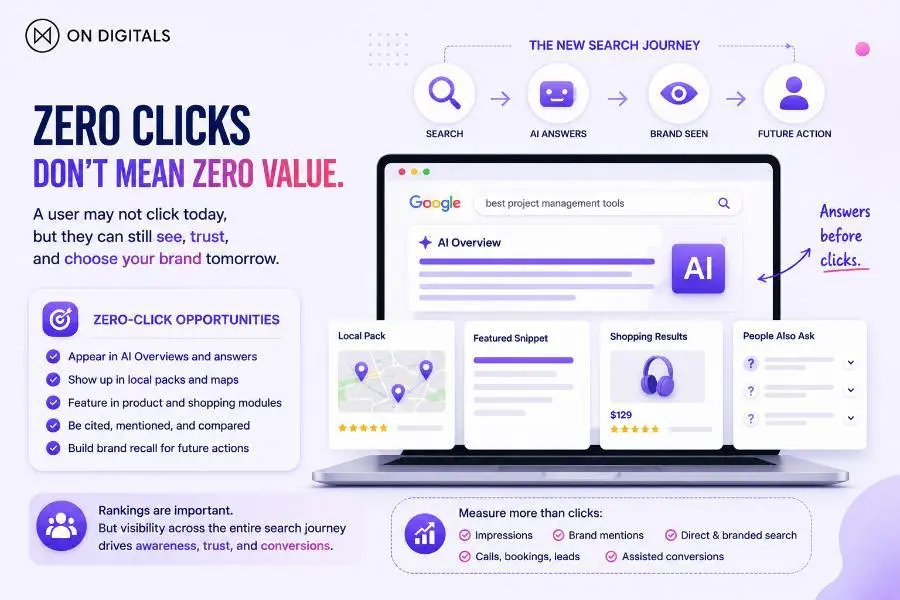
Zero-click visibility can still create business value by building recognition across AI answers, SERP features, local results, and product discovery moments before a customer is ready to click or convert.
Zero-click search is a customer acquisition challenge and opportunity
Customer acquisition is becoming more expensive across many industries. That means every visit, interaction, and search query matters more than before.
A zero-click environment can feel frustrating because some users receive the answer without entering your conversion path. They may never see your lead form, product page, email offer, or call to action.
However, businesses can still gain an advantage by making the journey better for users who do click.
Coveo’s article on site search and customer acquisition makes an important point: search data reveals what people want, what they cannot find, and where they encounter friction. That insight applies to external search as well as site search.
Use zero-click search behaviour to identify:
- Questions customers ask before they are ready to buy.
- Information Google or AI can answer without your site.
- Topics where users still need depth, comparison, proof, or a personalised recommendation.
- Pages where visitors arrive but cannot find the next action.
- Gaps between your content and real customer needs.
Your website should give users a reason to click beyond the summary.
That may include:
- Original research or benchmarks.
- A practical framework.
- Industry-specific guidance.
- A calculator, template, checklist, or tool.
- Detailed pricing or process information.
- Real examples or case studies.
- A comparison that helps users make a decision.
- A clear path to book, buy, enquire, or speak with an expert.
A short answer can win visibility. A deeper resource can win the visit, the lead, and the relationship.
Zero-click searches reveal what people need and where they get stuck
Search queries are not just keywords. They are evidence of customer intent.
When people search repeatedly for definitions, comparisons, pricing, troubleshooting, alternatives, locations, or product availability, they are telling you what they need before they are ready to contact your business.
Zero click searches SEO should help you separate two types of demand:
Ask-to-know queries
These are basic informational searches. They may include simple definitions, dates, calculations, weather, opening hours, or general facts.
Examples:
- What is technical SEO?
- How many hours are in a week?
- What is a knowledge panel?
- What time does a store open?
These queries can support awareness, but they are often vulnerable to zero-click results because Google or AI tools can answer them quickly.
Ask-to-act queries
These searches show that the user may need help choosing, comparing, buying, booking, fixing, or deciding.
Examples:
- Best SEO agency for a B2B company.
- SEO audit checklist for an ecommerce site.
- How much does SEO cost for a startup?
- Local SEO services for multi-location brands.
- AI search strategy for SaaS companies.
These queries are more likely to create a click because users need context, proof, trade-offs, and a recommendation that fits their situation.
Before creating content, ask:
- Does this keyword support a business decision?
- Can our brand add original insight or expertise?
- Does the SERP leave room for a click?
- Is there a useful action after the answer?
- Would the user need deeper information than a short AI summary can provide?
Semrush’s zero-click search strategy recommends prioritising queries that can create purchase intent, awareness value, or realistic SERP-feature opportunities, while deprioritising basic factual searches with little business value.
Redefine success metrics: stop grading SEO like it is 2016
A fall in organic click-through rate does not automatically mean your SEO strategy is weaker.
In a zero-click environment, your brand may be more visible than before while receiving fewer traditional website visits. That is why zero click searches SEO requires a reporting model that combines visibility metrics with business outcomes.
Imaginuity’s zero-click search analysis frames this shift clearly: organic sessions alone may no longer reflect the full impact of search visibility, especially when users can call, request directions, compare products, or receive an answer without leaving Google.
Track visibility metrics such as:
- Search impressions by query group.
- Visibility for high-intent keywords.
- Featured Snippet and People Also Ask ownership.
- Local pack visibility where relevant.
- Google Business Profile calls, direction requests, website clicks, and messages.
- Brand mentions in AI search tools where they can be observed.
- Branded search growth over time.
- Share of voice against direct competitors.
Track business metrics such as:
- Qualified organic leads.
- Demo requests, enquiries, and bookings.
- Assisted conversions.
- Conversion rate by landing page.
- Pipeline influence in your CRM.
- Revenue from organic landing pages.
- Returning users and branded visits after awareness campaigns.
The goal is not to replace traffic with vague “awareness” language. The goal is to show how visibility contributes to real customer actions over a longer journey.
How to create zero-click and AI-ready content
Zero-click content should provide immediate value, but it should also make users want deeper context from your website.
A strong zero-click content section should:
- Answer the question directly in the first one or two sentences.
- Define key terms clearly.
- Use headings that reflect real customer questions.
- Keep each section understandable on its own.
- Use concise checklists when they improve clarity.
- Include specific examples, entities, industries, or use cases.
- Add expert perspective, original data, or first-hand experience.
- Link naturally to deeper internal resources.
- Make the next action obvious.
For example, a weak answer might say:
SEO is important because it helps websites rank better.
A stronger answer might say:
SEO improves a website’s visibility when customers search for products, services, or answers. In a zero-click environment, SEO also helps brands appear in SERP features, AI-generated answers, local results, and high-intent comparison searches.
The second answer is easier to extract, but it also introduces the next layer of context.
To create content worth citing or clicking, include:
- Clear definitions.
- Practical frameworks.
- Expert commentary.
- First-party data.
- Real examples.
- Screenshots, workflows, or templates.
- Decision-support content.
- Honest limitations and trade-offs.
This is where zero click searches SEO connects with AEO, GEO, and AIO.
- AEO helps pages provide direct answers to questions.
- GEO helps brands become clearer and more reference-worthy in generative AI answers.
- AIO improves the clarity, structure, context, and technical accessibility that help AI systems interpret content.
For more guidance on this broader shift, see AI and the future of SEO and Search and AI Marketing.
Build entity and brand signals beyond your website
In a zero-click search world, users may encounter your business on Google Maps, review platforms, news sites, AI answers, social media, directories, or discussion communities before they visit your website.
That makes entity clarity and brand consistency more important.
Your brand should be easy to understand across the web.
Check that you have:
- A clear company description.
- Consistent business name and positioning.
- Accurate contact details.
- Strong About and author pages.
- Public proof of expertise.
- Reviews and testimonials where appropriate.
- Relevant media mentions and backlinks.
- Consistent organisation and website schema.
- Clear service, product, and location information.
- Social and directory profiles that match your business identity.
Forbes’ discussion of zero-click marketing reflects the broader marketing shift: businesses increasingly need to compete for attention and recognition in environments where the user may not visit a traditional website immediately.
For local businesses, entity signals also include a complete Google Business Profile, accurate categories, updated opening hours, high-quality reviews, photos, service details, and location pages that support local relevance. You can explore this further in our guide to AI for local SEO.
A step-by-step framework for zero click searches SEO
Step 1: Audit where zero-click behaviour affects your site
Review Google Search Console, SERP features, rankings, click-through rates, and key landing pages.
Look for patterns such as:
- High impressions with declining clicks.
- Rankings that improved without traffic growth.
- Informational pages affected by AI Overviews or Featured Snippets.
- Local queries that generate calls and directions instead of website sessions.
- Product pages appearing in shopping results.
- High-value queries where competitors own SERP features.
Do not assume every low-CTR page is a problem. First, understand the SERP and the user intent.
Step 2: Categorise keywords by business value
Group your keywords into:
- Awareness queries.
- Educational queries.
- Comparison queries.
- Problem-solving queries.
- Local-intent queries.
- Product or service queries.
- Branded queries.
- Conversion-focused queries.
Prioritise the themes that can influence a purchase, enquiry, booking, or shortlist decision.
Step 3: Match the content to the search feature
Review the live SERP before writing or updating a page.
Ask:
- Does the query trigger an AI Overview?
- Is there a Featured Snippet?
- Are People Also Ask questions visible?
- Is local intent dominant?
- Does Google show shopping, video, images, maps, or review content?
- Is the user looking for a quick answer or deeper guidance?
Then create the right asset.
Use concise definitions and checklists for quick-answer queries. Use comparison pages, expert guides, tools, pricing explainers, or case studies for higher-intent searches that need deeper evaluation.
Step 4: Give users a reason to continue
A zero-click answer should not be the end of your content strategy.
Offer value that cannot be fully delivered in a search summary:
- A downloadable resource.
- A detailed framework.
- A sector-specific guide.
- A service comparison.
- A calculator or diagnostic tool.
- A case study.
- A consultation path.
- A clear internal link to the next relevant page.
This is where strong information architecture matters. Your answer page should guide users toward deeper resources, not sit in isolation.
Step 5: Improve technical clarity
Search engines and AI systems need to access and understand your content before they can surface it.
Review:
- Crawlability and indexability.
- Canonical tags.
- Internal linking.
- HTML heading structure.
- Mobile usability.
- Page speed.
- Image alt text.
- Duplicate content.
- Relevant schema markup.
- Broken links and redirect chains.
Schema does not guarantee rich results or AI citations. It can, however, help search engines interpret the visible content more accurately when it is implemented correctly.
Step 6: Monitor visibility and business impact
Review your performance monthly or quarterly.
Track:
- Impressions and click-through rate by query type.
- SERP feature coverage.
- Brand mentions and branded search growth.
- Local actions and Google Business Profile performance.
- Referral traffic from AI platforms where available.
- Assisted conversions and lead quality.
- Pages that influence pipeline, bookings, or revenue.
The strongest zero click searches SEO strategy balances immediate visibility with measurable customer action.
Common mistakes when adapting to zero-click search
Chasing every Featured Snippet:
Not every snippet is worth winning. A keyword may generate impressions but have little business value. Focus on queries that support awareness, decision-making, or conversion.
Treating all lost clicks as failure:
Some clicks disappear because users receive a complete answer. Others disappear because your content no longer matches the intent. Analyse the SERP before drawing conclusions.
Creating shallow answer pages:
A short definition can help visibility, but it may not be enough to earn trust or a click. Pair concise answers with deeper resources, proof, and next steps.
Ignoring local and product actions:
For local businesses, calls, directions, reviews, and bookings may matter more than traffic. For ecommerce brands, product visibility, feed quality, availability, and reviews may matter more than blog sessions.
Measuring only sessions and rankings:
A strong ranking report does not prove commercial impact. Combine visibility metrics with leads, assisted conversions, pipeline influence, and revenue.
Using AI to publish generic content at scale:
AI can help with research and content operations. It cannot replace subject-matter expertise, original insight, commercial judgement, or quality control.
Tools and checks to review before publishing:
Use tools to understand the SERP, not simply to produce more content.
Useful tools include:
- Google Search Console for impressions, clicks, queries, pages, and indexing signals.
- Google Analytics 4 for engagement, conversions, and assisted journeys.
- Semrush or Ahrefs for keyword research, SERP feature tracking, competitor analysis, and content gaps.
- ChatGPT or Gemini for question clustering, content-brief support, and workflow efficiency.
- Screaming Frog for crawling, technical checks, and internal-link review.
- Brand-monitoring tools for mentions, sentiment, and share of voice.
Before publishing or refreshing a page, ask:
- Does the opening answer the main query immediately?
- Is the content written for a real user decision?
- Does the page include a clear next step?
- Are the claims specific, accurate, and supportable?
- Does the page offer something beyond a generic AI summary?
- Does the internal linking help users continue their journey?
- Is the page technically accessible and mobile-friendly?
- Are you measuring the right outcome for this query?
FAQ
What are zero-click searches?
https://ondigitals.com/llm-optimization/
Are zero-click searches bad for SEO?
They can reduce clicks for simple informational queries, but they can also create visibility through AI answers, Featured Snippets, local results, knowledge panels, and product modules. Their value depends on the query, business model, and conversion path.
How can businesses benefit from zero-click search?
Businesses can benefit by appearing in high-visibility SERP features, building brand recognition, earning local actions, and creating content that leads users to deeper resources when they need more information.
What should be measured in zero click searches SEO?
Track impressions, SERP feature presence, branded search, local actions, AI visibility where available, assisted conversions, lead quality, and revenue impact—not only clicks and rankings.
Should every zero-click keyword be targeted?
No. Prioritise keywords with business value, awareness potential, decision-stage intent, or realistic SERP-feature opportunities. Deprioritise basic factual queries that offer little differentiation or conversion potential.
Does schema guarantee AI Overview or Featured Snippet visibility?
No. Schema can help search engines understand your content when it accurately reflects what users see, but it does not guarantee a rich result, Featured Snippet, AI Overview citation, or ranking.
Build a zero-click strategy that still drives business outcomes
Zero click searches SEO is not a reason to stop investing in SEO. It is a reason to build a stronger visibility strategy. The businesses that succeed will not rely only on clicks. They will combine answer-first content, technical SEO, brand signals, local and product visibility, conversion paths, and measurement that reflects real customer behaviour.
The goal is not to own every SERP feature. It is to appear where your customers make decisions, provide enough value to earn trust, and give them a compelling reason to choose your business when they are ready to act.
Explore SEO Services or Search and AI Marketing to build a search strategy that protects traffic where it matters and grows visibility across traditional search and AI-driven discovery.

NEWEST POSTS
- Advertising Industry In Vietnam: The 2026 Trends, Channels and Market-Entry Strategy
- Best SEO Company in Vietnam: Latest Shortlist For Businesses
- How To Leverage Social Media For Customer Service Like A Pro?
- Social Media Post Tips – 8 Ways To Boost Engagement
- How To Use Social Media for Sales – In-depth Beginner Guide
Read more