
Off-Page SEO: How to Build Authority Beyond Your Website
Vincent
12/06/2024
20
Off-page SEO is the work done beyond your website to build trust, reputation and discoverability. It includes earning relevant backlinks, gaining credible brand mentions, improving local reputation and creating content worth citing. Effective off-page SEO does not rely on link volume or automated tactics. It connects external visibility with useful content, editorial relevance and measurable business value.
Off-page SEO in 60 seconds
Off-page SEO helps people and search engines find evidence that a website is worth paying attention to. That evidence may come from:
- an editorial backlink
- a respected publication mentioning your brand
- a customer review
- a local listing
- a useful resource shared by an industry community
Backlinks remain important, but they are not the whole strategy. A website can collect hundreds of links and still struggle if those links come from irrelevant pages or sites with no real audience.
One of the highlighting point is to earn credible external signals that make sense for your audience and support the pages that matter most to the business.
| Off-page SEO area | Main role | What good execution looks like |
| Relevant backlinks | Support trust, discovery and referral traffic | Editorial links from pages that genuinely help readers |
| Digital PR | Earn coverage and citations | Newsworthy stories, original data or expert commentary |
| Brand mentions | Build recognition outside your website | Accurate references from relevant communities and publications |
| Local reputation | Support trust for location-based businesses | Genuine reviews, accurate listings and local coverage |
| Content distribution | Increase discovery of useful assets | Sharing content where the intended audience already gathers |
| Partnerships and expertise | Build long-term visibility | Useful collaborations, interviews, events and co-created resources |
A good off-page strategy starts with a simple question: why would another website, journalist, customer or industry expert want to reference this page?
What is off-page SEO?
Off-page SEO refers to activities outside your own website that can improve how people discover and reference your brand. It is often associated with link building because external links can help search engines understand that other pages consider your content useful enough to cite.
However, off-page SEO is broader than backlink acquisition. It can include:
- public relations
- reviews
- local citations
- expert appearances
- social distribution
- partnerships
- brand mentions
These activities do not all work in the same way, and they should not all be measured with the same metric.
A link from a relevant publication may send referral traffic and support a page’s credibility. A local review may influence whether someone books an appointment. An expert quote may introduce a brand to a new audience. A social post may help a useful guide reach writers who later decide to cite it.
The common thread is external validation. Off-page SEO creates more opportunities for people outside your website to encounter the brand, evaluate its expertise and decide whether it is worth recommending.
Off-page SEO cannot replace strong on-page content or technical SEO. A site with thin content, unclear page intent or unresolved crawl issues may struggle even with a strong external profile. External visibility is most useful when it points to pages that answer a real customer question well.
Off-page SEO vs on-page SEO vs technical SEO
SEO has several connected parts. Each one solves a different problem.
| SEO area | Main focus | What the business controls directly |
| On-page SEO | Content relevance, page intent, headings, internal links and information architecture | High |
| Technical SEO | Crawlability, indexability, rendering, speed, canonicalisation and structured data | High |
| Off-page SEO | External visibility, reputation, editorial references and relationships | Partial |
On-page SEO helps a page explain what it is about. Technical SEO helps search engines access, understand and index that page. Off-page SEO helps build evidence that the page or brand deserves attention beyond its own domain.
For example, a detailed guide may be well written but difficult to find because it has limited internal links and no external visibility. Another guide may earn links but fail to convert readers because it does not answer the search intent clearly. A sustainable SEO strategy needs all three areas to work together.
Off-page SEO is also less controllable than on-page or technical work. You can improve a landing page directly. You cannot force a respected publisher to cite it. That is why the strongest off-page strategies focus on creating genuine reasons for others to reference the work.
Why does off-page SEO matter?
Off-page SEO matters because search visibility is not only about what a business says about itself. Customers, publishers, communities and industry experts often look for external signs that a company is credible.
A good website should be able to explain its expertise. Off-page SEO can help demonstrate that the expertise is recognised outside the website as well.
It helps strong pages compete in crowded search results
Many competitive search results include several pages that answer the basic query well. The difference may come from which businesses have built a stronger reputation, earned more relevant references or developed clearer topical visibility over time.
This does not mean a backlink automatically moves a page to the top of Google. Search rankings depend on many signals, including relevance, helpfulness, technical accessibility and the way a page addresses the user’s need. External signals can support a strong page, but they cannot rescue a poor one.
The most useful links tend to support pages that already deserve attention. A research report, specialist guide, original tool or clear product comparison is easier to cite than a page created only to target a keyword.
It can generate referral traffic and brand discovery
A relevant link can bring visitors directly to your site. This matters because referral visitors may be more qualified than broad traffic. They arrived through a source they already trust and clicked because the linked page appeared useful in that context.
A feature in an industry newsletter may bring new readers to a report. A product review may introduce customers to an ecommerce brand. A partner article may send potential B2B buyers to a case study. A local event listing may help nearby customers find a service business.
These outcomes can create value even when a link does not immediately change organic rankings. Referral traffic, branded search activity and new commercial conversations are all signs that external visibility is reaching the right people.
It supports reputation, not a single authority score
SEO tools often use metrics such as Domain Rating, Domain Authority, Authority Score or Trust Flow. These can be useful for research because they help compare sites and prioritise outreach opportunities.
They are not Google’s own ranking metrics. A higher third-party score does not guarantee that a link will improve rankings, create referral traffic or lead to customers.
A better approach is to examine the real context around a potential link:
- Is the source relevant to your market?
- Does the page have useful content and real readers?
- Would the reference help someone understand the topic?
- Does the linked page answer the question raised by the source?
- Is the link likely to bring qualified visitors?
These questions are more useful than chasing a single tool number.
It can strengthen local trust when location matters
Local businesses often rely on off-page signals before a customer ever visits the website. People may see reviews, map listings, local news coverage or directory profiles while deciding where to book, buy or enquire.
For a local business, off-page work may include:
- Keeping Google Business Profile information accurate
- Maintaining consistent business details across relevant directories
- Encouraging genuine reviews from real customers
- Responding professionally to feedback
- Building local partnerships and community visibility
- Earning relevant local coverage
These actions are not a shortcut to rankings. They help customers find accurate information and make more confident decisions.
It can support clearer brand recognition
A customer may not click an external mention immediately. They may remember the brand and search for it later. They may recognise the name when they see it in a search result. They may be more likely to trust the business after seeing it referenced by a credible source.
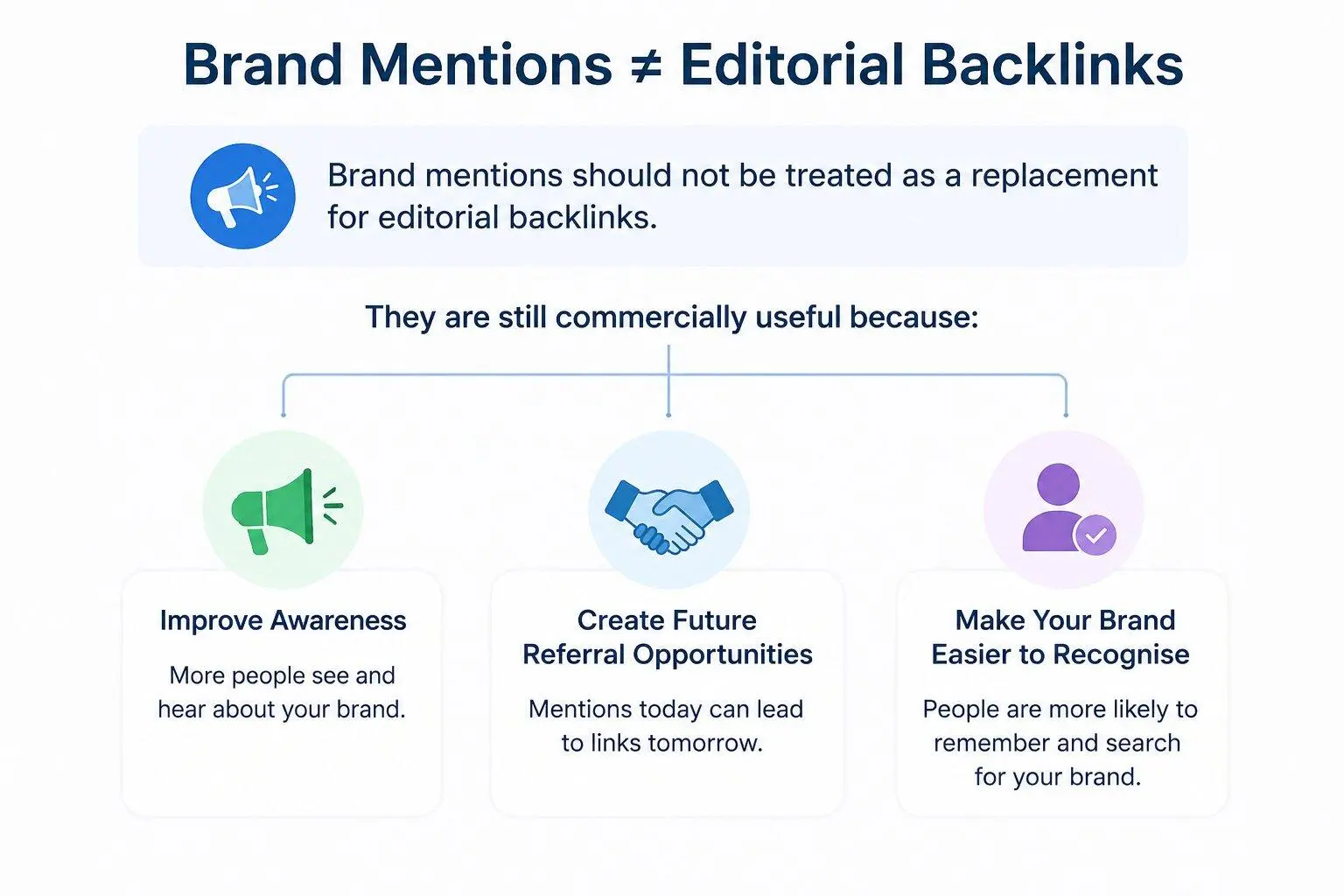
Brand mentions should not be treated as a replacement for editorial backlinks. They can still be commercially useful because they improve awareness, create future referral opportunities and make the brand easier for people to recognise.
What does off-page SEO include today?
Off-page SEO should be viewed as an ecosystem rather than a list of backlink tactics. Different activities help at different stages of visibility and trust.
| Off-page activity | What it can support | What it should not become |
| Editorial link earning | Relevant citations, referral traffic and topical visibility | A volume-driven placement campaign |
| Digital PR | Media coverage, expert visibility and newsworthy references | Generic press releases sent to every publisher |
| Guest expertise | Useful contributions to an aligned audience | Keyword-rich guest posts created only for links |
| Partnerships | Co-created resources, webinars, events and shared audiences | Reciprocal links with no reader value |
| Reviews and citations | Local trust and accurate business information | Fake reviews or irrelevant directory submissions |
| Content distribution | Discovery of useful assets | Social posting as an assumed ranking shortcut |
| Brand mention outreach | Recovering missed citations where a link would help readers | Demanding links from every brand reference |
The best mix depends on the business model, audience and available assets. A local clinic may prioritise reviews, local listings and community coverage. A B2B consultancy may focus on expert commentary, partner resources and industry publications. An ecommerce business may need product reviews, buying guides and creator or publisher exposure.
The strategy should fit the way customers research and choose. There is no universal off-page SEO package that works equally well for every website.
Backlinks: What makes a link worth earning?
A backlink is a link from one website to another. It can help users move from one source to a related resource. It may also provide search engines with context about how pages are connected across the web.
Not every backlink has the same value. A link should be judged by its relevance, placement, destination and likely value for real users.
Relevance matters more than surface-level prestige
A backlink from a relevant industry publication can be more valuable than a link from a large but unrelated website. Relevance makes the reference more believable and more useful to readers.
For example, a manufacturer of industrial safety equipment may benefit from a link in an engineering publication or trade association resource. A local accounting firm may benefit from coverage in a regional business guide. A skincare clinic may benefit from references in trusted beauty or health publications, provided the claims and context are appropriate.
A generic high-metric website may still be less useful if its audience has no reason to care about the linked content. The question is not only, “How strong is this website?” It is also, “Why would this website’s readers need this page?”
Editorial placement makes the link more meaningful
An editorial backlink is placed because the author or publisher believes it adds value to the content. It may support a claim, provide further reading, cite a data source or direct readers to a useful tool.
This differs from a link placed in a footer, sidebar, author bio or low-quality directory without meaningful context. These placements are not automatically harmful, but they usually provide less editorial value than a natural reference within a useful article.
A well-placed link should feel necessary. If removing the link makes the article less useful, the citation is probably doing a real job for the reader.
The destination page needs to deserve the attention
A strong source cannot make a weak landing page valuable. The destination page needs to provide a clear next step for the reader.
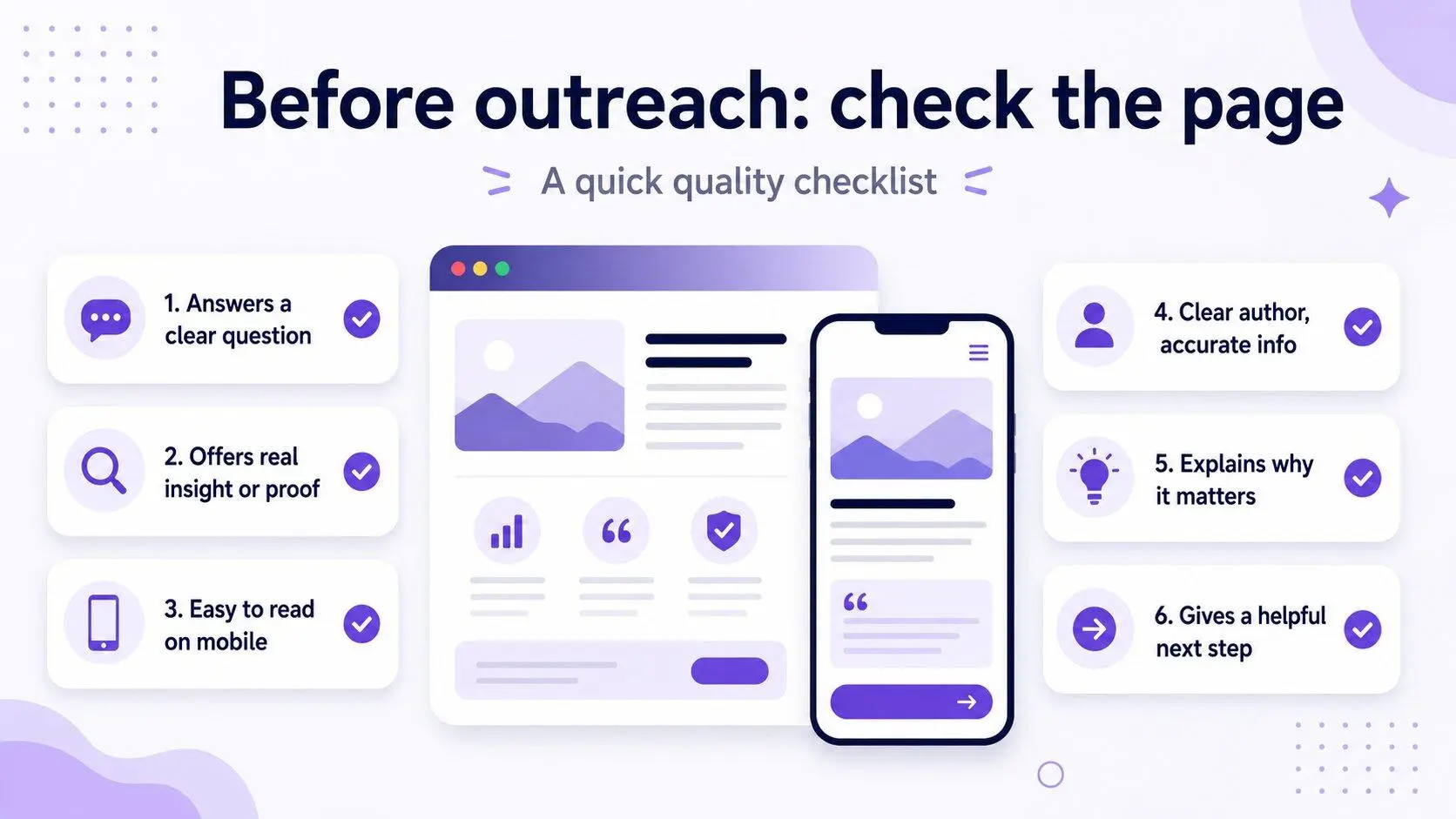
Before outreach begins, review the page you want people to link to:
- Does it answer a specific question?
- Does it offer original insight, evidence or practical usefulness?
- Is it easy to read on mobile?
- Does it include clear authorship and accurate information?
- Does it explain why the topic matters?
- Does it offer a useful next action without forcing a sale?
A generic service page may still earn links if it includes specialist knowledge, original research or clear resources. However, most linkable assets work best when they are genuinely useful in their own right.
Referral potential is a quality signal
A link is more valuable when a real person may click it. Referral traffic is not the only goal of link building, but it is an important quality check.
A placement that sends a small number of highly relevant visitors can be more useful than a large number of low-value links that never generate engagement. Referral visitors may read more pages, subscribe to a newsletter, request information or become future customers.
This is why off-page SEO should be measured beyond rankings. A useful external mention can create commercial value even when its direct SEO impact is difficult to isolate.
Anchor text should read naturally
Anchor text is the visible text people click. It should make sense in the sentence and help readers understand what they will find after the click.
Natural anchor text may include a brand name, article title, descriptive phrase or a simple reference such as “this guide” when the surrounding context is clear. Repeating the same exact-match commercial keyword across many links can look forced and may create unnecessary risk.
The aim is not to engineer an exact anchor-text ratio. The aim is to make every link sound like something a writer would naturally use for their readers.
Paid, sponsored and community links need clear treatment
Some placements are paid, sponsored or user-generated. These can still be valid for brand visibility, referral traffic or commercial partnerships. They should not be treated as a way to pass ranking credit.
Sponsored placements should be identified appropriately. Links in user-generated content, such as comments or community profiles, should also be handled carefully. The main principle is transparency: a paid relationship should be disclosed, while community participation should focus on helping people rather than inserting promotional links.
For a more detailed framework on evaluating relevant, editorial and useful links, explore our guide to high-quality backlinks.
Off-page SEO strategies that still work
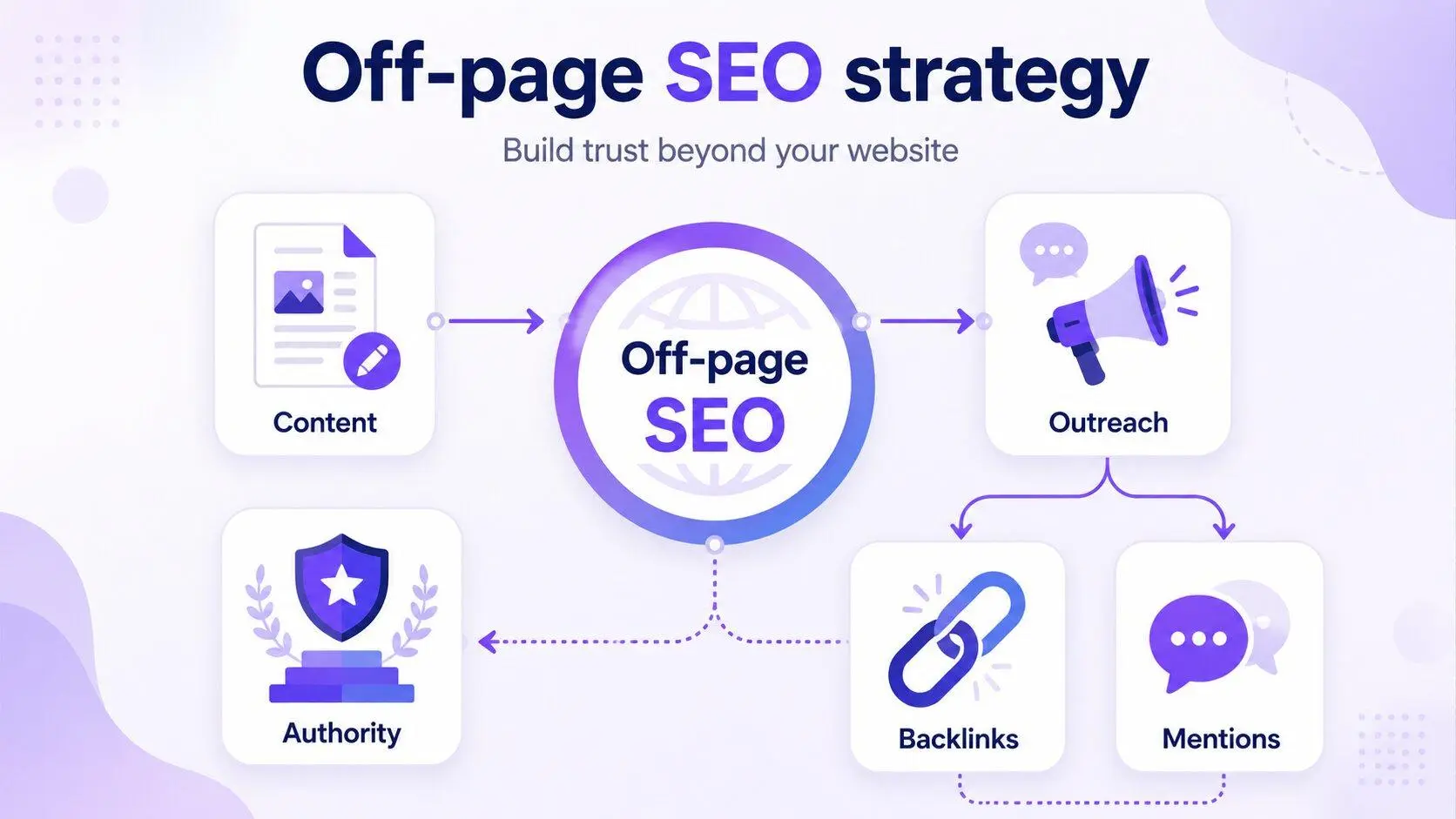
The safest off-page SEO strategies create value even without search engines. They help someone learn, compare, discover or trust a business. Search visibility is a possible outcome, not the only reason the activity exists.
Create assets that people genuinely want to reference
A linkable asset gives another publisher a reason to cite your website. It should solve a problem, clarify a complex topic or provide evidence that is hard to find elsewhere.
Examples of useful linkable assets include:
- Original research or survey findings
- Data studies with a transparent methodology
- Industry benchmarks with clear scope
- Specialist templates or calculators
- Product comparison resources
- Visual explainers that simplify complex topics
- Detailed buyer guides
- Case studies with useful context
- Expert commentary on timely market changes
The asset does not need to be large. It needs to fill a real gap. A well-structured checklist can earn links if it helps an audience complete a task. A small data set can become useful if it answers a question journalists and industry writers already have.
Before creating an asset, identify the people who may reference it. This could include journalists, bloggers, buyers, educators, industry partners or existing customers. Their needs should shape the format and angle.
Use digital PR to earn coverage and citations
Digital PR is one of the strongest off-page approaches because it combines visibility, editorial relevance and potential referral value. Instead of creating a press release about the business itself, the goal is to contribute a story, insight or asset that a relevant publication wants to cover.
A digital PR campaign may be based on original data, a market trend, expert commentary, a timely business issue or a useful public resource. The best ideas offer something beyond promotion. They give a writer a reason to include the brand in a story that matters to their audience.
For example, a recruitment company may publish data about hiring demand in a specific sector. A software company may provide an expert explanation of a changing regulation. A retail brand may create useful insight around a seasonal buying trend. The angle should connect to a real audience question, not simply announce that the company exists.
Digital PR requires patience. Not every pitch will result in coverage. The objective is to build a repeatable process for producing useful stories, identifying relevant media and communicating with editors or writers respectfully.
Contribute expert insight to relevant publications
Guest contributions, interviews, podcast appearances, webinar participation and expert roundups can support off-page SEO when they are genuinely useful to the host audience.
The key is expertise. A useful contribution should offer a clear viewpoint, practical explanation, original experience or evidence-based insight. It should not be a thin article designed mainly to place a commercial keyword link.
A strong guest contribution usually has three qualities:
- It fits the publication’s existing audience and editorial style.
- It gives readers an insight that is not already repeated across the web.
- Any link included helps readers access a relevant source, guide or tool.
This approach can build trust with publishers over time. It can also create opportunities for future collaboration, media requests or co-created resources.
Build partnerships that create a useful shared audience
Partnerships can produce meaningful off-page visibility when both organisations contribute something valuable. This may include a joint report, co-hosted webinar, industry event, educational guide, charity initiative or product integration resource.
The best partnerships are not created for reciprocal links. They are created because both sides have related audiences and can offer a stronger resource together than either could produce alone.
For example, a logistics provider may collaborate with an ecommerce platform on a guide to fulfilment planning. A legal adviser may join a business association webinar. A software company may create a workflow template with a specialist consultant.
The links and mentions that result from these activities are more sustainable because they are connected to a real business relationship and audience need.
Reclaim useful unlinked mentions
Sometimes a credible website mentions a brand, report or data point without linking to the original source. A polite outreach request may be appropriate when adding the link would genuinely improve the reader experience.
The request should be specific. Explain where the original source is located and why it helps readers verify the information. Avoid treating every unlinked brand mention as an entitlement to a backlink.
Unlinked mention outreach works best when the source already refers to a resource you created. It is less compelling when the page simply names the business in passing.
Use broken-link outreach selectively
Broken-link outreach involves finding a dead external link on a relevant website and suggesting an appropriate replacement. It can be useful when your content genuinely covers the same topic and improves the source page.
The process should begin with relevance, not volume. A website owner is more likely to respond when the replacement helps them fix a real usability issue. A generic email sent to hundreds of websites is unlikely to create meaningful results.
The strongest replacement pages are useful even without the link opportunity. They should be detailed, accurate and aligned with the original resource’s purpose.
Distribute content to the people who may amplify it
Content distribution can increase the chance that useful assets reach the right people. This may include sharing a report through an email newsletter, presenting an insight in a webinar, publishing a visual summary on LinkedIn or contributing a relevant discussion point to an industry community.
Social activity should not be treated as a direct ranking mechanism. A social post does not automatically create rankings because it receives engagement. Its value comes from discovery. The right person may see the content, mention it in an article, invite an expert to contribute or share it with a relevant audience.
Distribution works best when it is targeted. Share an asset where the intended audience already spends time. A B2B report may fit LinkedIn and specialist newsletters. A consumer buying guide may work through creator collaborations or product communities. A local business resource may be more useful in local media or neighbourhood groups.
Build genuine local reputation where relevant
For local businesses, off-page SEO often begins with accuracy and trust rather than outreach. Customers need to see consistent business details, credible reviews and clear signals that the company is active in the area it serves.
A local reputation plan may include:
- Updating business information on Google Business Profile
- Correcting inconsistent names, addresses or phone numbers
- Requesting honest reviews after a real customer experience
- Responding to feedback in a professional way
- Creating useful local resources
- Joining relevant community events or partnerships
- Earning local coverage when there is a meaningful story
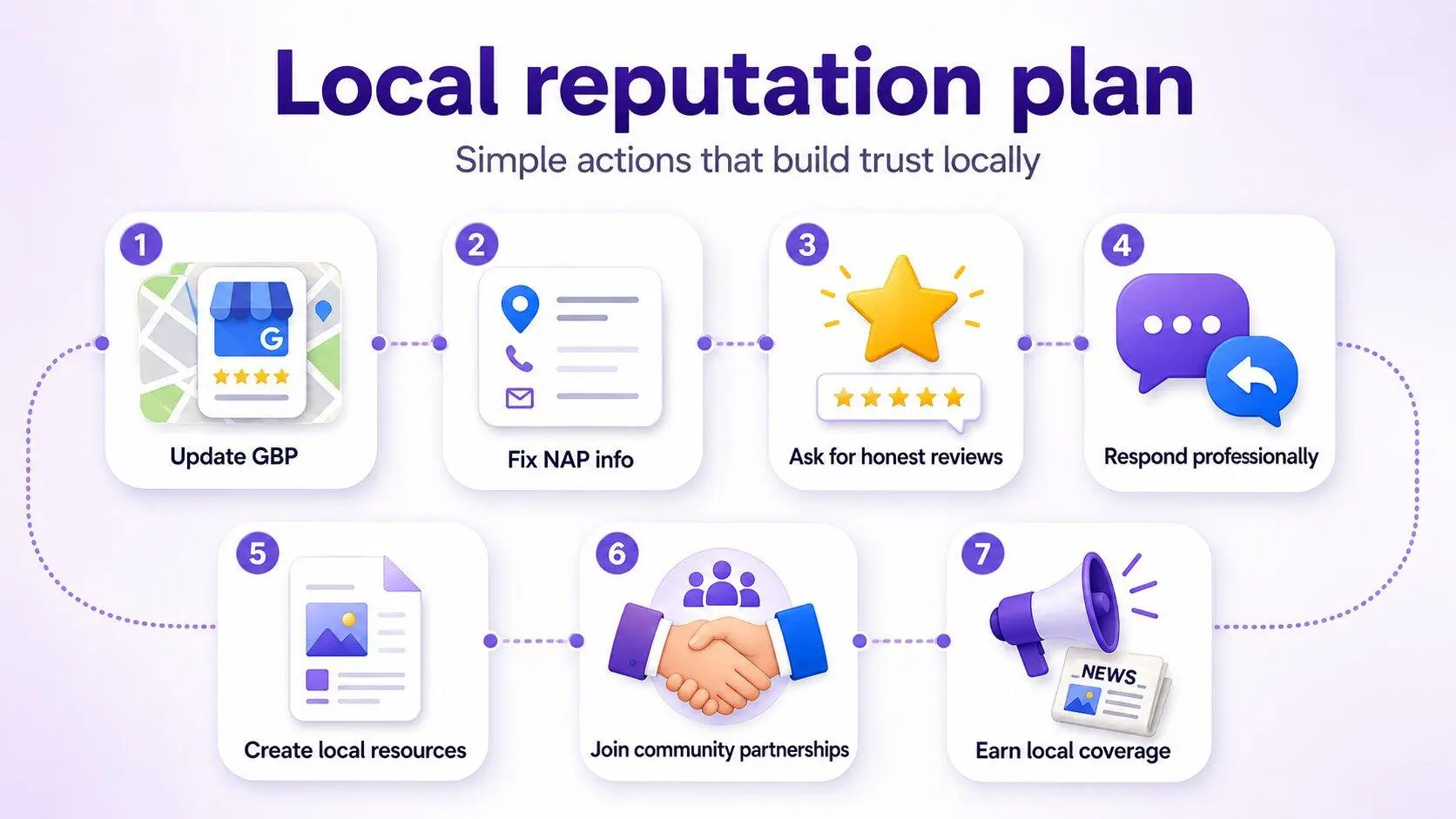
The objective is to appear accurately in the places customers actually use to research local services.
Choose off-page SEO tactics by business model
The right off-page strategy depends on the way customers discover and evaluate the business.
| Business situation | Stronger starting priorities | Lower-priority starting point |
| Local service business | Reviews, accurate listings, local partnerships and community coverage | Broad national outreach with no local relevance |
| B2B consultancy or professional service | Expert commentary, partner content, case studies and industry publications | Generic directory submissions |
| SaaS or technology company | Data-led PR, integration partnerships, comparison resources and webinars | High-volume guest-post packages |
| Ecommerce business | Product reviews, buyer guides, creator partnerships and publisher coverage | Links to generic category pages with no buying value |
| New brand with limited authority | Linkable assets, niche collaborations and targeted outreach | PBNs, link networks or automated campaigns |
| Established site with a messy profile | Audit, risk review, lost-link recovery and quality improvement | Aggressive new link acquisition before diagnosis |
Ecommerce requires a different approach from B2B service marketing. Product reviews, buying guides, publisher comparisons and practical usage content may be more valuable than broad industry thought leadership. At the same time, ecommerce businesses need to ensure that product pages, collections and guides are ready to receive external attention.
For a deeper breakdown of product-led authority building, publisher outreach and review visibility, read our guide to off-page SEO for ecommerce.
Start with a backlink and authority baseline
Do not begin outreach before understanding the current situation. A baseline helps the team identify what is already working, which pages deserve more visibility and whether there are obvious risks in the existing link profile.
A practical baseline review should include:
- Important pages that already attract external links
- Referring domains and the topics they cover
- New and lost links over time
- Brand mentions and unlinked citations
- Pages with referral traffic
- Competitor pages that earn relevant references
- Anchor-text patterns
- Links that appear unrelated, low-quality or unusually repetitive
The purpose is not to label every link as “good” or “toxic.” Tool scores are estimates. They can help teams prioritise what deserves a closer look, but they are not proof that a link is helping or harming the website.
A suspicious-looking link may be ignored naturally by search engines. A large pattern of manipulative links, repeated anchor text or paid placements may require deeper review. The right response depends on the context, history and scale of the issue.
For a practical comparison of platforms, data sources and review workflows, see our guide to backlink audit tools.
A practical off-page SEO strategy for sustainable growth
A sustainable strategy should connect business priorities, content quality and external visibility. It does not begin with a monthly target for the number of backlinks.
1. Decide which pages deserve external visibility
Start with pages that have both search potential and business value. These may include a high-quality service page, a buying guide, original research, a comparison page, a product category, a specialist resource or a case study.
Do not build links to every page at once. Prioritise pages that answer a clear user need and can support a meaningful commercial outcome.
For example, a B2B business may prioritise a guide that explains a complex problem before directing readers to a consultation. An ecommerce business may prioritise a buying guide that helps customers choose between product types. A local business may focus on a service page with clear location coverage and customer proof.
2. Identify audiences, publishers and relationships that matter
A useful prospect list should be based on relevance, not only website metrics. Consider trade publications, local media, partner businesses, professional associations, educational resources, creator communities and niche newsletters.
Ask what each audience wants to learn. A journalist may need timely data or expert commentary. A trade publisher may need a practical guide. A local organisation may need a useful community resource. A partner may need co-marketing material that helps their own customers.
This approach creates more thoughtful outreach and reduces the temptation to place links on irrelevant websites.
3. Create a reason for the reference
A strong pitch begins with value. It may offer a new data point, useful visual, expert quote, original template, product insight or resource that fills a gap in the existing content.
The reason should be clear before outreach begins. If the page does not offer something distinct, the team may need to improve the asset first.
Useful questions include:
- What makes this resource different from existing pages?
- Which audience problem does it solve?
- Why would a publisher cite it rather than another source?
- What evidence supports the claims?
- What format makes it easiest to use?
4. Reach out with editorial fit
Outreach should be brief, specific and respectful of the recipient’s time. It should show that the team understands the publication, article or audience.
A strong outreach message explains:
- Why the topic is relevant to the recipient
- What useful asset, insight or correction is being offered
- Why the linked resource helps the reader
- Where the reference might fit naturally
- What the recipient can do next
Avoid mass templates that only change the recipient’s name. They are easy to recognise and rarely create durable relationships.
For a detailed guide to prospect research, linkable assets and outreach approaches, explore how to get backlinks.
5. Review outcomes and improve the next cycle
Off-page SEO should be reviewed through quality and business impact. A successful campaign may earn fewer links than expected but create strong referral traffic, expert visibility or a valuable partnership.
Review what actually happened:
- Which asset earned the most relevant coverage?
- Which sources sent engaged referral visitors?
- Which pages attracted links naturally after publication?
- Which pitches received positive responses?
- Which industries or publication types were most relevant?
- Did branded search, organic visibility or commercial enquiries change over time?
Use the answers to improve future content and outreach. The objective is to create a system that becomes more informed with each cycle.
Off-page SEO tactics to avoid
Some tactics focus on manufacturing signals rather than earning them. They may appear fast or inexpensive, but they create risk because they do not provide clear value for readers.
| Risky tactic or pattern | Why it is risky | Better alternative |
| Private blog networks | Built mainly to manipulate ranking signals rather than help users | Earn relevant editorial citations |
| Automated backlink generation | Creates links without judgement, relevance or reader value | Use targeted outreach for useful assets |
| Link pyramids or tiered link schemes | Designed to manufacture link equity through layers of low-value links | Strengthen the destination content and earn direct references |
| Forum or blog-comment links with keyword anchors | Often promotional, repetitive and unrelated to the discussion | Participate where you can add real expertise without forcing a link |
| Low-quality directory or bookmarking submissions | Usually offer little audience value and can create spam patterns | Use only relevant local, industry or professional listings |
| Paid links that pass ranking credit | Can conflict with search-engine spam policies | Use sponsorship for visibility and qualify links appropriately |
| Large-scale reciprocal link exchanges | Can look artificial when the relationship has no user value | Build genuine partnerships and co-created resources |
| Repeating exact-match anchor text | Creates an unnatural pattern across the link profile | Let writers use natural language and brand references |
| Chasing .edu or .gov domains | Domain extensions do not automatically make a link relevant or valuable | Focus on topical fit, editorial context and audience value |
| Building links to thin pages | A link cannot make poor content useful | Improve the page before promoting it |
Private blog networks, link pyramids and automated backlink systems should not be presented as “advanced” strategies. They are built around manipulation rather than genuine recommendation.
The same principle applies to social bookmarking, comment links and profile links. A link in a legitimate community can be useful when it helps someone access a relevant source. Creating these links at scale because they are easy to place is not a sustainable authority strategy.
Paid sponsorships and partnerships can still have marketing value. They should be handled transparently. A paid placement may create referral traffic, brand visibility or commercial demand, but it should not be treated as a hidden way to influence rankings.
How should you measure off-page SEO?
Measure off-page SEO through the visibility, trust and business value it creates. A raw backlink count does not tell the full story.
| Metric group | What to review | Why it matters |
| Link quality | Relevant referring domains, editorial context and destination-page fit | Shows whether links are meaningful rather than merely numerous |
| Brand visibility | Mentions, publication coverage and branded search trends | Indicates whether more people are recognising the brand |
| Referral value | Referral sessions, engaged visits, leads and assisted conversions | Connects external visibility with business impact |
| Link-profile health | Lost links, unusual anchor patterns and irrelevant placements | Helps identify risks and recovery opportunities |
| Organic outcomes | Search visibility, ranking movement and organic conversions over time | Shows whether broader SEO performance is improving |
| Local trust | Review quality, listing accuracy and local referral sources | Important for businesses that depend on location-based decisions |
Third-party authority metrics can help compare sites, but they should not become the campaign’s main KPI. A site with a lower tool score may still have the exact audience you need. A site with a high score may be irrelevant to your market.
Review performance at a cadence that matches the activity. Active outreach campaigns may need monthly checks. Digital PR, expert visibility and organic growth often need a longer window. The point is to see patterns over time rather than react to every individual link.
A recurring review process helps teams stay focused. Use our off-page SEO checklist to review outreach quality, link relevance, local reputation, brand mentions and risk signals in a more consistent way.
How off-page SEO supports AI search and brand discovery
AI-driven search does not remove the need for useful content, clear website structure or credible sources. It increases the importance of being easy to understand and verify.
A brand is easier to evaluate when its own website clearly explains what it does, who is responsible for the content and how customers can take the next step. Relevant external references can reinforce that understanding by showing where the brand has been cited, reviewed or discussed.
This does not mean a backlink guarantees inclusion in an AI-generated answer. It also does not mean brands should chase mentions across every platform. The safer approach is to build useful resources, accurate brand information and credible external visibility over time.
The same foundation supports traditional search, referral discovery and emerging AI-search experiences: clear expertise, strong content, transparent claims and genuine external recognition.
Frequently asked questions (FAQs)
What is off-page SEO?
Off-page SEO is the work done outside a website to build reputation, visibility and external trust. It can include earning relevant backlinks, gaining media coverage, collecting genuine reviews, improving local citations and creating content that other people want to reference.
Is off-page SEO only about backlinks?
No. Backlinks are an important part of off-page SEO, but the broader strategy can also include digital PR, brand mentions, reviews, local listings, partnerships and content distribution. These activities help people discover and evaluate a brand outside its own website.
What is the difference between on-page SEO and off-page SEO?
On-page SEO improves what is on your website, such as content, headings, internal links and page intent. Off-page SEO focuses on external signals, including references, links, reviews and reputation. Technical SEO supports both by helping search engines crawl, understand and index the website.
Are backlinks still important for SEO?
Relevant editorial backlinks can still be valuable because they help users find related information and may indicate that other sources consider a page useful enough to cite. However, backlinks are not a standalone ranking solution. Quality, relevance, destination content and overall site health all matter.
Does social media directly improve Google rankings?
Social media should not be treated as a direct ranking switch. Its main value is discovery. Useful social distribution can help content reach customers, writers, partners or industry experts who may later visit, mention or reference the brand.
Are paid backlinks safe for SEO?
Paid placements can support brand awareness and referral traffic, but paid links should not be used to manipulate rankings. Sponsored relationships should be disclosed and handled appropriately. Businesses should avoid buying links that are marketed as guaranteed ranking improvements.
Can harmful backlinks hurt a website?
A website may attract low-quality links without creating them. The important distinction is whether there is a clear pattern of manipulative activity, such as paid schemes, automated link building or repeated keyword-rich placements. Review the context before taking action, rather than reacting to every low-quality domain reported by a tool.
How long does off-page SEO take to work?
Off-page SEO usually takes time because reputation and editorial visibility are built gradually. A useful asset may earn links quickly if it is timely and well distributed. Broader improvements in search visibility often take longer because they depend on content quality, competition, crawlability and the wider SEO strategy.
Build authority through evidence, not link volume
Off-page SEO is not a race to collect the most backlinks. It is a long-term process of earning external trust through useful content, credible relationships, relevant mentions and editorial visibility.
Start with a strong website foundation. Identify the pages that deserve external attention. Create resources that help people solve real problems. Then build relationships with publications, partners, customers and communities that have a genuine reason to reference the work.
The strongest off-page SEO strategy is the one that would still make sense without a ranking promise. It builds brand recognition, referral traffic and customer trust while giving search engines more evidence that the website is worth discovering.
On Digitals helps businesses connect technical SEO, content strategy, digital PR and authority-building work into an accountable search-growth system. Speak with our team about an SEO strategy built around durable visibility rather than short-term link volume.

NEWEST POSTS
- Advertising Industry In Vietnam: The 2026 Trends, Channels and Market-Entry Strategy
- Best SEO Company in Vietnam: Latest Shortlist For Businesses
- How To Leverage Social Media For Customer Service Like A Pro?
- Social Media Post Tips – 8 Ways To Boost Engagement
- How To Use Social Media for Sales – In-depth Beginner Guide
Read more