
What Is a PBN in SEO? Protect Rankings From Risky Backlinks
Vincent
10/02/2023
23
What is PBN in SEO? A PBN, or Private Blog Network, is a group of websites controlled mainly to place backlinks that influence search rankings. Here, PBN refers to SEO. The same abbreviation can also mean Performance-Based Navigation in aviation.
Private Blog Networks may seem attractive because link placement feels controllable. That control can also create a backlink pattern with little editorial value. Long-term visibility is more likely to come from trusted backlinks, where readers have a genuine reason to visit the destination page.
What is a PBN in SEO?
A Private Blog Network is a collection of websites that link to another website, often called a money site, with the aim of improving its search performance. These sites may use different domains, publishing schedules, or visual styles. Their purpose matters more than those surface details.
When links exist mainly to manipulate rankings, they can create risk under Google’s spam policies. Google defines link spam as creating links to or from a site primarily to influence search rankings. Its examples include low-value content created to manipulate link signals, excessive link exchanges, and paid placements that pass ranking credit.
PBNs are different from legitimate multi-site brands
Owning several websites does not automatically mean a business operates a PBN. A group of genuine brands may serve different locations, products, or audiences. Each site can have its own customers, editorial standards, and purpose beyond linking to another domain.
The distinction becomes clearer when you assess whether each website has value on its own.
|
Question |
Possible PBN pattern |
Legitimate multi-site brand |
|
Main purpose |
Pass ranking signals to another site |
Serve a distinct market or audience |
|
Content |
Thin pages created mainly to host links |
Useful content with independent value |
|
Linking behaviour |
Repeated links to commercial pages |
Editorial links when relevant |
|
Audience |
Limited signs of real visitors |
Clear reader or customer purpose |
|
Publishing standard |
Built around ranking benefit |
Built around product, service, or information needs |
|
Long-term value |
Depends on hiding manipulation |
Depends on real usefulness |
A legitimate content network can link between its websites. Those connections should make sense for the reader, just as any external reference should.
Why PBN backlinks can put rankings at risk
PBN links may create short-term movement in some cases. A temporary shift does not make the tactic stable, safe, or worth repeating.
Google’s policies focus on the purpose behind a link pattern. A network built to manipulate rankings can become a liability when the content is thin, the links lack relevance, or the sites exist mainly to funnel ranking signals elsewhere.
Link control can become a warning sign
The appeal of a PBN often comes from control. Someone can choose the target URL, anchor text, and publishing date. Editorial links work differently because the publisher decides whether a resource deserves to be cited.
That difference affects quality. Backlinks can support SEO when they guide readers toward useful evidence, a relevant tool, or deeper context. A placement loses much of that value when it appears only because the source website is controlled for ranking purposes.
Expired domains can create extra risk
Some networks rely on expired domains that once had established links or visibility. Buying an old domain is not inherently harmful. Google’s policies focus on cases where an expired domain is repurposed mainly to manipulate rankings while offering little value to users.
A changed domain with unrelated content can create a clear mismatch. For example, a former education site that suddenly publishes thin commercial articles may raise more questions than trust.
Authority metrics do not prove a link is safe
A high score in a third-party tool does not confirm that a backlink is useful or compliant. Domain-level metrics can support comparison, although they do not explain why a page links to you or whether the placement benefits its audience.
Domain Authority data can help benchmark broad link profiles against competitors. It cannot validate a link tactic by itself. Context, topical fit, and meaningful referral potential remain more useful signals when assessing a placement.
Artificial patterns can create lasting cleanup work
A questionable link profile can leave a business with more than a ranking concern. Teams may later need to investigate old vendors, identify repeated patterns, and assess whether priority pages have been linked through manipulative placements.
Recovery work often takes longer than a shortcut appears to save. That becomes especially true when important commercial pages rely on links with little editorial basis.
How to spot possible PBN backlinks
One backlink rarely proves that a network exists. A stronger assessment looks for repeated signals across several referring domains.
|
Signal |
Why it can be concerning |
What to check next |
|
Unrelated article topics |
The site links across industries with no clear audience connection |
Review the surrounding content |
|
Thin or generic content |
Pages may exist mainly to publish outbound links |
Check depth, originality, and author details |
|
Repeated commercial anchors |
Similar anchors can suggest coordinated placement |
Compare anchors across referring domains |
|
Heavy outbound linking |
A page may link to many unrelated commercial sites |
Review other external links on the site |
|
Weak audience signs |
Limited useful content can reduce referral value |
Check topic focus and publishing quality |
|
Sudden clusters of links |
Similar sites may link within a short period |
Compare timing, target pages, and context |
One signal alone rarely confirms a PBN. Properly disclosed sponsored content can be legitimate, while an occasional product link may fit the page’s purpose. Concern becomes more credible when several weak signals recur across different sites and point to the same commercial destination.
Weak editorial purpose is often the clearest clue
Ask why the link exists. A credible article may cite research, a practical template, or an expert resource because the reader benefits from the reference. PBN-style placements often struggle to answer that question.
The words before and after a link matter too. Google recommends descriptive anchor text with context that helps both users and search engines understand the linked page. Google’s link best practices also discourage forced keyword-heavy anchors.
PBN links vs sustainable link building
Sustainable link building starts with a resource people have a reason to reference. That resource may be original research, a useful calculator, a specialist guide, or a practical template.
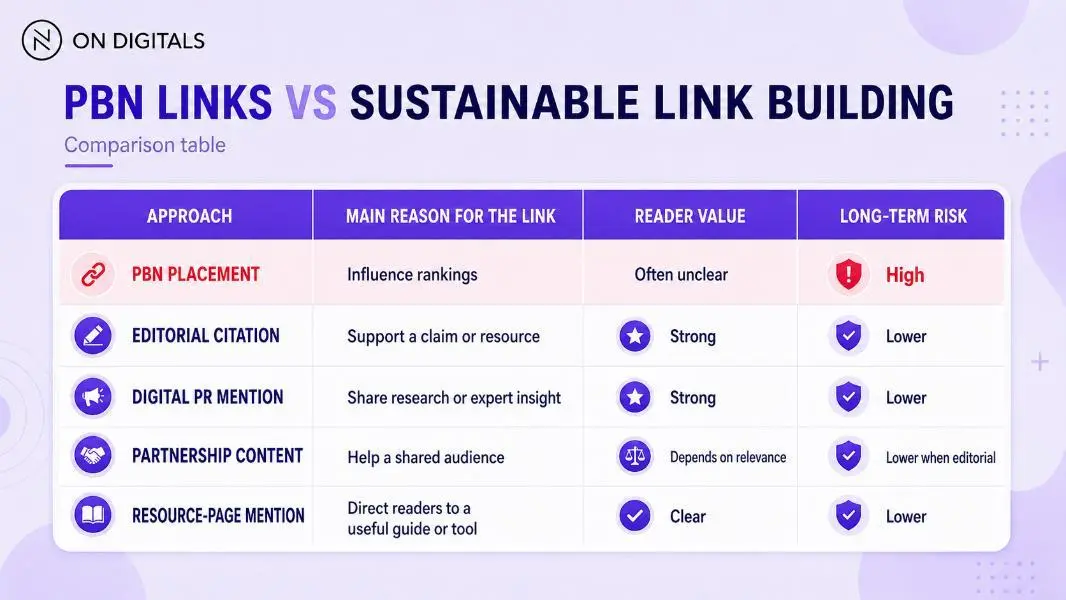 Sustainable link-building methods tend to provide clearer reader value and lower long-term risk than PBN placements.
Link quality should come before link volume. Strong references usually earn their value through topical relevance, natural placement, and an audience that may genuinely visit the destination page.
Digital PR creates a different kind of visibility
Digital PR can help a business become part of relevant industry conversations. A data-led story, expert commentary, or useful report may earn coverage from publishers who already serve the right audience.
The result is harder to control than a private network. It can also create stronger value because the mention has an editorial reason to exist.
Useful assets give publishers something to cite
Content becomes more linkable when it reduces research effort for other people. Original surveys, market benchmarks, and calculators are useful examples. The asset should solve a real information need rather than exist solely for outreach.
A publisher may still decide not to link. That is part of the process. Link earning works best when the resource remains useful even without immediate coverage.
What to do if your site already has PBN links
Some businesses inherit questionable backlinks from a previous agency, old campaign, or unknown referral source. The first step is to review the pattern before making changes.
Start with a structured backlink review
Use a backlink tool and Google Search Console to export referring domains. Then group links by source quality, target page, anchor pattern, and timing.
A practical review can follow these steps:
- Identify links pointing to important commercial pages.
- Check whether several low-quality domains use similar anchors.
- Review the context around each suspicious placement.
- Look for repeated themes across the referring sites.
- Check Search Console for manual-action messages.
- Record findings before contacting site owners or changing anything.
This process helps separate a few weak links from a wider artificial pattern.
Consider removal before disavow
A site owner may be willing to remove a link when the placement is clearly irrelevant or part of an old paid campaign. Removal is not always possible, especially when the domain is abandoned or the owner cannot be reached.
Google describes the disavow tool as an advanced feature. It should be considered carefully when there is a significant pattern of artificial links and a manual action, or a clear risk of one. Google’s disavow guidance explains how the tool works and why incorrect use can be harmful.
A routine disavow file for every low-quality link is rarely the right response. Manual review and documented evidence should come first.
Safer ways to build authority without PBNs
A stronger authority strategy earns attention because the website gives people something useful to reference.
Publish research that adds evidence
Original data can support journalists, analysts, and industry writers who need a reliable source. The subject does not need to be broad. A focused benchmark can still be valuable when it answers a question nobody else has quantified clearly.
Turn recurring questions into useful assets
Sales teams, customer-support teams, and specialists often hear similar questions repeatedly. A practical comparison, checklist, or tool can turn those questions into content with lasting value.
These assets can also support the wider site. A service page may gain more credibility when related educational content answers the research-stage questions around it.
Build relationships around shared audiences
Relevant partnerships can lead to natural mentions through co-created resources, interviews, events, or expert contributions. The strongest fit comes from audience overlap rather than the largest available website.
A smaller publication with the right readers can produce more meaningful referral traffic than a broad site with no connection to your market.
Questions to ask a link-building vendor
A reliable vendor should be able to explain how opportunities are sourced and why each placement is relevant.
|
Question to ask |
A stronger answer sounds like |
A concerning answer sounds like |
|
Where will the link appear? |
In relevant editorial content |
“We have private sites ready” |
|
Why would the publisher link? |
The page adds evidence or useful context |
“We control the placement” |
|
Who reads the source site? |
A defined audience with topic relevance |
“The metric is high” |
|
Is the link paid? |
Disclosed and qualified when needed |
“We can make it look natural” |
|
Can you show past work? |
Redacted examples with clear context |
Vague claims about guaranteed rankings |
A provider does not need to reveal confidential client details. They should still be able to explain the editorial logic behind the work.
FAQs about PBNs in SEO
Are PBNs against Google’s guidelines?
Google does not use the label “PBN” in every policy example. It does prohibit link spam, including links created mainly to manipulate rankings. A PBN that exists for that purpose can create policy risk.
Can a PBN improve rankings temporarily?
A short-term movement may happen in some cases. Search performance can change for many reasons, while a temporary gain does not establish that the tactic is safe or sustainable.
How can I identify PBN backlinks?
Review the wider pattern. Thin content, unrelated topics, repeated commercial anchors, and heavy outbound linking can be useful warning signs. One clue alone is rarely enough to reach a firm conclusion.
Should I disavow PBN links?
Start with a backlink review and check for manual-action messages in Search Console. Disavow should be considered carefully when there is strong evidence of a significant artificial-link pattern.
Is a private blog network the same as a multi-site brand?
No. A legitimate multi-site brand serves real users through distinct sites or offers. A PBN is typically organised around passing ranking signals to another website.
Why does PBN mean something different in aviation?
In aviation, PBN commonly means Performance-Based Navigation. This article uses PBN in the SEO sense: Private Blog Network.
Conclusion
A PBN may offer control over link placement, while that control can also reveal a lack of genuine editorial value. The safer path is to earn references that make sense for readers and fit the source page naturally.
On Digitals can help businesses review backlink risks and build an authority strategy around useful content, relevant publications, and long-term organic visibility.

NEWEST POSTS
- Advertising Industry In Vietnam: The 2026 Trends, Channels and Market-Entry Strategy
- Best SEO Company in Vietnam: Latest Shortlist For Businesses
- How To Leverage Social Media For Customer Service Like A Pro?
- Social Media Post Tips – 8 Ways To Boost Engagement
- How To Use Social Media for Sales – In-depth Beginner Guide
Read more