
SEO Competitor Analysis for Vietnam Market Entry
Vincent
20/03/2026
47
SEO competitor analysis is the process of identifying who your competitors are, why they win, and where your brand can surpass them. Competitor analysis is the foundation for creating the best SEO strategies. For businesses entering Vietnam, it must cover local SERPs, Vietnamese search intent, backlinks, content depth, AI Search visibility, and market-specific trust signals.
What is competitive analysis in SEO?
Competitive analysis in SEO is the process of comparing your website against the domains that rank and appear in AI-assisted answers for your target topics. It is different from business competitor analysis because your SEO competitors may include brands that do not sell the same product.
For example, a foreign skincare brand may compete with other skincare brands commercially. But in Google Search, it may also compete with Shopee, Lazada, Hasaki, beauty blogs, etc.
That difference matters because SEO competition is based on visibility, not only market category.
Why does SEO competitor analysis matter for Vietnam market entry?
SEO competitor analysis helps foreign businesses avoid entering Vietnam with global assumptions that do not match local SERPs.
A foreign company may already rank well in another market, but that authority does not automatically transfer to Vietnam. The brand may face different search languages, buyer education levels, local service expectations, etc.
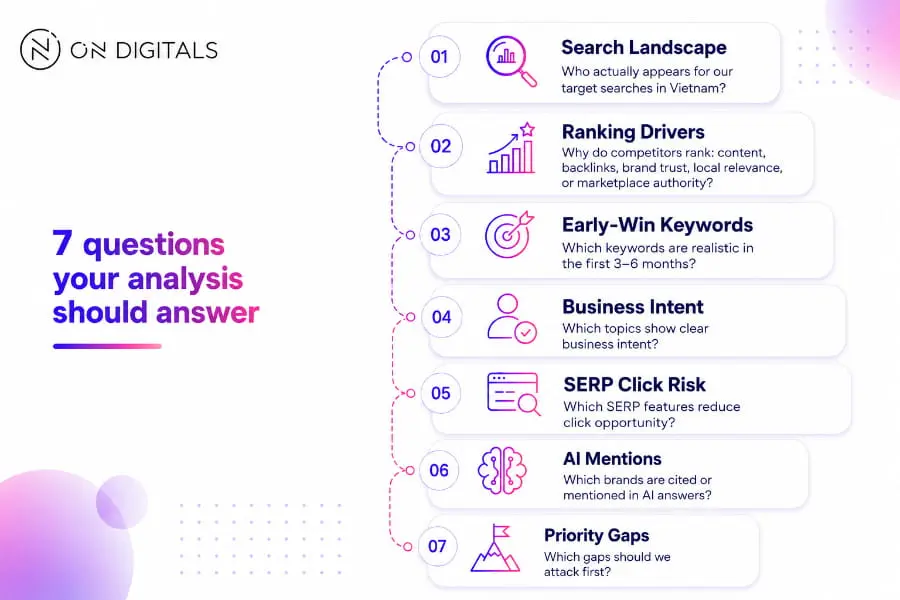
For market entry, SEO competitive analysis should answer seven questions
The output should not be a spreadsheet of keywords only. It should become a Vietnam SEO roadmap.
Step 1: Identify your real SEO competitors in Vietnam
Your real SEO competitors are the websites that appear repeatedly across your priority Vietnam search results, not just the companies your sales team names.
Start with Google Vietnam SERPs, use this three competitor groups:
| Competitor type | Example | Why it matters |
| Direct business competitors | Local/ foreign brands selling the same offer | Shows commercial positioning and service/ product depth |
| Search competitors | Publishers, directories, marketplaces, forums, YouTube | Shows who owns visibility and attention |
| AI Search competitors | Brands/ sources cited by AI Overviews, ChatGPT, Perplexity, Gemini | Shows who AI systems treat as useful or trustworthy |
For Vietnam market entry, search competitors often include local directories, ecommerce marketplaces, category blogs, and media publishers.
For effective evaluation, you can apply:
- Free method: Search your core keywords manually in an incognito browser, set location to Vietnam where possible, and record the top 10 domains across 20-50 priority queries.
- Paid method: Use Ahrefs, Semrush, SE Ranking, Similarweb, or Sistrix to extract competing domains, keyword overlap, backlink gap, and traffic estimates.
Step 2: Run SEO keyword competition analysis
SEO keyword competition analysis compares:
- Which keywords competitors rank for;
- How difficult those keywords are;
- What intent they serve;
- Whether your website has the authority and content depth to compete.
For Vietnam entry, this must include English, Vietnamese, and mixed-language search behavior.
Do not start with only broad head terms. A new entry business should separate keywords into four groups:
| Keyword group | Example | Priority logic |
| Commercial | “seo agency vietnam”, “crm software vietnam” | High business value, harder to win |
| Comparison | “brand A vs brand B vietnam” | High intent, useful for market education |
| Problem-led | “how to reduce lead cost in vietnam” | Strong for B2B content and lead nurturing |
| Localized Vietnamese | “dịch vụ seo cho doanh nghiệp nước ngoài” | Essential for local search demand |
A common mistake is assuming English keywords are enough because the brand is international. In many categories, Vietnamese-language content is necessary for local buyers, while English content may serve regional managers, investors, or foreign headquarters.
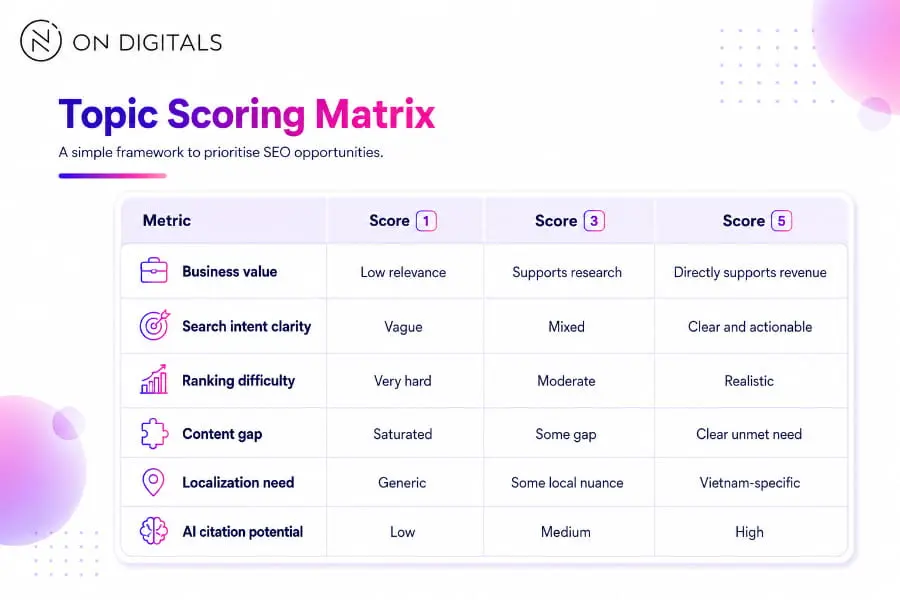
Keyword competitor analysis scoring matrix
Prioritize keywords that score high in business value, intent clarity, and content gap, even if search volume is modest.
Step 3: Analyze search intent and SERP features
Search intent and SERP feature analysis shows what Google believes users want for each query. Before creating content, check whether the SERP is dominated by which type of page or content.
This step is critical because ranking a blog post against a service-page SERP is difficult. Ranking a service page against an informational SERP is also inefficient.
Google’s 2026 guidance for generative AI search says AI Overviews and AI Mode are part of Google Search, and that core SEO practices remain relevant for appearing in these features. It also explains that AI Mode may use techniques such as query fan-out, where Google issues multiple related searches to build a more complete answer.
That means competitor analysis should no longer check only one keyword. Instead, it should check the topic network around that keyword.
Step 4: Move from keyword gaps to topic and entity gaps
Modern SEO competitor analysis should compare topical authority and entity coverage together.
A competitor may outrank you because it has a stronger cluster around the topic, clearer entity relationships, better internal links, and more supporting pages that answer related questions.
For example, a foreign HR software company entering Vietnam should not only analyze “HR software Vietnam”. It should analyze the broader topic cluster, such as:
- Payroll compliance in Vietnam
- Labor contracts in Vietnam
- Employee onboarding in Vietnam
- HR software for SMEs
- HR automation
- Time tracking
- Employee data security
- Integration with accounting software
- Vietnamese HR regulations
- Case studies by company size
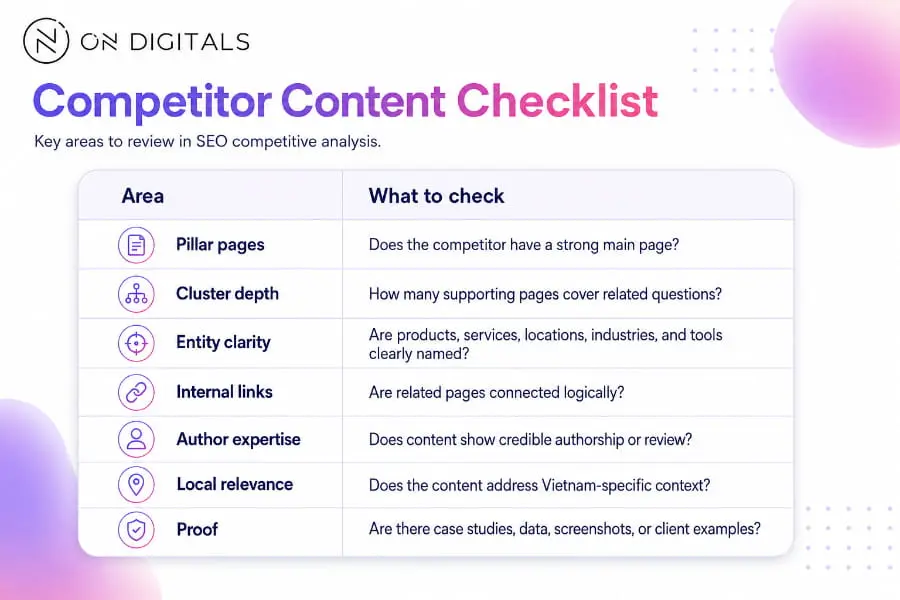
Competitor topic gap audit comparison
Google’s people-first content guidance encourages original information, analysis, expertise, clear sourcing, and content that provides substantial value beyond rewriting other sources.
For AI search, this matters even more. Ahrefs analyzed 863,000 SERPs and 4 million AI Overview URLs in March 2026 and found that only 38% of pages cited in AI Overviews also ranked in the top 10. The rest came from positions 11-100 or beyond the top 100 blocks.
That suggests AI citation analysis should be treated as a separate competitor layer, not only a ranking report.
Step 5: Analyze competitor content quality and E-E-A-T
Competitor content analysis should identify why a page deserves trust.
For foreign businesses in Vietnam, trust signals matter because users may not know the brand, the service quality, the local team, or the company’s experience in the market.
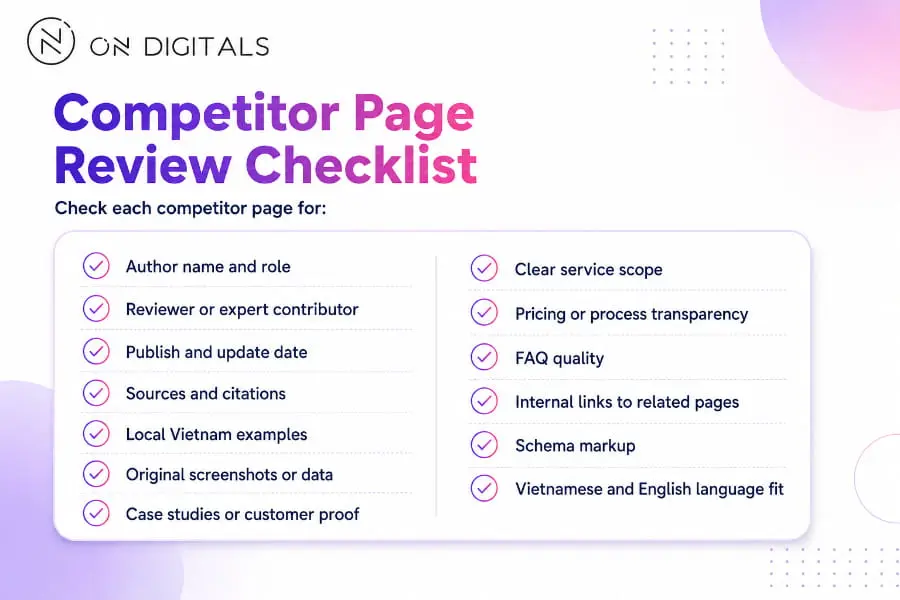
Competitor content quality checklist
Google ranking systems aim to prioritize helpful information created to benefit people, and it recommends evaluating content by asking who created it, how it was created, and why it was created.
E-E-A-T is especially important for YMYL-adjacent categories such as healthcare, finance, legal, education, and investment. It is also important for B2B categories where trust affects lead quality and sales cycles.
Important nuance: E-E-A-T is not a simple score that you can add to a page. Search quality raters help evaluate whether its systems are working, but their feedback does not directly rank individual pages.
Step 6: Analyze backlinks, digital PR, and brand mentions
Backlink analysis shows which websites trust or reference your competitors.
Do not only look at Domain Rating or Domain Authority. Third-party authority metrics are useful for benchmarking, but they are not the same as Google’s ranking systems. Focus on relevance and quality.
Backlink analysis should answer:
| Question | Why it matters |
| Which local Vietnamese sites link to competitors? | Shows market trust and PR opportunities |
| Which industry associations mention them? | Reveals authority channels |
| Which pages earn links naturally? | Shows linkable asset opportunities |
| Which anchors are common? | Helps understand topic association |
| Which links look risky? | Helps avoid copying bad tactics |
| Which unlinked mentions exist? | Shows outreach opportunities |
Be careful with link shortcuts. Google’s spam policies prohibit practices such as link spam, expired domain abuse, scaled content abuse, and site reputation abuse.
Google announced these spam policies in its March 2024 update and later clarified that third-party content is not automatically a violation unless it is used to abuse search rankings by exploiting the host site’s ranking signals.
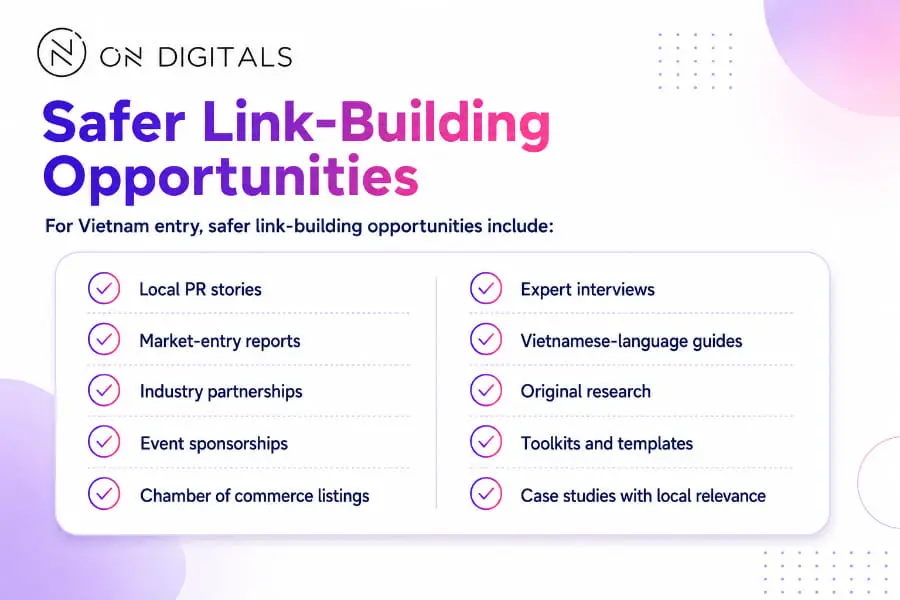
Link-building opportunities in Vietnam
Step 7: Analyze technical and on-page competitiveness
Technical SEO competitor analysis checks whether competitors have structural advantages that make their pages easier to crawl, understand, and rank. This includes page templates, internal links, schema, speed, indexation, canonical handling, hreflang, mobile UX, and content accessibility.
For foreign businesses, technical SEO often becomes more complex because the website may need English and Vietnamese pages, country folders, hreflang, local landing pages, and localized metadata.
Check:
| Technical area | What to compare |
| URL structure | /vn/, /vi/, subfolder, subdomain, or country page |
| Hreflang | Correct language and country targeting |
| Canonicals | Avoid wrong canonicalization across language pages |
| Internal links | Connect service, blog, case study, and local pages |
| Schema | Organization, Article, FAQPage, BreadcrumbList, LocalBusiness where relevant |
| Core Web Vitals | Compare page experience and mobile speed |
| Indexation | Check which competitor pages are indexed |
| Page templates | Identify scalable structure advantages |
| Image SEO | Alt text, filenames, captions, image compression |
| Conversion UX | CTAs, forms, trust signals, lead flow |
Google Search Console helps site owners measure search traffic, analyze queries, impressions, clicks, and position, and identify issues affecting appearance in Google Search.
For multilingual Vietnam SEO, technical accuracy matters. A strong Vietnamese page should not simply be a translated English page. It should match Vietnamese search intent, examples, trust signals, and conversion expectations.
Step 8: Analyze competitors in AI search, GEO, and AEO
AI search competitor analysis identifies which brands and sources appear in AI Overviews, AI Mode, ChatGPT, Perplexity, Gemini, and other answer engines for your priority topics.
The goal is to understand who is being cited or mentioned as a trusted source when users ask market-relevant questions.
This is the biggest gap in most SEO competitor analysis guides. Track five AI visibility signals:
| Signal | What to record |
| Citation | Which URL is linked or cited? |
| Mention | Which brand is named without a link? |
| Position | Whether the source appears early or late in the answer? |
| Passage | Which sentence or claim the AI uses? |
| Reason | Why may the source have been selected? |
For Google specifically, Google’s AI optimization guidance says the same SEO fundamentals remain important for AI Overviews and AI Mode. It also says there is no need for special AI files, special markup, or AI-only text files to appear in generative AI search.
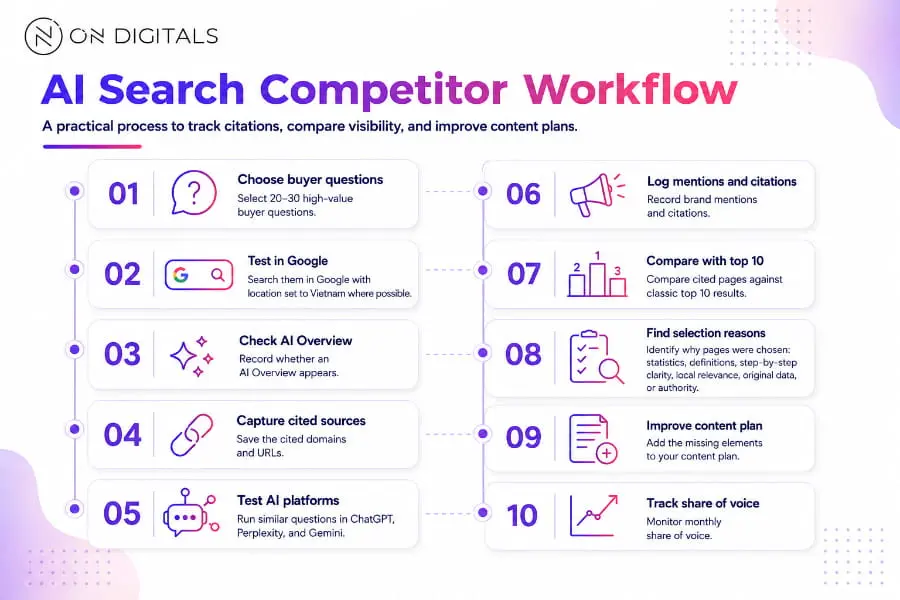
Practical AI Search competitor workflow
Do not treat AI search data as perfectly stable. AI answers can vary by prompt, location, language, personalization, time, and index changes. Use it as a directional signal, not an absolute ranking report.
Step 9: Build an Impact × Effort × Win Probability roadmap
The value of SEO competitor analysis comes from prioritization. A long list of keyword gaps, backlink gaps, and content gaps is not useful until it becomes an action roadmap.
Use this scoring model:
| Factor | Score 1 | Score 3 | Score 5 |
| Business impact | Low awareness | Supports consideration | Direct lead or revenue value |
| Search demand | Very small | Moderate | Strong or strategically important |
| Competition level | Dominated by strong players | Mixed | Realistic to win |
| Content gap | Competitors cover it well | Some weakness | Clear gap |
| Local relevance | Generic | Some Vietnam angle | Strong Vietnam-specific intent |
| AI citation potential | Low | Medium | Strong answer/citation potential |
| Execution effort | High | Medium | Low |
Then calculate:
Priority Score = (Impact + Demand + Win Probability + Local Relevance + AI Potential) – Effort
Use the score to create a 90-day, 6-month, and 12-month roadmap. Example:
| Opportunity | Impact | Effort | Win probability | Priority |
| Vietnam market-entry service page | 5 | 3 | 4 | High |
| “How to choose [service] in Vietnam” guide | 4 | 2 | 4 | High |
| Broad “best software” keyword | 5 | 5 | 1 | Low |
| Local partner directory outreach | 3 | 2 | 4 | Medium |
| AI Search FAQ refresh | 4 | 2 | 3 | High |
This is the missing bridge between analysis and execution.
Step 10: Turn competitor analysis into a content brief
An SEO competitive analysis should produce content briefs, not just insights. Each winning opportunity should become a page brief with search intent, target audience, primary keyword, related entities, competitor weaknesses, source requirements, internal links, schema, CTA, and measurement plan.
Use this content brief format:
| Brief field | What to include |
| Target market | Vietnam, English-speaking expats, Vietnamese buyers, regional decision-makers |
| Search intent | Informational, commercial, comparison, local, transactional |
| Primary keyword | One clear target query |
| Secondary keywords | Related variations and local language terms |
| SERP features | AI Overview, PAA, video, local pack, marketplace, forum |
| Competitor weaknesses | Missing local proof, no pricing, no Vietnam examples, weak FAQ |
| Required sections | H2s that answer buyer questions |
| E-E-A-T assets | Author bio, case study, screenshot, data, source citations |
| Internal links | Service page, related guide, case study, contact page |
| Schema | Article, FAQPage, BreadcrumbList, LocalBusiness where relevant |
| CTA | Consultation, market-entry audit, download checklist |
| Success metric | Rankings, AI citations, leads, assisted conversions |
For foreign businesses entering Vietnam, the brief should include a localization note: what must be rewritten for Vietnamese buyers, not merely translated.
SEO competitive analysis checklist
Use this checklist before building the roadmap.
Competitor identification
- List direct business competitors.
- List domains that rank in Vietnam SERPs.
- List publishers, marketplaces, directories, forums, and YouTube competitors.
- List AI Search competitors from AI Overviews, ChatGPT, Perplexity, and Gemini.
- Separate English and Vietnamese SERPs.
Keyword and intent analysis
- Export competitor keywords.
- Group keywords by intent.
- Identify commercial, informational, comparison, and local terms.
- Score keyword difficulty and business value.
- Check whether SERP format matches your planned page type.
Topic and entity analysis
- Map competitor pillar pages.
- Map supporting cluster pages.
- Identify missing subtopics.
- Check entity coverage.
- Review internal links.
- Compare local Vietnam context.

Competitor analysis checklist
Content quality and E-E-A-T
- Check author and reviewer details.
- Check update date.
- Check sources and citations.
- Check original data or case studies.
- Check images, screenshots, examples.
- Check trust pages: About, contact, policy, case studies.
Backlinks and mentions
- Identify competitor referring domains.
- Separate local Vietnam links from global links.
- Find PR and partnership opportunities.
- Identify linkable assets.
- Check risky link patterns.
- Record unlinked brand mentions.
Technical and on-page
- Check title, H1, headings, meta.
- Check schema.
- Check indexation.
- Check mobile UX.
- Check Core Web Vitals.
- Check hreflang and language targeting.
- Check conversion path and CTAs.
AI search visibility
- Track AI Overview citations.
- Track AI Mode citations where available.
- Track ChatGPT/Perplexity/Gemini mentions.
- Record cited URLs and passages.
- Calculate AI share of voice.
- Identify reasons competitors are cited.
Prioritization
- Score each gap by impact.
- Score each gap by effort.
- Score win probability.
- Build a 90-day roadmap.
- Convert top gaps into content briefs.
- Assign measurement KPIs.
Free vs paid SEO competitor analysis tools
Foreign businesses can run a useful SEO competitor analysis with free tools, but paid tools make keyword, backlink, and AI visibility analysis faster. The best approach is to start free for strategy validation, then use paid tools when the market-entry plan needs scale.
| Need | Free method | Paid method |
| Identify competitors | Manual SERP review | Ahrefs, Semrush, SE Ranking |
| Keyword gap | Google autocomplete, GSC, SERP notes | Ahrefs/Semrush keyword gap |
| SERP features | Manual Google checks | Rank trackers with SERP feature data |
| Backlinks | Limited free backlink checkers | Ahrefs, Semrush, Majestic |
| Content gaps | Manual page comparison | Content gap tools |
| AI search visibility | Manual prompts and screenshots | AI visibility trackers |
| Technical audit | GSC, PageSpeed Insights, Screaming Frog free limit | Screaming Frog paid, Sitebulb |
| Local SEO | Google Maps, Business Profile checks | Local rank trackers |
Google Search Console is useful when the website already has data, because it shows queries, impressions, clicks, and average position. For a brand entering Vietnam with no local organic footprint, manual SERP research and competitor tools are needed before GSC becomes useful.
How often should you run SEO competitor analysis?
Run a full SEO competitor analysis before entering Vietnam, then refresh it every quarter. Run lighter checks monthly for priority keywords, AI Search visibility, new backlinks, SERP features, and competitor content updates.
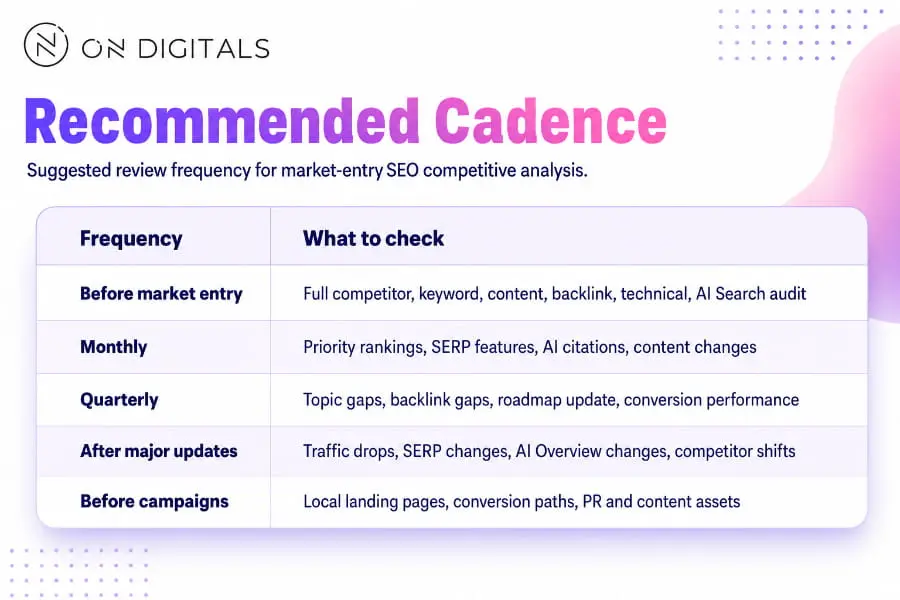
Recommended competitor analysis cadence
Google’s updates and spam policies can change the competitive landscape, especially where competitors rely on low-quality scaled content, reputation abuse, or affiliate-style content.
Common SEO competitor analysis mistakes
The most common mistake is copying competitor tactics without understanding why they work. A competitor may rank because of brand authority, backlinks, history, local trust, marketplace strength, or topic depth. Copying their headings or word count will not recreate those signals.
Avoid these mistakes:
| Mistake | Why it fails | Better approach |
| Treating business competitors as SEO competitors | They may not rank | Use SERP-based competitor lists |
| Looking only at keywords | Misses topics, entities, AI Search | Analyze clusters and citations |
| Copying top-ranking content | Creates commodity content | Add local proof and original value |
| Ignoring Vietnamese search intent | Misses local demand | Research English and Vietnamese SERPs |
| Prioritizing highest-volume keywords | Often too competitive | Use impact × effort × win probability |
| Ignoring SERP features | Click opportunity may be low | Analyze AI Overviews, PAA, video, local packs |
| Relying only on paid tools | Data may miss nuance | Combine tools with manual SERP review |
| Skipping conversion analysis | Rankings may not create leads | Review CTAs, trust signals, forms, CRM quality |
SEO competitor analysis by industry
SEO competitor analysis should change by business model. A SaaS company, ecommerce brand, local service provider, and B2B manufacturer will face different SERP competitors in Vietnam.
| Industry | Main SEO competitors | Key analysis focus |
| B2B SaaS | Review sites, software lists, blogs, Linkedin, competitors | Comparison terms, integration pages, use cases, lead quality |
| Ecommerce | Marketplaces, category pages, product reviews, social content | Product SEO, category depth, reviews, image SEO |
| Local services | Google Maps, directories, local competitors, review platforms | Local pack, GBP, reviews, service-area pages |
| Education | Universities, study abroad sites, forums, YouTube | Trust, FAQs, program comparison, parent/student intent |
| Healthcare | Clinics, hospitals, medical publishers, directories | E-E-A-T, author credentials, YMYL trust |
| Manufacturing | Industry directories, trade media, technical guides | Technical specs, B2B content, PR, international trust |
| Hospitality | OTAs, travel blogs, Google Maps, YouTube | Local SEO, visual content, reviews, travel intent |
For foreign businesses, this section should be customized before publishing if the article targets a specific vertical.
Frequently Asked Questions (FAQs)
What is SEO competitor analysis?
SEO competitor analysis is the process of identifying which websites compete with your brand in organic search, what keywords and topics they rank for, how they earn authority, and where your website can realistically win. It includes keyword gaps, content quality, backlinks, technical SEO, SERP features, local relevance, and AI Search visibility.
How do you do an SEO competitive analysis?
Start by identifying real SERP competitors, then analyze keyword gaps, search intent, topic clusters, content quality, backlinks, technical SEO, and AI Search citations. After collecting the gaps, score them by business impact, effort, local relevance, and win probability. The final output should be a prioritized SEO roadmap and content briefs.
What is SEO keyword competition analysis?
SEO keyword competition analysis evaluates how difficult and valuable a keyword is based on current ranking pages, search intent, domain authority, content depth, backlinks, SERP features, and business relevance. For Vietnam market entry, it should include English and Vietnamese terms, local modifiers, and regional buyer behavior.
Who are my SEO competitors?
Your SEO competitors are the domains that repeatedly appear for your target searches. They may include direct competitors, publishers, directories, marketplaces, YouTube channels, forums, review sites, and AI-cited sources. They are not always the same as your business competitors.
How often should SEO competitor analysis be updated?
A full SEO competitor analysis should be refreshed quarterly. Priority keywords, AI citations, SERP features, backlinks, and competitor content updates should be checked monthly. Refresh the analysis faster after major Google updates, market-entry campaigns, or sudden ranking changes.
Can I do SEO competitor analysis with free tools?
Yes. You can start with manual Google SERP review, Google Search Console, Google Trends, PageSpeed Insights, Google Business Profile checks, free backlink tools, and spreadsheet scoring. Paid tools make the work faster, but they do not replace strategic judgment, local market understanding, or manual SERP review.
Final takeaway
SEO competitor analysis for Vietnam market entry is not just a keyword gap exercise. It is a market intelligence process that shows who owns visibility, why they are trusted, which topics Google understands, which sources AI systems cite, and where a foreign business can win with the right sequence.
The strongest approach combines classic SEO analysis with AI Search visibility. On Digitals can provide you with customized and high-performing SEO services for firms to surpass your SEO competitors.

NEWEST POSTS
- Advertising Industry In Vietnam: The 2026 Trends, Channels and Market-Entry Strategy
- Best SEO Company in Vietnam: Latest Shortlist For Businesses
- How To Leverage Social Media For Customer Service Like A Pro?
- Social Media Post Tips – 8 Ways To Boost Engagement
- How To Use Social Media for Sales – In-depth Beginner Guide
Read more