
SERP Analysis Guide for Vietnam Market Entry
Vincent
22/01/2026
45
SERP analysis is the process of studying Google search results to understand user intent, ranking competitors, AI Overviews, and content requirements. This step is a must for high-performing SEO strategies. For businesses, it helps decide which keywords, formats, local signals, and AI visibility opportunities are worth investing in.
Why SERP analysis matters for Vietnam market entry?
SERP analysis helps foreign businesses avoid building SEO strategies from global assumptions. Vietnam’s search results may include local companies, marketplaces, publishers, directories, video results, map packs, social discussions, AI Overviews, and Vietnamese-language pages that do not appear in other markets.
For foreign brands, this means SERP analysis should ask:
|
Question |
Why it matters |
|
What intent does Google show in Vietnam? |
Prevents wrong page type |
|
Who owns the SERP? |
Reveals real SEO competitors |
|
Which features reduce clicks? |
Helps forecast traffic realistically |
|
Are AI Overviews present? |
Shows whether citation visibility matters |
|
Are local/map results present? |
Signals local SEO priority |
|
Are Reddit, forums, or UGC ranking? |
Signals demand for real experience |
|
Which language dominates? |
Guides English vs Vietnamese content |
A foreign company may rank well in Singapore, Australia, or the U.S., but Vietnam SERPs may reward different examples, local trust signals, Vietnamese phrasing, marketplace presence, or service-page structure.
What changed in SERP analysis in the AI search era?
SERP analysis now must include AI Overviews, AI Mode, zero-click behavior, and AI citation tracking.
A traditional SERP check that only reviews the top 10 blue links is incomplete because Google can now summarize answers, cite sources and change click behavior.
Google’s official AI search guidance says SEO best practices remain relevant because AI Overviews and AI Mode rely on Google’s core ranking and quality systems. It also explains that AI features can use techniques such as query fan-out, where Google issues multiple related searches to build a more complete answer.

SERP analysis in the AI search era
BrightEdge reported in February 2026 that AI Overview presence grew from roughly 30% to 48% of tracked queries over the past year, and that AI Overviews averaged more than 1,200 pixels tall when they appeared.
Click behavior has also changed. Pew Research Center found that users who encountered a Google AI summary clicked a traditional search result in 8% of visits, compared with 15% when no AI summary appeared.
For SERP analysis, the conclusion is clear: Ranking is still important, but visibility, citation, screen space, and click opportunity now need separate analysis.
SERP analysis framework for Vietnam market
Use this framework before building a page, content cluster, service page, or market-entry SEO roadmap.
|
Layer |
What to analyze |
Output |
|
Search intent |
Informational, commercial, local, transactional, mixed |
Correct page type |
|
Organic competitors |
Ranking domains, page types, authority, content depth |
SEO competitor set |
|
SERP features |
AI Overview, PAA, map pack, video, shopping, forum |
Click opportunity |
|
AI layer |
Cited sources, brand mentions, answer structure |
AI visibility plan |
|
Content quality |
E-E-A-T, examples, data, freshness, localization |
Content brief |
|
SERP stability |
Ranking volatility and page turnover |
Investment confidence |
|
Execution path |
Tools, manual checks, priority scoring |
SEO roadmap |
This structure works better than a simple “check the top 10” method because Vietnam SERPs often contain fractured intent. One query can show service pages, tools, informational guides, YouTube videos, map results, and AI answers at the same time.
Step 1: Define the query and market context
Start SERP analysis by defining the exact query, language, location, device, and business goal. A SERP is not universal. Google can change results based on country, city, language, device, personalization, and search settings.
For Vietnam market entry, test at least four query variations:
|
Query type |
Example |
Purpose |
|
English commercial |
“digital marketing agency Vietnam” |
Regional or foreign decision-makers |
|
Vietnamese commercial |
“dịch vụ digital marketing tại Việt Nam” |
Local business demand |
|
Problem-led |
“how to enter Vietnam market online” |
Educational demand |
|
Local intent |
“SEO agency Ho Chi Minh City” |
Map pack and local competitors |
Google’s own explanation of ranking says results can be affected by factors such as meaning, relevance, quality, location, past Search history, and Search settings.
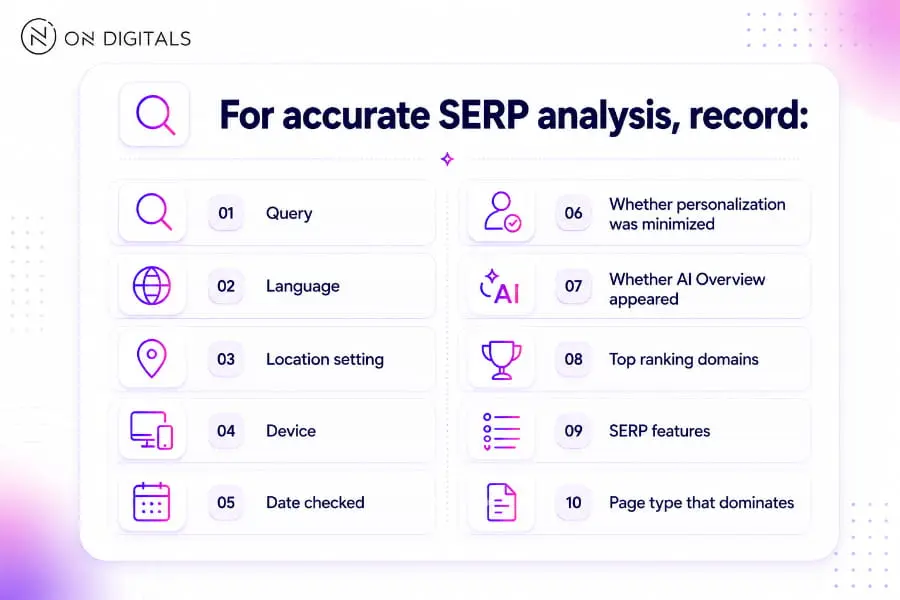
SERP analysis items
This makes the analysis repeatable and trustworthy.
Step 2: Identify the real SERP competitors
SERP or SEO competitors are the domains that appear for your target searches. It’s completely different from the way you analyze competitors generally.
This distinction is important because your content may not need to beat only businesses. It may need to beat the page type Google prefers.
If the SERP is dominated by tools or marketplaces, a standard blog post may struggle. If the SERP is dominated by guides, FAQs, and comparison pages, a strong educational asset can compete.
Step 3: Analyze search intent and fractured intent
Search intent analysis identifies what users want and what Google believes is the best answer format. In fractured-intent SERPs, Google mixes several intent types on one results page, so your content must decide which intent to serve and whether to support secondary intent.
Common SERP intent types:
|
Intent |
SERP clues |
Best page type |
|
Informational |
Guides, PAA, definitions, AI Overview |
Blog guide or resource |
|
Commercial |
“Best”, “top”, comparison pages |
Comparison or service page |
|
Transactional |
Product pages, shopping results |
Category or product page |
|
Local |
Map pack, local directories |
Local landing page + GBP |
|
Tool intent |
Tool pages, calculators, software pages |
Tool page or interactive asset |
|
UGC intent |
Reddit, forums, discussions |
Experience-led content |
For the serp analysis cluster, the insight from your competitor research is important: the SERP mixes tool-page intent and how-to educational intent. That means the strongest page should be a hybrid: a detailed how-to guide plus a neutral tool comparison and free manual workflow.
Step 4: Map classic SERP features
SERP features tell you how much click opportunity remains after Google answers or reshapes the page. A keyword with strong volume may still be weak if AI Overviews, ads, videos, map packs, and People Also Ask push organic results down.
Track these features:
|
SERP feature |
What it means |
Action |
|
AI Overview |
Google summarizes the answer |
Track citations and answer gaps |
|
Featured snippet |
Concise answer opportunity |
Add direct answer blocks |
|
People Also Ask |
Follow-up questions matter |
Add FAQ/H2 answers |
|
Local pack |
Location is important |
Build local SEO assets |
|
Video carousel |
Visual explanation matters |
Add video or visual content |
|
Shopping/product results |
Transactional intent exists |
Optimize product/category pages |
|
Reddit/forum results |
Users want real experience |
Add first-hand proof |
|
Image pack |
Visual SEO matters |
Optimize image metadata |
For foreign businesses entering Vietnam, this layer helps decide whether to create a blog article, service page, comparison page, local landing page, video, tool, or downloadable checklist.
Step 5: Analyze the AI layer
AI-layer SERP analysis identifies which sources are cited or summarized in AI-generated answers. This is now one of the biggest gaps in traditional SERP analysis because a brand can rank in classic results but still lose visibility if competitors are cited in AI answers.
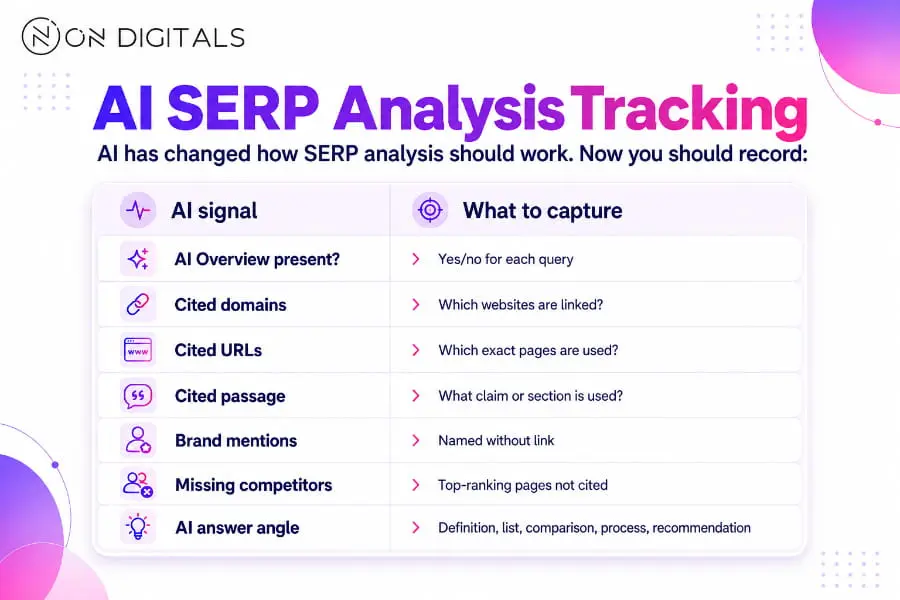
AI has changed how SERP analysis should work
For Vietnam entry, test both English and Vietnamese prompts in Google, ChatGPT, Perplexity, Gemini, and any tool your buyers are likely to use. Treat results as directional, because AI answers can vary by prompt, location, time, and personalization.
Step 6: Evaluate SERP stability before investing
SERP stability analysis helps decide whether a keyword is worth investing in. If the same pages have held top positions for months, the SERP may be harder to break into. If ranking pages change often, there may be room for a stronger new page.
Some signals to check:
|
Signal |
What it suggests |
|
Same top 5 for months |
Harder, more stable SERP |
|
Frequent top 10 changes |
Opportunity for new content |
|
Many weak pages ranking |
Content quality gap |
|
Many high-authority domains |
Higher authority barrier |
|
New pages appearing |
Freshness may matter |
|
UGC/forums rising |
Experience and community signals matter |
This step prevents wasted effort. A foreign business should not spend three months creating content for a keyword where the SERP is dominated by global authorities and low in conversion value. It may be better to target a narrower specific query.
Step 7: Evaluate content quality and E-E-A-T signals
Content quality analysis shows why top-ranking pages deserve visibility. For the Vietnam market, this includes local relevance, author credibility, proof, freshness, original data, and business usefulness.
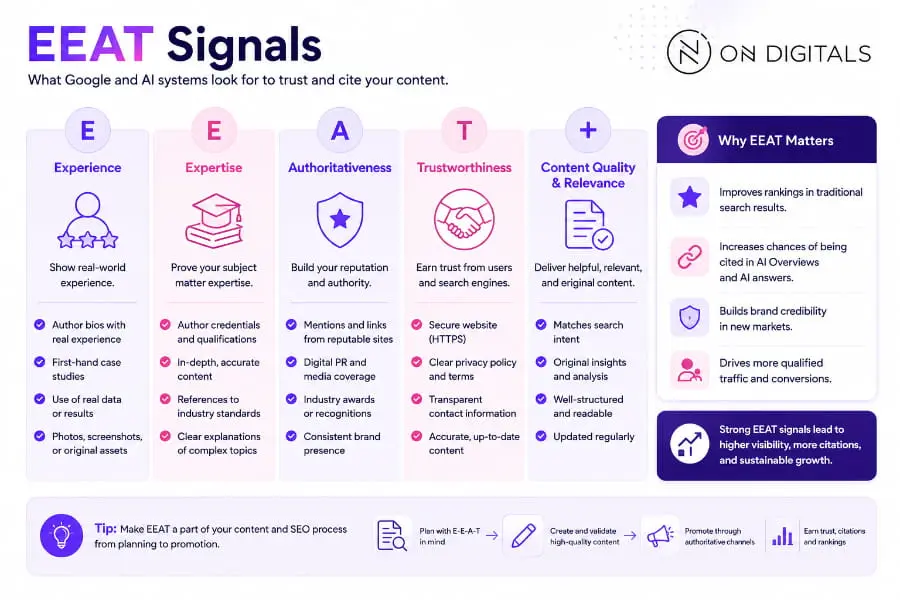
Content quality and E-E-A-T signals
For On Digitals content, this means the page should not only explain SERP analysis. It should show the process with real screenshots, a sample SERP table, a tool comparison, and a final action roadmap.
Step 8: Compare free and paid SERP analysis tools
A strong SERP analysis guide should not push only one paid tool. Foreign businesses entering Vietnam may need a mix of manual checks, free tools, and paid platforms depending on budget, market stage, and competition level.
|
Need |
Free method |
Paid method |
|
Manual SERP review |
Google Search incognito, location/language checks |
SERP trackers |
|
Query data |
Google Search Console, Google Trends |
Semrush, Ahrefs, SE Ranking |
|
SERP features |
Manual screenshots |
Rank tracking tools |
|
AI Overview tracking |
Manual query log |
AI visibility tools |
|
Backlinks |
Free backlink checkers |
Ahrefs, Semrush, Majestic |
|
Technical checks |
PageSpeed Insights, GSC |
Screaming Frog, Sitebulb |
|
CTR and performance |
GSC reports |
SEO dashboards |
|
Local SEO |
Google Maps, Business Profile checks |
Local rank trackers |
Google Search Console is essential once the site has data. It lets site owners see which queries bring users to the site and analyze impressions, clicks, and position on Google Search.
Step 9: Turn SERP analysis into an SEO action plan
SERP analysis should end with a decision, not just a spreadsheet. The final output should tell the team whether to create a page, update a page, build a tool, localize content, add video, pursue backlinks, improve E-E-A-T, or avoid the keyword.
Use this action matrix:
|
SERP finding |
Recommended action |
|
AI Overview present, weak citations |
Create source-backed direct answers |
|
PAA dominates |
Add FAQ and question-led H2s |
|
Tool pages dominate |
Add a calculator, checklist, or template |
|
Local pack appears |
Build local landing page and GBP strategy |
|
Video results appear |
Create video or visual explainer |
|
Reddit/forum results appear |
Add real experience and customer questions |
|
Top results lack Vietnam context |
Build localized market-entry content |
|
SERP is too stable and competitive |
Target long-tail or adjacent cluster first |
|
Organic results below the fold |
Forecast lower click potential |
|
Competitor pages are outdated |
Publish fresher, better-sourced content |
Then score each opportunity:
|
Factor |
Score 1 |
Score 3 |
Score 5 |
|
Business impact |
Low |
Medium |
High |
|
SERP accessibility |
Hard |
Moderate |
Realistic |
|
Content gap |
Small |
Clear |
Large |
|
AI citation potential |
Low |
Medium |
High |
|
Localization opportunity |
Weak |
Some |
Strong |
|
Execution effort |
High |
Medium |
Low |
Prioritize pages where business impact, gap size, and win probability are high.
SERP analysis checklist
Use this checklist before writing or optimizing a page.
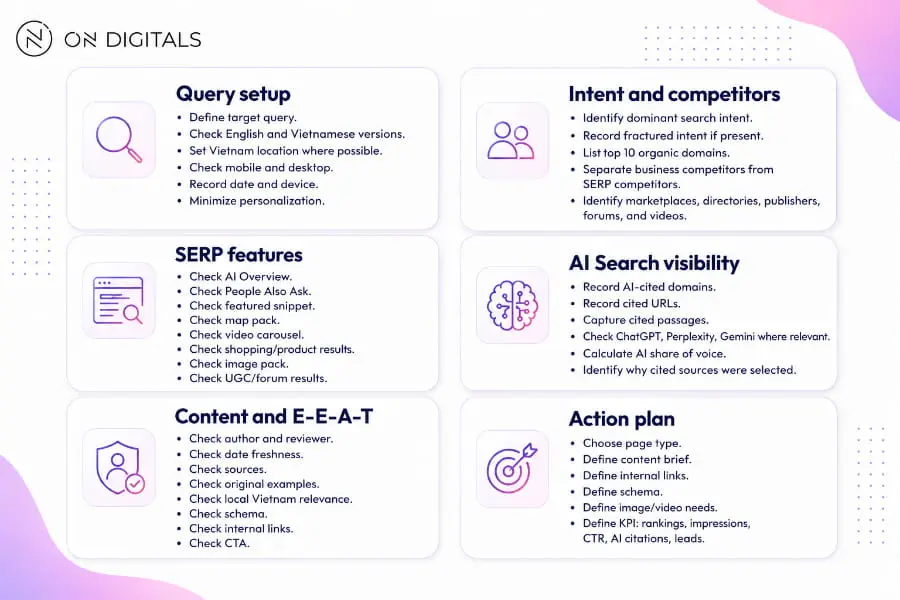
SERP analysis checklist
SERP analysis by query type
SERP analysis should change by query type. A market-entry SEO plan should not apply one template to every keyword.
|
Query type |
What to inspect |
Best output |
|
Informational |
AI Overview, PAA, guides, snippets |
Expert guide or FAQ page |
|
Commercial |
Service pages, comparison pages, review sites |
Service/comparison page |
|
Local |
Map pack, reviews, local pages |
GBP + local landing page |
|
Ecommerce |
Marketplaces, product pages, images |
Category/product optimization |
|
Video |
YouTube, short-form results |
Video + supporting article |
|
UGC/forum |
Reddit, Quora, local forums |
Experience-led article |
|
Tool intent |
Calculators, software pages |
Tool page + guide |
For the serp analysis query cluster, the ideal page should combine a how-to guide, checklist, free workflow, tool comparison, and AI Search analysis layer. This helps satisfy both educational and tool-evaluation intent.
Common SERP analysis mistakes
The most common SERP analysis mistake is checking the top 10 results without asking why Google selected those results. A page may rank because of authority, intent fit, freshness, backlinks, local relevance, UGC demand, or because the SERP is unstable.
Avoid these mistakes:
|
Mistake |
Why it fails |
Better approach |
|
Looking only at top 3 |
Misses SERP structure |
Analyze full page & features |
|
Ignoring AI Overview |
Misses citation competition |
Track AI sources separately |
|
Treating SEO competitors as business competitors |
Wrong competitive set |
Use SERP-based competitor list |
|
Ignoring Vietnam localization |
Weak market fit |
Compare English and Vietnamese SERPs |
|
Copying competitor headings |
Creates commodity content |
Add original proof and local insight |
|
Over-trusting schema |
Schema does not guarantee rich results |
Use schema for clarity |
|
Ignoring zero-click |
Overestimates traffic |
Forecast click opportunity |
|
Skipping measurement |
No feedback loop |
Track GSC, leads, and AI citations |
Google’s structured data guidelines also state that valid structured data does not guarantee rich-result appearance, so schema should support clarity rather than be treated as a ranking shortcut.
How to measure SERP analysis results?
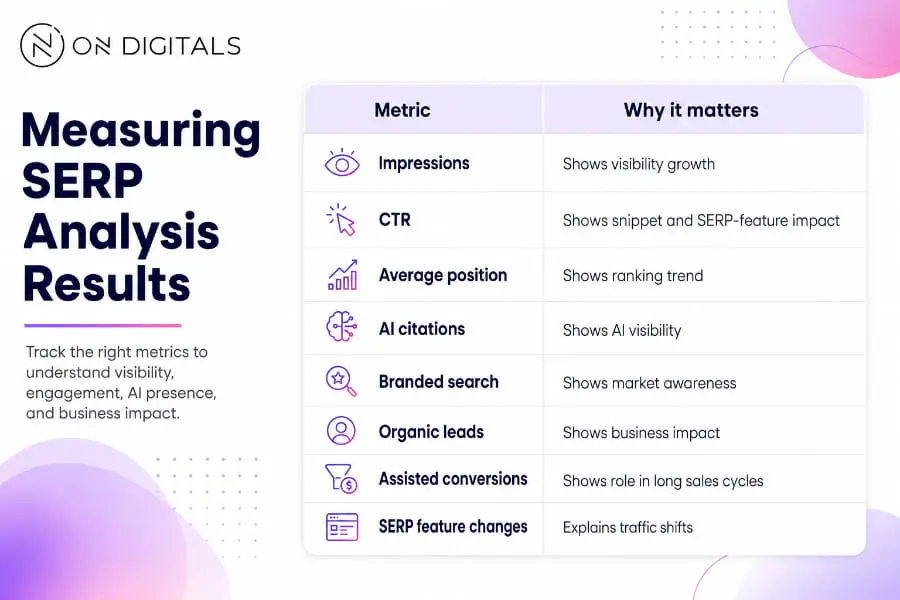
Measure SERP analysis by whether it improves decisions and performance. Good analysis should lead to better page selection and clearer SEO priorities.
Metrics to measure SERP analysis results
Search Console’s documentation explains how impressions, clicks, and position are counted in performance reports, including special cases where elements must be visible or expanded to count.
For AI-era reporting, do not panic when impressions rise faster than clicks. AI Overviews, answer boxes, map packs, and other features can change click behavior. Instead, separate three questions:
- Did visibility improve?
- Did click opportunity change?
- Did business outcomes improve?
Frequently Asked Questions (FAQs)
What is SERP analysis?
SERP analysis is the process of studying search engine results pages to understand search intent, ranking competitors, SERP features, AI Overviews, content requirements, click opportunity, and SEO difficulty. It helps marketers decide what type of page to create and whether a keyword is worth targeting.
How do you analyze a SERP?
Start by checking the query in the right country, language, and device. Then record search intent, top-ranking pages, SERP features, AI Overviews, cited sources, content quality, backlinks, local results, and page formats. The final output should be a content brief or SEO action plan.
Why is SERP analysis important for SEO?
SERP analysis prevents teams from creating the wrong page for the wrong intent. It shows whether Google prefers guides, service pages, product pages, local results, videos, forums, or AI summaries. This helps improve ranking potential, click forecasts, and content strategy.
How has AI Search changed SERP analysis?
AI Search adds a new visibility layer. Marketers now need to analyze AI Overviews, AI Mode, cited sources, brand mentions, answer structure, and zero-click behavior. Ranking in the top 10 is still useful, but Ahrefs found that many AI Overview citations come from outside the top 10.
Can SERP analysis be done for free?
Yes. You can use manual Google searches, Google Search Console, Google Trends, PageSpeed Insights, Google Maps, and a spreadsheet. Paid tools make SERP tracking, backlink analysis, keyword data, and AI visibility monitoring faster, but manual review is still necessary for intent and local nuance.
How often should SERP analysis be updated?
For priority keywords, update SERP analysis monthly. For broader SEO planning, refresh it quarterly. Update faster after major Google updates, AI Overview changes, ranking drops, or when entering a new market like Vietnam.
Key Takeaway
SERP analysis is no longer just checking who ranks in the top 10. It is a market intelligence process that shows what users want, what Google rewards, what AI systems cite, which features reduce clicks, and where a foreign business can realistically win in Vietnam.
For businesses entering Vietnam, the strongest SERP analysis combines classic SEO, local search, Vietnamese-language intent, AI visibility and E-E-A-T review. The key to success is not to copy competitors, but to choose better opportunities, build stronger pages, and connect search visibility to qualified demand.
On Digitals can help firms accelerate the process and drive high value with our comprehensive SEO services.

NEWEST POSTS
- Advertising Industry In Vietnam: The 2026 Trends, Channels and Market-Entry Strategy
- Best SEO Company in Vietnam: Latest Shortlist For Businesses
- How To Leverage Social Media For Customer Service Like A Pro?
- Social Media Post Tips – 8 Ways To Boost Engagement
- How To Use Social Media for Sales – In-depth Beginner Guide
Read more