
Is AI Killing SEO? A Practical Guide to AI and the Future of SEO
Vincent
14/08/2025
49
AI and the future of SEO are closely connected, but AI is not killing SEO. It is changing how people discover information, how search engines present answers, and how businesses earn visibility. In 2026, the priority is to strengthen SEO foundations while creating content, brand signals, and technical systems that search engines and AI platforms can understand and trust.
For many businesses, the concern is practical rather than theoretical. AI Overviews, AI Mode, ChatGPT, Gemini, and other conversational tools can answer basic questions before users click through to a website. When informational traffic falls, it can feel like SEO is losing its value.
But fewer clicks on simple queries do not mean your brand has become invisible. They mean visibility, measurement, and conversion are changing. The key question is no longer whether AI will affect SEO. It already has. The better question is: how can your business remain discoverable when customers search through both traditional results and AI-generated answers?
What does AI and the future of SEO mean?
AI and the future of SEO means adapting your search strategy for a world where users may ask questions, compare options, and make decisions without relying only on a list of blue links.
A customer might ask an AI tool for:
- A definition or explanation.
- A shortlist of services or products.
- A comparison between providers.
- A step-by-step solution.
- Advice tailored to a specific business need.
- Follow-up questions before visiting a website.
SEO still matters because search engines and AI systems need reliable sources to understand what a business offers, which topics it is qualified to discuss, and whether its content deserves to be shown.
The future of SEO combines established disciplines with new visibility requirements:
- Technical SEO that allows pages to be crawled, rendered, indexed, and understood.
- Content that answers questions clearly and accurately.
- Brand signals that demonstrate real-world credibility.
- Expert input, proof, and first-hand experience.
- Structured information that systems can extract and summarise.
- Authority across websites, reviews, media, communities, and relevant platforms.
ResearchFDI’s view of the future of SEO and AI reflects this broader shift: AI is changing the way businesses approach online visibility, but it does not remove the need for a strong digital presence.
Is AI killing SEO or changing how SEO works?
AI is not killing SEO. It is exposing weak SEO strategies and raising the standard for useful content.
For years, some businesses gained visibility through volume rather than value: thin articles, repetitive keywords, generic location pages, weak backlinks, and content designed mainly to manipulate rankings. AI-driven search makes those weaknesses more visible because users can receive a summary without clicking through to low-value pages.
The SEO practices that still matter are the ones that help users make informed decisions:
- Clear technical foundations.
- Accurate and accessible information.
- Helpful explanations instead of keyword repetition.
- Content backed by expertise or real experience.
- Strong internal linking and topical relevance.
- Credible brand signals beyond one webpage.
- Direct answers to questions customers genuinely ask.
Forbes’ discussion of how AI is transforming SEO explores how AI tools, smarter algorithms, and changing search behaviour are reshaping the SEO playbook. The implication is not that businesses should abandon SEO. It is that they need to improve how they research, create, optimise, and measure it.
Why AI and the future of SEO affect rankings, clicks, and conversions
AI changes the search journey because it can answer informational questions before users visit a website. A user may ask for a definition, recommendation, comparison, or process and receive a response directly within Google Search or an AI assistant.
This can reduce clicks for some top-of-funnel searches. However, it can also create new opportunities when your business is cited, mentioned, or recommended during the research process.
The impact differs by business model:
- Informational publishers may see fewer clicks for simple definition-based searches.
- Service businesses may benefit when AI helps users identify credible providers.
- Ecommerce brands may need stronger product information, reviews, comparisons, and buying guidance.
- B2B companies may gain visibility through expert content that supports complex buying decisions.
- Local businesses may need consistent information across Google Business Profile, websites, reviews, and directories.
The key shift is moving beyond rankings and traffic alone. Businesses should also consider:
- Visibility for business-critical queries.
- Brand mentions in AI-generated answers.
- AI Overview or answer-engine citations where available.
- Branded search growth.
- Qualified traffic and assisted conversions.
- Leads, demos, enquiries, bookings, and sales.
Publishers will need E-E-A-T and brand signals more than ever
AI can generate readable text quickly. What it cannot easily reproduce is lived experience, original research, a credible point of view, customer proof, and a recognisable brand.
That is why E-E-A-T and brand signals matter more as generic content becomes easier to produce.
Your content should demonstrate:
- Experience: First-hand examples, real workflows, screenshots, testing, case studies, or lessons learned.
- Expertise: Subject-matter knowledge, accurate explanations, and specialist input.
- Authoritativeness: Relevant backlinks, media mentions, professional recognition, and topical depth.
- Trustworthiness: Transparent authorship, current information, source links, clear contact details, and careful claims.
Exploding Topics’ future SEO analysis highlights the growing importance of E-E-A-T and brand signals as AI changes discovery. A business with rankings but little brand recognition may be more vulnerable than one that is consistently trusted and referenced across multiple sources.
Build these signals through:
- Expert-led articles and opinion pieces.
- Original surveys, research, or proprietary data.
- Case studies with specific outcomes and limitations.
- Customer reviews and testimonials.
- Digital PR and relevant media coverage.
- Author pages and clear company information.
- Useful activity on the channels your audience actually uses.
The goal is not to publish everywhere. It is to build a credible presence where your customers, industry experts, and trusted sources naturally overlap.
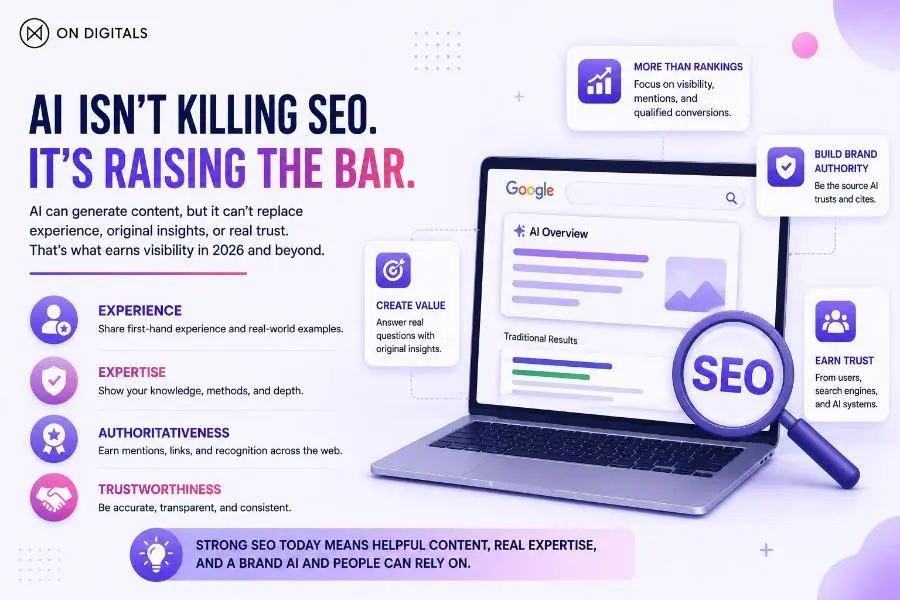
AI can generate content, but durable SEO visibility still depends on real experience, expert insight, credible authority, and trust that users and AI systems can verify.
AI means the death of SEO? Not so fast
SEO has changed many times before. Keyword stuffing, exact-match domains, mass link building, mobile-first indexing, featured snippets, Core Web Vitals, and helpful content systems each changed what worked.
AI is another major change, but it does not remove the need for businesses to be found.
Opace’s analysis of AI and the future of SEO makes a useful point: search may shift from lists of links toward AI-generated answers, but people still need trustworthy information, useful recommendations, products, services, and sources they can verify.
SEO is evolving from a narrow ranking exercise into a broader visibility discipline.
Your strategy should combine:
- Search intent research.
- Technical SEO.
- Helpful content.
- Digital PR and authority building.
- Brand marketing.
- User experience.
- Conversion optimisation.
- AI-aware content structuring.
A business that only optimises for search engines may lose touch with changing user behaviour. A business that only chases AI visibility may ignore the foundations that make AI visibility possible. The stronger approach is a hybrid strategy that supports both.
The rise of LLMs and ChatGPT as a potential rival to search
Large language models are becoming another discovery channel. Users can ask follow-up questions, request comparisons, build plans, summarise research, and receive tailored answers without opening several browser tabs.
This changes the questions marketers need to prepare for.
Traditional keyword research may focus on searches such as:
- SEO agency Vietnam.
- Best SEO tools.
- How to improve Google rankings.
AI prompts are often more detailed:
- Which SEO strategy should a startup use with a limited budget?
- What should I fix first if traffic falls after AI Overviews?
- Compare SEO agencies for a B2B company expanding into Southeast Asia.
- How can I make content more likely to appear in AI search results?
These prompts are longer, more contextual, and usually involve several decision factors.
Your content should therefore include:
- Clear definitions.
- Direct answers near the beginning of each section.
- Comparisons and trade-offs.
- Practical examples.
- Specific audience and use-case context.
- Recommendations with realistic conditions.
- Follow-up answers in FAQs.
This is where AEO, GEO, and AIO support traditional SEO.
Answer Engine Optimization (AEO) focuses on structuring content so it can provide a direct, useful answer to a question.
Generative Engine Optimization (GEO) focuses on making your brand and content easier to understand, trust, and reference in AI-generated responses.
AI Optimization (AIO) focuses on making content easier for AI systems to interpret, summarise, and use responsibly. It combines semantic clarity, logical structure, accurate entity information, technical accessibility, and sufficient context for a model to understand what a page is about.
In practice, AIO means defining important terms, using descriptive headings, maintaining clean site architecture, supporting claims with evidence, and giving users complete answers rather than vague statements.
None of these disciplines replaces SEO. They build on it.
What still works in AI and the future of SEO?
The fundamentals still work, but they must be executed with more care.
Build content around real questions and decisions
Create pages that solve a clear user problem. Start each important section with the answer, then provide supporting context, examples, limitations, and next steps.
Avoid writing pages that repeat a keyword in different forms. Instead, cover the questions users may ask before they compare, shortlist, enquire, or buy.
Make content easy to understand
AI systems and human readers both benefit from logical structure.
Use:
- Descriptive headings.
- Short paragraphs.
- Direct language.
- Lists where they improve clarity.
- Definitions before deeper explanations.
- Clear examples.
- Contextual internal links.
Avoid vague claims such as “AI will transform everything” unless you explain what changes, who is affected, and what they should do next.
Improve technical accessibility
Technical SEO remains essential. A useful article cannot perform well when search engines cannot crawl, render, understand, or index it properly.
Check:
- Crawlability and indexability.
- Internal linking.
- Canonical tags.
- Page speed and mobile usability.
- Clear HTML heading structure.
- Relevant schema markup.
- Image alt text.
- Duplicate or thin pages.
- Broken links and redirect chains.
AI visibility does not replace technical SEO. It gives businesses another reason to keep websites accessible, semantically clear, and easy to navigate.
Create content AI cannot easily commoditise
Generic AI content is easy to create and easy to replace. Your strongest content should include value that cannot be copied from ten similar pages.
Add:
- Original frameworks.
- First-party research.
- Expert commentary.
- Real screenshots or process examples.
- Industry-specific recommendations.
- Client stories where appropriate.
- Unique data or benchmarks.
- Honest limitations and trade-offs.
A page is more likely to support AI-driven discovery when it includes:
- A direct answer to the main question.
- Clear definitions for important concepts.
- Specific entities, products, services, locations, or industries.
- First-hand experience or expert commentary.
- Original examples, research, screenshots, or frameworks.
- Claims that are specific and verifiable.
- Relevant source links and contextual internal links.
- Clear information about who the advice applies to and when it may not apply.
Use AI to improve the SEO workflow, not replace expertise
AI can reduce time spent on repetitive SEO work. It can help with query clustering, content-gap reviews, SERP pattern summaries, draft briefs, internal-link suggestions, reporting notes, and early-stage content outlines.
Use AI to support:
- Keyword and topic clustering.
- Competitive content analysis.
- Content brief creation.
- FAQ and follow-up question research.
- Internal-link opportunity discovery.
- Metadata drafts.
- Reporting summaries.
- Content refresh prioritisation.
The risk begins when teams treat AI output as the final strategy.
AI can organise information quickly, but it cannot reliably judge commercial priorities, validate industry claims, understand customer objections, or replace first-hand expertise. Use AI for speed and structure. Use people for judgement, differentiation, accuracy, and business decisions.
A practical implementation framework for marketers and SEO teams
Step 1: Protect your SEO foundation
Audit technical health, indexation, site structure, core landing pages, internal links, mobile experience, and page speed.
Start with pages that already drive leads, revenue, or qualified organic traffic.
Step 2: Map high-value search journeys
Identify the questions customers ask before they buy, compare, shortlist, enquire, or renew.
Group them by:
- Awareness.
- Problem-solving.
- Research.
- Comparison.
- Purchase intent.
- Post-purchase support.
Step 3: Improve answer quality on priority pages
Rewrite weak sections with direct answers, clearer structure, expert context, and useful examples.
Add FAQs only when they answer genuine follow-up questions. Do not use FAQ sections only to repeat keywords.
Step 4: Build brand proof around your expertise
Strengthen author pages, company information, review profiles, digital PR, relevant partnerships, social content, and industry mentions.
Your brand should look credible even when a user encounters it outside your website.
Step 5: Optimize for AI discovery without chasing shortcuts
Use AEO, GEO, and AIO principles:
- Make key points easy to extract.
- Define important terms clearly.
- Keep claims specific and verifiable.
- Add context around entities, products, services, and industries.
- Use schema where relevant.
- Publish content worth citing.
Step 6: Measure visibility and business outcomes
Track rankings and traffic, but also monitor brand demand, referral traffic, lead quality, assisted conversions, and the pages that influence revenue.
Create a recurring review process for AI-driven discovery:
- Test important customer questions in Google AI experiences, ChatGPT, Gemini, Perplexity, and other relevant tools.
- Record whether your brand, pages, products, or competitors are mentioned.
- Track referral traffic from AI platforms where analytics data is available.
- Compare branded search growth with changes in organic visibility.
- Review whether high-value pages appear for comparison, recommendation, and decision-stage questions.
- Measure qualified leads and assisted conversions, not only top-of-funnel visits.
Common mistakes when adapting SEO for AI
Treating AI as a shortcut for unlimited content:
Publishing more pages is not the same as publishing more value. Generic AI content can weaken topical quality, create duplication, and make your brand less distinctive.
Abandoning traditional SEO:
AI search does not remove the need for keyword research, technical optimisation, internal links, backlinks, and user experience. These are still the infrastructure that supports visibility.
Chasing citations without building authority:
You cannot force an AI tool to cite your content. Focus on becoming a credible source through accurate, useful, original, and well-structured information.
Measuring only organic traffic:
Traffic matters, but it does not tell the full story. A page may influence branded search, conversions, sales conversations, or AI-driven discovery before a user clicks.
Over-automating content and decisions:
AI can speed up research and drafting. It should not publish unverified claims, make strategic decisions without context, or replace expert review.
Tools and metrics to review before publishing:
Use AI tools to support research and efficiency, not to replace quality control.
Useful tools may include:
- Google Search Console for query performance, indexing, and search visibility.
- Google Analytics 4 for engagement, conversions, and user journeys.
- Semrush or Ahrefs for keyword research, competitor analysis, backlinks, and content gaps.
- ChatGPT or Gemini for topic clustering, draft outlines, question analysis, and workflow support.
- Brand-monitoring tools for brand mentions, sentiment, and reputation signals.
- Screaming Frog or similar crawlers for technical audits.
Before publishing, check:
- Does the page answer the main question immediately?
- Is the advice accurate and current?
- Does it contain expert insight, original examples, or real proof?
- Are the headings clear enough for users and AI systems?
- Does it link to related pages naturally?
- Is the page technically accessible?
- Does the CTA match the reader’s stage of decision-making?
FAQ
Is AI killing SEO?
No. AI is changing how people search and how search engines present answers, but SEO remains essential for crawlability, rankings, content quality, authority, and business visibility.
Will AI Overviews reduce website traffic?
They can reduce clicks for some informational searches because users may receive answers directly in search. However, businesses can still earn visibility through citations, brand mentions, stronger rankings, and content that supports higher-intent decisions.
Should businesses optimize for ChatGPT instead of Google?
No. Businesses should strengthen traditional SEO while also making content useful for conversational AI search. A hybrid approach is more resilient than choosing one channel over another.
What is the difference between SEO, AEO, GEO, and AIO?
SEO improves visibility in search engines. AEO helps content provide direct answers. GEO helps brands become more understandable and reference-worthy in generative AI responses. AIO improves the clarity, context, structure, and technical accessibility that help AI systems interpret content.
Does AI-generated content rank in Google?
AI-generated content can rank when it is useful, accurate, original, and edited with real expertise. Low-value, repetitive, or manipulative content is unlikely to build durable visibility.
What should businesses measure in the future of SEO?
Track rankings, qualified organic traffic, branded search, leads, assisted conversions, customer enquiries, key-page engagement, brand mentions, and the quality of traffic from search and AI discovery channels.
Build an SEO strategy that works with AI, not against it
AI and the future of SEO are not about replacing search strategy. They are about raising the quality of it. Businesses that invest in technical health, useful content, expert proof, strong brands, and measurable customer outcomes will be better positioned across traditional search and AI-driven discovery.
The right strategy is not SEO versus AI. It is SEO strengthened by AEO, GEO, AIO, better content operations, and a brand that users and AI systems can trust.
Explore SEO Services or Search and AI Marketing to build a search strategy that protects your current visibility while preparing your brand for AI-driven discovery.

NEWEST POSTS
- Advertising Industry In Vietnam: The 2026 Trends, Channels and Market-Entry Strategy
- Best SEO Company in Vietnam: Latest Shortlist For Businesses
- How To Leverage Social Media For Customer Service Like A Pro?
- Social Media Post Tips – 8 Ways To Boost Engagement
- How To Use Social Media for Sales – In-depth Beginner Guide
Read more