
Linkedin Ads vs Google Ads: Which Channel Fits Your B2B Growth Strategy?
Vincent
06/03/2026
36
Linkedin Ads vs Google Ads isn’t simply a choice between a brand channel and a performance channel. Google Search can capture demand from people already looking for a solution. Linkedin can reach defined professional audiences before, between or alongside those searches. The right starting point depends on search demand, ICP clarity, deal value, and how well your business measures lead quality after the click.
B2B buyers rarely move from one ad to one sale. They may research a problem, compare providers, involve colleagues and return later when the timing is right. That makes channel selection more complex than comparing click costs or form submissions.
Linkedin Ads vs Google Ads
Google Search Ads are often the stronger first choice when buyers already use clear search terms to find your product or service. A company searching for “enterprise payroll software” or “ISO 27001 consultant” has already expressed a need. A relevant Search campaign can place the business in front of that demand during research.
Linkedin Ads are often more useful when a business needs to reach a defined B2B audience before people actively search. This can apply to a new category or an account-based strategy. A cybersecurity provider, for example, may need to reach IT leaders at selected company sizes before those teams start looking for a solution.
Neither channel wins in every situation. The better choice depends on what the buyer knows, who the buyer is and what needs to happen before a conversation becomes an opportunity.
| Start with Google Search Ads when… | Start with Linkedin Ads when… | Use both when… |
| Buyers already search for the category | Your ICP is highly specific | You need to generate and capture demand |
| Your offer has clear commercial keywords | The problem needs education | The sales cycle has several stages |
| You need lower-funnel enquiries soon | You need to reach roles or target accounts | Buyers research before they search |
| Search demand is proven | The category has little search vocabulary | Your CRM can track multi-touch journeys |
A business should not choose Google because “it converts faster” or Linkedin because “it creates better leads”. Both channels can create valuable outcomes when the offer, campaign and follow-up process match the audience.
What are you really comparing?
The phrase “Google Ads vs Linkedin Ads” can be misleading because Google Ads is a broad advertising platform. It includes keyword-led Search campaigns, but it can also run visual campaigns across other Google surfaces.
For most B2B channel decisions, the more useful comparison is Google Search Ads vs Linkedin Ads.
Google Search Ads are designed to match ads with what people are actively looking for. Someone enters a query because they need information or a solution. This makes Search valuable when the market already understands the problem and uses familiar language to describe it.
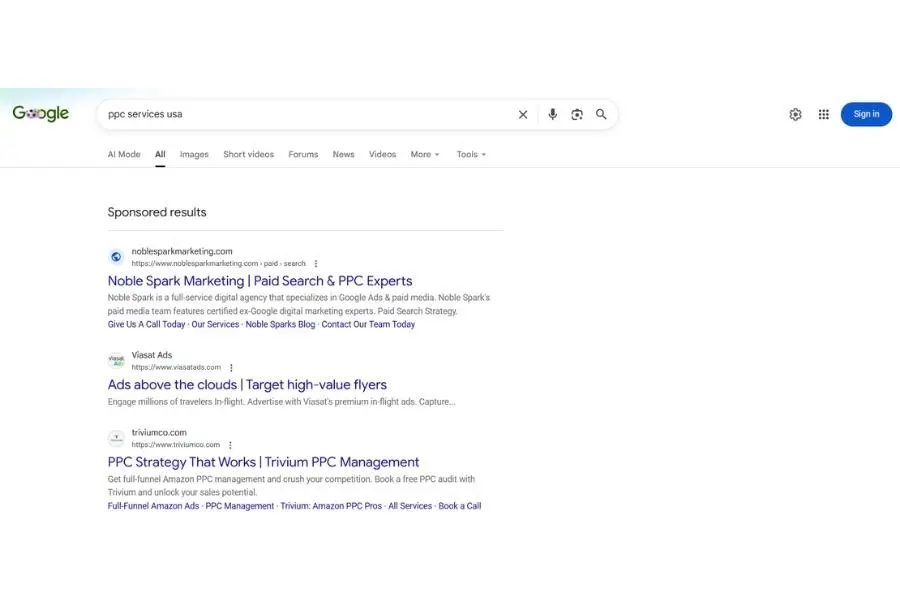
Google Search ads example
Google Ads can also support broader activity through video, display and Demand Gen campaigns. These formats may help with awareness or remarketing. However, they should not be treated as the same thing as keyword-led Search campaigns.
Linkedin Ads works differently. It lets businesses reach people according to professional context, such as job role, seniority, company type or industry. This makes it useful when the company knows which professionals it needs to influence but cannot rely on those people to search at that moment.
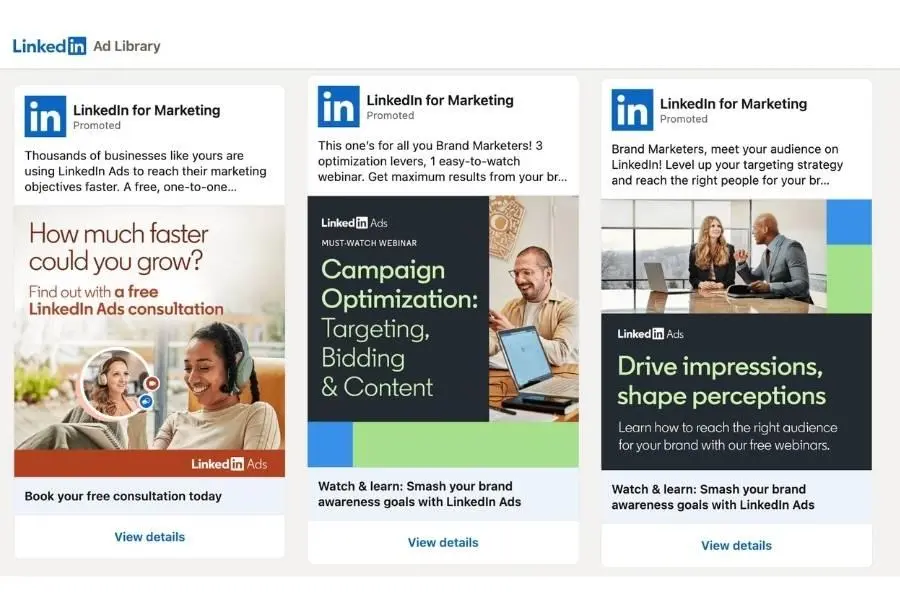
Linkedin ads example
The distinction matters because a B2B strategy can fail when the wrong campaign type is used for the job. A company may run Search Ads for a solution nobody knows to search for. Another may run Linkedin Ads to a broad audience even though strong high-intent search demand already exists.
Demand capture vs demand generation
The clearest way to compare the channels is to separate demand capture from demand generation.
Demand capture means the buyer already knows there is a problem and is looking for a solution. They may search for specific information. Google Search is often useful here because the search query reveals an immediate need.
Demand generation means the buyer may not yet know that a solution exists, or may not have language to search for it. The business needs to introduce a problem and explain a better approach. Linkedin can be useful because it allows the advertiser to place that message in front of a relevant professional audience.
A company selling an established CRM platform may find strong search demand for terms related to sales software and customer data. Search campaigns can capture people evaluating options.
A company introducing a new compliance technology may find that the target audience searches only for the symptoms of the problem, not for the newer category itself. Linkedin can help explain the risk and value before search demand develops.
Demand generation does not mean immediate revenue is impossible. Demand capture does not mean every lead is ready to buy. The difference is the starting point of the buyer conversation.
“What” targeting vs “who” targeting
Google Search and Linkedin use different core signals.
Google Search Ads focus on what someone is looking for. The advertiser selects relevant keywords, then builds ads and landing pages that match the likely intent behind those searches. The strongest signal is the buyer’s expressed need.
Linkedin Ads focuses on who the person is professionally. The advertiser can build an audience around professional characteristics, then show a message that is relevant to that group. The strongest signal is the buyer’s role, company context or account fit.
| Question | Google Search Ads | Linkedin Ads |
| Core targeting logic | What is the buyer searching for? | Who is the buyer professionally? |
| Strongest signal | Search query and intent | Role, company, industry or seniority |
| Best starting point | Existing demand | Defined ICP or account-based strategy |
| Common risk | Keywords attract research with weak commercial intent | Audience becomes too narrow or is not ready to act |
| Useful first-party layer | Customer Match and conversion data | Matched audiences and website engagement data |
Neither approach is complete on its own. A search query may show urgent intent but give little information about whether the buyer matches the ideal customer profile. While a Linkedin audience may match the ICP well but not have an immediate need.
That is why businesses should avoid over-targeting. A very narrow Linkedin audience can restrict delivery and limit learning. A broad keyword set can generate clicks from people who are not a fit. The goal is to create enough focus to protect quality while keeping enough scale to test properly.
When should a B2B business choose Google Ads, Linkedin Ads or both?
A business should start with the channel that addresses its largest current constraint.
If the company has strong search demand but does not appear for high-intent queries, Google Search is usually the first priority. This is common for established services, software categories and B2B solutions where buyers already know what to search for.
If the company sells a complex or newer offer, Linkedin may be more useful first. This is common when the buyer needs to understand the problem before they can evaluate a provider. It is also useful for account-based campaigns where the advertiser needs to reach particular companies and job functions.
| Business condition | Better first move | Why |
| Buyers know the category and search for it | Google Search Ads | Existing demand can be captured |
| The offer is new or poorly understood | Linkedin Ads | The audience needs education before search |
| The campaign targets named accounts or senior roles | Linkedin Ads | Professional targeting matters most |
| The business needs immediate consultation requests | Google Search Ads | High-intent queries may shorten the path to contact |
| Multiple stakeholders influence the sale | Both channels | Linkedin can build familiarity while Search captures later intent |
| Budget is only enough for one meaningful test | One channel | Splitting too early can create weak data on both |
The word “meaningful” matters. A test should run long enough to reveal whether the channel can reach the right people and create qualified conversations. Splitting a limited budget across too many campaigns often produces data that is too thin to guide a decision.
Lead Gen Forms vs landing pages: Which conversion path fits?
Channel choice is only part of the decision. The conversion path matters just as much.
Linkedin Lead Gen Forms can reduce friction because key professional information is often pre-filled from the person’s profile. This can suit offers that are easy to understand, such as webinar registrations, report downloads, event sign-ups or an initial consultation request.
A landing page may be better when the offer needs explanation. A complex B2B service may require proof, implementation details, pricing context or qualification questions before someone is ready to submit a form. The landing page also gives the business more room to explain the value proposition and track on-site behaviour.
Google Search Ads often direct people to landing pages because the user has already shown a specific need. The page should make the next action obvious. It should not force the visitor to search through several sections to understand what the business offers.
| Use a Lead Gen Form when… | Use a landing page when… |
| The offer is simple and clear | The offer needs detailed explanation |
| Reducing form friction is important | The buyer needs case studies or proof |
| The goal is a download, event or early-stage enquiry | The business needs qualification questions |
| Your team can route leads into the CRM quickly | You need to observe on-site engagement before conversion |
A minimum B2B workflow should identify the lead source, assign an owner, set a response expectation and record the next status. That may include lead, marketing-qualified lead, sales-qualified lead, opportunity and closed-won customer. The labels can vary, but the definition must be consistent across marketing and sales.
Which platform is more cost-effective?
Neither platform is automatically cheaper. The useful comparison is cost per qualified opportunity, not cost per click or cost per form submission.
Linkedin campaigns may produce higher media costs in some B2B markets because they reach a smaller professional audience. That can still be commercially sensible when deal values are high and the campaign reaches the right people.
Google Search may produce a lower cost per lead because buyers are already searching. That can still be inefficient when the keyword attracts students, job seekers, businesses outside the target market or people seeking free information.
A business should compare cost against the outcome that matters at each stage.
| Funnel stage | Useful metrics |
| Initial response | Reach, click-through rate and landing-page engagement |
| Lead capture | Cost per lead, form completion and contact rate |
| Qualification | MQL rate, SQL rate and meeting rate |
| Pipeline | Cost per opportunity and pipeline value |
| Revenue | Closed-won revenue, customer acquisition cost and payback period |
| Account-based activity | Engaged account rate and account progression |
CPC, CPL and conversion rate still matter. They help diagnose what is happening inside a campaign. They should not be the final budget decision.
A campaign can look efficient at the top of the funnel but perform badly once sales follows up. A campaign with a higher CPL can produce stronger pipeline when the leads come from the right companies, roles and buying stages.
How do Google Ads and Linkedin Ads work together in a B2B funnel?
The two channels can complement each other when each has a clear role.
Linkedin can introduce a message to the right professional audience. This may include a case study, industry point of view, or guide that helps buyers understand a problem. The aim is not always to ask for a demo immediately. It may be to create familiarity with the category and the business.
Google Search can capture people later when they look for a solution, compare providers or search for a more specific term. A person who first sees a Linkedin campaign may later search for the category, the company or a competitor. A Search campaign can help the business appear at that later stage.
Retargeting can support consideration when it is used carefully. Visitors who read a guide or watched a product video may need a more relevant next step, such as a comparison page, a case study or a consultation offer. The message should match what the person has already shown interest in.
A simple full-funnel model may look like this:
- Linkedin reaches a defined ICP with an educational or problem-led message.
- The buyer engages with a guide, event, video or landing page.
- The business uses helpful follow-up content to support evaluation.
- Google Search captures later high-intent queries.
- The CRM records which leads become qualified opportunities and customers.
This is not a rule that every B2B business must follow. Some companies can succeed with Search alone because demand is strong. Others need Linkedin because their market is not actively searching yet. The combined approach is most useful when the sales cycle involves research over time.
How should teams measure Linkedin and Google Ads performance?
Both channels should connect to one shared view of lead quality.
Platform reporting can show clicks, impressions, form fills and engagement. These figures are useful for optimisation. However, they do not show whether the campaign created a sales conversation, an opportunity or revenue.
The business should use consistent campaign naming, UTM parameters and CRM fields. The CRM should record where the lead came from, which campaign influenced it and how the lead progressed.
Google Ads can receive later-stage conversion information so campaigns are not judged only by online form completions. Linkedin lead data can also be routed into CRM or marketing automation tools for follow-up and reporting. This makes it possible to compare channels against the same definition of quality.
A reporting view should answer four questions:
- Which channel generated the lead?
- Did the sales team contact the lead?
- Did the lead become a qualified opportunity?
- Did the opportunity create revenue or meaningful pipeline?
This approach avoids a common problem. Marketing may report a low cost per lead, while sales reports that few of those leads are worth pursuing. Both teams can be correct if they are looking at different stages of the same journey.
Common mistakes when comparing Linkedin Ads and Google Ads
One mistake is treating all Google Ads activity as Search Ads. Search, Demand Gen, video and display campaigns have different purposes. The decision should be based on the campaign type, not only the platform name.
Another mistake is judging Linkedin by CPC alone. Professional targeting can cost more, but the real question is whether it reaches the right accounts and supports qualified pipeline.
Other common mistakes include:
- Assuming a professional audience is ready to buy
- Making Linkedin audiences so narrow that campaigns cannot learn
- Sending every visitor to a generic homepage
- Treating a form fill as a qualified lead
- Splitting a small budget across too many channel tests
- Running campaigns without sales follow-up rules
- Optimising only to last-click data in a long sales cycle
- Reusing the same message for every buyer stage
The strongest B2B campaigns create a clear connection between audience, offer, landing experience and sales follow-up.
Frequently asked questions (FAQs)
Is Linkedin Ads or Google Ads better for B2B lead generation?
Neither is universally better. Google Search is often stronger when buyers already search for the category or solution. Linkedin can be stronger when the business needs to reach specific professional audiences before they begin searching. The better channel is the one that can generate qualified opportunities at a sustainable cost.
Should a business start with Google Search or Linkedin Ads?
Start with Google Search when there is proven demand and clear commercial keywords. Start with Linkedin when the ICP is very specific, the category needs education or the company is targeting named accounts. Use both when the sales cycle requires awareness before high-intent search.
Why can Linkedin Ads cost more per click?
Linkedin campaigns can be more expensive because advertisers compete to reach professional audiences with specific job roles, industries and company profiles. Higher click cost is not necessarily a problem for a high-value B2B offer. The key question is whether those clicks lead to qualified opportunities and revenue.
Can a small B2B company use Linkedin Ads?
Yes, but the company should have a clear ICP, a focused offer and a realistic test plan. A small business may struggle if it targets too broadly or tries to reach every job title at once. Start with one audience hypothesis and one useful conversion offer.
Should Linkedin campaigns use Lead Gen Forms or a landing page?
Lead Gen Forms can work well for simple offers that benefit from less friction, such as webinars or downloadable guides. A landing page can be better for complex offers that need proof, qualification or detailed explanation. The choice should depend on the buyer’s readiness and the sales process.
Can Google Ads and Linkedin Ads work together?
Yes. Linkedin can build awareness and reach the right professional audience. Google Search can capture later intent when those buyers begin researching solutions. The two channels work best when campaign data and lead outcomes are connected in the same CRM process.
How do I measure which platform creates a better pipeline?
Track each lead from source through qualification, opportunity and revenue. Platform metrics such as clicks and CPL are useful, but they should be reviewed alongside CRM data. Compare cost per qualified opportunity, pipeline value and closed-won revenue before shifting budget.
Choose the channel that matches buyer behaviour
Google Search Ads can be valuable when buyers already know what to search for. Linkedin Ads can be valuable when the business needs to reach a defined professional audience before a search happens.
The best choice is not about which platform has the lowest CPC or the most features. It is about which channel supports the next useful action in the buyer journey.
Start with the business constraint. Capture existing demand when it is available. Create awareness when the market needs education. Connect every campaign to a lead process that sales can manage. Then judge performance through qualified pipeline and revenue, not only through form volume.
Explore PPC Management Services from On Digitals to build a paid-media strategy that connects demand generation, demand capture and measurable B2B pipeline.

NEWEST POSTS
- Advertising Industry In Vietnam: The 2026 Trends, Channels and Market-Entry Strategy
- Best SEO Company in Vietnam: Latest Shortlist For Businesses
- How To Leverage Social Media For Customer Service Like A Pro?
- Social Media Post Tips – 8 Ways To Boost Engagement
- How To Use Social Media for Sales – In-depth Beginner Guide
Read more