
SEO Myths In The AI Search Era: Is SEO Worth The Investment?
Vincent
24/07/2025
19
Current SEO myths are not just outdated tips. They affect many aspect in your online visibility, and also long-term growth. If you need the broader foundation first, start with what is SEO. Many SEO mistakes begin when businesses misread SEO updates, AI search, overvalue shortcuts like llms.txt or schema, or underestimate how long-term SEO investment should be measured.
The biggest SEO myth is that SEO has been replaced
Search engine optimization has not been replaced by AI search. SEO best strategies remain relevant for AI Overviews and AI Mode because these features rely on Google’s core Search ranking and quality systems.
What changed is the definition of visibility: brands now need ranking, citation, and useful content that deserves to be reused by both people and AI systems.
Google still held about 90.02% global search engine market share in April 2026, so ignoring Google Search would be commercially risky. At the same time, HubSpot reports that over 92% of marketers plan to use or already use SEO for traditional and AI-powered search engines, while nearly 30% report decreased search traffic as users turn to AI tools.
The answer is not that SEO is dead, but is that weak SEO is easier to expose.
Which SEO myths are false, partly true, or real changes?
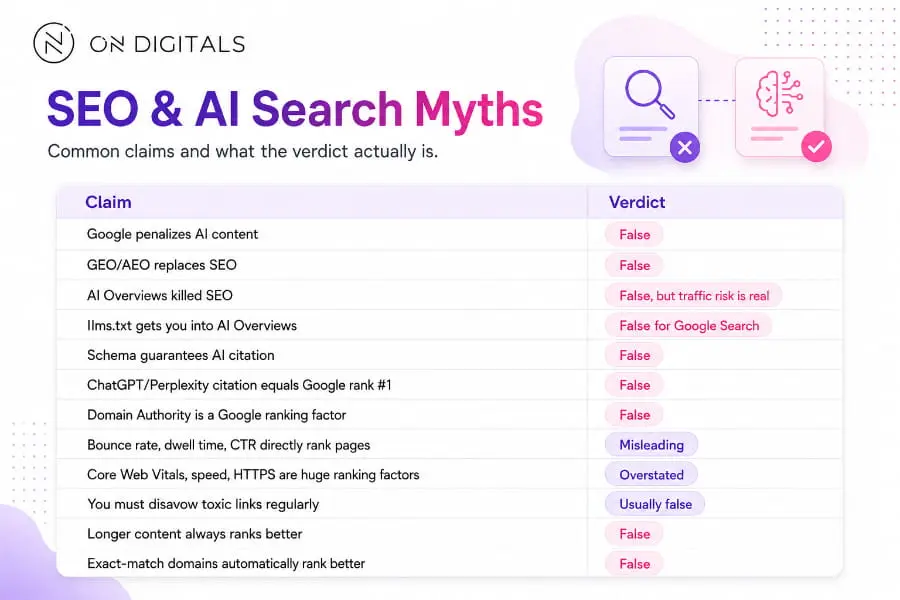
Myth 1: Google penalizes content written with AI
Google does not penalize content just because AI helped create it. What matters is content usefulness, originality, and accuracy. The risky behavior is scaled, low-value content production, not responsible AI assistance.
Why do people believe this myth?
Many websites lost traffic after core updates and spam updates, then blamed AI content as the single cause.
Low-value content often has several problems at once: copied structure, weak originality, thin expertise, no first-hand proof, poor topical fit, and no clear reason to trust the author.
Google’s spam policy specifically targets scaled content abuse: many pages produced mainly to manipulate rankings, especially when they provide little or no value. Google names generative AI as one possible method, but the policy applies no matter how it’s created.
What to do instead?
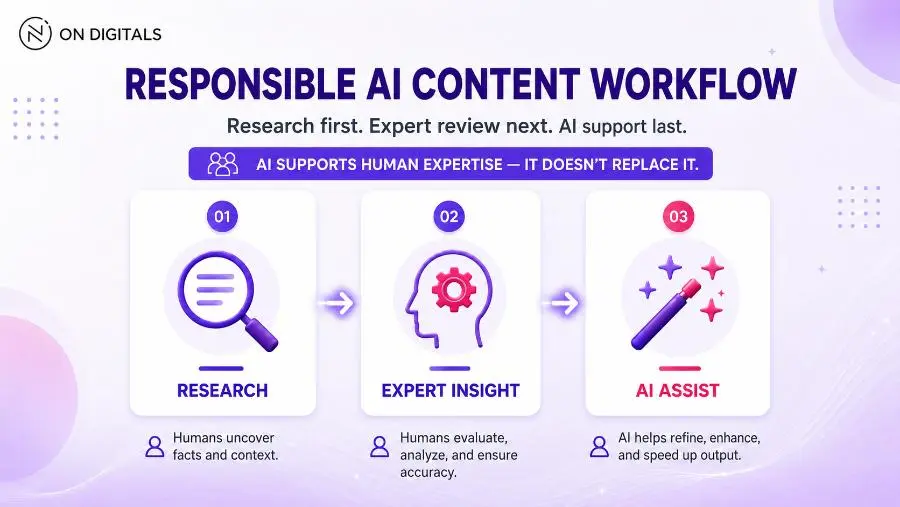
Use AI for research support, do not use AI as a substitute for expert judgment, first-party data, examples, screenshots, client-side implementation lessons, or source verification.
For an On Digitals article, the safe workflow is:
- Start with search intent and business pain points.
- Pull official sources and SERP evidence.
- Add agency experience: audits, GSC screenshots, GA4 patterns, CRM lead quality insights.
- Use AI to organize, not invent.
- Review every claim before publishing.
Myth 2: GEO and AEO are completely different from SEO
GEO and AEO are not separate replacements for SEO. AEO and GEO are terms used for visibility in AI search experiences, but from Google Search’s perspective, optimizing for generative AI search is still optimizing for the search experience.
What is shared between SEO, AEO, and GEO?
Technically, the foundation for AI search visibility is identical to traditional SEO. A page must be discoverable and well-structured to be cited by an AI engine.
If you are unsure of the basics, refer to our guide on what is SEO to see how the system supports AI citations.
What is different in AI search?
AI search raises the bar for passage-level usefulness. A page can rank and still be ignored by AI systems if it lacks concise, standalone answers.
This is why On Digitals content should use direct H2 openings, factual density, entity clarity, FAQ answers, and sourceable details.
The internal writing standard explicitly treats GEO paragraphs, H2 direct answers, FAQ, and standalone passages as important for AIO/AEO/GEO readiness.
What to do instead?
Do not build a separate GEO strategy that ignores your SEO foundation. Build a search and AI visibility strategy with three layers:
- Technical access: crawlability, indexability, structured content, clean architecture.
- Content value: original insight, examples, data, first-hand experience.
- Answer readiness: direct answers, FAQ, definitions, comparison tables, source citations.
Myth 3: AI Overviews and ChatGPT killed SEO, so SEO is no longer worth the investment
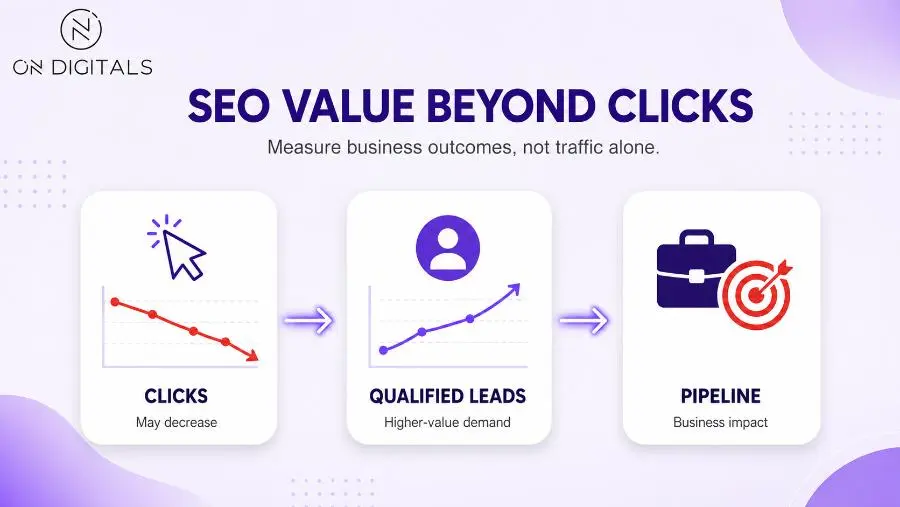
AI Overviews may reduce clicks in certain search results, but SEO remains valuable. The key change is how success is measured, with greater emphasis on visibility, brand presence, conversions, and overall business impact rather than rankings alone.
What does the data say?
Pew Research Center found that users who encountered a Google AI summary clicked traditional search results in 8% of visits, compared with 15% when no AI summary appeared. Pew also found that users clicked links inside the AI summary in only 1% of visits with such a summary.
Ahrefs re-ran a study using December 2025 data and found that the presence of an AI Overview correlated with a 58% lower average clickthrough rate for the top-ranking page. This is not a universal rule for every query, but it confirms that AI Overviews can materially reduce clicks for affected SERPs.
Why SEO is still worth investing in?
SEO is still worth investing in when the strategy targets business outcomes. For B2B and high-consideration services, useful organic content can support trust, and conversion paths that paid media alone cannot sustain.
The investment case changes:
| Old SEO investment logic | SEO investment logic |
| Rank higher to get more traffic | Build visibility across search and AI surfaces |
| Publish more articles | Publish stronger, more original assets |
| Measure keyword positions only | Measure rankings, citations, leads, and pipeline |
| Optimize for clicks | Optimize for trust, recall, and qualified demand |
| Treat SEO as a channel | Treat SEO as search infrastructure |
What to do instead?
Do not stop SEO because AI Overviews reduce some clicks. Reallocate SEO investment toward:
- High-intent service pages
- Bottom-funnel comparison content
- First-party research
- Original case studies
- Technical SEO and indexation
- A content strategy for B2B growth with entity-rich content clusters
- Conversion-focused landing pages
- Content refreshes based on GSC and CRM data
Myth 4: llms.txt will get your website into AI answers
For Google Search, llms.txt is not a shortcut into AI Overviews or AI Mode. Google’s 2026 generative AI Search guide says websites do not need special machine-readable files, AI text files, markup, or Markdown to appear in generative AI search.
Why did this myth spread?
llms.txt became popular because it sounds like robots.txt for AI. The idea is appealing: create a clean text file, tell LLMs what to read, and improve AI visibility. The problem is that Google’s official guidance does not support this as a requirement or ranking lever for Google’s AI search features.
Search Engine Land also reported in July 2025 that Google’s Gary Illyes said Google would not crawl and use llms.txt for AI Overviews, and that normal SEO remains the path for AI Overview visibility.
What to do instead?
A website can experiment with llms.txt as a low-risk documentation asset, but it should not be treated as a primary SEO or AI search lever. Priority should go to:
- Crawlable HTML pages
- Clear internal linking
- Updated XML sitemaps
- Descriptive headings
- Strong canonical strategy
- Helpful, original content
- Source citations
- Clean page templates
Myth 5: Schema markup guarantees AI Overview inclusion
Schema markup does not guarantee AI Overview inclusion. Google says structured data is not required for generative AI search and that there is no special schema.org markup needed for AI Overviews or AI Mode. Structured data can still support normal SEO by helping pages become eligible for rich results.
Why do people believe this myth?
Schema feels technical and controllable. That makes it attractive. Many teams want a checklist item that says: add FAQ schema, get AI citation. But Google’s structured data guidelines make clear that valid structured data does not guarantee search appearance, even for traditional rich results.
What schema is still useful for?
Schema still matters when it accurately represents visible page content. It can help Google understand entities, page type, breadcrumbs, authorship, FAQs, articles, products, local business details, and other structured elements.
Schema should be used for:
- Article
- BreadcrumbList
- FAQPage
- Organization
- Person or Organization author markup
What to do instead?
Use schema as a clarity layer, not a promise. The content must still answer real questions, show expertise, cite official sources, and provide original value.
Myth 6: Being cited by ChatGPT or Perplexity is the same as ranking #1 on Google
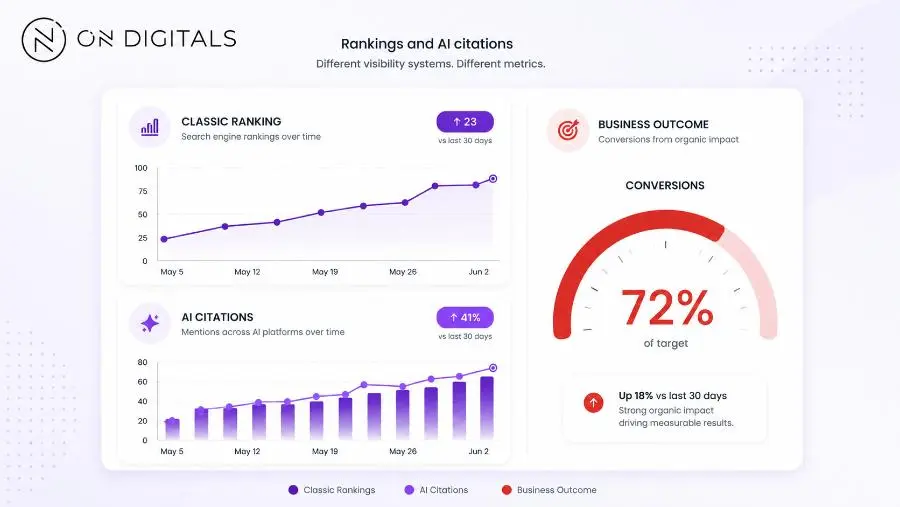
AI citation and Google ranking are different visibility systems. A page can rank well on Google and not be cited by an LLM. A brand can be mentioned in an AI answer without owning the top Google result. Treat AI citation as a separate metric, not a replacement for ranking.
Why this matter?
Traditional SEO is URL-based and query-based. AI citation can be entity-based, passage-based, source-based, and context-dependent. AI systems may synthesize information from several pages, mention a brand without linking, or cite a source that is not the highest-ranking classic result.
Google’s AI Search guidance describes techniques like retrieval-augmented generation and query fan-out. This means AI features can retrieve and combine information through related queries, not only through the exact keyword a user typed.
What to measure instead?
A modern search dashboard should separate:
- Classic Google rankings
- Organic clicks
- AI Overview presence
- AI Overview citations
- ChatGPT/Perplexity/Gemini mentions
- Branded search growth
- Assisted conversions
- Lead quality from organic pages
- Sales-qualified lead movement
What to do instead?
Create content that can perform at both page level and passage level. Each key section should answer one clear question, mention the entity clearly, include facts, and cite credible sources. This is also aligned with On Digitals’ standard that each H2 should work as a standalone answer for readers and AI systems.
Myth 7: Domain Authority is a Google ranking factor
Domain Authority is not a Google ranking factor. It is a third-party metric from Moz that estimates ranking strength. It can be useful for competitive benchmarking, but Google does not use Moz DA as a direct ranking signal.
Why do people believe this myth?
The confusion is understandable. Websites with high DA often rank well because they tend to have strong backlink profiles, brand recognition, topical coverage, and historical trust. But correlation does not mean Google is using the Moz DA score.
Search Engine Journal summarizes Moz’s own position: Domain Authority is not a Google ranking factor and has no effect on SERPs.
What to do instead?
Use DA, DR, Authority Score, and similar metrics as proxy indicators. Do not make them the goal. Better SEO goals include:
- Earning relevant referring domains
- Building topical authority
- Improving internal links
- Publishing original insights
- Strengthening author and organization signals
- Improving conversion paths from organic pages
Myth 8: Bounce rate, dwell time, and CTR are direct Google ranking factors
Bounce rate, dwell time, and CTR are useful diagnostic metrics, but treating them as simple direct ranking factors is misleading. A high bounce rate may indicate poor content fit, but it can also mean the user got the answer quickly. Optimize for satisfaction and conversion, not metric superstition.
Why does this myth persist?
SEO teams can see CTR, engagement, and bounce rate in tools. Visible metrics feel actionable. But visible does not mean direct. The safer interpretation is that poor engagement can reveal a content or UX problem, while good engagement can support business outcomes.
For On Digitals, the practical question is not “Will lowering bounce rate improve ranking tomorrow?” It is “Does this page answer the right intent, attract the right visitor, and move the user toward a useful next step?”
What to do instead?
Use engagement metrics as a diagnostic layer:
| Metric | What it may indicate | Better action |
| Low CTR | Weak title/meta or wrong intent | Rewrite title, meta, SERP angle |
| High bounce rate | Intent mismatch or quick answer | Check scroll depth, CTA, query intent |
| Low engagement time | Thin content or poor UX | Improve structure, examples, and readability |
| No conversions | Weak offer or CTA mismatch | Adjust CTA, form, trust signals, page flow |
Myth 9: Core Web Vitals, page speed, and HTTPS are massive ranking factors
Core Web Vitals, page speed, HTTPS, and mobile usability matter, but they are often exaggerated as ranking levers. Google says Core Web Vitals are used by ranking systems, but good scores do not guarantee top rankings. Relevance and helpful content still matter more for many queries.
What Google actually says?
Google’s page experience documentation says there is no single page experience signal. It also says Core Web Vitals are used by ranking systems, while good Core Web Vitals scores do not guarantee top rankings.
HTTPS is also a ranking signal, but Google described it as a very lightweight signal when it introduced the signal in 2014. It remains important for user trust and security, but it should not be sold as a magic ranking fix.
What to do instead?
Fix page experience issues when they block users, crawling, conversion, or trust. Prioritize:
- Slow templates that affect many URLs
- Mobile layout problems
- Intrusive pop-ups
- Poor readability
- Broken forms
- Unclear CTAs
- Heavy scripts on lead-generation pages
- Security and HTTPS issues
Myth 10: You should disavow toxic backlinks regularly
Most websites do not need routine disavow work. Google’s own disavow documentation says the tool is advanced, should be used with caution, and most sites will not need it because Google can assess which links to trust without additional guidance.
When disavow may be necessary?
Google says disavow should be considered when there are many spammy, artificial, or low-quality links and those links have caused, or are likely to cause, a manual action. The first step should be attempting to remove the links from the other site.
What to do instead?
Do not disavow links just because a third-party tool labels them “toxic.” First, check:
- Google Search Console manual actions
- History of paid links or link schemes
- Sudden unnatural link spikes
- Exact-match anchors at scale
- Links created by previous SEO vendors
- Rankings and traffic trend context
Disavow should be a remediation tool, not a monthly SEO hygiene ritual.
Other classic SEO myths that still waste budget
Some SEO myths are smaller, but they still lead teams toward the wrong work. The common pattern is the same: turning one minor signal, proxy metric, or outdated tactic into a strategy.
Exact-match domains automatically rank better
Google says words in domain names can be one of many relevance factors, but its exact match domain system works to avoid giving too much credit to domains created mainly to match queries.
A domain like “best-seo-agency-vietnam-example.com” is not a substitute for authority, service clarity, technical quality, and useful content.
Longer content always ranks better
There is no ideal word count. A 900-word page can outperform a 4,000-word article if it answers the query better. Google’s AI Search guidance also says there is no requirement to break content into tiny chunks or follow a specific page length for AI understanding.
Content should be as long as needed to satisfy the intent and as short as possible to stay useful.
Submitting or pinging Google guarantees faster indexing
Submitting a URL can help Google discover a page, but discovery does not guarantee indexing or ranking. Google’s 2026 AI Search guidance states that meeting requirements does not guarantee crawling, indexing, or serving.
For important pages, improve internal links, sitemap quality, canonical clarity, content uniqueness, and crawl paths.
What is not a myth?
The biggest mistake is dismissing every new search challenge as just another SEO myth. AI search has created real changes. The winners will be teams that separate false shortcuts from real shifts.
Real change 1: Informational clicks are harder to win
AI Overviews and zero-click results can reduce traffic for simple informational queries. This makes traffic forecasting less predictable and makes business-level measurement more important. Pew and Ahrefs both show meaningful click pressure when AI summaries appear.
Real change 2: Brand/entity clarity matters more
AI systems need to understand who you are, what you do, where you operate, what services you provide, and why your content is trustworthy. This makes consistent entity language important across service pages, blog posts, author bios, case studies, schema, and third-party mentions.
Real change 3: Commodity content is weaker
Google’s 2026 AI Search guide recommends creating valuable, non-commodity content and says unique, compelling, useful content may influence generative AI search presence more than many other tactics.
This is where first-party data, screenshots, benchmarks, client-side implementation lessons, and expert commentary matter.
Real change 4: SEO reporting must connect to business outcomes
Rankings and traffic are still useful. They are not enough. For B2B and high-consideration services, reporting should connect organic visibility to:
- Qualified leads
- CRM status
- Sales-qualified opportunities
- Assisted conversions
- Branded search
- Retargeting audience quality
- Service-page conversion rates
- Content-assisted sales conversations
Is SEO worth the investment?
SEO is worth the investment when it is treated as a long-term search visibility and demand-generation system. It is not worth it when the plan is only to publish generic articles, chase third-party metrics, or copy competitor headings without adding expertise.
SEO is worth investing in when:
- Your buyers search before they contact vendors.
- Your category needs trust and education.
- Paid media costs are rising.
- Sales cycles are long.
- Your website has weak service pages.
- Your brand is not being cited in AI answers.
- Your content lacks proof, examples, and original insight.
- Your technical SEO blocks important pages from being discovered.
SEO is not the right priority when:
- Your website cannot convert traffic yet.
- There is no clear offer or positioning.
- Tracking is broken.
- Leadership expects guaranteed rankings.
- The only plan is AI-generated content volume.
- There is no budget for expertise, editing, design, or implementation.
The practical answer is not invest or do not invest. WWhat you should bear in mind is to invest in the parts of SEO that reduce business risk: technical clarity, high-intent pages, expert content, brand authority, conversion paths, and measurement.
A better SEO investment framework
A good SEO strategy should not start with “How many blog posts per month?” It should start with where search can support revenue, trust, and qualified demand.
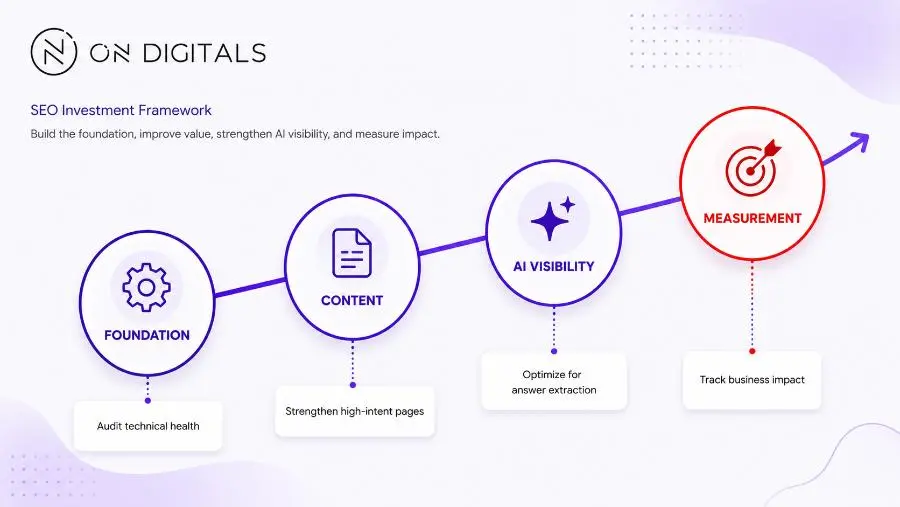
1. Protect the foundation
Conduct a technical SEO audit to check crawlability, indexation, canonical tags, redirects, sitemap quality, internal links, Core Web Vitals, mobile UX, schema, and tracking. Technical SEO does not create demand by itself, but it protects every SEO investment after it.
2. Strengthen high-intent pages
Service pages, comparison pages, industry pages, case studies, and pricing or consultation pages often matter more than top-funnel blogs. These pages should explain the problem, service scope, process, proof, FAQs, and next step clearly.
3. Build non-commodity content
Create assets competitors cannot easily copy:
- First-party GSC trend analysis
- AI Overview visibility tests
- SEO myth verification tables
- Vietnam market examples
- CRM lead-quality learnings
- Before-after content refresh screenshots
- Case studies with approved metrics
- Expert commentary from the SEO team
4. Optimize for answer extraction
Each key page should include direct answers, definitions, comparison tables, FAQs, and source-backed explanations. This supports featured snippets, AI Overviews, ChatGPT-style summaries, Perplexity citations, and human scanning.
5. Measure business impact
Track keyword visibility, organic clicks, AI citations, conversion rate, lead quality, assisted conversions, and CRM progression. SEO should be judged by contribution to growth, not only by traffic.
Frequently Asked Questions (FAQs)
Is SEO dead in 2026?
SEO is not dead in 2026. It has changed because AI Overviews, AI Mode, ChatGPT, Perplexity, and zero-click results affect how users find answers. Google still says SEO best practices remain relevant for generative AI Search, so the stronger approach is to optimize for search visibility, AI citation, and conversion together.
Does Google penalize AI-generated content?
Google does not penalize content only because it was created with AI. Google’s guidance focuses on quality, originality, accuracy, relevance, and people-first usefulness. However, using AI to generate many low-value pages for ranking manipulation can violate Google’s scaled content abuse policy.
Is GEO better than SEO?
GEO is not better than SEO because it is not a separate replacement. GEO focuses on visibility in generative AI answers, while SEO provides the technical, content, authority, and relevance foundation that AI search systems still rely on. For Google Search, GEO should be treated as an extension of SEO.
Do AI Overviews reduce SEO traffic?
AI Overviews can reduce clicks for affected queries. Pew found lower traditional-result clicks when AI summaries appeared, and Ahrefs found a 58% lower average CTR for the top-ranking page when AI Overviews were present. The impact depends on query type, industry, brand strength, and whether the page is cited.
Should businesses still invest in SEO?
Businesses should invest in SEO when search influences buyer research, trust, comparison, and lead generation. The investment should focus on technical foundations, high-intent pages, non-commodity content, AI search readiness, and conversion measurement. SEO is weaker when treated as generic blog production or a guaranteed ranking service.
Final takeaway
The most dangerous SEO myths are not the old ones about word count or Domain Authority. The dangerous myths are the AI-era claims that push teams into extremes: stop investing in SEO, build a separate GEO silo, publish AI content at scale, or rely on llms.txt and schema as shortcuts.
SEO is still worth the investment when it helps your business become easier to find, easier to trust, and easier to choose. The work is more strategic now: build technical clarity, publish original expertise, answer real questions, earn citations, and connect organic visibility to qualified demand through our SEO Services.

NEWEST POSTS
- Advertising Industry In Vietnam: The 2026 Trends, Channels and Market-Entry Strategy
- Best SEO Company in Vietnam: Latest Shortlist For Businesses
- How To Leverage Social Media For Customer Service Like A Pro?
- Social Media Post Tips – 8 Ways To Boost Engagement
- How To Use Social Media for Sales – In-depth Beginner Guide
Read more