
Shopify SEO Guide For Optimizing Product, Technical, And AI Search Visibility
Vincent
26/02/2026
14
Shopify SEO is the process of improving a Shopify store so search engines and AI answer engines can understand and rank its core page types. It’s a part of SEO strategy for e-commerce sites. For ecommerce teams, the work starts with technical setup and page intent. From there, it expands into structured data, measurement, Shopify Markets, and AI Search readiness.
What should Shopify stores prioritize first?
Before adding a single piece of new content to Shopify, make sure the store’s SEO fundamentals are fully optimized. Start with the elements that decide whether Google can access, understand, and measure the right pages.
Focus first on:
- Crawlability and index control
- Product and collection page intent
- Page speed and Core Web Vitals
- Structured data
- Google Search Console and GA4 measurement
These foundations help Google understand which URLs deserve visibility. They also reduce duplicate-page risk and make SEO results easier to measure.
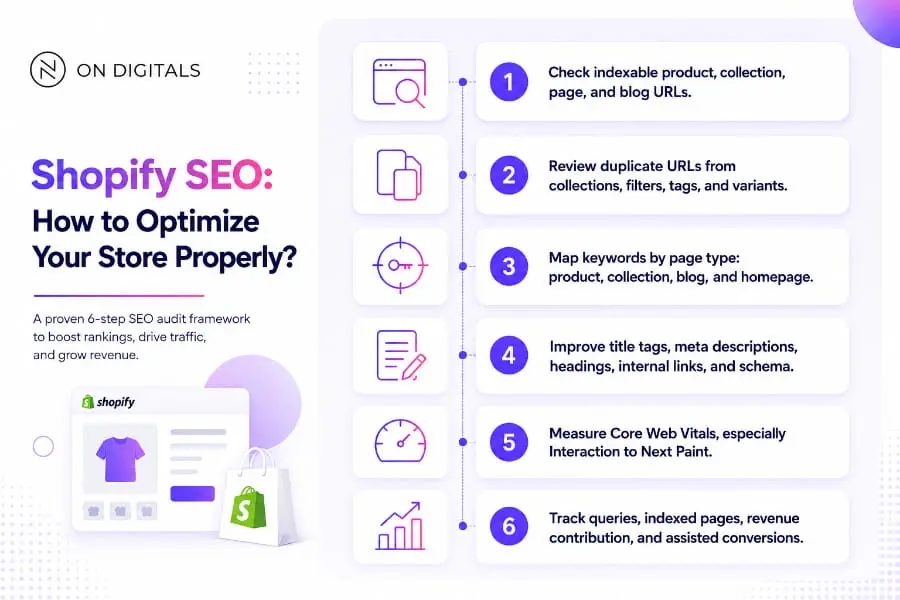
Shopify SEO audit workflow
This article focuses on stores already using Shopify. If the business is still choosing an ecommerce platform, compare Shopify with other platforms in a separate platform-selection guide instead of using this page for that decision.
What is Shopify SEO? How Shopify works for search?
Shopify SEO means preparing a store for organic search. That includes technical setup, content, templates, internal links, structured data, and performance.
Shopify has several SEO-friendly features built in. It creates sitemap.xml, supports editable metadata, uses canonical tags, and allows robots.txt.liquid customization. Its ecommerce templates also give stores a clean base. Those features are useful starting points, but they do not replace SEO planning.
The main limitation is control.
Shopify uses fixed URL folders such as /products/, /collections/, /pages/, and /blogs/. Since a store cannot fully remove those folders, the SEO strategy should work with Shopify’s structure instead of forcing a custom one.
Is Shopify good for SEO?
Shopify is generally good for SEO when the store has a clear structure and optimized templates.
Useful collection content, fast theme performance, and clean indexation also matter. Ranking becomes harder when the store creates duplicate URLs, publishes thin product pages, relies on too many apps, or leaves filters unmanaged.
Shopify is often strong for teams that need:
- Fast ecommerce setup without custom backend development
- Editable metadata for products, collections, pages, and blogs
- Built-in sitemap and canonical support
- App ecosystem for redirects, schema, image compression, and audits
- Shopify Markets for multi-region selling
The common SEO problems usually come from implementation. For example, a store may install apps that inject heavy JavaScript. It may also duplicate product URLs through collections, publish thin category pages, or leave discontinued products without a redirect plan.
Takeaway: Shopify can support organic growth, but it needs a store-specific SEO process. The platform gives the base. The SEO team still has to manage search intent, crawl efficiency, content quality, and performance.
Technical SEO on Shopify: What to check first?
Technical SEO on Shopify should start with three questions.
- Can Google find the right URLs?
- Can it avoid low-value duplicates?
- Can it evaluate the pages that matter for revenue?
To answer those questions, start with indexation and crawl paths. Then review canonical tags, sitemap coverage, robots.txt.liquid, and page performance.
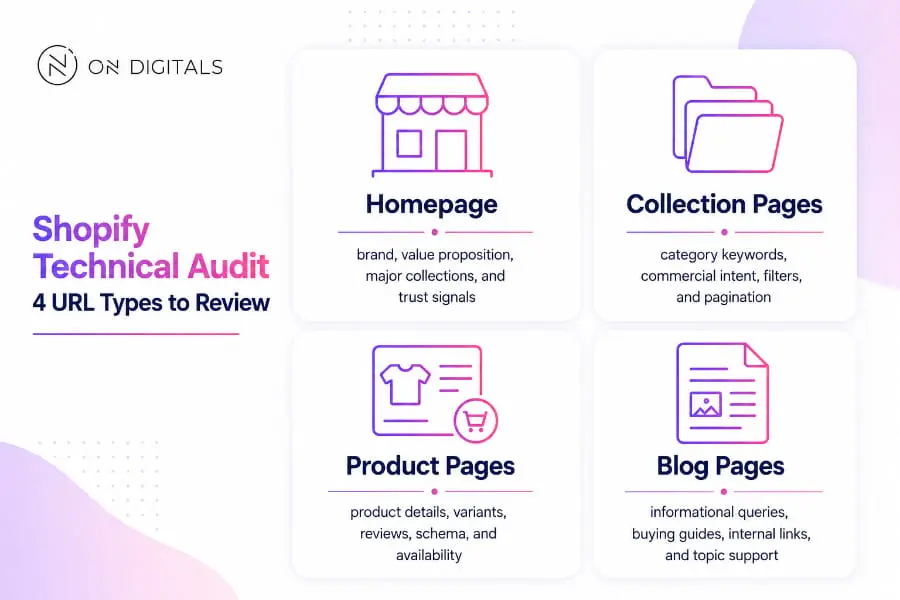
4 URL types to review in Shopify technical audit
The most important early check is Google Search Console coverage. Look first for repeated patterns such as “Crawled – currently not indexed” and “Discovered – currently not indexed”. Then review duplicate canonical warnings, excluded filter URLs, and low-performing collections.
Shopify sitemap and robots.txt.liquid
Shopify automatically generates sitemap.xml for products, collections, pages, and blogs. This helps discovery, but it does not decide which pages deserve ranking. Large stores still need internal links and unique page content around the sitemap. They also need index control.
Shopify also allows robots.txt.liquid customization. This can help block low-value crawl paths, but it should be used carefully. Blocking the wrong folder may prevent Google from accessing important product or collection pages.
Recommended checks:
- Open /sitemap.xml and confirm key product and collection URLs appear.
- Review robots.txt.liquid rules before blocking filters, search pages, or app URLs.
- Compare sitemap URLs with indexed URLs in Google Search Console.
- Check whether important collections receive internal links from navigation, homepage blocks, and related product sections.
Canonical tags and duplicate product URLs
Shopify stores often create product URLs inside collection paths, such as /collections/collection-name/products/product-name. The canonical tag usually points back to the main /products/product-name URL, but this does not always solve every duplication issue.
Canonical tags are hints, not commands. If the site keeps promoting collection-based product URLs, Google may still crawl many duplicates. This can happen through internal links, breadcrumbs, apps, or templates. On larger stores, it can waste crawl budget and make reporting harder.
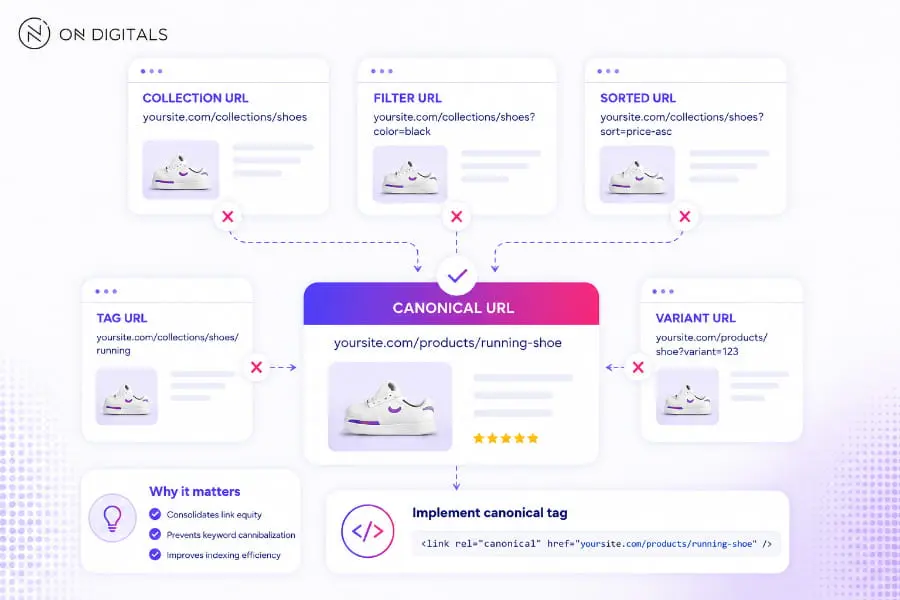
Canonical tag and duplicated product URLs
A practical fix is to make the main product URL the preferred internal link target where possible. Breadcrumbs can still show collection context. Product cards, related products, and navigation should avoid creating extra duplicate crawl paths.
Core Web Vitals and INP for Shopify stores
Core Web Vitals matter for Shopify because ecommerce pages often carry more than the theme itself. Reviews, chat widgets, recommendation tools, tracking tags, and app-injected JavaScript can all affect performance.
Since March 2024, Interaction to Next Paint has replaced First Input Delay as a Core Web Vital. Stores should measure real interaction delay, not only loading speed.
For Shopify, page speed problems usually come from a few repeat sources:
- Heavy themes with unused JavaScript or large layout sections
- Apps that inject scripts into product and collection templates
- Unoptimized media, especially oversized hero images and product photos
Use Lighthouse and PageSpeed Insights for quick diagnostics. Then check Chrome DevTools and Search Console’s Core Web Vitals report to connect lab findings with real user data.
A useful Shopify performance workflow:
- Test homepage, top collection, top product, and blog template separately.
- Compare before-and-after scores when removing or disabling apps.
- Review third-party JavaScript by domain in Chrome DevTools.
- Compress and resize images before upload where possible.
- Avoid adding multiple apps for functions that the theme can already handle.
Takeaway: Do not treat speed as a one-time theme choice. Whenever the store adds a sales, review, personalization, or tracking tool, the SEO team should check how that app affects performance.
Keyword research for Shopify SEO
Shopify keyword research should map search intent to the right page type. Product keywords usually belong on product pages. Category demand should lead to collection pages.
Comparison and education queries fit better in blogs, while brand or value-proposition keywords often belong near the homepage.
A store that targets every keyword with product pages will miss broader category demand. A store that targets commercial queries with only blogs may attract readers who do not convert. The page type has to match the user’s buying stage.
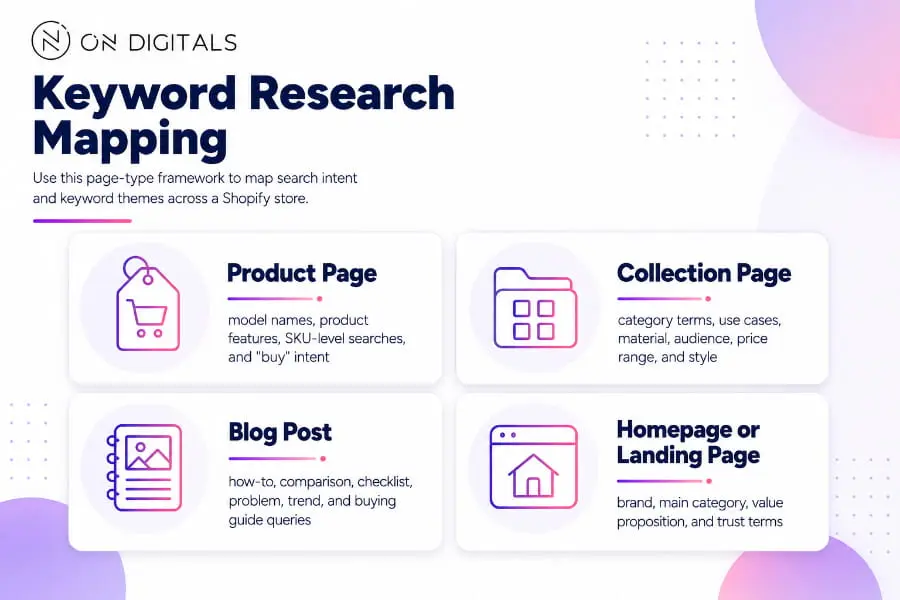
Keyword research mapping
For example, “organic cotton baby clothes” may fit a collection page. “How to wash organic cotton baby clothes” fits a blog post. “Organic cotton baby romper size 6M” fits a product page.
The keyword list from this brief should be distributed by intent, not repeated across every section. “Shopify SEO” is the main topic. “Is Shopify good for SEO” and “is Shopify bad for SEO” work better as FAQ or decision-support queries.
More specific terms should support dedicated optimization sections.
Shopify product page SEO
Shopify product page SEO should help shoppers and search engines answer four questions: what the product is, who it is for, why it is different, and whether it is available.
A strong page supports those answers through clear product information. Use the title, description, structured data, images, reviews, delivery details, and internal links to make the value easy to understand.
A strong product page usually needs:
- A product title with the main product entity and one useful modifier
- A short, benefit-led description above the fold
- Details such as specifications, material, size, compatibility, or ingredients
- Unique images with descriptive alt text
- Genuine review and rating data, where available
- Related products and collection links
- Clear availability, shipping, return, and warranty information
Shopify product title SEO should balance search clarity and conversion. Do not stuff every modifier into the title. Start with the main product entity, then add one useful attribute.
Depending on the product, that attribute may be size, material, model, audience, or use case.
A weak title: “Premium Product New Arrival Best Quality”
A stronger title: “Organic Cotton Baby Romper – 6M, Long Sleeve”
For product descriptions, avoid copying manufacturer text across many SKUs. Duplicate descriptions make it harder for Google to identify unique value, especially when multiple stores sell the same product.
Shopify collection SEO
Shopify collections SEO is often more important than product SEO for non-brand organic traffic. Collection pages can target category-level queries that individual products cannot.
A good collection page explains the category, shows relevant products, handles filters carefully, and links to useful subcategories or guides.
Collection pages should not be empty grids. Add helpful copy that explains how shoppers should choose. This may cover selection criteria, product differences or other buying considerations.
The copy should help users decide, not just only repeat keywords.
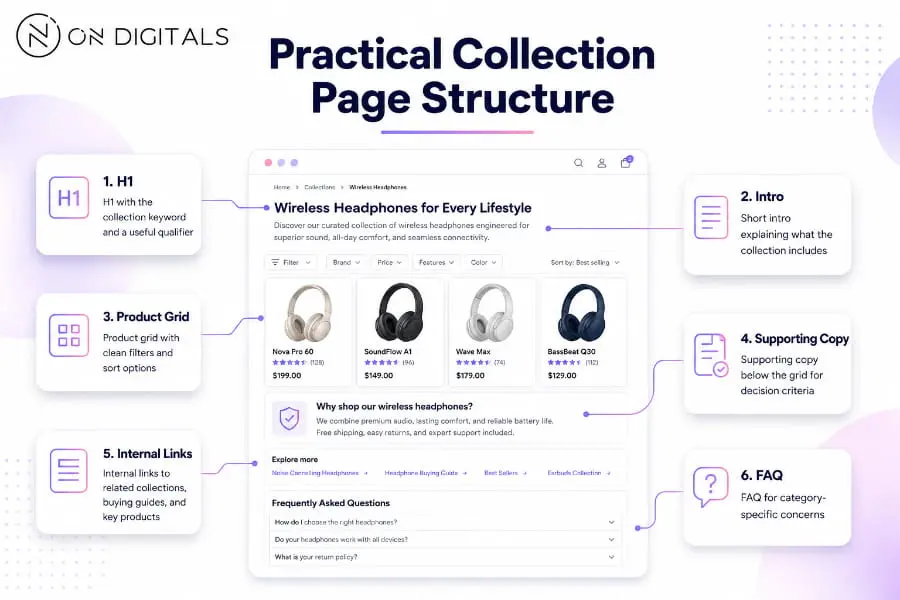
Shopify practical collection page structure
Filters need special care. Options such as color, size, price, tag, vendor, and availability can create many near-duplicate URLs. If those pages are crawlable and indexable without unique demand, they may dilute crawl budget and create index bloat.
For large stores, decide which filter combinations deserve indexation. For example, “black running shoes for women” may deserve a landing page if search demand exists. A random size-price-sort URL usually does not.
Shopify custom meta tags best practices for SEO
Shopify custom meta tags should be written for each important template, especially products, collections, blogs, and key pages. The title tag should clarify the topic. The meta description should explain why the page is worth clicking, whether that value comes from the product range, the offer, or the decision benefit.
For product pages, include the product name and the key attribute where relevant. Collection metadata should make the category and selection benefit clear. Blog metadata should show the question, process, or outcome the article answers.
Good meta practices:
- Keep title tags clear and specific, usually under 60 characters where possible.
- Keep meta descriptions around 145-155 characters where possible.
- Avoid duplicating the same title pattern across many pages.
- Include commercial context without overclaiming.
- Update metadata when products, collections, or search intent change.
Shopify homepage SEO should not try to rank for every product category. Its role is to support the brand and main value proposition, then guide users toward primary collections, trust signals, and other high-value pages.
Schema markup benefits for Shopify SEO and structured data
Schema markup helps search engines understand the store’s products and supporting information. For Shopify SEO, the highest-value area is usually Product structured data. Offers, availability, reviews, breadcrumbs, organization details, and article content can support it.
Product data and Merchant listing eligibility are usually more relevant than outdated FAQ schema tactics.
Shopify themes and apps may generate structured data automatically, but automatic does not always mean correct. Product schema should match the visible page content. Check fields such as name, image, description, SKU, brand, offers, price, currency, availability, and aggregateRating when genuine review data exists.
Important schema checks:
- Product schema for product pages
- BreadcrumbList schema for navigation context
- Organization schema for brand identity
- Article schema for blog posts
- FAQPage schema only when the page has visible FAQ content and the implementation still fits Google’s current rich result policy
Google reduced FAQ rich results for most sites in 2023, so FAQ schema should not be treated as the main ecommerce SEO opportunity. For Shopify stores, accurate product and merchant information usually matters more, especially offer data, reviews, price, and availability.
Use Google’s Rich Results Test and Search Console enhancement reports to confirm whether structured data is valid. If an app adds duplicate schema blocks, clean them up before publishing more pages.
AEO and GEO for Shopify: Optimizing for AI Search
AEO and GEO for Shopify mean structuring store content so AI answer engines can understand the business.
AI and answer engines need clear signals about entities, products, categories, etc. To provide those signals, use direct answers, structured data, crawlable content, and page sections that stand alone.
AI systems need extractable information that explains what the store sells and who each product suits. They also need clear category differences, policy details, and reasons to trust the recommendation.
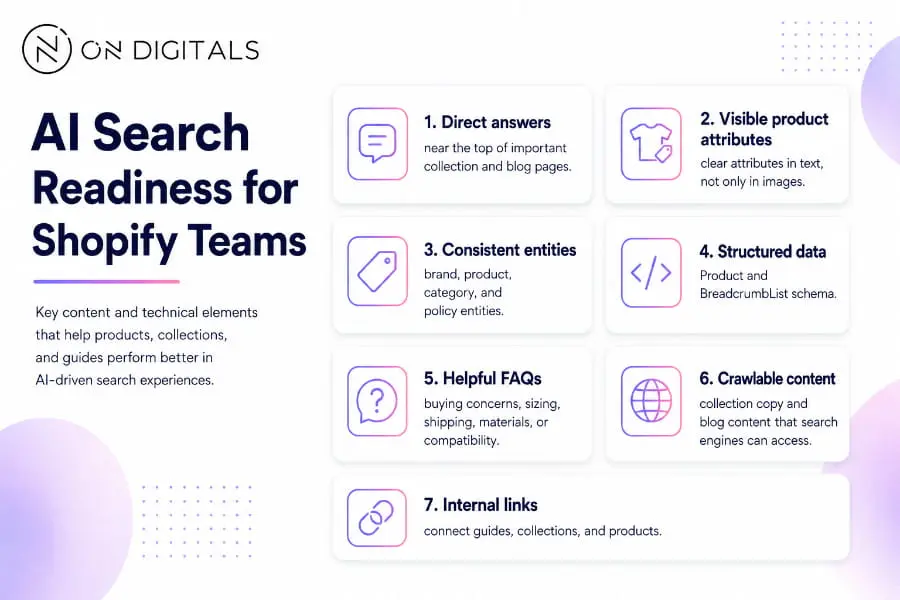
Shopify teams can improve AI Search readiness by adding these elements
llms.txt may help communicate important AI-crawl paths if the business decides to maintain it, but it should not replace basic SEO. Search engines and AI systems still need crawlable HTML. They also need structured data, useful headings, and reliable page content.
For Shopify, Liquid server-side rendering is generally easier for crawlers than content that appears only after client-side JavaScript from apps. If critical product details load through third-party scripts, test them carefully.
Reviews, buying information, and other conversion content should be visible in rendered HTML and Google’s URL Inspection tool.
Off-page SEO and content for Shopify
Off-page SEO on Shopify should support product discovery, brand trust, and category authority. Backlinks are useful, but ecommerce stores often get better long-term value from assets people can actually reference.
Examples include buying guides, partnerships, PR, digital assets, and content that earns citations naturally.
For Shopify stores, content should support the commercial funnel:
- Buying guides for category-level consideration
- Comparison articles for product or use-case decisions
- Care guides that reduce post-purchase uncertainty
- Industry trend content for brand awareness
- Case studies or customer stories when approved
- FAQ pages for policy, shipping, sizing, and compatibility concerns
Avoid publishing generic blog posts that do not link to collections or products. A blog article should help users move from a problem or question to a relevant product category, guide, or next step.
For On Digitals, this is where our SEO services connect with content planning. Our SEO team should not only consider what keywords can we rank for, but also what page helps the customer decide, and how will we measure business value?
Shopify Markets, hreflang, and international SEO
Shopify Markets helps stores sell across countries. International SEO still needs more than the feature setup. Review hreflang, localized content, currency accuracy, and region-specific search intent instead of relying on machine translation alone.
International Shopify SEO should check:
- Domain or subfolder structure for each market
- Hreflang implementation across language and region versions
- Currency, shipping, tax, and availability accuracy
- Localized collection and product copy
- Search demand differences by country
- Duplicate content risk across English variants
If a store uses translated content, review the important commercial pages manually. Loose translation can create trust issues in product claims, material terms, return policies, and measurement units.
Shopify SEO apps: How to choose without slowing the store?
Shopify SEO apps can help with technical and on-page issues. The risk is app bloat. Every additional app can add scripts, requests, or theme changes that affect Core Web Vitals and maintenance.
Choose apps based on the problem they solve, not because an app store category recommends them. Before installing, check whether the theme or Shopify admin already supports the function.
App selection guide:
- Schema apps: useful when theme schema is missing, duplicated, or incomplete. Test output with Rich Results Test.
- Redirect and broken-link apps: useful for stores with discontinued products, migrations, or frequent URL changes. Review redirect chains regularly.
- Image optimization apps: useful for large catalogs, but confirm image quality and lazy-loading behavior after compression.
- SEO audit apps: useful for bulk checks, but do not treat automated scores as strategy. They often miss search intent and cannibalization.
- Review or UGC apps: useful for trust, but test JavaScript impact and schema accuracy.
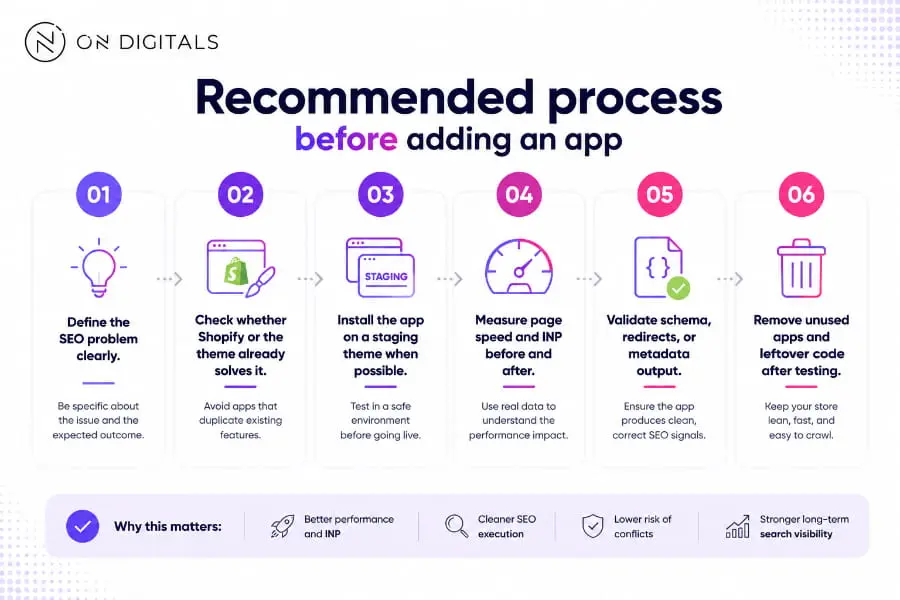
Process before adding an app on Shopify
When should a Shopify store hire an SEO agency?
A Shopify store should consider hiring an SEO agency when the site has large catalogs or indexation issues. Support also becomes useful when slow templates, international markets, weak category visibility, or unclear measurement start limiting growth. Agency support is strongest when technical SEO, content, analytics, and ecommerce strategy need to work together.
Hiring external support can make sense when:
- The store has hundreds or thousands of SKUs.
- Product and collection pages compete with each other.
- Google Search Console shows many excluded or duplicate URLs.
- Organic traffic grows but revenue contribution remains unclear.
- Apps, theme changes, or tracking updates affect performance.
- The business is expanding through Shopify Markets.
A good Shopify SEO partner should explain trade-offs, not only promise rankings. For example, an agency may recommend keeping some low-demand product pages indexable for long-tail queries, while consolidating thin collection pages that do not have unique intent.
How to measure Shopify SEO with Google Search Console and GA4?
Shopify SEO should be measured with Google Search Console, Google Analytics 4, Shopify Analytics, and ecommerce conversion data. Ranking improvements matter, but the stronger business view connects visibility to outcomes.
Track these reports regularly:
- Search Console Performance by query, page, country, and device
- Search Console Indexing for excluded, duplicate, and not-indexed URLs
- Core Web Vitals for product, collection, and blog templates
- GA4 organic landing pages and ecommerce events
- Shopify Analytics sales, conversion rate, and product performance
- CRM or order quality data where available
For large stores, segment reporting by template. Product pages, collection pages, and blogs behave differently. Blogs may support assisted discovery. Collection pages should usually carry stronger commercial value.
A practical monthly SEO report should answer:
- Which pages gained or lost impressions and clicks?
- Which collections drive non-brand discovery?
- Which product pages have indexation or duplicate issues?
- Which queries show buying intent but low CTR?
- Which pages need new internal links or updated metadata?
- Which SEO traffic contributes to purchases, leads, or assisted revenue?
Common Shopify SEO problems and how to fix them?
The most common Shopify SEO problems include duplicate URLs, thin collection pages, weak product descriptions, app bloat, and filter indexation, etc.
Most of these issues do not require a full rebuild. They need a structured audit and a clear fix order.
Duplicate product URLs through collections
Prefer canonical product URLs in internal links and monitor duplicate canonical warnings.
Thin collection pages
Add useful category copy, buying criteria, internal links, and FAQ where relevant.
Product tags creating low-value pages
Review tag URL crawlability and avoid indexing pages without unique search demand.
Apps slowing templates
Measure before and after installation, remove unused apps, and check JavaScript impact.
Outdated structured data
Validate Product, Offer, BreadcrumbList, and Organization schema with official testing tools.
“Crawled – currently not indexed” for many URLs
Check content uniqueness, internal links, canonical signals, and whether the page deserves indexation.
Blog content not supporting revenue
Link educational articles to relevant collections, product groups, service pages, or buying guides.
Frequently Asked Questions (FAQs)
Is Shopify good for SEO?
Shopify can be good for SEO when the store has clean architecture and optimized product or collection pages. Valid structured data, fast templates, and a clear content strategy strengthen that base. SEO problems usually come from duplicate URLs, weak category copy, unmanaged apps, filter pages, and poor measurement rather than Shopify itself.
Is Shopify bad for SEO?
Shopify is not inherently bad for SEO, but it has limits that teams need to manage. Fixed URL folders can restrict structure. Duplicate collection product URLs, app bloat, and filter-page duplication can also create SEO issues. These risks are manageable with technical audits, internal-link control, schema validation, and performance monitoring.
How should I optimize Shopify product titles for SEO?
Shopify product titles should include the core product entity and one or two useful attributes. Depending on the product, that may mean size, material, model, audience, or use case. Avoid stuffing every keyword into the title. Use the description, specifications, schema, and collection links to support additional details.
How important are Shopify collections for SEO?
Shopify collections are highly important because they often target category-level commercial queries. A strong collection page can rank for searches that are broader than a single product. Instead of relying only on product grids, add helpful intro copy, relevant filters, internal links, FAQ, and unique category guidance.
What schema matters most for Shopify SEO?
Product schema is usually the most useful starting point. Offer data, BreadcrumbList, Organization details, and Article schema for blogs can support it. FAQ schema can still be used when the page has visible FAQ content, but ecommerce teams should not rely on FAQ rich results as the main SEO opportunity.
Do Shopify SEO apps help rankings?
Shopify SEO apps can help with schema, redirects, metadata, broken links, and image optimization. They do not replace strategy. Apps can also slow a store if they add unnecessary scripts, so install them only for a specific problem and test performance before and after.
How can Shopify stores prepare for AI Search?
Shopify stores can prepare for AI Search by writing direct answers and making product attributes crawlable. Structured data, stronger collection content, useful FAQs, and links between guides and relevant products also help. AI systems need clear entities, visible text, and trustworthy page structure to understand ecommerce content.
Conclusion
Shopify SEO works best when ecommerce teams treat the platform as a system, not just a website builder. Organic visibility is shaped by product pages and collections, but also by technical settings, structured data, and analytics.
The strongest Shopify SEO strategy combines ecommerce fundamentals with newer search behavior. Manage duplicate URLs and collection content first. Then validate product schema, measure INP, prepare key pages for AI Search, and connect SEO work to revenue and customer quality.
If your Shopify store needs a clearer search growth plan, On Digitals can review the technical setup first. Thus, the team can assess deeper before recommending the next optimization priorities.

NEWEST POSTS
- Advertising Industry In Vietnam: The 2026 Trends, Channels and Market-Entry Strategy
- Best SEO Company in Vietnam: Latest Shortlist For Businesses
- How To Leverage Social Media For Customer Service Like A Pro?
- Social Media Post Tips – 8 Ways To Boost Engagement
- How To Use Social Media for Sales – In-depth Beginner Guide
Read more