
What is topical authority and how do you build it for SEO?
Vincent
04/12/2025
24
Topical authority is the level of trust and expertise a website builds for a topic cluster. In SEO, it grows when a site covers a topic deeply, connects related pages clearly, earns relevant trust signals, and keeps information useful for both search engines and real readers.
The idea behind topical authority in SEO is that search engines don’t only look at one page in isolation. They also look at how well your website covers a subject and whether users can find complete answers across your content.
What is topical authority?
Topical authority means your website is seen as a reliable source for a specific topic. It is not about publishing random articles or repeating the same keyword many times. It is about building a clear body of content that answers many related questions around one subject.
For example, a website that wants to build authority around “content marketing” should not stop at one general guide. It may also need pages about content strategy, content pillars, blog planning, website content, content audits, content briefs, distribution, measurement, and content refreshes.
Each page answers one specific need. Together, they show that the website understands the topic from many angles.
A simple way to understand it:
- A single article can answer one question.
- A topic cluster can answer a group of related questions.
- A website with strong topical authority becomes a trusted source for that subject.
For SEO, this helps search engines connect your pages to a wider topic. For users, it creates a better experience because they can move from a basic explanation to deeper resources without leaving your website.
Topical authority vs domain authority
Topical authority and domain authority are related, but they are not the same. Domain authority is a general idea of how strong a website is overall, often influenced by backlinks and domain-level trust. Topical authority focuses on how strong a website is within one subject area.
|
Criteria |
Topical authority |
Domain authority |
|
Main focus |
Expertise in one topic or niche |
Overall site strength |
|
Built by |
Content depth, topic coverage, internal links, expert input |
Backlinks, domain history, site-wide trust |
|
SEO value |
Helps pages rank across related topic queries |
Helps the site compete more broadly |
|
Example |
A small SEO blog ranking well for technical SEO topics |
A large publisher ranking across many unrelated topics |
|
Common risk |
Covering the topic too narrowly or too thinly |
Having authority but weak relevance for a specific query |
A large website may have strong domain authority, but that does not always mean it has the best answer for every topic. A smaller website can sometimes compete well if it covers a niche more clearly, more deeply, and more usefully.
For example, a focused B2B marketing website may have better topical authority for “SEO content strategy” than a general business magazine that only publishes one surface-level article on the topic.
This is why topical authority is important for growing websites. You may not be able to compete with the biggest domains on every keyword, but you can become highly relevant within a focused topic area.
Why topical authority matters in SEO
Topical authority matters because modern SEO depends on meaning and trust. Search engines need to understand not only what one page says, but also whether the whole website has enough useful content around the subject.
When your site has strong topical authority, several things can improve.
Your pages can rank for more related queries
A strong topic cluster gives search engines more context, so one page may start ranking for long-tail keywords, question-based searches, and related terms that were not the only focus keyword.
Users can move through your content more naturally
Someone may start with a basic question like “what is topical authority” and then click to articles about content pillars, keyword research, or internal linking. This helps users learn more and helps your website keep them engaged.
Topical authority can support better internal linking
When your website has many useful pages around the same subject, you can link them together in a way that feels natural. This helps both readers and search engines understand which pages matter most.
Support AI search visibility
AI Overviews, answer engines, and large language model tools often look for clear, structured, and trustworthy information. A website with strong coverage, useful definitions, examples, and expert context is easier for these systems to understand.
For businesses investing in SEO, topical authority also makes content more efficient. Instead of publishing isolated posts, every new page can support a larger cluster. This is how a strong SEO content can turn individual articles into a connected growth asset.
How topical authority works
Topical authority works through a combination of content coverage, relevance, internal links, trust signals, and freshness. No single factor creates authority on its own. Search engines look at the wider pattern of your website.
Here are the main signals that support topical authority.
|
Signal |
What it tells search engines |
What to improve |
|
Topic coverage |
Your site covers the subject from multiple angles |
Build missing cluster pages |
|
Search intent match |
Each page answers a clear user need |
Align each page with one main intent |
|
Semantic relevance |
Your content includes related concepts and entities |
Use examples, subtopics, and clear definitions |
|
Internal links |
Your related pages are connected logically |
Link pillar and cluster pages together |
|
Expert input |
Your content reflects real experience or knowledge |
Add examples, author context, and practical insight |
|
Freshness |
Your content stays accurate over time |
Update old pages regularly |
|
Relevant backlinks |
Other sites trust your content in the same niche |
Earn links from related sources |
A website does not build topical authority by publishing many short articles around similar keywords. That can create thin content or keyword cannibalization. The goal is to cover the topic in a structured way.
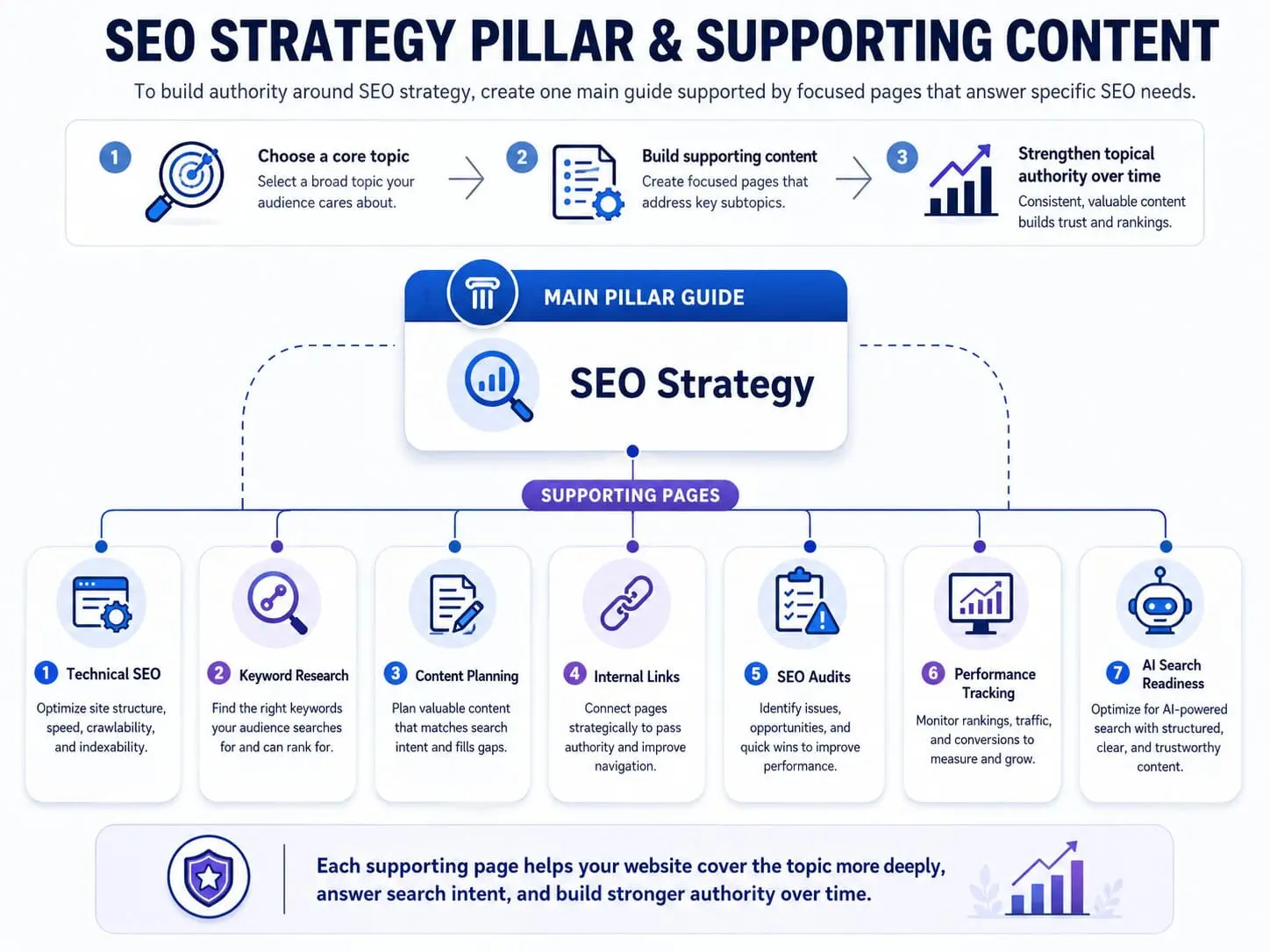
The pages should not compete with each other. Each one should answer a different question and link to related resources where useful.
Signs your website has topical authority
You may not see a single official score that says “your topical authority is strong.” Instead, you can look for patterns across rankings, traffic, engagement, and search visibility.
Your website may be building topical authority if:
- Several pages rank within the same topic cluster.
- Your site gains impressions for many related long-tail queries.
- Users move from one related page to another.
- Your pillar pages and cluster pages support each other.
- Relevant websites link to your topic resources.
- Your content appears in AI answers, featured snippets, or answer-style results.
- Your brand becomes associated with a specific subject.
For example, a digital agency may notice that its pages about content pillars, SEO content planning, website content, content audits, and internal linking all start gaining impressions. That is a stronger sign than one blog post ranking alone.
Another sign is that your website starts ranking for queries you did not directly target. This can happen when search engines understand your content well enough to connect it to related questions.
However, topical authority also needs quality. If users click your pages but leave quickly because the content is thin, unclear, or repetitive, the cluster may not perform well over time.
How to build topical authority
To build topical authority, you need more than a list of keywords. You need a topic system. That system should include clear topic groups, useful content, internal links, expert insight, and regular updates.
1. Choose topic groups that match your business
Start with topics that are close to your business, audience, and expertise. A good topic group should be broad enough to support several pages but focused enough to stay relevant.
For example, “marketing” is too broad for most companies. “SEO strategy for B2B websites” is more focused. It can support subtopics such as keyword research, technical SEO, content planning, service pages, lead generation, and reporting.
Before choosing a topic group, ask:
- Does our audience care about this topic?
- Does it connect to our products or services?
- Can we create at least five to ten useful supporting pages?
- Do we have real experience or insight to add?
- Can this topic support traffic, trust, leads, or conversion?
A topic that has search demand but no business relevance may bring traffic without value. A topic that is too sales-focused may not answer what people are searching for. The strongest topics usually sit between audience needs and business goals.
2. Research keywords, questions, and entities
Keyword research is still important, but topical authority needs more than one primary keyword. You should understand the full set of questions, subtopics, and related concepts around your main subject.
Start with a seed keyword such as “topical authority.” Then look for related searches like “what is topical authority,” “topical authority in SEO,” “how to build topical authority,” “topical authority tool,” and “topical authority vs domain authority.”
Also look at People Also Ask questions, competitor headings, customer questions, sales team notes, and AI search prompts. These sources show what users actually want to understand.
Entities are important too. For topical authority, related entities may include topic clusters, pillar pages, internal links, E-E-A-T, semantic SEO, backlinks, Google Search Console, GA4, and content audits.
When your content uses the right related concepts naturally, it becomes easier for search engines and readers to understand the topic.
3. Build a topic cluster map
A topic cluster map shows how your main topic and supporting pages connect. This helps you avoid random publishing and duplicate content.
Here is a simple example for a digital agency:
|
Pillar topic |
Cluster pages |
Purpose |
|
SEO strategy |
Keyword research, technical SEO, content audit, internal linking, AI search |
Build search visibility |
|
Content marketing |
Content pillars, content calendar, SEO briefs, website content |
Build demand and trust |
|
Paid media |
Google Ads, Meta Ads, LinkedIn Ads, landing pages, tracking |
Drive qualified leads |
|
Website growth |
UX, CRO, website content, technical performance |
Improve conversion |
|
Analytics |
GA4, GTM, UTM, CRM reporting |
Measure performance |
The pillar page gives a broad overview. Cluster pages go deeper into specific questions. Together, they create a clearer structure for users and search engines.
If your website already has content, you may not need to start from zero. Some old articles can become cluster pages. Some broad pages can be refreshed into pillar pages. Some overlapping pages may need to be merged.
For brands building a wider content system, content pillars can help organize themes before turning them into SEO clusters.
4. Create pillar and cluster pages
A pillar page is the main hub for a broad topic. It should explain the topic clearly, cover important subtopics, and link to deeper pages.
A cluster page focuses on one narrower search intent. For example, if the pillar is “SEO strategy,” cluster pages may cover “technical SEO audit,” “content refresh,” “internal linking,” and “long-tail keyword research.”
Each page should have one clear job. Avoid creating several pages that answer the same query in slightly different wording. This can confuse search engines and split ranking signals.
Also avoid creating thin cluster pages. If a subtopic is too small to support a useful page, include it inside a larger guide instead. The goal is not to publish more pages. The goal is to publish the right pages.
5. Strengthen internal links
Internal links help turn separate pages into a connected topic cluster. Without internal links, your content may exist on the same website but still feel disconnected.
A strong internal linking structure usually includes:
- Pillar pages linking to relevant cluster pages.
- Cluster pages linking back to the main pillar.
- Related cluster pages linking to each other where useful.
- Descriptive anchor text that explains the destination page.
- No important pages left orphaned.
Anchor text matters because it gives context. Instead of writing “read more,” use a clearer phrase such as “technical SEO audit checklist”.
Internal links should help the reader. If the link feels forced, it probably does not belong there.
6. Add expert insight and information gain
Topical authority is not only about covering many subtopics. Your content also needs to add value that users cannot get from every other article on the same subject.
This is where expert insight and information gain matter.
Information gain means your content adds something useful, original, or more specific than the average result. This can include:
- Practical examples from real projects.
- Original frameworks or checklists.
- Expert explanations.
- Updated tool workflows.
- Comparison tables.
- Clearer definitions for beginners.
- Lessons from audits, campaigns, or reporting.
For example, an article about topical authority becomes stronger when it explains how a business can map clusters, measure performance in Google Search Console, and decide which old pages to merge or update.
Generic content may explain the definition. Strong content helps the reader make a better decision.
7. Refresh clusters and close topic gaps
Topical authority is not built once and then forgotten. Search behavior changes. Competitors update their pages. Tools change. New questions appear.
Review your topic clusters regularly. Look for pages with declining traffic, outdated examples, missing internal links, weak FAQs, or unclear search intent.
You should also look for content gaps. A content gap is a useful topic your audience cares about but your website does not cover yet.
Good update triggers include:
- Rankings or impressions are dropping.
- A competitor has published a stronger guide.
- A new tool, platform, or search feature has changed the topic.
- Users ask new questions in sales calls or support chats.
- AI search results show missing angles.
- Old pages overlap and compete with each other.
Regular updates help your content stay accurate and useful. They also show search engines that the website is maintained, not abandoned.
Topical authority tools and what to measure
There is no single perfect topical authority tool that tells the full story. Instead, use several tools to understand coverage, rankings, engagement, internal links, and content gaps.
|
Tool or data source |
Use case |
What to check |
|
Google Search Console |
Track topic-level search visibility |
Impressions, clicks, queries, average position by cluster |
|
GA4 |
Measure traffic quality |
Engagement rate, conversions, assisted paths |
|
Ahrefs |
Find keyword gaps and link opportunities |
Competing pages, content gaps, backlinks, internal links |
|
Semrush |
Track rankings and topic clusters |
Keyword groups, position changes, topical metrics |
|
Screaming Frog |
Audit crawl and internal linking |
Orphan pages, click depth, anchor text |
|
AlsoAsked or PAA research |
Find user questions |
FAQ ideas and cluster topics |
|
ChatGPT or Perplexity manual checks |
Review AI answer visibility |
Brand mentions, citations, missing explanations |
The most useful measurement is cluster-based. Do not only ask whether one article ranks. Ask whether the whole topic group is gaining visibility.
For example, if your “SEO strategy” cluster gains more impressions, more ranking keywords, stronger internal engagement, and more qualified enquiries, that is a better sign than one page getting temporary traffic.
For business websites, also measure whether users move from educational content to service pages. Topical authority should support visibility, but it should also help the right audience understand your expertise and take the next step.
Common mistakes that weaken topical authority
Publishing too many unrelated topics
If a website talks about SEO, travel, finance, food, software, and lifestyle without a clear reason, search engines may struggle to understand its core expertise.
Creating thin cluster pages
A short article created only to target a keyword may not help users or search engines. It may also compete with stronger pages on the same site.
A third mistake is ignoring search intent
Two keywords may look similar but require different answers. For example, “what is topical authority” needs a clear definition, while “how to build topical authority” needs a step-by-step strategy.
Weak internal linking is also common
If pillar pages do not link to cluster pages, and cluster pages do not link back, the topic structure becomes harder to understand.
Some websites also forget to update old content
An outdated page can lose rankings even if it used to perform well. This is especially true for SEO topics, where tools, search features, and best practices change over time.
Generic AI-style content without expert input
Covering the same points as every competitor is not enough. To build authority, your content needs examples, practical workflows, clear opinions, or original insight.
Topical authority checklist
Use this checklist before building or refreshing a topic cluster:
- The topic connects to your business and expertise.
- The topic has real audience demand.
- The topic can support at least five to ten useful subtopics.
- There is a clear pillar page for the main topic.
- Each cluster page targets one clear search intent.
- Pillar and cluster pages link to each other naturally.
- The content includes examples, expert insight, or practical frameworks.
- Old pages are reviewed and refreshed regularly.
- Rankings, impressions, engagement, conversions, and AI visibility are tracked by cluster.
- Irrelevant or overlapping pages are merged, updated, redirected, or removed when needed.
If your site fails many of these checks, it may not need more content yet. It may need a clearer structure first.
Frequently Asked Questions (FAQs)
What is topical authority?
Topical authority is the level of expertise and trust a website builds around a specific subject. In SEO, it comes from covering a topic deeply, organizing related pages, using internal links, adding expert insight, and keeping content useful over time.
What is topical authority in SEO?
Topical authority in SEO means search engines can recognize your website as a strong source for a specific topic. It can help your pages rank for related queries because your website shows depth, relevance, and useful coverage across the subject.
How do you build topical authority?
You build topical authority by choosing focused topic groups, researching related keywords and questions, creating pillar and cluster pages, strengthening internal links, adding expert insight, earning relevant backlinks, and updating content regularly.
What is the difference between topical authority and domain authority?
Topical authority focuses on expertise within one subject. Domain authority describes the overall strength of a website, often influenced by backlinks and site-wide trust. A smaller website can have strong topical authority in a niche even if its overall domain strength is lower.
Is topical authority a Google ranking factor?
Topical authority is not usually described as one simple ranking factor with one score. It is better understood as a combination of signals, including content relevance, depth, internal links, expertise, backlinks, and user satisfaction across related topics.
What tools can measure topical authority?
No single tool measures topical authority perfectly. You can use Google Search Console, GA4, Ahrefs, Semrush, Screaming Frog, People Also Ask research, and manual AI search checks to evaluate topic coverage, rankings, internal links, engagement, and content gaps.
How long does it take to build topical authority?
Building topical authority usually takes months, not days. The timeline depends on your website history, competition, content quality, publishing consistency, internal linking, backlinks, and how well your pages match search intent.
Do backlinks matter for topical authority?
Backlinks can support topical authority when they come from relevant and trustworthy websites. A backlink from a site in the same niche usually gives stronger topical context than a random backlink from an unrelated source.
How does topical authority affect AI search and LLM citations?
AI search systems often need clear, trustworthy, and well-structured information. Websites with strong topic coverage, concise definitions, useful examples, expert context, and updated content may be easier for AI systems to understand, summarize, or reference.
Can a small website build topical authority faster than a large website?
Yes, a small website can build topical authority by focusing on a narrow topic and covering it better than broader competitors. The key is to choose a realistic niche, create useful content, link related pages clearly, and update the cluster over time.
Final thoughts
Building topical authority is not about publishing more content for the sake of volume. It is about choosing the topics your business can credibly own, covering them from useful angles, linking related pages clearly, and measuring whether the cluster supports visibility, trust, and qualified demand.
For beginners, the simplest starting point is to choose one important topic, create a strong pillar page, build helpful cluster pages around it, and link them together. Over time, update the content, close gaps, and improve pages based on real search and user data.
If your website has scattered content or weak topic coverage, On Digitals can help audit your SEO content structure and build a clearer topical authority roadmap. Explore how our on-page SEO service can support stronger page structure, internal links, and search visibility.

NEWEST POSTS
- Advertising Industry In Vietnam: The 2026 Trends, Channels and Market-Entry Strategy
- Best SEO Company in Vietnam: Latest Shortlist For Businesses
- How To Leverage Social Media For Customer Service Like A Pro?
- Social Media Post Tips – 8 Ways To Boost Engagement
- How To Use Social Media for Sales – In-depth Beginner Guide
Read more