
How And When to Outsource SEO Campaigns Without Losing Control?
Vincent
22/07/2025
38
Outsourcing SEO works best when the business knows what to hand off and what to keep in-house. The work after signing matters just as much as vendor selection, because the bigger risk is not simply hiring the wrong SEO company or freelancer. It is handing over SEO before the working rules are clear, from scope and access control to QA and asset ownership.
Start by deciding what to outsource and what to keep in-house
The first outsourcing decision is responsibility design. SEO touches strategy and technical implementation, but it also affects the wider operating workflow. Content and analytics need to be considered alongside brand voice.
Approvals and publishing also shape how the work moves. Some tasks can move outside the company, while the decisions that shape positioning and accountability should stay close to the internal team.
Use this split as a practical starting point:
- Keep strategy ownership in-house. An external partner can recommend priorities, but the business should still decide which services, products, markets, and margins matter most.
- Outsource technical audits when the website needs specialist diagnosis. Keep final implementation approval with the website owner or development team.
- Outsource content briefs and drafts when the provider understands search intent. Keep brand voice, expert review, and final approval inside the company.
- Outsource link prospecting or digital PR only with strict quality rules. Keep final approval for risky placements.
- Outsource reporting setup when analytics is weak. Keep access to all accounts and dashboards.
- Keep publishing control unless the provider has a clear QA process and limited permissions.
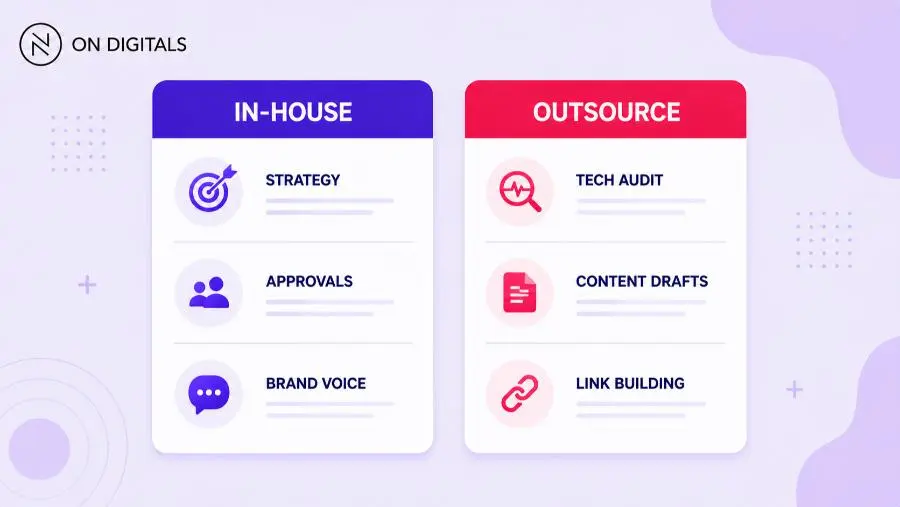
This split prevents a common problem where the vendor controls the SEO machine and the business can no longer explain what is happening.
Choose the right outsourcing model
SEO outsourcing can mean several different things, and in practice the best model depends on the scope and budget. The internal management capacity available inside the business matters just as much.
A small business may only need one specialist for a narrow task. A larger company may need a partner that can coordinate SEO with analytics and content. Development support may also need to sit inside the same workflow.
Common models include:
- Freelancer: best for narrow tasks and the business needs enough knowledge to review the work.
- SEO agency: best when the campaign needs strategy, execution, reporting, and coordination across several workstreams.
- Specialist marketplace: useful when hiring needs to move quickly and skills screening matters. The business still needs a clear brief and management process.
- White-label SEO partner: useful for agencies that need delivery support behind the scenes. Quality control and client communication must be tightly managed.
- Offshore or nearshore team: useful when the company wants strong execution capacity at a more flexible cost. Time zone, communication, and documentation become more important.
Do not choose a model only by price; choose it by the management load your team can actually handle. A low-cost freelancer can become expensive if every deliverable needs heavy revision.
Build the scope before you ask for proposals
A vague SEO brief creates vague proposals, so define what success should look like before contacting providers and make the required work explicit. Many outsourcing projects fail at this point: the business asks for “SEO support,” then receives keyword reports and generic blog drafts. Rankings may improve, but the work still does not connect to revenue.
A useful SEO scope of work should include:
- Business goal: leads, sales, bookings, qualified traffic, or market entry.
- Priority pages: the service, category, product, or content pages that matter first.
- Deliverables: audits, briefs, page updates, content drafts, technical tickets, links, dashboards, or reports.
- Volume: how many pages, briefs, articles, fixes, or reviews per month.
- Workflow: who writes, reviews, edits, approves, implements, and publishes.
- KPIs: impressions, clicks, rankings, conversions, lead quality, or revenue contribution.
- Ownership: who owns content, data, accounts, backlinks, documents, and dashboards.
- Exit terms: what happens to assets and access when the contract ends.
Vet providers with proof
Good vetting is skills-based: ask providers to explain how they would approach your actual website instead of walking through a generic SEO checklist. A strong provider should be able to discuss page priorities and technical risks. Search intent and measurement should also be clear, without overpromising what the team can implement.
Ask for three types of proof:
- Process proof: how they choose priority pages, build content briefs, handle technical fixes, and report progress.
- Performance proof: examples of traffic or lead improvement, with enough context to understand the starting point.
- Quality proof: sample audits, briefs, dashboards, or content reviews that show how detailed the work is.
Avoid turning this stage into a beauty contest. If you need a fuller agency evaluation process, use a Vietnam SEO company selection guide. For this article, the key point is operational fit: can the provider work inside your process without creating hidden work for your team?
Onboard the SEO partner with safe access control
Access handover is one of the most overlooked parts of SEO outsourcing. Use secure credential sharing instead of chat or email. Keep permissions at the lowest role that still lets the partner do the work, and give admin access only when there is a clear reason. Use the least-privilege principle from the first day.
A safe onboarding checklist should cover:
- Google Search Console: add the partner as a user, not as the owner unless there is a strong reason.
- Google Analytics 4: provide only the permission level needed for setup, reporting, or analysis.
- Google Business Profile: use manager access instead of shared passwords.
- CMS: create a named account with the right role. Avoid shared admin logins.
- SEO tools: use workspace seats or project access where possible.
- Documents and assets: keep strategy, briefs, drafts, and reports in a folder owned by the business.
- Passwords and API keys: use a password manager with revocable access.
Also define who owns the work before execution begins. Content drafts and keyword maps should remain accessible if the provider leaves. The same rule should apply to technical tickets and dashboards. Reporting templates should remain available too.
Set a 30/60/90-day operating plan
Outsourced SEO needs a working rhythm; without one, the campaign can turn into a monthly report with unclear progress. A 30/60/90-day plan gives both sides a practical timeline for setup and execution, with early evaluation built in.
In the first 30 days, focus on diagnosis and setup. The partner should review the website, analytics, priority pages, and search demand. Technical issues and conversion paths need a separate pass. At the same time, the business should provide access and brand context. Product information and clear approval rules should be ready too.
By day 60, the work should move into execution. Priority pages should have updated briefs or recommendations, while technical issues should be converted into tickets. Content workflows should be tested with a small batch before the team scales production.
By day 90, the campaign should show early direction. Search Console impressions and page improvements should be easier to track. Crawl fixes and content production should be visible in the workflow too. Full ROI may take longer, but the process should no longer feel unclear.
Use this timeline to decide whether to scale the relationship or adjust the scope. It also shows which workflow problems need fixing.
QA every deliverable, especially in the AI content era
Outsourcing SEO requires stronger quality control because AI can make low-quality output look polished. A report may look professional while hiding weak analysis. A content batch may read smoothly while repeating generic advice. A link list may look long but include irrelevant placements.
Use deliverable-specific QA instead of vague approval:
- SEO audit: check whether each issue has evidence, priority, impact, and implementation guidance.
- Content brief: check search intent, target page, entities, internal links, expert inputs, and conversion angle.
- Draft content: check originality, brand voice, factual accuracy, structure, and whether it says anything useful beyond common SEO advice.
- Technical ticket: check whether the task is clear enough for a developer to implement.
- Link or PR placement: check relevance, traffic quality, editorial context, and risk.
- Report: check whether the metrics connect to business goals rather than vanity rankings.
QA is not there to slow down the vendor. It catches problems before they become published content or technical debt. It also protects the budget.
Manage communication without creating meetings for everything
Outsourced SEO works best with a clear cadence: weekly check-ins are useful during onboarding, while biweekly calls and asynchronous updates often work better once the workflow stabilizes.
A simple cadence can look like this:
- Weekly during month one: access, audit findings, page priorities, and blockers.
- Biweekly during execution: deliverables, approvals, technical tickets, and next actions.
- Monthly performance review: rankings, impressions, traffic, conversions, lead quality, and decisions.
- Quarterly strategy review: scope, budget, priorities, and whether SEO still matches business goals.
For offshore or cross-time-zone teams, documentation matters more than extra meetings. Use written briefs and clear acceptance criteria. Shared dashboards and decision logs help the team avoid repeated clarification and protect the work when people change roles.
Know when to scale, switch vendors, or bring work back in-house
Outsourcing should not be permanent by default. The right model can change as the business grows: some companies start with a freelancer and later move to an agency, while others use an agency to build the system before bringing content or analytics in-house.
Scale the outsourced scope when the provider delivers useful work and communication is smooth. Early indicators should move in the right direction before volume increases. Increase volume only after the QA process is stable.
Switch vendors when deliverables stay generic or reporting avoids business outcomes. A provider that cannot explain the work clearly is another warning sign. Missed deadlines and poor documentation should be treated seriously when they repeat. Risky link practices need the same level of caution.
Bring work back in-house when SEO becomes core to the business and the team has enough capability to manage it. External specialists can still support audits or technical issues. They can also help during campaign spikes when extra expertise is needed.
Before ending any agreement, run an exit checklist that starts with account access and report exports. From there, collect content files and save keyword maps. Document technical tickets and remove unnecessary permissions before the relationship closes.
Frequently Asked Questions
What SEO tasks should I outsource first?
Start with tasks that need specialist skill or extra capacity. Technical audits and keyword research are common first choices. Content briefs, on-page recommendations, and reporting setup can follow. Strategy and brand voice should stay close to the internal team. Final approval and account ownership should stay there too.
Is it better to outsource SEO to a freelancer or an agency?
A freelancer is often better for narrow tasks with clear deliverables. An agency is usually better when the campaign needs strategy and coordination. Content, technical SEO, and reporting can then sit under one operating rhythm. The right choice depends on scope and management capacity.
How do I manage an outsourced SEO team?
Manage outsourced SEO with a clear scope and safe access control. Scheduled reviews and written acceptance criteria keep the work accountable. Use monthly reporting to connect SEO work with business outcomes, not only rankings or task volume.
When should I stop outsourcing SEO?
Stop or change the model when deliverables stay generic or quality problems repeat. Reporting also needs to connect to business goals. You may also bring SEO in-house when the channel becomes central enough to justify internal capability.
Key takeaways
SEO outsourcing is not just a hiring decision; it is an operating system for handing off work without losing strategy or ownership, and quality control is what keeps that system useful.
Start by deciding which SEO tasks should move outside the business and which decisions must stay internal. From there, build a clear scope before execution begins, then choose the right model and set access rules.
Once the campaign starts, manage it through a 30/60/90-day plan and deliverable QA. Reporting should stay clear and tied to decisions, so the outsourced relationship gives the business more capacity without making the team lose control.

NEWEST POSTS
- Advertising Industry In Vietnam: The 2026 Trends, Channels and Market-Entry Strategy
- Best SEO Company in Vietnam: Latest Shortlist For Businesses
- How To Leverage Social Media For Customer Service Like A Pro?
- Social Media Post Tips – 8 Ways To Boost Engagement
- How To Use Social Media for Sales – In-depth Beginner Guide
Read more