
AI Overviews SEO: How Google’s AI Answers Change Visibility and Tracking
Vincent
03/12/2025
49
AI Overviews SEO means applying strong SEO fundamentals to content that may support Google’s AI-generated search results. Important pages still need to be crawlable, indexable and useful to readers. They also need clear answers, original value and reliable supporting information. The goal is not to force inclusion in an AI Overview. It is to improve useful visibility across search and measure the result accurately.
Google Search is no longer only a list of links. Some queries now show an AI-generated summary before, alongside or between traditional results. This can change how people discover information, compare options and decide which source to open.
What are Google AI Overviews?
Google AI Overviews are AI-generated summaries that may appear in Search when Google determines they can help answer a query. They can include links to webpages that support the response, but they do not show for every search.
An AI Overview is different from a featured snippet. A featured snippet usually highlights a passage from one webpage. An AI Overview can summarise information from several sources and may guide the user toward follow-up questions.
It is also different from Google AI Mode. AI Mode is a more conversational search experience that lets users continue exploring a topic through longer questions. AI Overviews are summaries that can appear within the standard Search results experience.
The distinction matters because each feature creates a different user journey. A featured snippet may answer one direct question. An AI Overview may help someone compare several ideas before they choose a source to explore further.
How will AI Overviews change SEO?
AI Overviews change how users interact with results pages, but they do not make traditional SEO irrelevant. Websites still need relevance, technical accessibility and helpful content. The difference is that visibility can no longer be assessed only through a ranking position and a click-through rate.
Visibility is no longer only a ranking position
Traditional SEO reporting often focuses on where a page ranks for a keyword. That remains useful, especially for commercial queries. However, AI Overviews can introduce another layer of visibility.
A page may appear as one of several supporting links. A brand may be mentioned in the generated response without receiving the same click volume as a classic organic result. A query may also trigger an AI Overview in one market but not another.
This means teams need to monitor more than a static position. They should track whether the AI Overview appears for a priority query, whether their URL is shown as a supporting source and whether that visibility leads to meaningful visits.
Informational traffic may become less predictable
Some simple informational queries can create more zero-click behaviour. A user who only wants a short definition may not need to visit a page after reading a complete answer in Search.
This does not mean informational content has lost its value. Useful guides can still create brand familiarity, support later commercial searches and attract readers who need deeper context. The important question is whether the page gives people a reason to continue.
A basic definition may be enough for a quick search. A comparison guide, practical framework or original research piece can remain valuable because readers often need more than a summary. They may want to understand limitations, see examples or compare several options before making a decision.
Content needs to answer the next question
AI-assisted search often encourages users to ask broader questions. Someone may begin with “What is technical SEO?” and then ask how it affects a website migration, which issues matter most or whether an agency is needed.
This means content should not stop at the first definition. A strong page needs to answer the main question clearly, then guide the reader through the next relevant decisions.
For example, an article about AI Overviews SEO should not only explain the feature. It should also explain what changes for content teams, which pages deserve attention and how performance should be measured.
The answer is not to create a separate page for every possible question variation. It is to build useful topic coverage around the questions that matter most to the audience.
Measurement needs a wider view
SEO teams still need to monitor rankings, impressions and clicks. However, AI Overviews create a reason to add source visibility, referral quality and conversion signals to the reporting process.
A page may receive fewer clicks from a broad informational query yet attract more engaged visitors from a complex comparison query. Another page may gain impressions but lose relevance because the AI Overview answers the question more completely than the page itself.
The useful measure is not whether an AI Overview exists. It is whether the content supports qualified discovery and meaningful business outcomes.
AI Overview and SEO: what still matters?
The core principles of SEO remain relevant for AI Overviews. A webpage still needs to be accessible to Google. It still needs useful content. It still needs to match what the user is trying to understand.
AI Overview optimisation should therefore begin with the same foundation that supports normal organic search.
|
SEO foundation |
Why it still matters |
|
Crawlability |
Google needs to access important pages and their content |
|
Indexability |
A page must be available in Google’s index to be considered for Search visibility |
|
Internal linking |
Relevant links help users and search engines discover related pages |
|
Search intent |
The page needs to match the reason behind the query |
|
Useful text content |
Important information should remain readable as HTML text |
|
Original value |
Unique examples, research or expertise give users a reason to choose the page |
|
Images and video |
Visual assets can support understanding when they are genuinely useful |
|
Structured data |
Schema can clarify eligible page types when it matches visible content |
Structured data remains useful when it accurately describes content that users can see. It can support eligible rich results, but it is not an AI Overview shortcut.
The same principle applies to page structure. Clear headings, short paragraphs, lists and tables can help readers understand information faster. They should not be added because a team believes AI systems require a certain “content chunking” formula.
The focus should remain on clarity. A complicated topic needs a clear explanation. A comparison needs a readable table. A process needs steps that follow a logical order.
Which pages should you prioritise for AI Overviews SEO?
Not every page needs to be optimised with AI Overviews in mind. Start with pages that already support a meaningful business objective and answer complex, research-heavy questions.
A good priority page often has one or more of these traits:
|
Page type |
Why it may matter |
|
Detailed how-to guide |
Users may need a step-by-step explanation |
|
Comparison page |
Buyers need help evaluating trade-offs |
|
B2B service guide |
Readers may ask about process, fit, cost drivers or timelines |
|
Original research page |
Unique data can provide value beyond a generic summary |
|
Product or category content |
Clear product information can support discovery for ecommerce searches |
|
Local service page |
Direct questions often include service and location context |
|
High-traffic educational article |
It may influence later commercial or branded searches |
A complex B2B service page is often a good starting point. Buyers may want to know what the service includes, whether it fits their business, how long it takes and what results depend on. These questions are hard to answer through a short generic paragraph.
Ecommerce businesses should focus on accurate product information, clear category pages and well-maintained business data. Local businesses should prioritise service detail, location information, reviews and a complete Business Profile.
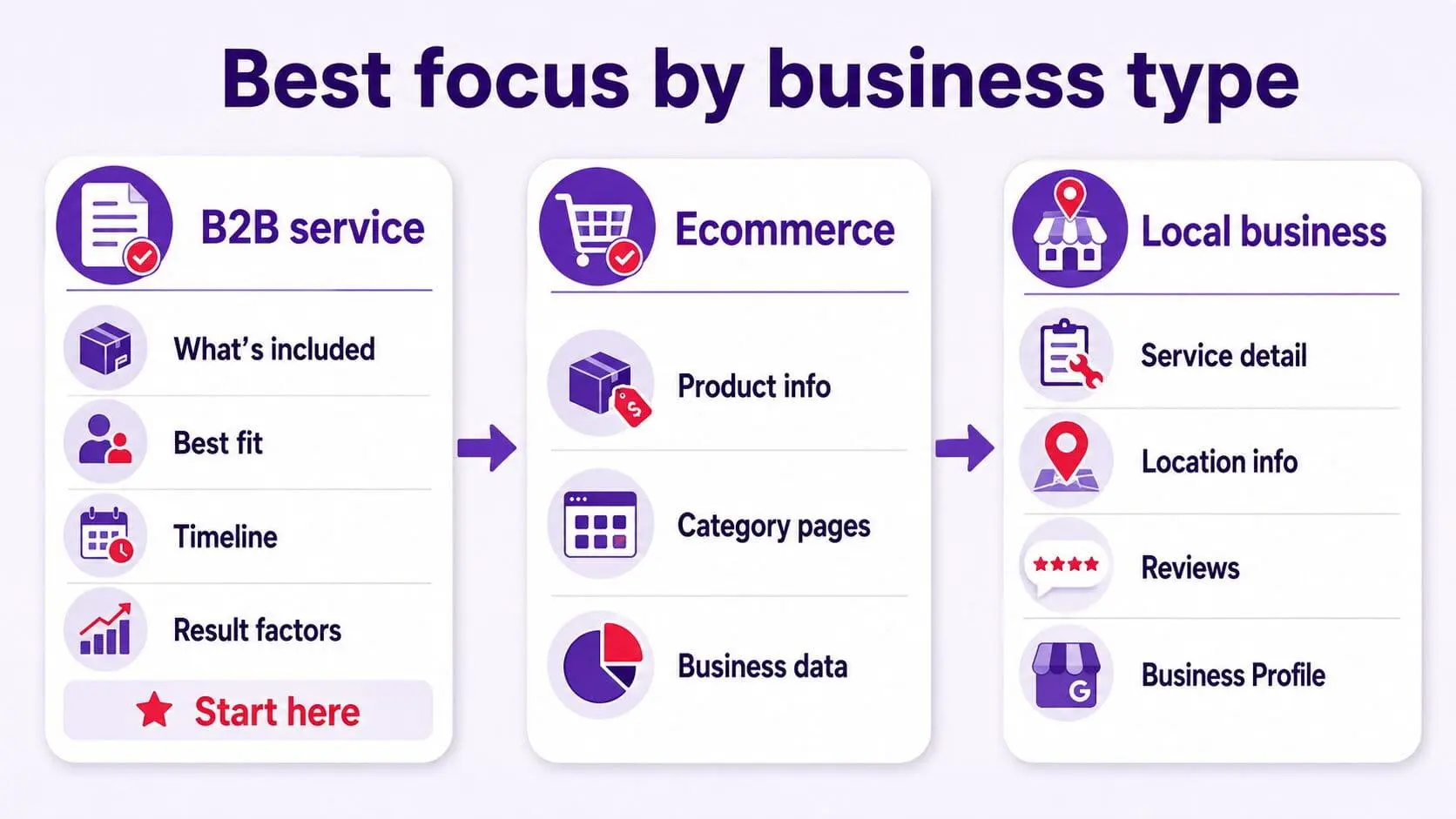
The goal is to improve the pages where clearer information can support both visibility and buyer confidence.
How to improve AI Overviews SEO without chasing hacks
A practical AI Overviews SEO strategy should improve the website overall. It should not depend on special tags, artificial mentions or content written only to appear in an AI response.
1. Check crawlability, indexing and snippet eligibility
Start with the basics. Confirm that priority pages are accessible to search engines and are not blocked by technical issues.
Review the page status in Google Search Console. Check whether the page is indexed. Look for noindex directives, incorrect canonicals, rendering problems or weak internal links.
Important content should appear in the rendered HTML. Do not hide the main answer inside an image, an inaccessible interactive element or a section that does not load correctly.
This is not glamorous work, but it matters. A page cannot support AI Overview visibility if Google cannot properly access or understand it.
2. Build content around complex buyer questions
AI Overviews are more likely to matter when a user is researching a topic rather than looking for one simple fact. This makes complex questions a useful content opportunity.
Start with the questions buyers ask before they make a decision. A marketing manager may want to compare SEO with paid advertising. A founder may want to know whether an agency is suitable for a new market. An ecommerce team may need to understand which product feed issues affect visibility.
Use search-query data, sales notes, customer feedback and SERP research to identify these questions. Then group them into useful sections instead of creating disconnected pages for every phrase.
A clear article structure helps readers move from the broad question to the next decision. It should not bury the answer beneath a long introduction or vague thought-leadership copy.
3. Add original value that a generic summary cannot replace
AI-generated summaries can describe common knowledge. They are less useful when a reader needs a specific point of view, original data or practical experience.
This creates an opportunity for businesses that can contribute something real. A case study can explain what happened during a project. A research report can show original findings. An expert article can explain a method and its limitations.
The content does not need dramatic claims. It needs useful detail.
For example, an article about technical SEO can explain how to identify indexation issues during an audit. It can describe the difference between a crawl problem and a content-quality problem. It can explain why one issue should be prioritised before another.
That level of context gives readers a reason to continue beyond a summary.
4. Make key answers clear, then add the context readers need
A strong section should answer its heading in the opening lines. It should then explain the conditions, evidence and next action.
This is especially useful for questions that involve comparison or risk. A reader may want a short answer first, but they still need to understand when that answer applies.
For instance, a section titled “Do AI Overviews reduce organic traffic?” could begin by explaining that the effect varies by query. Simple questions may produce fewer clicks, while complex research queries can still lead users to supporting sources.
The rest of the section can explain why. It can discuss zero-click behaviour, content depth and the role of user intent. The direct answer remains easy to find, but the page still provides value beyond one sentence.
5. Strengthen topical and brand evidence
A page becomes more useful when it connects to a wider body of credible information. Internal links help readers move from a broad topic to a deeper guide. Author information helps them understand who created the content. Sources and examples make important claims easier to assess.
Authority also develops beyond one webpage. A business may strengthen its position through original research, relevant customer proof, expert commentary and useful references from outside the site.
The focus should remain on relevance. A generic mention on an unrelated platform rarely explains why a business is credible. A detailed industry contribution, customer story or partner resource can add stronger context.
6. Use schema, images and video correctly
Schema should match the visible page content. It can help Google understand certain eligible page types and support rich-result features. It should not be added as a shortcut for AI Overview inclusion.
Images and video can improve a page when they make an explanation easier to understand. A process diagram can clarify a workflow. A product video can demonstrate use. A screenshot can support a technical guide.
The visual must add information. Decorative images, fake dashboards and generic AI illustrations do not strengthen the answer.
For ecommerce websites, product data should remain accurate and consistent. For local businesses, service information and business listings should reflect the current offer. These details help users assess the business before they visit the website.
AI Overviews SEO rank tracking: how to measure visibility
AI Overview rank tracking should not be treated like one fixed ranking position. AI Overviews can change by query, country, device and the sources Google chooses to display.
A better approach is to track four layers of performance.
|
Measurement layer |
What to review |
|
AI Overview presence |
Does the priority query trigger an AI Overview? |
|
Source visibility |
Does your page or brand appear as a supporting source? |
|
Organic performance |
Are impressions, clicks and landing-page behaviour changing? |
|
Business value |
Are engaged sessions, enquiries or qualified leads improving? |
Begin with a list of priority questions. These should reflect real buyer needs, not random prompts. A B2B company may track comparison questions, process questions and service-evaluation queries. An ecommerce business may track product research and category questions.
For each query, record the country, device, date and visible source links. Note whether your page appears. If it does not, identify the likely content gap. The page may lack depth, proof, technical accessibility or a clear answer to the question.
Then compare this information with Search Console and analytics data. If a page gains AI Overview visibility but attracts no useful traffic, the query may have low commercial value. If traffic falls but engaged sessions rise, the overview may be filtering out users who only wanted a quick fact.
This approach avoids a common reporting mistake. A screenshot of one AI Overview may be interesting, but it does not show whether visibility is stable or valuable.
AI Overview SEO rank tracking tools
AI Overview tracking requires more than one tool because no single platform can explain every part of the user journey.
|
Need |
Tool or method |
What it helps answer |
|
Official Google visibility |
Google Search Console, including generative AI reporting where available |
Which pages, countries and devices generate visibility in Google’s AI features |
|
Organic performance |
Google Search Console and Google Analytics 4 |
Whether impressions, clicks, sessions and conversions are changing |
|
SERP feature monitoring |
Third-party SEO tools with AI Overview tracking |
Which target queries trigger AI Overviews and whether a domain appears |
|
Technical diagnosis |
URL Inspection, crawl tools and Rich Results Test |
Whether priority pages are crawlable, indexable and technically sound |
|
Manual quality review |
Standardised query log |
Whether answer format and source links have changed |
|
Brand context review |
Media and mention monitoring |
Whether the business is represented accurately beyond its website |
Third-party platforms can help teams detect patterns across large keyword sets. However, their query databases, tracking locations and scoring methods differ. Treat their data as directional rather than as an official Google ranking position.
Google Search Console remains a core source because it connects visibility with page performance. Where generative AI reports are available, they can provide a dedicated view of impressions from AI features. Teams should still review standard Search Console and GA4 data because business value does not end with an impression.
What businesses should prioritise first
The right first step depends on the current weakness.
|
Business situation |
First priority |
|
Technical issues or poor indexation |
Fix crawlability, indexing and internal links |
|
Many impressions but weak click-through rate |
Improve intent match, title, opening and page relevance |
|
Complex buyer questions with vague content |
Add clearer answers, comparisons and practical examples |
|
Strong content but weak proof |
Add author expertise, case context and reliable sources |
|
Weak external brand context |
Build original research, customer proof and relevant coverage |
|
Ecommerce visibility issues |
Improve product data, feed quality and category content |
|
Local service visibility issues |
Improve Business Profile, reviews and location-specific service pages |
A business does not need to solve every problem before improving content. It should simply avoid treating AI Overviews as the first priority when core SEO problems remain unresolved.
The best sequence is usually practical: make priority pages accessible, improve their usefulness, strengthen proof and then measure what changes.
What not to do for AI Overviews SEO
Several popular tactics can distract teams from useful work.
- Do not create an “AI Overview schema.” Google does not provide a special markup type for this purpose.
- Do not create hundreds of pages for minor wording variations. A useful topic page should answer related questions naturally instead of producing low-value content at scale.
- Do not use a special AI text file as a substitute for technical SEO. Important content still needs to be accessible through normal website pages.
- Do not add FAQ sections only to chase an AI citation. FAQs should answer genuine recurring questions and remain useful for readers.
- Do not seek artificial brand mentions. A reference is valuable when it adds context, expertise or customer proof. Repeated promotional mentions do not create the same trust.
- Do not refresh an article by changing the date alone. Update facts, examples, sources and recommendations when the topic has genuinely changed.
Most importantly, do not treat AI Overviews as a separate search engine that can be hacked. The strongest approach is still to publish useful content that solves a real problem better than a generic summary can.
Frequently asked questions (FAQs)
Do AI Overviews replace traditional SEO?
No. AI Overviews change how information can appear in Google Search, but SEO remains essential. Pages still need to be crawlable, indexable, relevant and useful. AI Overviews add another visibility surface rather than replacing the need for strong organic search foundations.
Can a page appear in AI Overviews without ranking first?
A page does not need to hold the first traditional organic position to appear as a supporting source. However, it still needs to be indexed, eligible for a normal Search snippet and relevant to the user’s query. Strong content and technical foundations remain important.
Does schema improve AI Overview visibility?
Schema can help Google understand eligible content types and support rich-result features when it matches the visible page. It does not guarantee an appearance in AI Overviews. Start with useful content, clear HTML and accurate information before adding structured data.
How do I track AI Overview performance in Search Console?
Use Search Console to review impressions, clicks and page performance. Where generative AI reports are available, use them to review visibility from AI features by page, country, device and date. Combine this with GA4 and conversion data to understand whether the visibility supports business value.
Are AI Overview clicks always lower quality than organic clicks?
Not necessarily. Some simple queries may create fewer clicks because users receive the answer directly in Search. However, visitors who click through after reviewing an AI Overview may be researching a more complex decision and could be more engaged. Review landing-page behaviour and conversion signals before drawing conclusions.
Which AI Overview SEO rank tracking tools should teams use?
Start with Google Search Console and Google Analytics 4. Add a structured manual query log for priority questions. Third-party AI Overview tracking tools can help monitor large keyword sets, but their data should be treated as directional because coverage and methodologies differ across vendors.
Build useful visibility before chasing AI inclusion
AI Overviews SEO is not about forcing Google to select a page for an AI-generated response. It is about improving the content, technical quality and evidence that make a website useful during modern search journeys.
Start with the pages that matter most to your business. Make them crawlable, clear and supported by real expertise. Answer the questions buyers ask before they are ready to contact a provider. Then track visibility alongside traffic quality and conversion outcomes.
For a broader strategy that connects technical SEO, answer-ready content and qualified demand, explore AEO Services from On Digitals.
NEWEST POSTS
- Advertising Industry In Vietnam: The 2026 Trends, Channels and Market-Entry Strategy
- Best SEO Company in Vietnam: Latest Shortlist For Businesses
- How To Leverage Social Media For Customer Service Like A Pro?
- Social Media Post Tips – 8 Ways To Boost Engagement
- How To Use Social Media for Sales – In-depth Beginner Guide
Read more