
Google AI Overviews: What They Are, How They Work and Why They Matter
Vincent
07/10/2025
33
Google AI Overviews are AI-generated snapshots in Google Search that help people understand a question and explore supporting links. They may appear when Google believes a generated response adds value beyond a standard results page. For website owners, the essentials remain the same: useful content, technical accessibility and pages that can appear as normal Search results.
The overview can explain a topic quickly, then point the user towards links for deeper research. This can change how people discover a business. A user may receive a short answer without clicking. Another may use the overview to compare options, then open several supporting pages before making a decision. The difference depends on the question, the search context and how much information the user needs.
For that reason, Google AI Overviews matter to both users and businesses. They do not make SEO obsolete. They make LLM optimization essential alongside with SEO.
What are Google AI Overviews?
Google AI Overviews are summaries generated within Google Search. They can bring together key information for a question and provide links that let users explore the web in more detail.
They are designed for searches where a quick overview may help someone get started. A person researching a complex topic may have several related questions. Rather than searching each phrase separately, they can ask a longer question and use the overview as a starting point.
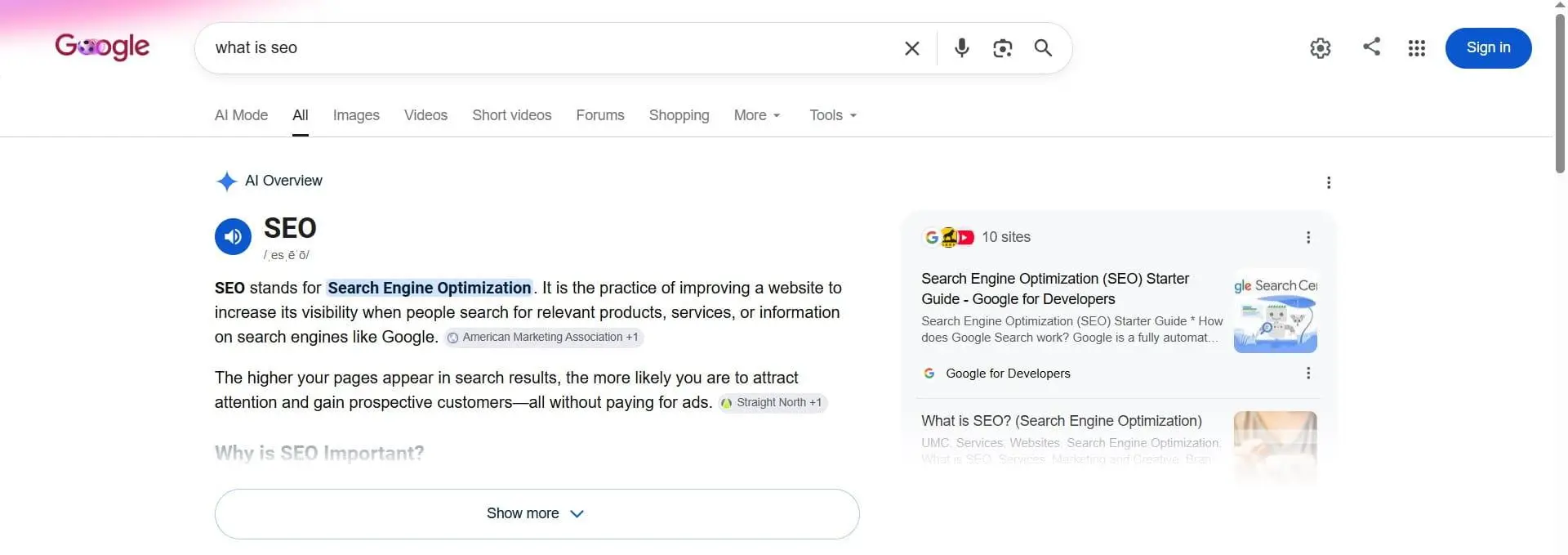
AI Overviews are not a replacement for webpages. The supporting links remain important because they give users a way to check the source, find more detail and compare perspectives. An overview may introduce a topic, but it rarely provides every condition, example or limitation that matters to a real decision.
For example, someone searching “How should a B2B company choose an SEO agency?” may need more than a short recommendation. They may want to understand service scope, reporting, industry fit and contract terms. The overview can summarise the topic, while specialist pages give the user the evidence needed to decide.
When do AI Overviews appear?
AI Overviews do not appear for every Google search. Google shows them when its systems determine that a generative response can be especially helpful for the query.
They are often more useful when a question involves several ideas, needs a comparison or benefits from information gathered across different sources. A user may ask how two products differ, how to plan a multi-step task or what factors should guide an important purchase.
Availability can also vary. The feature changes by country, language, device, query type and Google’s product rollout. The same keyword may therefore show an AI Overview in one context but not in another.
This is why businesses should avoid treating AI Overviews as a predictable ranking position. There is no permanent box that appears for every relevant query. The practical goal is to maintain content that remains useful when Google chooses to include supporting links.
How do Google AI Overviews work?
Google does not publish a fixed formula for every AI Overview. However, the user journey is simple to understand.
First, Google evaluates the search and decides whether an AI-generated response would add value. This does not happen for every query.
Second, Google creates a snapshot that addresses the main question. The wording, format and supporting links can change based on the query and available information.
Third, users can open the supporting links, review standard results or continue exploring through follow-up questions. This gives people more than one path to research a topic.
The links shown in an AI Overview may not look identical to the highest-ranking blue links for the same keyword. A classic search result is designed to rank pages against the query. An AI Overview can surface supporting pages that help explain parts of a broader question.
That does not mean a business should create separate pages for every wording variation. It is more useful to publish one clear, well-supported page that answers a topic properly. The page can then address natural follow-up questions through logical headings, examples and internal links.
AI Overviews vs Featured Snippets vs AI Mode
Google Search includes several features that can look similar at first glance. They serve different purposes and create different research journeys.
|
Feature |
Main purpose |
Source format |
Typical user behaviour |
|
AI Overviews |
Provide an AI-generated snapshot of a topic or question |
May show several supporting links |
Read a summary, then open sources or continue exploring |
|
Featured Snippets |
Give a quick answer from one webpage |
Usually highlights a passage, list or table from one source |
Find a fast answer to a focused question |
|
AI Mode |
Support deeper, conversational exploration |
Responses and links can change with follow-up questions |
Ask broader questions, compare options and refine the search |
A featured snippet is usually a direct extract from a webpage. It may answer “What is technical SEO?” with a short definition, numbered list or comparison table.
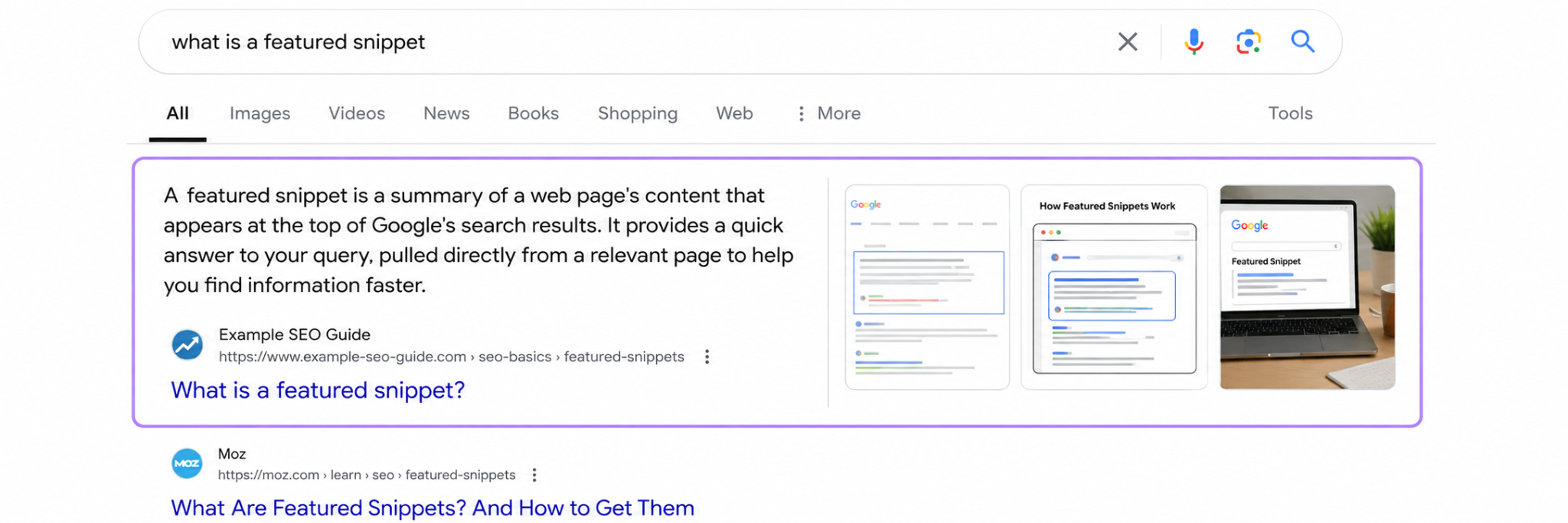
An AI Overview can combine several points into a generated response. It is more likely to support research that involves more than one step or perspective.
AI Mode is a separate conversational experience. It allows users to continue asking questions without starting a new search each time. A user may begin with an AI Overview, then move into AI Mode when they need more detailed exploration.
Can Google AI Overviews make mistakes?
Yes. Like other generative AI features, AI Overviews can be inaccurate, incomplete or misleading. A short answer may also miss important context.
This is especially important for health, finance, legal matters and other high-stakes topics. Users should not rely on one generated response for a major decision. They should open supporting links, compare reputable sources and seek qualified advice where appropriate.
The same principle applies to website owners. Publishing clear information is important, but accuracy matters more than sounding certain. A company should explain what it knows, show where important claims come from and state the limits of a recommendation.
For example, an agency should not promise that SEO will achieve a fixed outcome by a fixed date. A better explanation describes the factors that affect progress, such as site condition, competition and the quality of existing content.
This approach helps people make better decisions. It also gives the website a stronger role than simply repeating a general answer that could appear in any summary.
How do AI Overviews affect website owners?
AI Overviews can affect how people see search results, but they do not replace normal SEO. Websites still need to be accessible, relevant and useful.
The biggest change is that visibility may no longer mean only “ranking in position three.” A brand may be visible through a supporting link in an overview. A user may also receive enough information from the summary that they do not click any result for a simple question.
This creates both a risk and an opportunity.
Simple informational pages may receive fewer clicks when the overview answers the question completely. However, detailed pages can still earn visits when readers need proof, practical examples or specific guidance for their situation.
A B2B buyer, for instance, may use an overview to understand a topic quickly. They are more likely to visit a source page when they need to compare providers, assess the process or understand what a service includes.
The AIO optimized response is to create pages that add value beyond a basic definition. Strong content can explain the “why,” the “when” and the “what next” after the initial answer.
Can a website rank in Google AI Overviews?
A website does not receive a fixed “AI Overview ranking” in the way it might rank first or fifth in classic organic results. Google may show a page as a supporting link for one query and not show it for a similar query.
Website owners can improve the conditions that make a page eligible and useful. They cannot control whether an AI Overview appears, which sources Google shows or the exact language in the generated response.
|
What website owners can influence |
What website owners cannot control |
|
Whether a page can be crawled and indexed |
Whether an AI Overview appears for a specific query |
|
Whether key information is available as readable text |
The exact supporting links shown in a response |
|
Whether the page is eligible to display a normal Search snippet |
The wording of Google’s generated answer |
|
Content accuracy, depth and source transparency |
A permanent “AI Overview ranking position” |
|
Internal links and page structure |
How the feature changes across users, markets or time |
Google’s guidance for website owners remains practical. Pages should be crawlable and indexable. Important information should be visible as text. Internal links should help users and search engines discover related content. Structured data should describe content accurately when the page is eligible for it.
There is no special AI Overview schema. There is no guaranteed content template. A high-quality page remains the best foundation.
Can users and website owners control AI Overviews?
Users and website owners have different types of control.
What users can do
Users cannot switch off AI Overviews as a single Google Search feature. They can, however, choose the Web filter after searching to view text-based web results without features such as AI Overviews.
They can also open supporting links, search again with a more specific question or use follow-up questions where Google offers them. When an overview looks inaccurate, users can send feedback to Google.
These actions matter because generated answers should be checked, especially when the information affects health, money, safety or another important decision.
What website owners can do
Website owners can manage what they allow Google to crawl, index and display through normal Search controls. These include noindex rules and preview controls such as nosnippet, data-nosnippet and max-snippet.
However, these controls can affect how content appears more broadly in Google Search. They are not an “AI Overview off switch” for one page alone.
Before limiting content, a business should consider the wider trade-off. Preventing snippets may reduce visibility in standard results as well as AI features. In most cases, the better first step is to improve the source page so it presents accurate, useful information.
What should businesses do now?
Businesses do not need a separate AI-only website strategy. They need stronger source pages and a clearer view of the questions their audience asks.
Start with the pages closest to meaningful discovery. These may be service pages, category pages, comparison guides or educational articles that support an important buying decision.
Then review whether each page does four things well:
- It answers the main question early.
- It explains the conditions behind the answer.
- It supports important claims with evidence or practical experience.
- It gives the reader a useful next step.
The first two points improve clarity. The third builds trust. The fourth prevents the page from becoming a dead end after a quick answer.
For example, a service page should not simply state that a business offers “AI-ready SEO.” It should explain what the work involves, who it is suited to and how success is measured. A guide should not only define an SEO term. It should also explain why the term matters and where the reader should look next.
This is more valuable than producing generic content designed to imitate an AI response. A generic answer may be easy to summarise, but it gives readers little reason to choose the business behind it.
Frequently asked questions (FAQs)
Are Google AI Overviews the same as AI Mode?
No. AI Overviews are AI-generated snapshots that can appear within normal Google Search results. AI Mode is a more conversational experience that lets users explore a topic through follow-up questions. A person may move from an overview into AI Mode, but the features have different roles.
Are Google AI Overviews the same as Featured Snippets?
No. Featured Snippets usually display a direct passage from one webpage. AI Overviews are generated summaries that can include several supporting links. Both features may help users find information quickly, but they use different formats and source relationships.
Do AI Overviews appear for every search?
No. Google displays AI Overviews only when its systems determine that a generated response would be helpful. Availability can also vary by query, language, country, device and product rollout.
Can AI Overviews make mistakes?
Yes. Google notes that AI-generated responses can make mistakes. Users should check important information through supporting links and other reliable sources, especially for health, financial, legal or safety-related decisions.
Can a website rank first in an AI Overview?
Not in the same way it ranks first in a standard list of organic results. A page may appear as a supporting link, but Google can change the sources and response based on the query and context. No tactic guarantees inclusion.
Do I need special schema for AI Overviews?
No. Google does not offer a special schema type for AI Overviews. Structured data can still help with eligible rich results when it accurately reflects visible content, but it does not guarantee that a page will appear in an AI-generated response.
Are Google AI Overviews available everywhere?
Availability changes as Google expands the feature across countries and languages. The most reliable way to check the current status is Google Search Help, which maintains the latest availability information for users and markets.
Understand the feature before trying to optimize for it
Google AI Overviews are designed to help people understand questions quickly and explore supporting sources when they need more detail. They do not replace normal search results, and they do not remove the need for accurate, useful webpages.
For website owners, the priority is simple: create content people can verify, make important pages accessible to search engines and give readers more value than a short generic summary. This creates a stronger foundation for SEO today, regardless of how Google presents the results page tomorrow.

NEWEST POSTS
- Advertising Industry In Vietnam: The 2026 Trends, Channels and Market-Entry Strategy
- Best SEO Company in Vietnam: Latest Shortlist For Businesses
- How To Leverage Social Media For Customer Service Like A Pro?
- Social Media Post Tips – 8 Ways To Boost Engagement
- How To Use Social Media for Sales – In-depth Beginner Guide
Read more