
LLM optimization: practical guide for SEO and business decisions
Vincent
19/11/2025
21
LLM optimization is the process of improving how large language models interpret, retrieve, and surface your brand or content across AI-powered search systems. In 2026, this is no longer a technical niche—it is a core part of SEO, content strategy, and digital visibility. Businesses, marketers, and SEO teams use LLM optimization to ensure their content is correctly understood, cited, and recommended by AI systems such as Google AI Overviews, ChatGPT, and other retrieval-augmented engines. This guide explains how LLM optimization works, why it matters for rankings and conversions, and how organizations can implement a structured framework to improve AI visibility and performance outcomes.
What LLM optimization means and when it matters
LLM optimization refers to the process of structuring, refining, and distributing digital content so that large language models can better understand, retrieve, and represent it in generated responses. Unlike traditional SEO, which focuses primarily on improving rankings within search engine result pages through signals such as backlinks, keyword relevance, and technical optimization, LLM optimization shifts the focus toward how content is interpreted and utilized inside AI-generated answers. In other words, the goal is no longer just visibility in search listings, but inclusion and accurate representation within AI systems that synthesize and generate responses for users.
At a deeper level, LLM optimization is about aligning content with how large language models process information. These models do not “read” content in the same way humans do. Instead, they break content into semantic units, analyze contextual relationships, and compare those units across vast datasets to determine meaning, relevance, and trustworthiness. This means that content must be structured in a way that is not only readable for humans but also machine-interpretable at a semantic level.
At its core, LLM optimization is about improving three key signals that determine whether content will be selected and used in AI-generated outputs. The first is how clearly your content is interpreted by AI systems. This refers to structural clarity, logical hierarchy, and semantic consistency. When content is well-organized, AI systems can more easily extract meaning and connect ideas without ambiguity. The second signal is how strongly your content is associated with authoritative entities. In modern AI systems, entities such as brands, products, services, and topics carry significant weight. Clear and consistent entity relationships help models understand what your content represents and how it connects to broader knowledge graphs. The third signal is how frequently your content is selected as a trusted source in generated outputs. This depends not only on content quality but also on how well it aligns with retrieval patterns and trust signals used by AI systems.
In practical terms, this shift means that content evaluation is no longer limited to traditional ranking factors like keyword density or backlink profiles. Instead, content must fit into a machine-readable knowledge structure where meaning, context, and relationships are clearly defined. Large language models continuously evaluate content by breaking it into segments, comparing those segments with other sources, and determining whether the information is reliable, relevant, and consistent enough to be included in a generated response. If the content lacks structure or semantic clarity, it becomes less likely to be retrieved, even if it performs well in traditional SEO rankings.
LLM optimization becomes especially critical in environments where users rely on AI-driven discovery systems rather than traditional search engine result pages. This includes AI Overviews, conversational assistants, enterprise AI tools, and hybrid search environments where users receive direct answers instead of browsing through multiple links. In these environments, visibility is determined not by ranking position alone, but by whether AI systems choose to include your content in synthesized responses. This fundamentally changes how content strategy must be approached, especially for businesses that depend on organic discovery.
As Google’s AI systems and other large language model-based platforms continue to evolve, structured and semantically clear content is becoming significantly more important than traditional keyword optimization. Machine readability, entity clarity, contextual consistency, and structural hierarchy all play a direct role in determining whether content is retrieved, summarized, or ignored by AI systems. This means that even highly authoritative content can lose visibility if it is not properly structured for machine interpretation.
Another important aspect of LLM optimization is its impact on content adaptability across different AI systems. Because large language models are trained on diverse datasets and operate using probabilistic reasoning, content must be flexible enough to be interpreted correctly in multiple contexts. This requires maintaining consistent meaning across different sections, reinforcing key concepts through structured repetition, and ensuring that entity relationships remain stable throughout the content ecosystem.
In simple terms, LLM optimization matters whenever your content needs to be understood by machines before it is presented to humans. This is especially important in environments where AI systems act as intermediaries between users and information sources. Instead of users directly navigating to websites, they increasingly rely on AI-generated summaries, recommendations, and conversational responses. If your content is not optimized for this layer of interpretation, it risks becoming invisible in the very systems that now shape digital discovery.
Ultimately, LLM optimization represents a fundamental shift in how digital content is created, structured, and distributed. It moves beyond traditional SEO mechanics and focuses on aligning content with the way modern AI systems process knowledge. Businesses that understand and implement LLM optimization effectively are better positioned to maintain visibility, relevance, and authority in an increasingly AI-driven information ecosystem.
Why this topic affects rankings, indexation, user experience, or conversions
LLM optimization plays a critical role in how modern search engines and AI systems interpret, evaluate, and present content relevance. While traditional SEO primarily focuses on ranking signals such as backlinks, keyword optimization, and technical structure, LLM optimization expands this scope by influencing how content is understood, summarized, and reused within AI-generated responses. This shift is especially important in 2026, where AI systems increasingly act as the primary interface between users and information sources.
Instead of simply determining where a page ranks in search results, LLM optimization affects whether the content is even selected for inclusion in AI-generated answers. This makes it a foundational layer of visibility in both traditional search engines and emerging AI-driven discovery systems.
There are four major impact areas that define why LLM optimization directly affects rankings, indexation, user experience, and conversions.
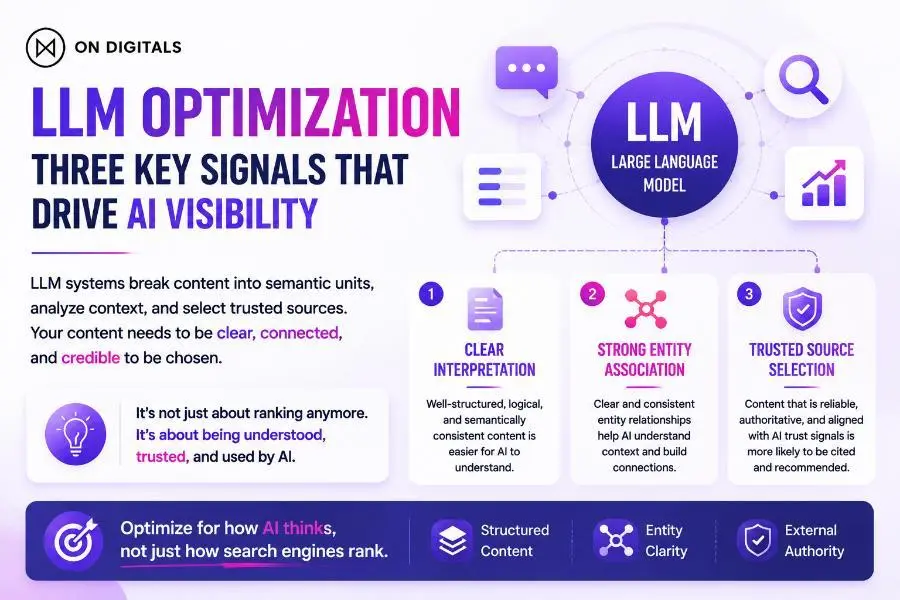
LLM optimization shifts visibility from ranking positions to how effectively AI systems understand, interpret, and reuse your content.
1. Indexation clarity
Indexation clarity refers to how easily search engines and AI systems can understand and categorize content based on its structure and semantic meaning. LLM optimization improves indexation by ensuring that content is logically organized, clearly structured, and semantically consistent across all sections.
When content follows a clean structure with well-defined headings, clear entity usage, and consistent topic flow, AI systems can more effectively interpret relationships between different ideas. This includes understanding how entities relate to each other, how topics are grouped, and how user intent is addressed within the content.
Poorly structured content, on the other hand, creates ambiguity. When information is scattered or inconsistently formatted, AI systems may struggle to correctly interpret meaning, leading to incomplete indexing or reduced visibility in AI-generated responses. As a result, even high-quality content may fail to appear in relevant AI outputs simply because it lacks structural clarity.
2. Ranking influence through semantic authority
LLM optimization also influences ranking systems indirectly through the strengthening of semantic authority. Modern search engines increasingly rely on entity-based understanding rather than isolated keyword matching. This means that content is evaluated based on how well it demonstrates topical depth, contextual relevance, and entity consistency across multiple sections.
By reinforcing key entities throughout a piece of content and ensuring consistent contextual alignment, LLM optimization helps build stronger semantic authority signals. These signals allow search engines and AI systems to better understand the credibility and relevance of the content within a specific topic domain.
Over time, this improved semantic clarity can contribute to stronger rankings, not because of traditional keyword manipulation, but because the content is easier for machines to interpret as authoritative and relevant within its subject area.
3. User experience in AI search
User experience has fundamentally changed with the rise of AI-generated search results. Instead of browsing multiple web pages, users increasingly receive direct answers from AI systems that synthesize information from various sources.
In this environment, LLM optimization determines whether your content is included in those synthesized responses. If your content is not structured in a way that AI systems can easily interpret, it may never be selected for inclusion—even if it performs well in traditional SERP rankings.
This creates a significant gap between ranking visibility and actual discovery. A page can rank on the first page of search results but still fail to appear in AI-generated answers if it lacks semantic clarity or proper entity alignment. As a result, optimizing for LLM systems becomes essential for maintaining visibility in modern search experiences where direct answers replace link-based navigation.
4. Conversion impact
The final and most business-critical impact of LLM optimization is its effect on conversions. When AI systems misinterpret, underrepresent, or completely ignore your content, users may never reach your website in the first place. This leads to lost traffic opportunities that cannot be recovered through traditional SEO optimization alone.
Even when traditional SEO performance appears strong, poor LLM optimization can reduce conversion potential by limiting exposure in AI-generated summaries, recommendations, or conversational responses. This means fewer qualified users entering the funnel, reduced engagement, and ultimately lower conversion volume.
On the other hand, well-optimized content ensures that AI systems accurately understand your offering and present it correctly to users. This improves the quality of traffic entering your ecosystem, increases relevance, and strengthens the likelihood of conversion. In this way, LLM optimization directly connects technical content structure with real business outcomes such as leads, sales, and revenue.
Overall, LLM optimization affects rankings, indexation, user experience, and conversions by shaping how AI systems interpret and distribute content. It is no longer just a technical enhancement for SEO teams but a core requirement for maintaining visibility and performance in AI-driven search environments.
Deploying Machine Learning Models for Real-Time Predictions Checklist
One of the most advanced aspects of LLM optimization is aligning content with machine learning prediction systems. Modern LLMs and retrieval engines rely on real-time inference to determine which content is most relevant for a query.
A structured checklist helps ensure content is machine-readable and prediction-ready.
Data structure consistency
Content should maintain predictable hierarchy, including clear headings, logical progression, and structured formatting. This allows AI systems to parse relationships between concepts efficiently and consistently.
Entity clarity
Brands, services, and topics must be clearly defined as structured entities rather than ambiguous references. This improves how AI systems connect concepts across different sources and contexts.
Context reinforcement
Important ideas should appear in multiple semantic contexts throughout the content. This reinforces model understanding and increases the likelihood of retrieval during AI response generation.
Real-time adaptability signals
Content should reflect updated information patterns, especially in fast-changing industries. AI systems prioritize freshness when determining relevance for dynamic queries.
Multi-source validation
High-performing content is often supported by external references and authoritative mentions. This strengthens trust signals and improves inclusion probability in AI-generated responses.
Why Enterprises Must Optimize LLMs as Usage Scales
As organizations scale their digital presence across multiple channels, markets, and content ecosystems, LLM optimization becomes a strategic requirement rather than a simple optimization layer. At enterprise level, content is no longer evaluated as isolated pages or individual assets. Instead, it is interpreted as part of a larger, interconnected knowledge system that large language models continuously analyze, retrieve, and summarize in real time.
In this environment, the way content is structured, connected, and interpreted directly influences how often and how accurately a brand appears in AI-generated responses. Enterprises that fail to optimize for LLM systems often experience fragmented visibility, inconsistent messaging, and reduced presence in AI-driven search environments—even when their traditional SEO performance appears strong.
At scale, LLM optimization is no longer about improving a single page or keyword cluster. It becomes about ensuring that the entire content ecosystem is machine-readable, semantically consistent, and aligned with how AI systems process information across multiple sources.
Information fragmentation at enterprise scale
One of the most significant challenges enterprises face is information fragmentation. As organizations grow, their content is often distributed across multiple websites, subdomains, regional platforms, documentation hubs, and third-party channels. While this distribution may be necessary for operational or marketing reasons, it creates a major challenge for AI systems trying to interpret the brand as a unified entity.
Large language models rely on pattern recognition and contextual relationships to understand meaning. When information is scattered without consistent structure or alignment, AI systems struggle to consolidate signals into a coherent representation. This leads to incomplete or inconsistent answers when the brand is mentioned in AI-generated outputs.
For example, if product information exists in multiple formats across different platforms without standardized structure, the model may interpret them as separate entities rather than part of a unified system. This weakens overall semantic authority and reduces the likelihood that the brand is accurately represented in AI responses.
Enterprise LLM optimization solves this by ensuring that content across all platforms follows consistent structural rules, entity definitions, and semantic relationships. This creates a unified knowledge layer that AI systems can reliably interpret and retrieve.
Scaling inconsistency across content systems
Another critical issue at enterprise level is scaling inconsistency. As content production increases, different teams, regions, or departments may create content with varying structures, tones, and semantic interpretations. Without a centralized LLM optimization framework, this naturally leads to inconsistencies in how information is presented and understood.
These inconsistencies can significantly impact how AI systems interpret the brand. When different content pieces describe the same concept in slightly different ways, large language models may generate conflicting interpretations or fail to establish strong entity associations. Over time, this reduces trust in the content ecosystem as a whole.
Scaling inconsistency also affects how authority is distributed across topics. Some pages may become over-optimized while others remain under-structured, creating imbalance in how AI systems prioritize information. This uneven optimization weakens overall semantic coherence and reduces the effectiveness of content at scale.
Enterprise LLM optimization addresses this by standardizing content structure, enforcing entity consistency, and ensuring that all new content follows the same semantic framework. This creates predictable patterns that AI systems can learn from, improving both accuracy and reliability in generated outputs.
Visibility dilution in AI-generated environments
A third major challenge is visibility dilution, which occurs when large volumes of content fail to maintain strong enough signals to be consistently included in AI-generated responses. As AI systems increasingly summarize information rather than list sources, only the most semantically strong and well-structured content tends to be selected.
In enterprise environments, where content volume is typically high, this creates a paradox: producing more content does not necessarily lead to greater visibility. In fact, without proper LLM optimization, increased content output can lead to weaker overall visibility because signals become diluted across too many unstructured or loosely connected assets.
Visibility dilution happens when content lacks strong entity relationships, consistent structure, or external validation signals. As a result, AI systems may choose to ignore or compress this information when generating responses, leading to reduced brand presence in AI-driven discovery experiences.
Enterprise LLM optimization prevents this by ensuring that every piece of content contributes meaningfully to a unified semantic system. Instead of operating as isolated assets, content pieces reinforce each other through structured relationships, consistent terminology, and shared contextual signals. This strengthens overall visibility and increases the likelihood of inclusion in AI-generated outputs.
The role of enterprise LLM optimization
At its core, enterprise-level LLM optimization ensures that content ecosystems remain coherent, structured, and machine-readable across all touchpoints. It transforms fragmented content systems into unified knowledge frameworks that AI models can interpret consistently at scale.
By addressing information fragmentation, scaling inconsistency, and visibility dilution, organizations can significantly improve how their brand is represented in AI-driven environments. More importantly, they ensure that as AI becomes a primary interface for information discovery, their content remains visible, accurate, and contextually relevant.
In a digital landscape increasingly dominated by AI-generated answers, enterprise LLM optimization is not just a technical enhancement—it is a foundational requirement for maintaining long-term visibility, authority, and competitiveness.
Maintain Reliability Under Production Load
One of the most overlooked yet critical aspects of LLM optimization is system reliability under high demand environments. As AI systems process massive volumes of queries in real time, content must remain stable, consistent, and fully retrievable across different contexts and usage conditions. Without this stability layer, even well-optimized content can fail to be correctly interpreted or surfaced by large language models.
In modern AI-driven ecosystems, reliability is not just a technical concern—it directly impacts how frequently and accurately your content is selected in AI-generated responses. When content structures fluctuate too often or lack consistency, it introduces ambiguity into how models interpret meaning, which reduces retrieval accuracy and weakens overall visibility.
Content Stability
Content stability refers to maintaining a consistent structural and semantic format across all published materials. Frequent changes in headings, layout, or information hierarchy can confuse indexing systems and disrupt how LLMs interpret relationships between concepts.
Stable formatting ensures that once a model has learned or indexed a piece of content, it can reliably recognize it again in future queries. This consistency improves long-term interpretability and reduces the risk of content being misrepresented or excluded from AI-generated outputs.
In LLM optimization, stability is not about avoiding updates—it is about ensuring that updates follow a predictable structural pattern that does not break semantic continuity.
Consistent Entity Mapping
Entity consistency is another foundational pillar of reliable LLM optimization. Large language models rely heavily on entity recognition to understand relationships between brands, services, topics, and contextual meanings.
If naming conventions vary across different pages or content sections, AI systems may interpret them as separate entities, which weakens topical authority and creates fragmentation in understanding.
Maintaining consistent entity mapping ensures that every mention of a brand, service, or concept is aligned across the entire content ecosystem. This improves relationship mapping, strengthens semantic clarity, and enhances the likelihood of correct representation in AI-generated responses.
In practice, this means standardizing terminology, avoiding unnecessary variations, and ensuring that all references follow a unified naming system.
Scalable Content Architecture
Scalable content architecture ensures that as content expands, it does not break the underlying semantic structure. In LLM optimization, scalability is not only about adding more content but about maintaining logical integrity as the information system grows.
A well-structured architecture allows new pages, sections, or topics to be added without disrupting existing relationships. This is essential for maintaining long-term machine readability, especially in large websites or enterprise-level content ecosystems.
Without scalability, content systems often become fragmented, making it harder for AI models to accurately interpret relationships between different entities and topics. A scalable structure ensures that every new addition strengthens the overall semantic network rather than weakening it.
Load Resilience
Load resilience refers to the ability of content systems to remain interpretable under high query variability and heavy processing conditions. In real-world AI environments, content is not accessed in a linear way—it is retrieved dynamically based on unpredictable user queries.
If content is not resilient, it may fail to be retrieved consistently under different query patterns or contextual variations. This reduces its visibility in AI-generated answers, even if it is technically well-optimized.
In the context of LLM optimization, load resilience ensures that content remains structurally and semantically stable even when processed at scale. This includes maintaining clarity under different retrieval paths, supporting multiple interpretation layers, and ensuring consistent output regardless of query complexity.
Ultimately, reliability under production load is what allows optimized content to perform consistently in real-world AI systems, where unpredictability is the default condition rather than the exception.
Step-by-step implementation framework for marketers/SEO teams
Step 1: Content audit
Content audit is the foundation of any LLM optimization strategy. In this step, teams systematically review existing content to identify structural weaknesses, unclear entity definitions, and inconsistent semantic hierarchy. The goal is to detect pages that may confuse AI systems due to poor formatting, weak topic clarity, or overlapping intent. A proper audit ensures that content is not only evaluated for human readability but also for machine interpretability. Pages that fail to meet structural or semantic standards are marked for rewriting, merging, or removal to improve overall content coherence.
Step 2: Entity mapping
Entity mapping focuses on defining all core topics as structured and consistent entities, including brands, services, categories, and user intents. This step is critical because large language models rely heavily on entity relationships to understand meaning. Without clear entity mapping, AI systems may interpret similar concepts as separate or unrelated, reducing semantic accuracy. By standardizing entity definitions across all content, businesses ensure that their information is consistently recognized and correctly associated within AI-generated responses.
Step 3: Content restructuring
Content restructuring involves rebuilding existing content into a clear hierarchical format that improves machine parsing and contextual understanding. This means organizing information from general concepts to specific details in a logical flow. Proper restructuring helps LLMs break content into meaningful segments, making it easier to retrieve, summarize, and interpret accurately. It also reduces ambiguity and improves alignment between user intent and content delivery. This step ensures that content is optimized not only for readability but also for structured machine processing
Step 4: Semantic reinforcement
Semantic reinforcement ensures that key concepts are consistently strengthened across multiple contextual layers without relying on keyword stuffing or repetitive phrasing. Instead of simple repetition, this step focuses on reinforcing meaning through varied explanations, examples, and contextual relationships. The purpose is to help AI systems better understand topic depth and relevance by seeing consistent signals across different parts of the content. This improves the likelihood that the content will be correctly interpreted and surfaced in AI-generated responses.
Step 5: External authority building
External authority building focuses on strengthening content credibility through citations, mentions, and references from trusted external sources. AI systems increasingly evaluate authority signals when deciding which content to include in generated responses. Strong external validation helps establish trustworthiness and improves the probability of content being selected by LLMs. This step ensures that content is not only internally optimized but also externally reinforced within the broader information ecosystem.
Step 6: AI readability testing
AI readability testing evaluates how effectively content is interpreted by large language models in real-world conditions. This step involves testing whether AI systems can accurately summarize content, recognize entities, and maintain contextual consistency when generating responses. If inconsistencies or misinterpretations are detected, the content is refined and re-optimized. This ensures continuous improvement and alignment with how AI systems actually process and present information.
Common mistakes, risks, and quality checks
Many businesses fail at LLM optimization due to incorrect assumptions about how AI systems interpret content.
Common mistakes include over-optimizing for keywords instead of entities, ignoring structural consistency, treating LLM optimization as traditional SEO, and lacking external authority signals.
Weak content hierarchy is another major issue, as it reduces the ability of AI systems to understand relationships between concepts. Poor internal linking structures also weaken semantic connectivity across content ecosystems.
Quality checks should evaluate whether content is understandable without context, whether entities are clearly defined, whether AI can summarize content accurately, and whether structure remains stable under scaling conditions.
Tools, metrics, or examples to review before publishing
Effective LLM optimization requires continuous measurement and validation.
Key metrics include AI citation frequency, semantic relevance score, entity recognition accuracy, content retrieval consistency, and organic visibility in AI-generated answers.
Tools used for evaluation often include AI testing environments, search simulation tools, and structured content analysis systems.
Visibility in LLM systems depends heavily on structured content clarity, semantic authority, and external validation signals, which are increasingly important in modern AI-driven search ecosystems.
FAQ
How is LLM optimization different from SEO?
SEO is primarily designed to improve rankings on search engines by optimizing factors such as keywords, backlinks, technical structure, and on-page relevance. In contrast, LLM optimization focuses on visibility within AI-generated responses rather than traditional search rankings.
While SEO determines whether a page appears in search results, LLM optimization determines whether your content is selected, summarized, or cited inside AI answers. This means LLM optimization operates at a deeper semantic level, where meaning, context, and entity relationships matter more than exact keyword matching.
In simple terms, SEO helps users find your website, while LLM optimization helps AI systems understand and represent your content correctly in generated outputs.
Why is LLM optimization important in 2026?
LLM optimization is increasingly important in 2026 because user behavior has shifted toward AI-first search experiences. Instead of scrolling through search engine results, users now rely heavily on AI-generated summaries that provide direct answers.
This shift means that visibility is no longer limited to ranking positions. Even high-ranking pages can lose traffic if AI systems do not select or reference their content. As a result, businesses must optimize their content for machine interpretation to ensure continued visibility in AI-driven environments.
Does LLM optimization replace SEO?
No, LLM optimization does not replace SEO. Instead, it extends SEO into AI-driven ecosystems. Traditional SEO remains essential for indexing, ranking, and organic traffic generation, while LLM optimization enhances how content is understood and reused by AI systems.
Both strategies work together. SEO ensures discoverability, while LLM optimization ensures interpretability and inclusion in AI-generated answers. Businesses that combine both approaches achieve stronger visibility across both search engines and AI platforms.
What affects LLM optimization the most?
The effectiveness of LLM optimization depends on several core factors. The most important is content structure, which determines how easily AI systems can parse and understand information hierarchy.
Another critical factor is entity clarity. Clearly defined entities such as brands, services, and topics help AI systems establish accurate relationships between concepts.
Semantic consistency also plays a major role, ensuring that ideas are reinforced across different sections of content without contradiction or ambiguity.
Finally, external authority signals—such as citations, backlinks, and brand mentions—help AI systems determine trustworthiness and relevance. Together, these factors determine how effectively content is interpreted and surfaced in AI-generated responses.
Final Strategic Insights & CTA
LLM optimization represents a fundamental shift in how digital visibility is achieved in the modern search and AI-driven ecosystem. Instead of optimizing content solely for traditional search engines, businesses must now optimize for large language models that interpret, summarize, and generate answers in real time. This shift reflects a broader transformation in how users access information, where AI systems increasingly act as intermediaries between content sources and end users. As a result, visibility is no longer defined only by rankings on search engine results pages, but also by whether content is selected, understood, and reused within AI-generated responses.
In this new environment, success in LLM optimization depends on three core pillars that work together to ensure content is both machine-readable and contextually valuable. The first pillar is structured content architecture. This refers to how information is organized, formatted, and hierarchically structured so that AI systems can easily interpret meaning and relationships. Well-structured content allows large language models to break down information into logical segments, improving retrieval accuracy and increasing the likelihood that the content will be included in generated responses. Without structured architecture, even high-quality content can be misinterpreted or ignored due to poor machine readability.
The second pillar is strong entity-based optimization. Entities such as brands, products, services, locations, and topics form the foundation of how AI systems understand meaning. In LLM optimization, it is not enough to simply include keywords; content must clearly define and consistently reinforce entities throughout the entire content ecosystem. This helps AI systems build accurate associations between concepts and ensures that the content is correctly interpreted within broader knowledge graphs. When entity relationships are weak or inconsistent, AI systems may struggle to understand context, which reduces visibility and relevance in generated outputs.
The third pillar is high-authority external validation. AI systems increasingly rely on external signals to determine trustworthiness and credibility. This includes citations, backlinks, brand mentions, and references from authoritative sources. High-authority validation helps reinforce the reliability of content and increases the probability that it will be selected as a trusted source in AI-generated responses. In competitive environments, external validation often becomes the differentiating factor between content that is surfaced by AI systems and content that is ignored.
Together, these three pillars form the foundation of effective LLM optimization. They ensure that content is not only indexed by search engines but also correctly understood, processed, and reused by AI systems across different platforms. Businesses that fail to align with these principles risk losing visibility as AI-driven discovery becomes the dominant mode of information access.
Organizations that adopt LLM optimization early gain a significant long-term advantage. As AI systems continue to evolve, they increasingly prioritize structured, semantically rich, and authoritative content. This means that businesses that invest in LLM optimization today are positioning themselves for sustained visibility in both traditional search engines and emerging AI-powered discovery platforms. Early adoption also allows organizations to build stronger content ecosystems over time, making it easier to scale visibility as competition increases.
At On Digitals, we help brands implement structured SEO and AI search strategies that align with modern LLM systems. Our approach focuses on building content ecosystems that are optimized not only for search engines but also for AI interpretation, ensuring long-term visibility across both traditional and generative AI environments. By combining structured content design, entity optimization, and authority-building strategies, we help businesses stay competitive in an increasingly AI-driven digital landscape.

NEWEST POSTS
- Advertising Industry In Vietnam: The 2026 Trends, Channels and Market-Entry Strategy
- Best SEO Company in Vietnam: Latest Shortlist For Businesses
- How To Leverage Social Media For Customer Service Like A Pro?
- Social Media Post Tips – 8 Ways To Boost Engagement
- How To Use Social Media for Sales – In-depth Beginner Guide
Read more