
AI for Local SEO: A Practical Guide for SEO and Business Decisions
Vincent
09/10/2025
28
AI for local SEO helps businesses manage local information, understand customer questions, improve Google Business Profile workflows, analyse reviews, and create more useful location-based content. In 2026, AI should support local visibility through better research, drafting, monitoring, and prioritisation. It does not replace accurate business data, local expertise, customer service, or human review.
A local business is more likely to be understood by search engines and AI-powered search systems when its information is consistent across its website, Google Maps, reviews, directories, and local content. The goal is not to automate everything. It is to make local SEO more reliable, useful, and measurable.
What does AI for local SEO mean and when does it matter?
AI for local SEO means using artificial intelligence to support local search activities that usually take significant manual time. This can include local keyword research, review analysis, Google Business Profile drafts, listing checks, competitor research, location-page planning, and performance reporting.
AI for local SEO matters when a business needs to:
- Manage one or more physical locations.
- Keep business information consistent across platforms.
- Understand local and conversational search queries.
- Improve Google Business Profile content and completeness.
- Respond to reviews more consistently.
- Create useful local FAQs, location pages, and service-area content.
- Identify local competitors, content gaps, and customer concerns.
- Measure calls, directions, website clicks, bookings, and local visibility.
AI should improve the workflow, not become the entire strategy. A business still needs correct opening hours, services, contact details, categories, reviews, customer proof, and useful local pages.
Why AI for local SEO affects visibility, trust, and conversions
Local search is increasingly conversational. People may ask for “a family dentist near me,” “a restaurant open late with outdoor seating,” or “a same-day plumber in District 7.” AI-powered search systems can use business websites, Google Business Profiles, reviews, maps, directories, FAQs, and local mentions to understand which business may fit that request.
That means local visibility depends on more than placing a city name in a title tag. A business needs clear local information, reliable proof, and content that answers real customer questions.
AI for local SEO can help businesses improve:
- Local content relevance.
- Google Business Profile consistency.
- Review response workflows.
- Listing accuracy.
- Local keyword and competitor research.
- Seasonal campaign planning.
- Reporting across calls, clicks, directions, reviews, and rankings.
However, AI does not guarantee higher rankings, inclusion in AI Overviews, or recommendations in ChatGPT, Gemini, or other AI search experiences. It can make your local SEO work more structured and easier to improve over time.
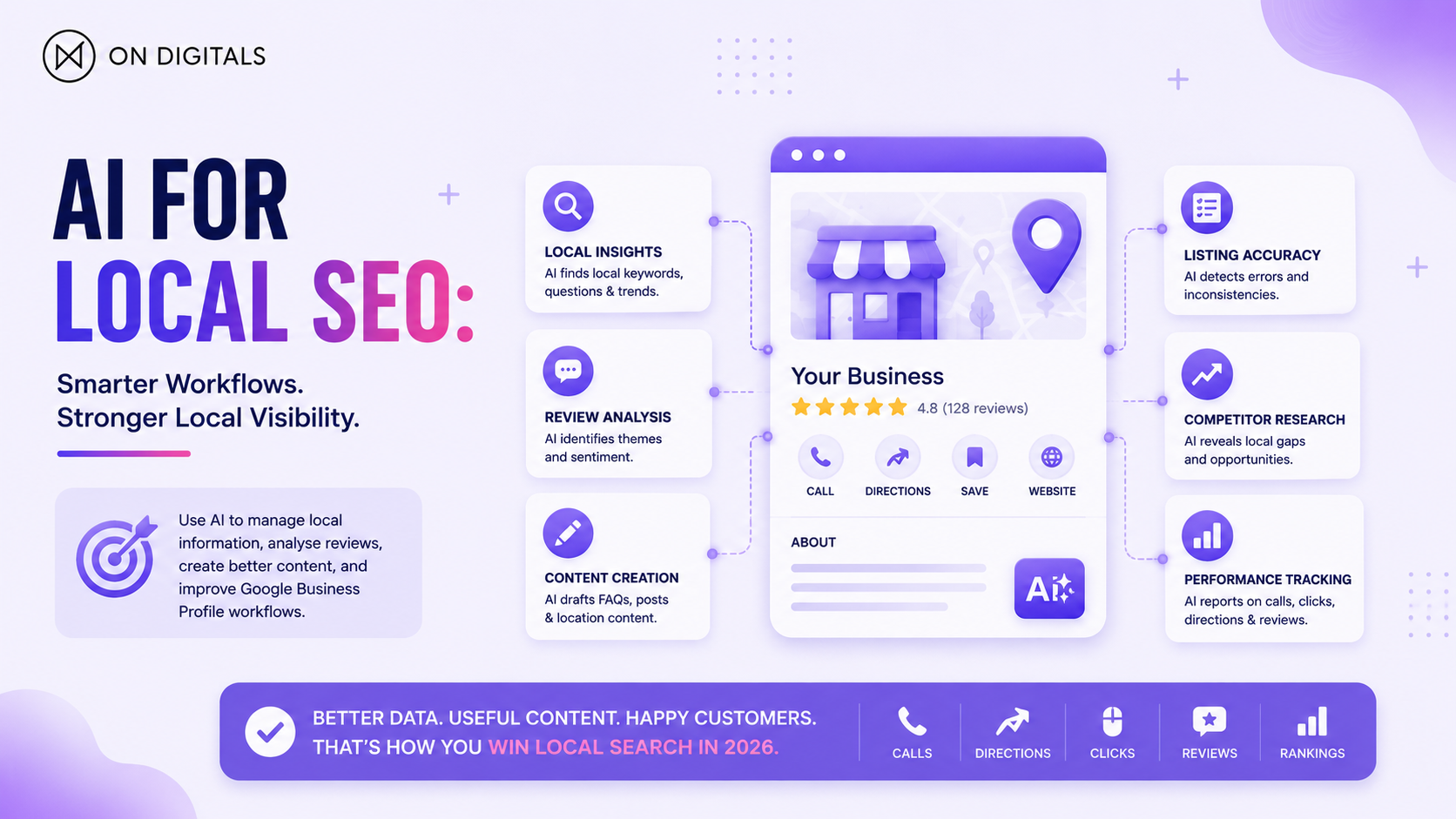
AI for local SEO supports smarter workflows across listings, reviews, local content, competitor research, and performance tracking.
Build accurate local data before using AI
AI cannot fix a weak local data foundation. Before using AI for local SEO content or automation, confirm that your business information is complete and consistent.
Check every location for:
- Business name.
- Address.
- Phone number.
- Opening hours.
- Service areas.
- Primary and secondary categories.
- Website and booking links.
- Products or services.
- Accessibility details.
- Payment options.
- Attributes that customers may search for.
These details should match across your website, Google Business Profile, Google Maps, social profiles, review sites, directories, franchise pages, partner pages, and industry listings.
SOCi’s guide to AI for local SEO highlights listing accuracy as a key issue for multi-location businesses. This is important because conflicting information can confuse customers and reduce confidence in the business.
For a single-location company, a monthly check may be enough. Multi-location brands need a more structured governance process, including ownership rules, approval workflows, and regular audits.
Use AI to improve Google Business Profile workflows
Google Business Profile is one of the most important local visibility assets for businesses with a physical location or service area. AI can help teams keep profiles active, useful, and more consistent, but public updates still need human approval.
Use AI to support:
- Drafting Google Business Profile posts.
- Creating first drafts for service descriptions.
- Finding missing profile fields or attributes.
- Summarising customer questions.
- Preparing Q&A ideas.
- Drafting review-response templates.
- Identifying repeated review themes.
- Planning seasonal local updates.
Simplified SEO Consulting’s article on AI and Google Business Profiles also focuses on how AI can support profile updates, review analysis, and local search workflows.
A safer process is:
- Give AI verified business information.
- Ask it to create a draft only.
- Check facts, pricing, availability, and service claims.
- Add local context and brand voice.
- Approve manually before publishing.
- Review performance and improve the workflow.
Do not let AI publish opening hours, promotions, service availability, or customer-facing claims without a human review. Incorrect information can create poor customer experiences and damage trust.
Create local content that AI systems can understand and cite
AI search systems need clear signals about what a business does, where it operates, who it serves, and how customers can take action. This is where AI for local SEO connects with AIO and GEO.
Your local content should answer natural customer questions, such as:
- What services do you offer in this area?
- Which districts, suburbs, or service areas do you cover?
- Are you open now, on weekends, or during holidays?
- Do you offer same-day service?
- What should customers expect before booking?
- Do you provide parking, delivery, accessibility, or payment options?
- How is your service different from nearby alternatives?
Useful local content can include:
- Unique location pages.
- Service-area pages.
- Local FAQs.
- Neighbourhood guides.
- Seasonal service pages.
- Local event content.
- Customer stories with real context.
- Decision guides for local buyers.
- Helpful comparison pages.
Avoid generating hundreds of nearly identical location pages. Replacing one city name with another does not create genuine local value. Each page should include relevant details such as local service availability, directions, staff expertise, customer needs, location-specific FAQs, nearby landmarks, or area-specific proof.
Zozimus’ AI local SEO strategy guide recommends using AI to support local keyword research, content planning, Google Business Profile activity, seasonal campaigns, and performance tracking. Use AI to speed up research, then add facts and local expertise before publishing.
Use AI to plan seasonal local demand
Seasonal demand matters for many local businesses. Search behaviour may change because of weather, holidays, school schedules, local events, travel, or industry-specific buying cycles.
AI for local SEO can help you identify recurring seasonal topics and plan content before demand peaks.
Examples include:
- Clinics preparing content around allergy season or holiday skincare needs.
- Home-service businesses planning ahead for heat, storms, or maintenance periods.
- Restaurants creating content around local events, group bookings, or holiday menus.
- Retailers align local promotions with seasonal demand and store availability.
Use this checklist before creating seasonal local content:
- Identify local seasonal queries and customer concerns.
- Check whether the business can actually provide the service or offer.
- Create a useful page, post, FAQ, or Google Business Profile update.
- Add clear location details and relevant calls to action.
- Share the content through local channels.
- Track calls, clicks, bookings, and direction requests.
- Review what worked before planning the next season.
The goal is not to produce more seasonal content. The goal is to publish the right information before customers need it.
Use AI for review management without losing trust
Reviews influence how customers evaluate a local business before visiting, booking, or calling. AI can help businesses process large volumes of feedback and identify recurring themes, but sensitive public responses still need people.
AI can help with:
- Grouping reviews by sentiment.
- Identifying repeated complaints.
- Summarising praise for staff, service, products, or delivery.
- Drafting first-response templates.
- Flagging urgent negative reviews.
- Identifying review themes that may affect operations.
- Finding useful customer language for FAQs or service improvements.
Human review is still needed for:
- Serious complaints.
- Legal, financial, medical, or regulated topics.
- Refund disputes.
- Private customer information.
- Public responses involving blame or conflict.
- Brand-sensitive situations.
Do not automate public review responses without approval. A generic response can make a complaint worse, while an inaccurate response can create compliance or reputational risk.
AI can help teams respond faster, but it cannot replace empathy, accountability, or real operational improvements.
Choose AI for local SEO tools by business need
There is no single best AI tool for every local business. Tool selection should follow the workflow you need to improve.
SEO.AI’s guide to local SEO tools compares tools for tasks such as Google Business Profile management, local keyword research, citation consistency, review monitoring, local rank tracking, content optimisation, and reporting.
Start by identifying your main need:
- Use Google Business Profile for core local presence.
- Use listing tools when citations and directory data are inconsistent.
- Use review tools when feedback volume is difficult to manage.
- Use rank-tracking tools when you need location-level visibility data.
- Use keyword and content tools when local pages or FAQs are weak.
- Use dashboards when you need to connect local SEO with calls, bookings, leads, and revenue.
For small businesses, a simple setup may be enough: Google Business Profile, a review workflow, local keyword research, and basic performance tracking.
For multi-location brands, the priorities may include:
- Central listing governance.
- Approval workflows.
- Location-level reporting.
- Review-response standards.
- Brand consistency.
- Scalable local content systems.
- Faster detection of outdated business information.
LSEO’s local SEO services page offers a service-led view of local visibility, including local search, listings, reputation, and local authority. The broader lesson is that tools only help when the underlying process has clear owners, standards, and business goals.
Top Tools That Use AI for Local SEO
Different AI tools can support different local SEO tasks:
- Semrush Local helps analyse local keywords, monitor rankings, and manage listings across platforms.
- BuzzSumo helps identify trending content, seasonal topics, and ideas relevant to local audiences.
- Brandwatch tracks brand mentions, local conversations, sentiment, and emerging trends across social channels.
- ChatGPT can draft local content, Google Business Profile posts, review replies, FAQs, and customer-support responses. Human review is still needed before publishing.
- Gemini can support local keyword research, data analysis, content planning, and location-based topic ideas.
Using the right mix of tools can reduce manual work and improve local SEO workflows. Accurate business information, useful local content, and human oversight still matter most.
Step-by-step AI for local SEO workflow
Step 1: Audit your local foundations
Review Google Business Profile, location pages, citations, reviews, schema, service areas, and business details.
Step 2: Identify customer questions
Use AI and keyword research tools to group local queries by location, urgency, season, service type, and customer intent.
Step 3: Prioritise high-value locations and pages
Choose the locations, services, or pages with the strongest commercial value. Do not optimise every location at once.
Step 4: Draft AI-assisted local content
Use AI to create outlines for local FAQs, location pages, Google Business Profile posts, review templates, and seasonal content. Add real local details before publishing.
Step 5: Improve listings and review workflows
Use AI to find data gaps, classify feedback, and suggest drafts. Keep human approval for public information and sensitive customer communication.
Step 6: Track business outcomes
Monitor local rankings, map visibility, calls, direction requests, website clicks, bookings, review trends, branded search, and qualified leads.
Common mistakes when using AI for local SEO
Publishing generic AI content:
Generic local pages do not create trust. Add verified services, local context, customer proof, specific FAQs, and practical information.
Treating AI as a ranking shortcut:
AI can improve efficiency and consistency. It cannot guarantee rankings, local-pack visibility, citations in AI answers, or customer trust.
Letting AI update critical business information:
Opening hours, prices, service areas, appointments, and offers require human verification before publication.
Creating duplicate pages for every location:
Each location page should have meaningful differences. Add local services, local proof, directions, customer needs, staff details, or area-specific content.
Ignoring reviews and reputation:
AI can summarise feedback, but it cannot fix poor service experiences. Use review insights to improve operations and customer communication.
Measuring rankings without conversions:
Track calls, bookings, clicks, direction requests, lead quality, and customer feedback alongside local rankings.
Metrics to review before scaling AI workflows
Before expanding AI for local SEO, check:
- Profile completeness.
- Listing accuracy.
- Location-page engagement.
- Local ranking and map visibility.
- Website clicks from local search.
- Calls and direction requests.
- Review volume and average rating.
- Review response rate.
- Branded search growth.
- Bookings, leads, and qualified enquiries.
These metrics show whether local SEO is improving customer discovery and business outcomes, not only keyword positions.
FAQ
What is AI for local SEO?
AI for local SEO is the use of artificial intelligence to support local search tasks such as keyword research, Google Business Profile management, review analysis, location-page planning, listing audits, competitor research, and reporting.
Can AI improve a Google Business Profile?
AI can draft posts, service descriptions, Q&A ideas, and review replies. A person should still verify business details, opening hours, offers, categories, and tone before anything is published.
Can AI help a business appear in AI search results?
AI can help a business create clearer local content, organise FAQs, improve listing consistency, and identify missing information. These improvements may make the business easier for AI systems to understand, but they do not guarantee a citation or recommendation.
Can AI write local landing pages?
Yes, but the content should not be published without editing. Add verified facts, local services, unique proof, customer context, images, and FAQs to avoid generic or duplicate pages.
What should local businesses measure beyond rankings?
Track calls, directions, website clicks, bookings, reviews, local-page engagement, branded search, lead quality, and conversion performance.
Is AI for local SEO useful for multi-location brands?
Yes. AI can support listing consistency, review workflows, local content planning, and location-level reporting. Human governance is still essential for business facts, customer communication, and quality control.
Build a more reliable local visibility strategy
AI for local SEO works best when it strengthens the local systems your business already needs: accurate location data, useful content, credible reviews, clear customer information, and consistent measurement.
The goal is not to automate local SEO blindly. It is to help your team make better decisions, maintain stronger local signals, and create content that customers, search engines, and AI systems can understand.
Explore SEO Services or Search and AI Marketing to build a local visibility strategy that connects AI-assisted workflows with measurable business growth.

NEWEST POSTS
- Advertising Industry In Vietnam: The 2026 Trends, Channels and Market-Entry Strategy
- Best SEO Company in Vietnam: Latest Shortlist For Businesses
- How To Leverage Social Media For Customer Service Like A Pro?
- Social Media Post Tips – 8 Ways To Boost Engagement
- How To Use Social Media for Sales – In-depth Beginner Guide
Read more