
Structured Data for SEO and GEO: A Practical Guide for SEO and Business Decisions
Vincent
08/10/2025
42
Structured data for SEO and GEO helps search engines and AI systems interpret the visible facts, entities, and relationships on your website more clearly. In 2026, it can support richer search presentation, stronger entity clarity, and more consistent machine-readable content. It is not a shortcut to rankings or AI citations, but it is an important technical layer for businesses that want to improve search visibility and prepare for AI-driven discovery.
For marketers, SEO teams, and website owners, the practical goal is simple: use the right schema for the right page, keep it aligned with the content users can see, and prioritise the pages that already influence leads, sales, bookings, or qualified traffic.
What does structured data for SEO and GEO mean and when does it matter?
Structured data for SEO and GEO means adding machine-readable markup, usually based on Schema.org vocabulary, to help systems understand what a page is about.
It can clarify important information such as:
- The organisation behind a website.
- The author of an article.
- A product, its price, availability, and identifiers.
- A local business location, opening hours, and contact details.
- A service and the audience it supports.
- A page’s place within a site hierarchy.
- A video, event, recipe, review, or article.
For SEO, structured data can help eligible pages qualify for supported rich-result experiences in Google Search.
For GEO, it can make entity information, product facts, authorship, services, and relationships easier for AI systems to interpret alongside the visible page content.
The important distinction is that markup does not replace content quality, authority, crawlability, or search intent. It helps machines interpret the information you already publish.
Passionfruit’s guide to AI-friendly schema markup offers a useful example of how schema can support clearer product, service, location, and organisation context across multiple markets.
Why structured data for SEO and GEO affects visibility, indexation, and conversions
Structured data does not directly guarantee rankings. Its value is more practical: it reduces ambiguity.
A search engine may be able to read a product page as ordinary text. But when product name, brand, price, availability, review information, and identifiers are clearly marked up and match the visible content, the page becomes easier to interpret consistently.
That can support:
- Eligibility for relevant rich-result features.
- Clearer product or service information in search.
- Better breadcrumb presentation.
- More reliable entity understanding.
- Easier content classification across large websites.
- More consistent data across templates, locations, and language versions.
- Better user confidence when search results show useful information before the click.
For ecommerce, structured data can help present product facts more clearly. For local businesses, it can reinforce location, service, and opening-hour information. For publishers, it can clarify articles, authors, dates, and topic relationships.
Digidop’s structured data overview correctly treats structured data as an indirect SEO lever: its impact is usually seen through improved clarity, enhanced search presentation, and stronger user engagement rather than a guaranteed ranking boost.
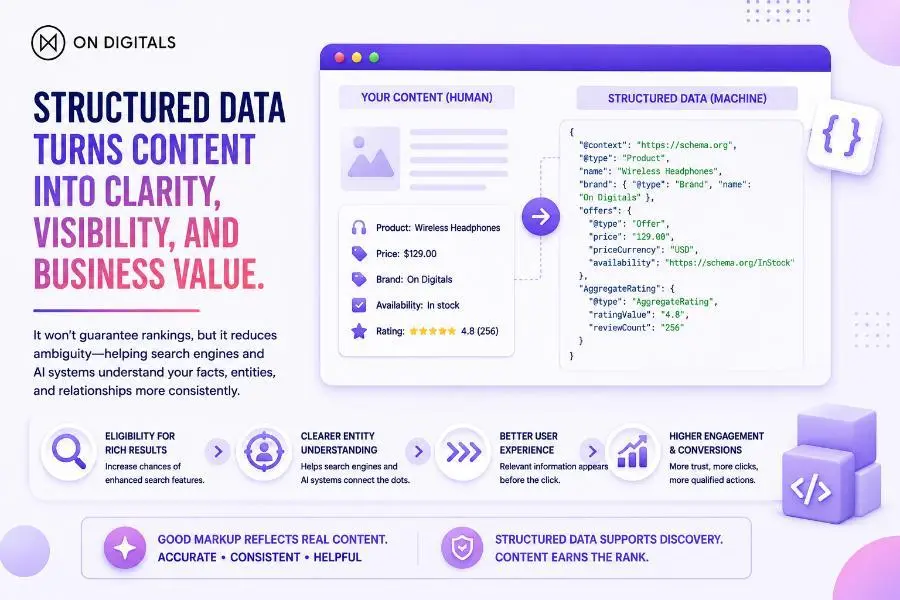
Structured data does not guarantee rankings, but it helps search engines and AI systems interpret your content, entities, and product facts with greater clarity and consistency.
Implementation patterns that are useful for AI-readable content
The best structured data is not the most complex markup. It is the markup that accurately reflects the page and gives machines useful context.
Start with the facts you want search engines and AI systems to understand consistently.
Use organisation and entity signals on core brand pages:
Your homepage and About page should clearly establish who you are.
Useful properties may include:
- Organisation name.
- Official website URL.
- Logo.
- Social or official profile links.
- Contact details.
- Founder or leadership information where relevant.
- Brand description.
- Parent or related organisation relationships.
This helps create a more consistent entity layer across your website and external brand presence.
Use article and author information for editorial content:
For blog posts, guides, and research pages, clarify:
- Headline.
- Author.
- Publisher.
- Date published.
- Date modified.
- Main image.
- Canonical page URL.
- Topic or article type where relevant.
This does not create an “E-E-A-T score.” However, clear author, publisher, and date information can help users and systems understand who created the content and when it was updated.
Use product and offer data for ecommerce pages:
For product pages, focus on information that customers can actually verify on the page:
- Product name.
- Brand.
- SKU, GTIN, or other identifiers where available.
- Price.
- Currency.
- Availability.
- Condition.
- Product variants.
- Review information when eligible and genuine.
Smartstore’s discussion of product data and AI search highlights an important ecommerce principle: product data should come from the same reliable source as the visible frontend data. Price, stock, variants, and product details should not conflict between your page and JSON-LD.
Use local and service information where the page supports it:
For businesses with physical locations or defined service areas, useful markup may include:
- Business name.
- Address.
- Telephone number.
- Opening hours.
- Service area.
- Geographic coordinates where relevant.
- Service details.
- Local landing-page context.
Do not create a LocalBusiness profile for a location that does not exist. For service-area businesses, make sure the page explains the real service area and business model clearly.
Mark up FAQs only when they are genuine:
FAQ content can still help users and improve page clarity. But do not add FAQ markup to invented questions or use it as a shortcut to gain more SERP space.
The FAQ must be visible on the page, useful to the user, and accurately represented in the markup.
Rich results, rich snippets, and featured snippets compared
These terms are often used interchangeably, but they are not the same.
Rich results:
Rich results are enhanced Google Search experiences that may use supported structured data. Depending on the page type, they can include product details, breadcrumbs, review information, recipe details, video enhancements, and other supported features.
A page can be eligible for a rich result without receiving one. Google decides whether and how a result appears.
Rich snippets:
“Rich snippet” is often used informally to describe an organic result that includes extra information, such as price, availability, ratings, or breadcrumbs.
In practice, it is safer to focus on whether your page is eligible for a Google-supported rich result rather than promising a particular visual result.
Featured snippets:
A featured snippet is a selected answer block that appears prominently in Google Search for some queries. It is not the same as a rich result and does not require schema markup.
Structured data can improve page clarity, but it does not guarantee a Featured Snippet, AI Overview citation, or any other specific search feature.
Opace’s comparison of schema, rich results, and AI search is useful because it frames structured data as part of a broader SEO, AEO, and GEO system rather than a standalone tactic.
Traditional SEO still has an indirect but measurable role
Structured data for SEO and GEO works best when the SEO foundation is already strong.
Schema cannot fix:
- A page that is blocked from crawling.
- Duplicate or thin content.
- Weak internal linking.
- Slow mobile pages.
- Poor product or service information.
- Low-quality reviews.
- Missing author credibility.
- Content that does not match the user’s search intent.
Traditional SEO remains the infrastructure that helps search engines discover, render, index, and evaluate your content.
Focus on:
- Crawlability and indexability.
- Logical site architecture.
- Clear internal linking.
- Canonical tags.
- Mobile usability.
- Fast page performance.
- Descriptive headings.
- Helpful, accurate content.
- Relevant backlinks and brand signals.
- Clear conversion paths.
Coast Technology’s perspective on schema and quality signals supports the broader idea that machine-readable information needs to work alongside content quality and user value. Markup without a useful page will not create durable visibility.
A step-by-step implementation framework for marketers and SEO teams
Step 1: Audit the pages that matter most
Start with pages that drive revenue, qualified traffic, bookings, product sales, or lead generation.
Review:
- Homepage and About page.
- Key service pages.
- Product pages.
- Category pages.
- Location pages.
- High-performing articles.
- Content templates used across the site.
Do not begin by adding every possible schema type to every URL.
Step 2: Match the schema type to the visible page purpose
Choose the markup that best describes the content users can see.
Examples:
- Organisation markup for company identity.
- Article markup for editorial content.
- Product and Offer markup for products.
- LocalBusiness markup for real locations.
- BreadcrumbList for navigational hierarchy.
- VideoObject for supported video pages.
- FAQPage only for genuine, visible FAQs.
Use the smallest accurate set of relevant markup. More schema is not always better.
Step 3: Map each schema property to a source of truth
Before generating JSON-LD, identify where every value comes from.
For example:
- Product price from the ecommerce database.
- Availability from inventory data.
- Article author from the CMS.
- Location address from a verified business record.
- Review information from an approved review system.
This prevents stale or conflicting markup.
Step 4: Use JSON-LD as the practical default
JSON-LD is usually the easiest format to manage because it is separate from the visible HTML structure and can be deployed through templates, CMS fields, or development workflows.
Microdata and RDFa can still be valid options, but they are often harder to maintain when page layouts change.
Step 5: Generate and deploy carefully
You can generate basic markup manually, through a CMS, a plugin, or a schema-generation tool.
Automation can save time, but it still requires review.
Before publishing, check:
- Does the markup match visible content?
- Are required properties present?
- Are prices, dates, and availability current?
- Are product variants handled correctly?
- Is the schema type actually relevant to the page?
- Are there duplicate or conflicting schema blocks?
Omnia’s structured data playbook for GEO is particularly useful for this stage because it focuses on implementation patterns that make facts, entities, product data, and content relationships clearer for machine interpretation.
Step 6: Validate before and after publishing
Use validation tools to identify syntax errors, missing properties, and supported rich-result eligibility.
Check:
- Google Rich Results Test.
- Schema Markup Validator.
- Google Search Console URL Inspection.
- Search Console Enhancement reports.
- A crawler such as Screaming Frog for sitewide checks.
Validation does not mean Google will show a rich result. It confirms whether the markup is technically valid and whether Google can detect supported structured data.
Step 7: Maintain markup as content changes
Structured data is not a one-time implementation.
Recheck it after:
- CMS or template changes.
- Product price or stock updates.
- New product variants.
- Website migrations.
- Redesigns.
- Content rewrites.
- Changes to author, organisation, location, or service information.
- Plugin or automation updates.
Common mistakes, risks, and quality checks
Marking up information that users cannot see:
Markup should reflect the visible page content. Hidden or misleading information can create quality problems and may cause Google to ignore the markup.
Using the wrong schema type:
Do not use Product markup for a generic service page or Article markup for a category page without editorial content.
Choose the type that accurately describes the page.
Adding fake reviews, ratings, or FAQs:
Review and FAQ markup must represent genuine content. Do not create schema solely to chase visual enhancements in search.
Allowing price, stock, or location data to become outdated:
This is especially risky for ecommerce and multi-location businesses.
Use shared data sources and maintenance checks so your frontend content and structured data remain aligned.
Overloading pages with unrelated markup:
A page can contain more than one relevant schema type, but the markup should tell a coherent story.
Avoid stacking unrelated entities simply because they are available in Schema.org.
Treating schema as a substitute for SEO:
Structured data helps interpretation. It does not replace strong content, technical SEO, user experience, internal linking, or brand authority.
Tools and metrics to review before publishing
Useful tools include:
- Google Rich Results Test for supported rich-result eligibility.
- Schema Markup Validator for Schema.org syntax and vocabulary checks.
- Google Search Console for indexing, detected issues, and enhancement reports.
- Screaming Frog for sitewide extraction and QA.
- CMS schema plugins or generators for efficient implementation on standard templates.
- Google Analytics 4 for engagement, conversions, and landing-page performance.
Track metrics that reflect both technical health and business value:
- Pages with valid detected structured data.
- Errors and warnings by schema type.
- Rich-result impressions where available.
- CTR changes on relevant page groups.
- Organic conversions from marked-up pages.
- Product-page engagement and revenue.
- Local calls, directions, and bookings.
- Crawl and indexation issues after major changes.
Do not try to isolate all ranking gains or losses to schema alone. Review structured data as one layer within a broader SEO system.
FAQ
What is structured data for SEO and GEO?
Structured data for SEO and GEO is machine-readable markup that helps search engines and AI systems interpret visible content, entities, products, services, authors, and page relationships more clearly.
Does structured data improve rankings?
Structured data is not a direct ranking shortcut. It can help eligible pages qualify for supported rich results and clarify page context, but rankings still depend on relevance, quality, technical accessibility, authority, and user intent.
Which schema type should I use first?
Start with the schema that most accurately describes your highest-value pages. Common priorities include Organization, BreadcrumbList, Article, Product, LocalBusiness, Service, and VideoObject where relevant.
Is JSON-LD better than Microdata or RDFa?
JSON-LD is usually the most practical choice because it is easier to deploy and maintain separately from page HTML. Microdata and RDFa can still work, but they may be harder to manage across changing templates.
Does FAQPage schema guarantee FAQ rich results?
No. FAQ content may help users, but Google decides whether to show any rich-result feature. Only use FAQPage markup when the questions and answers are genuine, visible, and relevant to the page.
Can structured data help with AI search visibility?
Structured data can make important facts and entity relationships easier for systems to interpret. It does not guarantee an AI citation or recommendation. Strong content, authority, accurate information, and technical SEO still matter.
Build structured data around real business value
Structured data for SEO and GEO is most useful when it supports a clear business objective. Start with pages that matter commercially, mark up the information users can verify, validate the implementation, and maintain it as your website evolves.
The strongest strategy is not to add more code everywhere. It is to create a reliable semantic layer that supports useful content, technical SEO, clearer entities, and a better search experience.
Explore SEO Services or Search and AI Marketing to build a structured data strategy that supports both traditional search visibility and AI-driven discovery.

NEWEST POSTS
- Advertising Industry In Vietnam: The 2026 Trends, Channels and Market-Entry Strategy
- Best SEO Company in Vietnam: Latest Shortlist For Businesses
- How To Leverage Social Media For Customer Service Like A Pro?
- Social Media Post Tips – 8 Ways To Boost Engagement
- How To Use Social Media for Sales – In-depth Beginner Guide
Read more