
Can Google Identify AI Generated Content: Practical Guide for SEO and Business Decisions
Vincent
24/07/2025
48
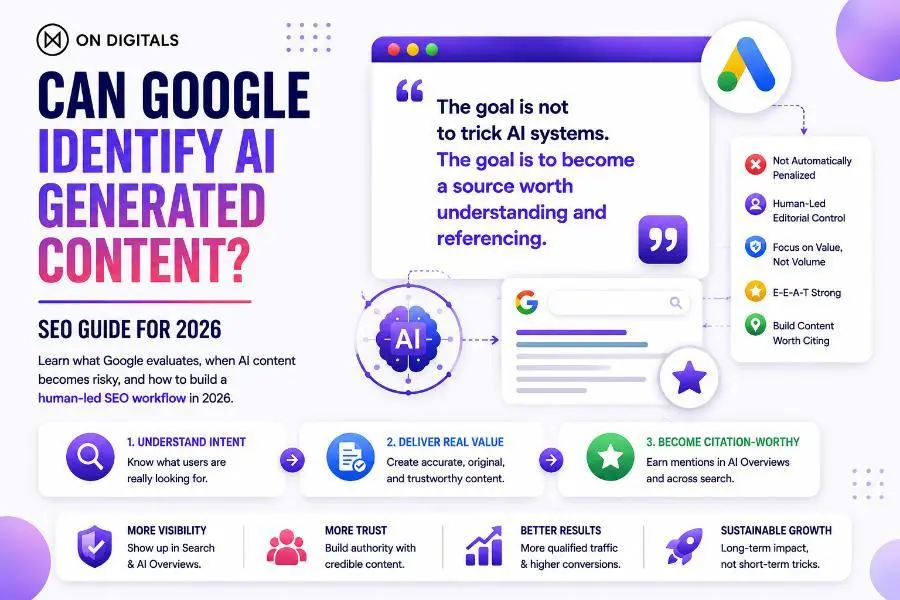
Can Google identify AI generated content? Google can address AI-generated content in search-quality and spam contexts, but it does not publish a universal detector that automatically penalises every page created with AI. For marketers and business owners, the practical issue is whether AI-assisted content is accurate, useful, original, and built for people rather than rankings alone.
In 2026, AI can speed up research, drafting, repurposing, and content operations. It can also make it easier to publish generic pages at scale. The difference lies in editorial control, subject-matter expertise, source verification, and whether the page genuinely helps a user make a decision.
What does “can Google identify AI generated content” mean and when does it matter?
The question “can Google identify AI generated content” often combines several different concerns:
- Can Google tell that AI was involved in creating a page?
- Can Google identify scaled or manipulative content?
- Can AI-assisted pages rank in Google Search?
- Will an AI-written article receive a manual action or lose visibility?
- Does Google treat AI content differently in AI Overviews or other generative search experiences?
These questions are related, but they are not the same.
Google does not state that every page using ChatGPT, Gemini, Claude, or another model will be detected and treated negatively. Its published guidance focuses on whether content is helpful, reliable, people-first, and not created mainly to manipulate rankings.
That means AI assistance is not automatically a problem. A page becomes risky when it is mass-produced, repetitive, inaccurate, misleading, copied from existing coverage, or published without a genuine reason to exist.
The more useful question is not, “Can Google identify AI generated content?” It is:
Does this content provide a trustworthy answer that a real person would find more useful than the alternatives already available?
Why this topic affects rankings, indexation, user experience, and conversions
AI-assisted content can underperform even when it is technically indexable and contains the right keywords.
A page may fail because it:
- Repeats information already covered by competitors.
- Gives a generic answer without real examples or experience.
- Contains outdated, incomplete, or unsupported claims.
- Does not match the user’s search intent.
- Uses the same structure and language across many pages.
- Lacks clear authorship, accountability, or brand context.
- Creates confusion between similar pages on the same site.
- Offers no practical next step for the reader.
This affects more than rankings. Weak content can reduce trust, create poor lead quality, confuse sales teams, and increase the risk of customers acting on inaccurate information.
For businesses operating in regulated, financial, health, legal, or high-consideration categories, the cost of poor AI content is even higher. An inaccurate explanation may not only perform badly in search; it can damage credibility with prospects.
Google’s AI-content guidance explains that using automation to create content primarily for ranking manipulation violates its spam policies. The key issue is not whether a human typed every sentence. It is whether the content exists to help users or to manufacture search visibility.
AI Overviews are answering questions. Will they cite your brand?
AI Overviews and other generative search experiences can answer part of a user’s question before they visit a website. That creates a new visibility challenge: users may receive the answer, compare options, or narrow their choices without clicking every result.
The goal is not to “trick” AI systems into citing your pages. The goal is to become a source worth understanding and referencing.
To improve your chances of being evaluated as useful, your content should make clear:
- What problem the page solves.
- Who the content is for.
- Which entity, product, service, or location it discusses.
- What evidence supports important claims.
- What makes the explanation more useful than a generic summary.
- Who is responsible for the content.
- When information was last reviewed or updated.
This is where AEO, GEO, and AIO overlap.
A strong AI-ready page often starts with a direct answer, then explains the context, trade-offs, evidence, and next action. It uses clear headings, accurate entities, relevant internal links, and original information that cannot be recreated by simply asking an AI tool for a generic article.
The legal-industry discussion in Attorney at Law Magazine’s guide to AI content is especially relevant for high-trust sectors: credibility depends on more than volume. It depends on responsible claims, accountable expertise, and content that reflects the realities of the service being offered.
For broader visibility planning, connect this work with Search and AI Marketing rather than treating AI search as a separate publishing channel.
How will Google address AI content that spreads misinformation or contradicts reliable consensus?
Google does not need to prove that every sentence came from AI to address harmful or low-quality content.
Its systems can evaluate pages through signals related to relevance, usefulness, spam patterns, page quality, technical accessibility, and the broader context of a site. For sensitive topics, search quality also depends heavily on accuracy, reliable sourcing, clear accountability, and whether the content reflects credible expertise.
This matters because AI tools can produce fluent language that sounds confident even when it is incomplete or wrong.
A safe AI-assisted workflow should therefore treat factual verification as mandatory, especially when content covers:
- Health, legal, financial, or safety decisions.
- Product claims and specifications.
- Pricing, availability, or service limitations.
- Regulations, policies, or compliance requirements.
- Scientific, historical, or statistical claims.
- Advice that could materially affect a customer’s decision.
Google’s guidance about AI-generated content reinforces a practical principle: quality and usefulness matter more than whether a page was created with a particular tool.
Do not use AI as a substitute for expert judgment. Use it to support a process that includes evidence, review, and clear responsibility.
AI-generated content for professional services: benefits, risks, and 2026 priorities
AI can be valuable for law firms, agencies, clinics, financial firms, B2B providers, and other professional-service businesses. It can help teams organise research, summarise interviews, develop outlines, create content variations, identify question clusters, and improve editorial efficiency.
But professional-service content has a higher burden of proof.
The best use cases include:
- Creating a first-draft outline from an approved brief.
- Turning expert interviews into structured content.
- Grouping recurring customer questions.
- Reformatting existing approved content for different channels.
- Finding missing definitions, examples, or comparison points.
- Supporting internal QA and content refresh planning.
The risky use cases include:
- Publishing unreviewed legal, medical, financial, or compliance guidance.
- Inventing case studies, testimonials, statistics, or quotes.
- Creating hundreds of city or service pages with only minor wording changes.
- Using AI to make claims the business cannot substantiate.
- Rewriting competitor content without adding original value.
- Producing content for queries outside the brand’s genuine expertise.
A professional-service website should show clear signs of accountability:
- Real author, reviewer, or subject-matter expert information.
- A visible business identity and contact details.
- Specific examples or relevant experience.
- Accurate service descriptions.
- Source links where claims need verification.
- Editorial review for high-risk pages.
- Clear updates when information changes.
This is more useful than trying to “humanise” AI text with arbitrary rewrites. Good content is not defined by whether it sounds less like AI. It is defined by whether it is accurate, specific, accountable, and useful.
AI watermarking and AI detector scores are not SEO quality checks
AI watermarking, content provenance, and AI detection are often confused with Google Search ranking systems.
Google’s tools for identifying AI-generated media focus on helping people understand how certain AI-generated or AI-edited media was created. That is not the same as saying Google Search uses those tools to rank or penalise every website that uses AI.
Similarly, third-party AI detectors can estimate whether text resembles patterns associated with certain models. They cannot reliably tell you whether Google will rank, demote, index, or manually penalise a page.
Do not use an AI-detector score as your main publishing gate.
A score may be useful as a prompt to review repetitive phrasing or over-generic writing. It is not proof of originality, expertise, quality, or SEO safety.
Instead, assess whether the page:
- Answers the target intent fully.
- Includes verified facts.
- Adds original examples, reasoning, or experience.
- Has an accountable author or reviewer.
- Matches the brand’s real services and expertise.
- Avoids unsupported claims.
- Connects naturally to related internal content.
- Gives the reader a useful next step.
What Google can assess more reliably than AI authorship
Google does not need a perfect AI detector to identify low-value content at scale.
It can assess outcomes and patterns that matter to search quality, including whether a site appears to publish repetitive pages, whether the content satisfies users, whether claims are misleading, and whether pages exist mainly to capture rankings.
This is why can Google identify AI generated content should not become an exercise in trying to hide tool usage.
The more relevant business risks are:
- Thin pages targeting many keyword variations.
- Content with no first-hand insight or unique angle.
- Large-scale template pages with minimal differentiation.
- Inaccurate or fabricated claims.
- Weak topic coverage.
- Duplicate or cannibalising URLs.
- Missing author and business context.
- Poor internal linking and unclear site architecture.
- Content that does not earn trust after the click.
Search Engine Journal’s review of evidence around AI-content detection is useful for understanding the debate, but it does not establish that Google has a universal detector for all AI-written pages. The practical conclusion remains the same: build content that can withstand editorial and quality scrutiny.
A step-by-step AI-assisted content framework for SEO teams
Step 1: Start with a real content brief
Define the target audience, search intent, business goal, page type, conversion path, key entities, claims that need sources, and internal pages that should be connected.
Do not begin with “Write 2,000 words about [keyword].” That approach produces generic output because the brief is generic.
Step 2: Research before prompting
Collect approved source material first:
- Product or service documentation.
- Expert interviews.
- Customer questions.
- Sales-call notes.
- Search Console queries.
- Industry research.
- Verified competitor gaps.
- Existing brand assets and positioning.
AI should work from a reliable information base, not from assumptions.
Filter Search Terms to Find Waste and Growth Opportunities
Step 3: Use AI for structure and first drafts
Ask AI to organise a brief, suggest question clusters, identify missing sections, propose alternative angles, or create a draft framework.
Then review the output for accuracy, intent fit, originality, and alignment with brand strategy.
Step 4: Add human expertise and original value
Add the material AI cannot create responsibly on its own:
- First-hand experience.
- Real case observations.
- Product/service nuance.
- Specific trade-offs.
- Expert explanation.
- Internal data.
- Customer objections.
- Decision criteria.
- Brand point of view.
Step 5: Run editorial and SEO quality assurance
Review:
- Facts, dates, figures, and links.
- Unsupported or overconfident claims.
- Search intent.
- Duplicated sections.
- Brand voice.
- Entity clarity.
- Internal links.
- Title, meta, headings, and structured data.
- Conversion path.
- Accessibility and mobile readability.
Step 6: Publish, monitor, and refresh
Track performance after publishing, but do not assume every ranking change is caused by AI usage.
Review search impressions, clicks, conversion quality, engagement patterns, assisted conversions, indexation, and whether the page remains current as the topic changes.
Common mistakes, risks, and quality checks
Treating AI content as publish-ready:
AI output should be treated as a starting point. It may be well-written but still inaccurate, generic, incomplete, or misaligned with your brand.
Trying to “beat” AI detectors:
Rewriting every sentence to sound more human does not solve the real problem. Improve the substance: evidence, expertise, examples, and user value.
Publishing at scale without a reason:
Creating hundreds of pages can be appropriate when each page has genuine differentiated value. It becomes risky when pages are only minor variations created to capture search demand.
Using E-E-A-T as a checklist score:
E-E-A-T is a useful quality framework, especially for sensitive topics. It is not a single ranking metric you can optimise with a few badges or author boxes.
Mistaking a traffic drop for AI detection:
Traffic can decline because of competition, intent shifts, technical issues, outdated content, poor internal linking, indexing problems, seasonality, or a mismatch between content and user needs.
Ignoring the business decision behind the query:
A page that answers a basic question may still fail commercially if it does not help users compare options, understand constraints, or take the next step.
Tools, metrics, and examples to review before publishing
Use tools to support editorial judgment, not replace it.
Useful tools include:
- Google Search Console for queries, indexation, impressions, and clicks.
- Google Analytics 4 for conversion paths and assisted journeys.
- Semrush or Ahrefs for SERP analysis, content gaps, and keyword cannibalisation.
- Screaming Frog for technical QA, internal links, canonicals, and duplicate pages.
- Grammarly or editorial tools for clarity and consistency.
- Plagiarism tools for checking duplication risk.
- AI tools such as ChatGPT, Gemini, or Claude for research support, outlining, and draft assistance.
- Subject-matter reviewers for high-stakes claims.
Before publishing, ask:
- Does this page have a clear purpose beyond targeting a keyword?
- Are all important claims verified?
- Does it add something competitors do not?
- Is there real human judgment, experience, or analysis?
- Is the author, reviewer, or organisation accountable?
- Are internal links useful and contextually relevant?
- Does the page match the intended conversion stage?
- Would you be comfortable defending every major claim to a customer?
FAQ
Can Google identify AI generated content?
Google can address AI-generated content in search-quality and spam contexts, but it does not publish a universal detector that automatically penalises every AI-assisted page. The main risk is low-value, inaccurate, or manipulative content, not AI assistance alone.
Does Google penalise AI-generated content?
Google does not prohibit AI-generated content simply because AI was involved. Content can create risk when it violates spam policies, is generated at scale to manipulate rankings, or fails to provide useful value to users.
Can AI content rank in Google Search?
Yes. AI-assisted content can rank when it is helpful, accurate, original, technically accessible, and aligned with search intent. It should still be reviewed by people with relevant expertise.
Does Google use AI watermarking to rank websites?
Google’s AI-content provenance tools help identify certain AI-generated media. They are not proof that Google Search uses watermarking to rank or penalise every website page.
Should businesses disclose AI use in content?
Disclosure may be appropriate when users reasonably expect it, when the content involves sensitive decisions, or when legal, contractual, or industry requirements apply. The right approach depends on your business, audience, and content type.
How should SEO teams use AI safely?
Use AI to support research, outlining, drafting, repurposing, and QA. Keep humans responsible for factual accuracy, experience-based insight, editorial decisions, brand voice, and final approval.
Build AI-assisted content that earns trust, not just impressions
Can Google identify AI generated content? Possibly in certain search-quality contexts. But the sustainable SEO question is whether your page deserves visibility after a user reaches it.
Use AI to improve the speed and consistency of your workflow, then add the research, expertise, evidence, and editorial judgment that make your content useful to real people.
Explore SEO Services or Search and AI Marketing to build a content system that supports Google Search, AI-driven discovery, and measurable business growth.

NEWEST POSTS
- Advertising Industry In Vietnam: The 2026 Trends, Channels and Market-Entry Strategy
- Best SEO Company in Vietnam: Latest Shortlist For Businesses
- How To Leverage Social Media For Customer Service Like A Pro?
- Social Media Post Tips – 8 Ways To Boost Engagement
- How To Use Social Media for Sales – In-depth Beginner Guide
Read more