
E-E-A-T for AEO: How to Build Credible, AI-Ready Content
Vincent
16/09/2025
48
E-E-A-T for AEO helps businesses create answers that people can verify and trust. It brings together first-hand experience, subject-matter expertise, external reputation and transparent website practices. The aim is to make important information credible enough to support better search and buying decisions.
People now use Google, AI Overviews, ChatGPT and other answer tools to ask questions in plain language. They may want a quick definition or advice before contacting a provider. In each case, the answer requires clear context, useful proof and a source the reader can trust.
What is E-E-A-T for AEO?
E-E-A-T stands for Experience, Expertise, Authoritativeness and Trustworthiness. It is a quality framework used to assess whether content appears accurate and reliable. For AEO, E-E-A-T strengthens the quality behind an answer rather than acting as a shortcut to higher rankings or AI citations.
AEO differs from SEO, focuses on making content easier to understand when someone asks a direct question. It includes clear headings, concise explanations, useful examples and well-structured pages. However, a short answer needs to be accurate and supported by evidence.
For example, a page answering “How long does B2B SEO take?” should not simply say “three to six months.” A stronger answer explains that timelines depend on competition, website condition, content gaps and the sales cycle. It may also explain that technical fixes can create earlier improvements, while competitive service pages often need longer-term authority building.
This is where E-E-A-T matters. It helps a business show that its advice comes from real work, informed judgement and transparent information.
Why E-E-A-T matters for answer quality
E-E-A-T matters because answer engines need content that reduces uncertainty. A reader may only see part of a page in a search result or AI-generated response. The selected passage therefore needs to stand on its own without becoming misleading.
A trustworthy answer usually starts with a direct response. It then gives enough context to explain when the answer applies. If the topic involves an important decision, it should also show evidence, source material or expert review.
Consider the difference below.
|
Weak answer |
More trustworthy answer |
|
“SEO takes six months.” |
“SEO often takes several months because search engines need time to crawl, assess and compare updated pages. Technical fixes may show earlier progress, while competitive topics usually need sustained content and authority work.” |
|
“This tool is the best for B2B teams.” |
“This tool may suit B2B teams that need longer sales-cycle reporting, but suitability depends on CRM integration, reporting needs and team workflow.” |
|
“Our agency delivers strong results.” |
“Our team connects SEO, content, paid media and tracking around lead quality, so performance can be assessed beyond traffic alone.” |
The stronger examples do not sound more impressive because they use bigger claims. They sound more credible because they explain the conditions behind the claim.
For AEO, this matters at page level. A well-written heading, concise paragraph or FAQ can be useful only when it reflects real expertise. A generic answer may look polished, but it often gives readers no reason to believe it over similar content elsewhere.
Experience, expertise, authority and trust: What each one means?
The four parts of E-E-A-T work together, but they are not identical. A business can have skilled employees without being widely recognised. It can also have many mentions online without making its website transparent. Understanding the differences helps teams improve the right signals.
|
E-E-A-T element |
Main question |
Useful evidence |
|
Experience |
Has the creator done this work in real life? |
Case context, process notes, testing, screenshots or first-hand lessons |
|
Expertise |
Does the creator understand the topic deeply? |
Relevant role, specialist knowledge, qualifications or expert review |
|
Authoritativeness |
Do others recognise this source as credible? |
Earned mentions, expert quotes, relevant links or industry references |
|
Trustworthiness |
Can readers verify and rely on the information? |
Sources, disclosures, contact details, updated dates and clear policies |
Experience: show what has been learned in practice
Experience is about first-hand involvement. A person who has run a campaign, audited a website or implemented a tracking system can explain details that a generic summary often misses.
For example, an article about website migration should explain common risks from real implementation work. It might cover redirect mapping, tracking checks or pages that lose visibility after launch. It does not need to reveal confidential client data. It only needs to show that the advice comes from practical knowledge.
Case studies are useful when they include context. A reader should understand the starting problem, the approach taken and the lesson that came from the work. Screenshots, workflow examples and transparent process notes can also strengthen experience when they are relevant.
Expertise: explain the subject with accuracy
Expertise is about knowledge and judgement. A technical SEO article should be written or reviewed by someone who understands crawling, indexing and site architecture. A healthcare article should involve a qualified medical professional. The higher the risk of misinformation, the more important expert oversight becomes.
For business content, expertise may come from professional experience rather than formal academic credentials. A growth strategist may have deep knowledge of B2B demand generation. A paid media specialist may understand campaign structure and lead-quality measurement. The article should make this connection clear through the author’s role, experience and approach.
An author bio alone is not enough. The body of the content should demonstrate understanding through accurate explanations, appropriate examples and sensible limitations.
Authoritativeness: earn recognition beyond your own website
Authoritativeness refers to reputation. A business cannot fully declare itself authoritative. Authority becomes stronger when respected people, publications, customers or partners recognise the expertise independently.
This may include a relevant industry publication that quotes the team. It may include a customer review with specific context. It may also come from original research that other people find useful enough to reference.
Not every business needs coverage from a major global publisher. A specialist consultancy may build meaningful authority through niche industry communities, trusted partners or detailed educational resources. The important point is relevance. A link or mention should support the topic the business claims to understand.
Trustworthiness: make important information easy to verify
Trustworthiness is the foundation that supports the other three elements. A page can contain useful expertise, but readers may still hesitate if they cannot identify the business, contact the author or verify major claims.
A trustworthy website should make key information visible:
- The business name and contact details
- Clear service descriptions
- Named authors or reviewers where relevant
- Sources for important factual claims
- Updated dates for time-sensitive content
- Policies that explain how the business operates
Technical basics also matter. HTTPS, accessible pages and a clear website structure support a safe user experience. These features do not create expertise on their own, but they reduce friction and make the business easier to assess.
What makes an answer worth trusting?
An answer is more trustworthy when it does more than state a conclusion. It should give the reader enough information to understand why the conclusion is reasonable.
A strong answer-ready section usually has five parts.
|
Element |
Why it matters |
|
Direct answer |
Helps readers understand the main point quickly |
|
Relevant context |
Explains when the answer applies and when it may not |
|
Evidence |
Supports claims with sources, experience or a clear method |
|
Named responsibility |
Shows who created or reviewed the information |
|
Helpful next step |
Guides the reader toward a related question or decision |
For example, an article about improving organic traffic may begin by saying that traffic growth often requires technical fixes, stronger content and better alignment with search intent. It can then explain how each factor affects visibility. A final section may point readers to a more detailed guide.
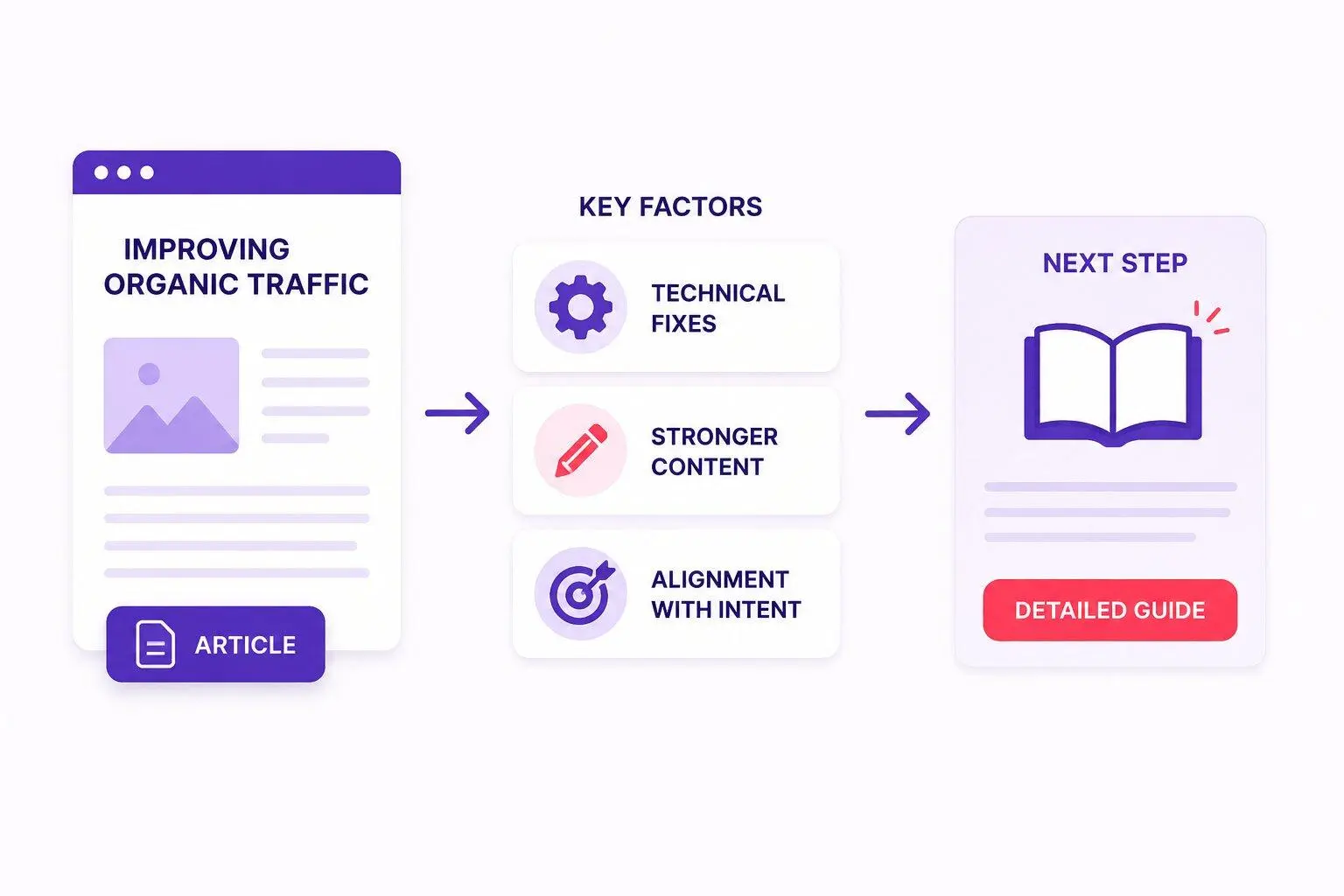
This structure helps readers who need a quick answer, while still serving those who need more detail. It also helps avoid the common problem of writing content that sounds confident but lacks explanation.
A practical E-E-A-T audit for existing content
Most businesses already have pages that can be improved. The first priority is not to rewrite every article. It is to identify pages that attract traffic, support important services or influence a buying decision.
A practical audit starts with six questions.
Does the page answer a real question?
A page should have a clear purpose. It may explain a concept, compare options or help a buyer evaluate a service. If the article tries to answer too many unrelated questions, the information can become vague.
Search queries, sales conversations and support questions are useful starting points. They show the language people use when they need help. The content should reflect that language without repeating keywords unnaturally.
Are important claims supported?
Claims need the right level of evidence. A general observation may only need a clear explanation. A claim about a platform, regulation, statistic or technical requirement should point to a credible source.
Primary sources are usually best for factual claims. This may include official platform documentation, research reports or original data. If the business has its own methodology, the page should explain how that method works rather than presenting it as an unsupported fact.
Is the author or reviewer relevant?
Not every article needs a long author profile. However, readers should be able to understand why the person creating the content is qualified to discuss the topic.
A technical guide can name the SEO specialist who reviewed it. A strategic article can identify the marketing lead responsible for the framework. A high-stakes topic may need a qualified professional reviewer. This creates accountability and makes the content easier to trust.
Is the business transparent?
A website should not make readers search for basic information. Service scope, contact details, business identity and policies should be easy to find. If a page includes affiliate links, sponsored content or a commercial relationship, it should disclose that clearly.
Transparency also includes stating limits. An agency cannot guarantee rankings. A tool cannot solve every workflow problem. A useful article says what the approach can support and what depends on other factors.
Is there relevant external validation?
External validation may come from reviews, independent references, industry partnerships or earned media. It should be relevant to the business and topic.
A software company might use verified customer reviews. A B2B agency may show a recognised industry feature or a partner reference. The goal is not to collect mentions for their own sake. The goal is to give buyers more confidence that the business is credible outside its own website.
Is the information still accurate?
Content becomes less trustworthy when old data, outdated screenshots or broken links remain visible. Regular updates are especially important for platform features, technical standards and changing market conditions.
Updating a date is not enough. A useful refresh checks the facts, examples, sources and recommendations. It should also remove advice that no longer reflects current practice.
E-E-A-T changes by topic and audience
Different topics need different forms of proof. A general marketing guide does not need the same evidence as a medical article. The goal is to match the level of trust-building to the decision being made.
|
Content type |
Most important E-E-A-T signal |
|
Technical guide |
Accurate documentation and implementation detail |
|
Service page |
Clear scope, process, team expertise and contact information |
|
Product comparison |
Transparent criteria, hands-on testing and balanced limitations |
|
Original research |
Clear methodology, sources and data context |
|
B2B strategy article |
Practical examples, decision logic and realistic expectations |
|
High-stakes advice |
Qualified authors, primary sources and careful wording |
Audience context matters too. A beginner may need a plain-English explanation before technical detail. A marketing manager may need process, measurement and implementation logic. A business owner may want to know what affects cost, risk or lead quality.
Good AEO content recognises these differences. It does not assume every reader needs the same answer in the same format.
Building authority beyond your website
On-page quality is essential, but a business also needs evidence that others recognise its work. This can come from relevant publications, trusted partners, expert interviews or customer reviews.
The strongest external signals are useful on their own. An original industry report gives journalists a reason to cite the business. A partner webinar can explain a shared solution. A detailed customer story can help buyers understand the practical impact of a service.
This is different from placing promotional content everywhere. LLM seeding for SEO can support the distribution of useful information across relevant channels, but the information still needs a clear source page, a genuine contribution and appropriate context.
Authority grows over time. It comes from repeated evidence that the brand understands its category and contributes something worth referencing.
How to measure E-E-A-T improvements for AEO
E-E-A-T should be measured through content quality, visibility and business value. There is no single public score that proves a website has strong E-E-A-T. Instead, businesses can monitor practical signals over time.
|
Measurement area |
What to review |
|
Content quality |
Author information, sources, first-hand proof and updated pages |
|
Search performance |
Impressions, clicks, rankings and query coverage |
|
Reputation |
Relevant links, earned mentions, expert references and reviews |
|
User value |
Engaged sessions, enquiries, qualified leads and assisted conversions |
Search data can show whether more people discover the content. Engagement and conversion data can show whether the content helps the right audience. External references can indicate whether the business is becoming more visible in relevant conversations.
These signals should be reviewed together. A page may receive traffic but still fail to create qualified demand. Another page may attract fewer visits but support important service enquiries. E-E-A-T is most useful when it supports better decisions, not when it becomes a separate reporting exercise.
Common E-E-A-T mistakes to avoid
One common mistake is treating E-E-A-T as a checklist. Adding an author box, a few external links and a trust badge does not improve weak content. The substance still needs to be useful, accurate and relevant.
Another mistake is publishing generic AI-written summaries without human insight. These articles may explain a topic at surface level, but they often lack first-hand detail, judgement or evidence.
Businesses should also avoid vague author claims. “Industry expert” means little unless the page explains the person’s relevant role or experience.
Other mistakes include:
- Using outdated statistics without checking the source
- Presenting marketing claims as proven facts
- Updating the date without improving the content
- Hiding service limitations or commercial relationships
- Building low-quality mentions that add no useful context
- Creating pages that repeat the same message without a clear purpose
The best safeguard is to ask a simple question: would this page still be useful if it did not rank immediately or appear in an AI response? If the answer is no, it needs more real value.
Frequently Asked Questions (FAQs)
Is E-E-A-T a Google ranking factor?
E-E-A-T is not a single ranking factor that can be measured as a score for each page. It is a quality framework used to assess whether content appears trustworthy and helpful. Businesses should use it as a standard for improving evidence, accountability and transparency across important content.
Does E-E-A-T guarantee an AI citation?
No. No content framework can guarantee that an AI tool will cite a page for a particular question. E-E-A-T can make content more credible and easier to assess, but source selection varies by platform, query and available information.
What is the difference between experience and expertise?
Experience comes from doing the work directly. Expertise comes from understanding the subject deeply. A person may have both, but they are not identical. A practical case study often demonstrates experience, while a clear technical explanation can demonstrate expertise.
Can a small business demonstrate E-E-A-T?
Yes. A small business can show E-E-A-T through clear service pages, named team members, genuine customer reviews and useful examples from real work. It does not need large media coverage to become credible within a specialist market.
Do author bios matter for every article?
Author bios are most useful when the topic requires specialist knowledge, involves important decisions or makes significant claims. A brief but relevant bio can show accountability. However, it should support strong content rather than replace it.
How often should E-E-A-T content be reviewed?
Review frequency depends on the topic. Pages about changing platforms, regulations or market data may need regular updates. Evergreen guides can be reviewed less often, but should still be checked when examples, sources or best practices change.
Build answer quality before chasing visibility
E-E-A-T for AEO isn’t a shortcut for winning one search result or forcing an AI recommendation. It is a way to build answers that are clear, evidence-based and accountable to the reader.
Start with the pages that matter most to your audience and business. Make the author, proof, source quality and service information easier to verify. Then build authority through useful contributions beyond your website.

NEWEST POSTS
- Advertising Industry In Vietnam: The 2026 Trends, Channels and Market-Entry Strategy
- Best SEO Company in Vietnam: Latest Shortlist For Businesses
- How To Leverage Social Media For Customer Service Like A Pro?
- Social Media Post Tips – 8 Ways To Boost Engagement
- How To Use Social Media for Sales – In-depth Beginner Guide
Read more