
AEO vs SEO vs GEO: How Businesses Balance Traffic, Answers and AI Visibility
Vincent
11/09/2025
26
AEO vs SEO vs GEO describes three related ways to improve digital visibility. SEO helps pages become discoverable in search results. AEO makes important answers clearer when people ask direct questions. GEO focuses on how a brand and its information are represented in generative search experiences. For most businesses, the right strategy is building the right mix for LLM optimization.
Search behaviour is becoming more varied. Someone may still type a short keyword into Google, compare options through a search results page or ask an AI tool a longer question. They may want a definition, a process or reassurance before making contact.
What is the difference between AEO and SEO?
SEO and AEO both help people find useful information. The main difference is where they place emphasis.
SEO, or Search Engine Optimization, focuses on making webpages easier to discover in search results. AEO, or Answer Engine Optimization, focuses on making the most important information on that page easy to understand as an answer.
AEO is not a replacement for SEO. A page cannot answer a question well if search engines cannot crawl it, index it or understand its relationship to the rest of the site. Likewise, a technically strong page may struggle to help users if it never answers the question that brought them there.
The two approaches work best together. SEO helps people and search systems discover the page. AEO helps the page explain its value quickly once it is found.
| Area | SEO | AEO |
| Main purpose | Improve organic discoverability | Improve answer quality and clarity |
| Typical user behaviour | Browsing, comparing and clicking | Asking a direct question and assessing the response |
| Main content focus | Search intent, topic depth and page relevance | Direct answers, context, proof and passage clarity |
| Important technical work | Crawlability, indexability, internal links and page experience | Accessible HTML, clear heading structure and visible key information |
| Useful metrics | Rankings, impressions, clicks and conversions | Priority-question coverage, answer accuracy, referral quality and assisted discovery |
| Common mistake | Chasing traffic without matching intent | Writing short answers without evidence or useful depth |
SEO should not be reduced to keywords and backlinks. Modern SEO also includes content planning, technical structure, page experience and business relevance. AEO should not be reduced to FAQs or schema. It is a way of making content more useful when users need a clear response before they are ready to click, compare or enquire.
A simple example shows the difference.
A traditional SEO page may target the phrase “SEO services Vietnam.” It should explain the service, rank for commercial searches and provide a clear path to contact the agency.
An AEO-ready version of the same page can also answer questions such as:
- What should an international company look for in an SEO agency in Vietnam?
- How does SEO support B2B lead generation?
- What affects the timeline of an SEO campaign?
- When should a company invest in technical SEO before content production?
The page remains one commercial page. It simply becomes more useful for the questions that buyers naturally ask.
SEO vs AEO vs GEO: where does each strategy fit?
SEO, AEO and GEO are widely used industry terms, but they do not have one universal definition. Different platforms and agencies may draw the boundaries differently. In this guide, they are used as practical working definitions.
SEO focuses on discoverability in search results. AEO focuses on answer-readiness. GEO, or Generative Engine Optimization, focuses on how a brand is understood and represented in generative search experiences.
GEO often includes work that happens beyond one page. It can involve brand positioning, original research, third-party references, reviews, expert content and consistent information across the web. Its purpose is to give people and systems enough reliable context to understand what the business does, who it helps and when it is relevant.
| Area | SEO | AEO | GEO |
| Main objective | Help pages earn visibility in search | Make important information easy to answer | Improve how a brand is represented in generative discovery |
| Primary focus | Relevance, technical quality, content depth and authority | Clear responses, context, evidence and page structure | Brand clarity, original proof, trusted references and consistent information |
| Typical discovery surface | Search results, featured snippets, local results and product results | Direct answers, People Also Ask, voice interfaces and AI-assisted search | Generative search experiences, AI summaries, chatbot results and research-heavy prompts |
| Content requirement | Comprehensive, relevant and technically accessible pages | Standalone answer sections with useful detail | Strong source pages plus credible supporting context beyond the website |
| Core business value | Organic traffic and qualified demand | Better answer quality during research and comparison | Clearer brand consideration in complex discovery journeys |
| Main risk | Optimising for rankings without serving the reader | Optimising for short answers without proof | Chasing mentions instead of building genuine relevance |
These strategies should not compete for budget as though they are unrelated channels. They often use the same core assets.
A service page with strong technical SEO can rank for a commercial query. If it answers common buyer questions clearly, it also supports AEO. If it includes original proof, clear author information and credible external references, it can also support GEO.
The difference is the job each layer performs.
SEO creates the conditions for discovery. AEO improves how the information is communicated. GEO extends the work into broader brand understanding and trusted context.
For Google specifically, the foundation remains useful, crawlable and indexable content. AI Overviews and AI Mode can surface supporting links for complex questions, but they do not require a separate “AI-only” website format.
Are AEO strategies more effective than traditional SEO?
AEO strategies are not automatically more effective than traditional SEO. Their value depends on the starting point of the business.
SEO should usually come first when a website has basic problems. A site that is difficult to crawl, poorly indexed, slow to load or disconnected by weak internal links needs an SEO foundation before it can benefit much from answer-focused optimisation.
AEO becomes more valuable when the foundation is already in place but the content still fails to answer important questions. This often happens on B2B websites. The service pages may contain the right keywords, yet buyers still cannot see how the service works, what makes the provider different or what conditions affect success.
GEO becomes more important when the business needs stronger context outside its own website. A brand may have useful pages but little evidence that other people recognise its expertise. In that situation, original research, expert commentary, customer proof and relevant third-party references may improve the wider picture.
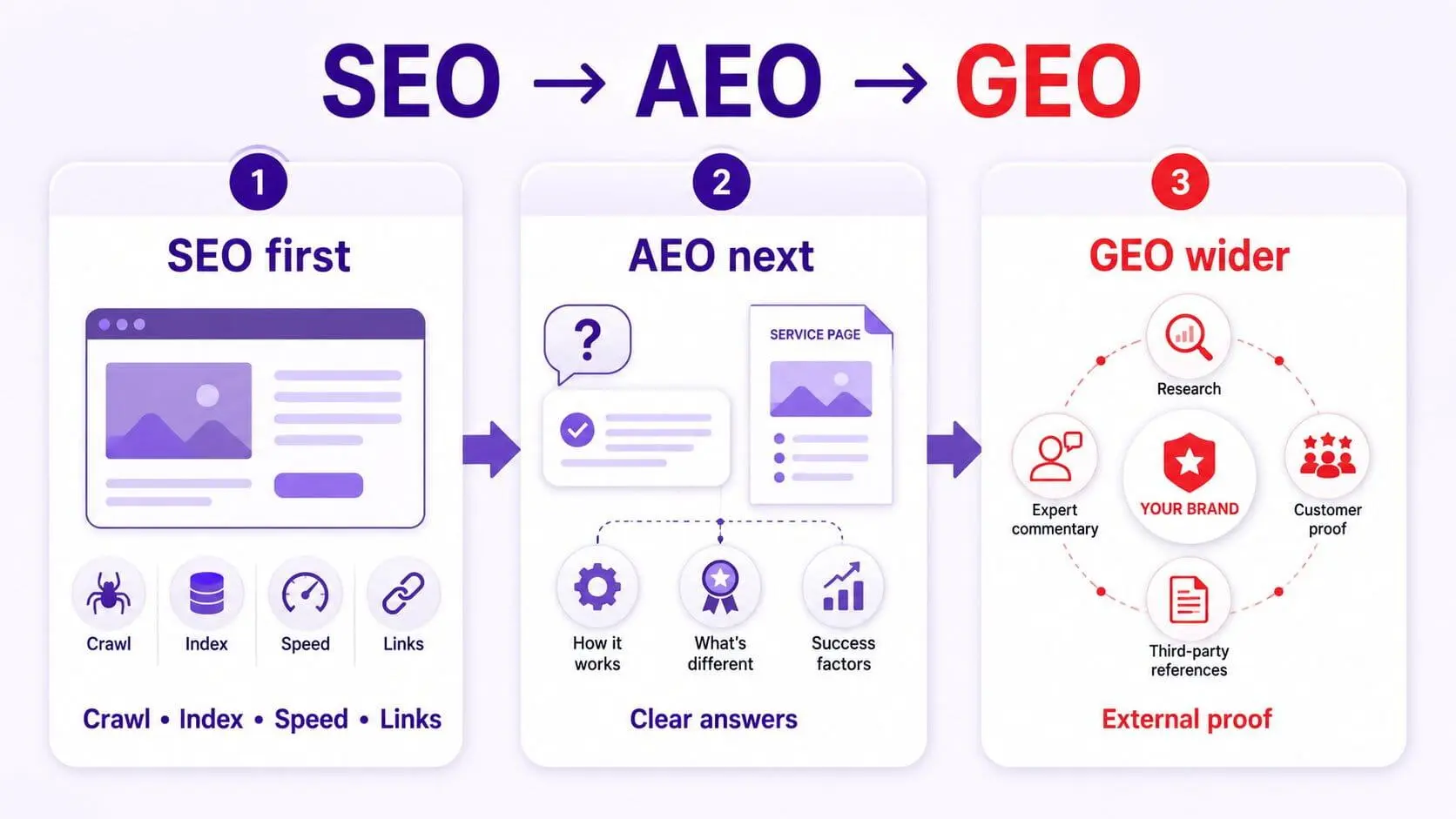
The question is not whether AEO is better than SEO. The useful question is: what is the biggest visibility constraint today?
| Business situation | First priority | Why |
| Website has crawlability, indexing or technical problems | SEO foundation | Search engines need to access and understand the pages first |
| Important pages rank but attract low-quality traffic | Search intent and content refinement | The page may not match what the visitor expects |
| Buyers ask detailed questions that the website does not answer | AEO content structure | Direct answers, comparisons and decision guidance are missing |
| Brand is unclear or described inconsistently | Positioning and core-page clarity | Users need to understand what the business offers and for whom |
| Brand has strong content but weak external credibility | GEO and authority building | The business needs proof beyond its own claims |
| Local or service business relies on urgent questions | Local SEO plus answer-ready pages | Users often search with direct, location-based needs |
| B2B company has a long sales cycle | Combined SEO, AEO and GEO strategy | Buyers need discovery, comparison, evidence and trust over time |
A company should not add AEO sections to every page just because AI search is growing. Some pages only need to rank for a simple commercial term. Others need detailed comparison tables because the buyer has a complex decision. The level of answer optimization should match the level of research involved.
For example, a page about “SEO services” needs a clear commercial explanation. A page about “SEO agency vs in-house team” should help buyers compare options. A page about “how long SEO takes” should explain the variables that affect timing. These pages work together, but they do not require the same format.
How SEO, AEO and GEO work together in one content system
The strongest strategy connects all three layers instead of treating them as separate projects. A business needs discoverability, answer quality and credible representation at the same time.
SEO creates discoverability
SEO helps priority pages become easier to find. It starts with technical basics, but it does not end there.
A healthy SEO foundation includes pages that search engines can crawl and index. It includes internal links that show how topics relate to one another. It includes content that matches the reason someone searched in the first place.
For a B2B company, this may mean creating a clear service page for a high-intent query. It may also mean publishing supporting guides that answer broader research questions. The guides help the business build topical relevance, while the service page gives commercial visitors a path to take action.
SEO also helps content remain accessible as the website grows. Without clear architecture, strong pages can become difficult to find. Without technical maintenance, search engines may miss important updates or spend time on low-value URLs.
This is why SEO remains the base layer. It makes the rest of the content system easier to discover and evaluate.
AEO improves answer quality
AEO focuses on the way a page responds to a question. It does not mean turning every article into a long FAQ. It means identifying the key decisions a reader needs to make and answering them in a clear order.
An AEO-ready section often starts with the answer. It then explains the context, conditions and next step.
For example, a section called “Should a B2B company invest in SEO or paid ads first?” should not begin with a broad introduction about digital marketing. It should state that the right choice depends on urgency, existing demand, sales cycle and website readiness. The following paragraphs can explain those factors in more detail.
This makes the content easier to scan, but it also makes the page more useful when someone arrives through a specific question. The reader does not need to search through several paragraphs to find the main point.
AEO also encourages clear entity language. Use the full name of an important platform or service when it first appears. Explain specialist terms in plain English. Avoid vague phrases such as “AI-powered growth” unless the page explains what that means in practice.
Evidence matters as well. A clear answer becomes more credible when it includes a source, a practical example, a stated limitation or a relevant expert perspective. This is especially important when the page discusses cost, timelines, technical requirements or high-stakes decisions.
GEO strengthens representation beyond one page
GEO looks at how the brand is understood in generative search and broader online research. It does not replace on-site content. It depends on it.
A company cannot build useful external visibility if its own service pages are unclear. Before seeking interviews, industry coverage or partner mentions, the business needs a source of truth. That means clear information about its category, audience, offer, methodology and proof.
Once that exists, GEO can extend the message through original research, customer stories, expert articles, relevant reviews and third-party references. Each asset should add a different kind of value.
A customer story can show practical experience. An industry report can provide data. A guest contribution can explain a useful point of view. A partner resource can show how the company fits into a broader solution.
The goal is not to place the brand name everywhere. Repeated, low-value mentions rarely help buyers understand why a business matters. A smaller number of useful, relevant references can be more valuable because they create context.
This work connects closely with fame engineering in GEO. Fame engineering focuses on building recognisable brand meaning. LLM seeding focuses on making reliable information available across relevant channels. Both should be grounded in authentic proof rather than citation chasing.
What should businesses optimize first?
A practical strategy begins with the most important gap, not the newest trend.
Many businesses have a mix of technical issues, weak content, unclear service pages and limited authority. Trying to fix everything at once often creates a long list of tasks without a clear commercial outcome.
Start with the pages closest to revenue or qualified demand. These may be service pages, category pages, comparison guides or high-traffic educational articles that influence later enquiries.
Then assess each page through three questions.
First, can people and search engines find it? This is the SEO question. Check indexability, internal links, search intent and technical quality.
Second, does it answer the reader’s likely questions? This is the AEO question. Check headings, direct answers, explanations, proof and next steps.
Third, does the brand have enough credible context around the topic? This is the GEO question. Check author expertise, case context, customer proof, external references and information consistency.
A simple prioritisation model can help.
| If the page has this problem | Improve this first | Example action |
| It has little visibility and weak rankings | SEO relevance and technical quality | Improve intent match, internal links and crawlability |
| It receives impressions but few clicks | Search-result relevance | Rewrite title, meta description and opening answer |
| It receives visits but users leave quickly | AEO structure and content clarity | Add direct answers, comparisons and clearer next steps |
| It supports a complex buying decision but lacks proof | E-E-A-T and GEO signals | Add expert perspective, case context and transparent evidence |
| It is mentioned externally but the website does not explain the offer clearly | Core-page clarity | Rewrite service scope, audience fit and process |
| It has old traffic but outdated information | Content refresh | Update sources, examples, screenshots and recommendations |
This approach prevents a common mistake: treating AEO as a separate campaign that begins only after SEO is “finished.” SEO is never completely finished. It needs maintenance as the site, market and search behaviour change.
The practical goal is to improve the page that has the strongest combination of business value and visibility opportunity.
A practical SEO and AEO strategy for B2B teams
B2B marketing often involves longer research cycles. Buyers may need to understand a problem before they compare providers. They may visit several pages, return later through a branded search and ask colleagues for input before contacting a company.
This is where a connected SEO and AEO system becomes especially useful.
1. Audit the technical and commercial foundation
Begin with the pages that matter most to the business. Check whether service pages are indexed, internally linked and aligned with the search terms that indicate commercial intent.
A page targeting “SEO services Vietnam” should not compete with a broad educational article about “what is SEO.” Each page needs a clear job.
The service page should explain the offer, the audience, the process and the outcome. The educational article can answer questions that help readers understand whether the service is relevant.
2. Map buyer questions around the sales journey
Keyword research shows what people type into search. Buyer-question mapping shows what they need to know before deciding.
A potential SEO client may begin with a broad question about organic traffic. Later, they may compare an agency with an in-house team. Closer to a decision, they may ask about reporting, timeline, cost drivers or lead quality.
These questions should not be forced into one long page. Group them according to intent. Use pillar pages for broad comparisons and spoke pages for deeper implementation topics.
This page is the pillar for the AEO cluster. It should help readers understand where AEO fits. The supporting guides should handle the detailed work.
3. Rewrite priority pages with direct answers and useful context
A strong page should make its main point early. It should avoid long introductions that explain the obvious before helping the reader.
Each important section can follow a simple pattern:
- A heading that reflects a real question or decision
- A direct answer in the opening lines
- Context that explains when the answer applies
- Evidence, an example or a framework
- A natural internal link to the next relevant topic
This pattern supports both readability and depth. It does not turn the page into a collection of disconnected snippets. The wider article still needs a clear argument and logical flow.
4. Add proof where the buyer needs reassurance
B2B buyers often need more than a definition. They want to know whether the provider understands their market, can explain the process and has experience with similar challenges.
Proof can take several forms. It may be an author profile, a project methodology, a customer story, original research or a transparent explanation of limitations.
The point is to make claims easier to assess. To further optimize AEO content, you need to adhere to the E-E-A-T framework.
5. Measure visibility and commercial impact together
A page can rank well but attract the wrong audience. It can also receive fewer visits yet influence important enquiries. This is why SEO and AEO reporting should not stop at rankings or screenshots of AI responses.
Track search performance, answer visibility and business outcomes together. Review which pages drive relevant sessions, which questions create engagement and which content supports qualified leads.
This creates a feedback loop. The team can then improve the content that matters rather than creating more articles simply because a keyword has search volume.
How should businesses measure SEO, AEO and GEO?
SEO, AEO and GEO need different indicators, but they should lead back to the same business question: is the content helping the right audience discover and evaluate the business?
| Area | What to measure | Useful data source |
| SEO | Rankings, impressions, clicks, organic sessions and conversions | Google Search Console, Google Analytics 4 |
| AEO | Coverage of priority questions, answer accuracy, source appearance and referral quality | Prompt library, manual checks, AI visibility platforms and analytics |
| GEO | Brand-description accuracy, relevant mentions, cited-source quality and referral patterns | Media review, reputation tracking, prompt monitoring and analytics |
| Business value | Qualified enquiries, assisted conversions, pipeline influence and sales feedback | CRM, analytics and sales reporting |
For Google Search, AI Overviews and AI Mode activity is included within normal Web reporting in Search Console. This means SEO teams should continue using Search Console as a core source of truth while also reviewing changes in query patterns, click-through rates and landing-page behaviour.
AEO measurement should begin with a controlled list of questions. Do not test random prompts every week and draw conclusions from one answer. Create a prompt library that reflects real buyer needs.
For each question, record the audience type, decision stage, platform, sources that appear and content gap identified. This makes it easier to see whether the business lacks a page, lacks proof or simply needs to rewrite an existing answer.
GEO measurement should focus on quality, not only volume. A brand may appear frequently but be described inaccurately. It may have several mentions but no connection to the use case that matters commercially. Review whether external coverage reinforces the right message.
The final layer is business impact. Search and AI visibility are useful only when they support meaningful discovery. Track engaged sessions, lead quality, assisted conversions and feedback from sales teams. These metrics show whether the content is attracting people who are likely to need the service.
Common mistakes when comparing AEO and SEO
One common mistake is treating AEO as the new version of SEO. AEO can extend an SEO strategy, but it cannot replace the need for search visibility, technical accessibility and useful pages.
Another mistake is treating every short answer as an AEO success. A page may answer a question in two sentences but still fail the reader if it gives no context, no evidence and no next step.
Businesses also sometimes assume schema alone makes a page ready for AI search. Structured data can help search engines understand eligible page types and support rich-result features when it matches visible content. It does not guarantee inclusion in AI Overviews, AI Mode or chatbot answers.
Other common mistakes include:
- Publishing a separate page for every small keyword variation
- Copying generic AI summaries without first-hand insight
- Chasing third-party mentions before improving core service pages
- Using vague claims such as “AI-ready” without explaining the work
- Treating one screenshot as proof of lasting AI visibility
- Ignoring local context, buyer stage and business relevance
- Updating publication dates without making meaningful content improvements
The best strategy is usually less dramatic. Improve the content that buyers need, make the page technically accessible and build proof that is useful beyond the website.
Frequently asked questions (FAQs)
Is AEO replacing SEO?
No. AEO does not replace SEO. SEO helps people and search engines discover useful pages. AEO improves how those pages answer direct questions once they are found. A strong AEO strategy still depends on technical quality, search intent, internal links and credible content.
What is the difference between SEO, AEO and GEO?
SEO focuses on organic discoverability in search results. AEO focuses on clear, answer-ready content for direct questions and AI-assisted search. GEO focuses on how a brand is understood across generative search experiences and trusted external sources. The three approaches overlap and work best as part of one visibility system.
Can one page support both SEO and AEO?
Yes. A well-structured page can rank for a search query and also answer related questions clearly. It needs a strong topic focus, useful headings, direct answers, accessible text and enough supporting detail to help the reader make a decision.
Do AEO strategies work better than traditional SEO?
Not by default. SEO is often the first priority when a website has technical, indexing or authority gaps. AEO becomes more valuable when the site already has useful content but needs clearer responses to complex buyer questions. The right balance depends on the business, audience and current website maturity.
Does schema improve AEO visibility?
Schema can help search engines understand eligible page types and may support rich-result features. It does not guarantee that content will appear in AI answers or direct-answer surfaces. The first priority is useful, visible content that is easy to crawl and matches the user’s question.
When should a business prioritise GEO?
A business should consider GEO when it has clear website content but lacks reliable external context. This may happen when the brand is poorly described, has limited proof outside its own site or operates in a category where buyers conduct detailed research before contacting providers.
How should B2B companies measure AEO?
B2B companies should measure AEO through a combination of priority-question coverage, search performance, referral quality and qualified leads. A prompt library can reveal content gaps, while Search Console, analytics and CRM data show whether answer-focused content supports real business outcomes.
Build search visibility before chasing AI mentions
SEO remains the foundation of digital discovery. It helps search engines find the right pages and helps businesses attract people who are already looking for a solution.
AEO strengthens that foundation by making important answers clearer, more useful and easier to verify. GEO extends the work by helping the brand build credible context across relevant sources and research journeys.
The strongest strategy does not choose between traffic, answers and AI visibility. It connects them. Start with a technically sound website. Improve the pages that matter most to buyers. Add direct answers, useful proof and clear internal paths. Then build wider recognition through content that others have a genuine reason to trust.

NEWEST POSTS
- Advertising Industry In Vietnam: The 2026 Trends, Channels and Market-Entry Strategy
- Best SEO Company in Vietnam: Latest Shortlist For Businesses
- How To Leverage Social Media For Customer Service Like A Pro?
- Social Media Post Tips – 8 Ways To Boost Engagement
- How To Use Social Media for Sales – In-depth Beginner Guide
Read more