
Fame Engineering in GEO: How Brands Build AI Availability
Vincent
06/10/2025
24
Fame engineering in GEO is the work of making a brand easier to distinguish and consider across search, AI-assisted discovery and trusted third-party sources. It combines useful content and relevant distribution. The aim is to help people and AI systems recognise when a brand is a relevant option.
Search is no longer limited to a list of blue links. People increasingly use AI tools to ask broad questions and decide what to explore next. A business therefore needs to optimize for LLM, hence increase its digital reputation.
What is fame engineering in GEO?
Fame engineering in GEO is a brand-building approach that improves how clearly a business is represented online. It helps a brand become easier to recognise in relevant buying situations through useful content, consistent information, independent validation and genuine public interest.
The word “fame” can sound misleading. In this context, it does not mean going viral or becoming known by everyone. A specialist B2B company does not need mass-market celebrity. It needs to be memorable and credible to the people who may need its solution.
Traditional SEO still matters. A site needs pages that search engines can crawl and index. It also needs content that answers a searcher’s question. Fame engineering adds another layer. It asks whether the wider web gives enough context for people to understand what makes the brand different.
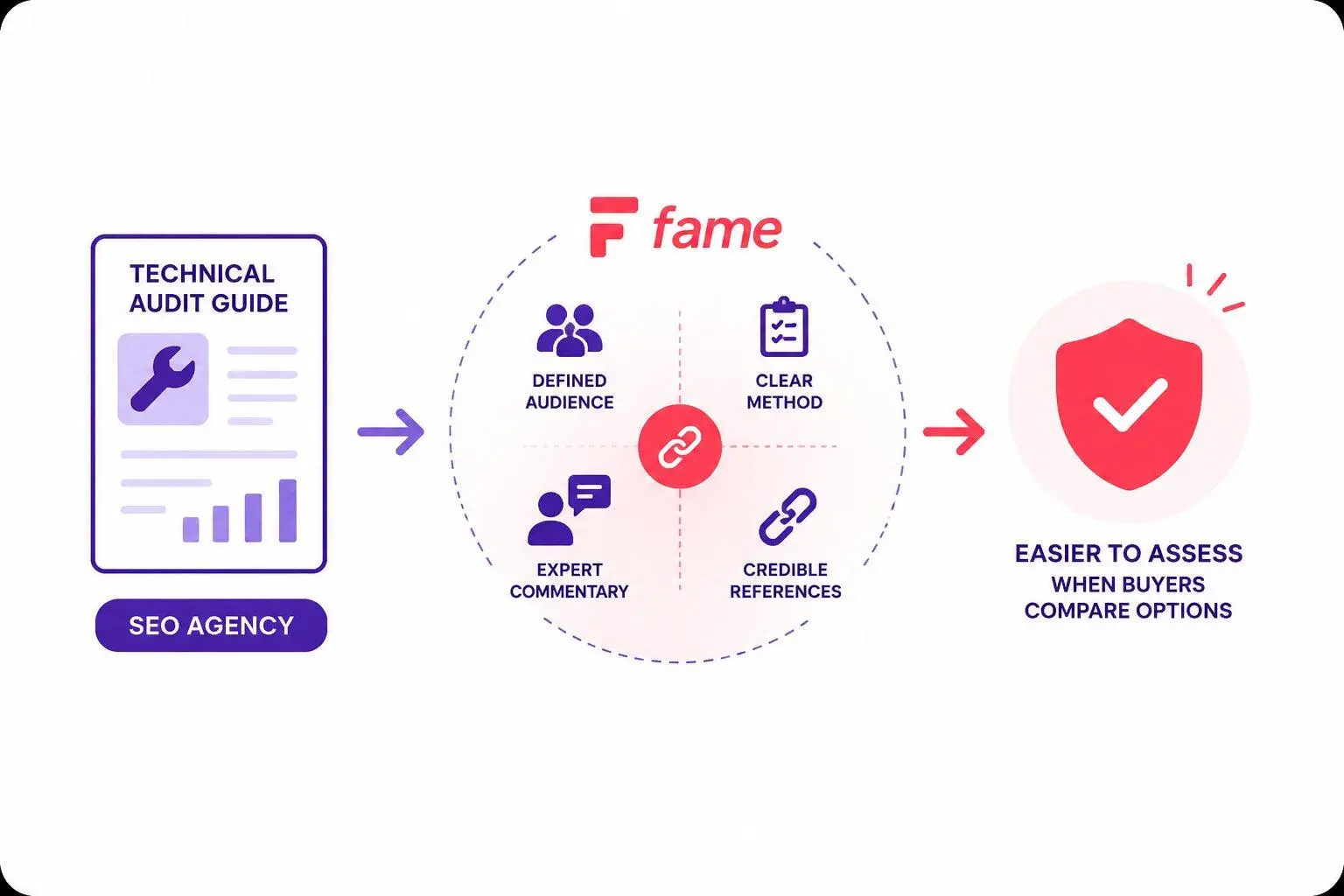
For example, an SEO agency may publish a useful technical audit guide. Fame engineering connects that guide with a defined audience, a clear method, expert commentary and credible references beyond the agency’s own website. This makes the brand easier to assess when a buyer is comparing options.
Fame engineering should not be treated as a way to manipulate AI answers. No business can guarantee that an AI tool will cite or recommend it for a particular query. The practical goal is more durable: create information that is accurate, useful and distinctive enough to support informed discovery.
Why fame engineering matters in AI-assisted search
AI-assisted search often responds to questions with more context than a short keyword. A user may ask for a solution in a certain industry, a comparison between options or a provider for a specific problem. To produce a useful answer, the system needs to understand the question and the available sources.
This is why fame engineering in GEO focuses on brand context. A brand is easier to assess when its category, audience, expertise and proof are clear. The same information helps a human buyer decide whether the business deserves a closer look.
A useful way to understand this is through three kinds of availability:
|
Type of availability |
What it means |
|
Mental availability |
A buyer thinks of the brand when a need arises |
|
Physical availability |
A buyer can access, contact or purchase from the brand easily |
|
AI availability |
AI-assisted search has enough accurate context to recognise when the brand may be relevant |
AI availability is not a guaranteed ranking factor or a public metric. It is a practical way to describe whether a brand has made itself understandable in the moments that matter to a buyer.
A company with vague service pages, inconsistent descriptions and little proof may be difficult to place. A company with clear pages, useful examples and relevant third-party references has a stronger foundation. That does not guarantee visibility, but it reduces uncertainty for both users and search systems.
Fame engineering vs SEO, AEO, GEO and LLM seeding
Fame engineering works with SEO, AEO and GEO. It does not replace them. Each activity solves a different part of the visibility problem.
|
Activity |
Main goal |
Main work |
|
SEO |
Improve organic discoverability |
Technical SEO, search intent, content depth and internal links |
|
AEO |
Make direct answers easier to extract |
Definitions, clear headings, FAQs and structured information |
|
GEO |
Improve readiness for generative search |
Entity clarity, source quality and helpful information |
|
LLM seeding |
Reinforce useful information across channels |
Canonical pages, credible third-party references and monitoring |
|
Fame engineering |
Build distinctive brand recognition |
Positioning, proof, digital PR and relevant public discussion |
SEO helps a business earn visibility when users search. AEO makes important information easier to understand quickly. GEO applies these principles to AI-assisted discovery. LLM seeding supports the distribution of accurate information across relevant channels.
Fame engineering looks at the full picture. It asks whether a brand is known for something specific, supported by proof and discussed in the right contexts. It is closely connected LLM seeding for SEO, but it should remain distinct. LLM seeding focuses on distributing information. Fame engineering focuses on the wider recognition and meaning of the brand.
The four building blocks of fame engineering
The current article’s four-pillar structure is worth keeping. Appeal, reach, distinctiveness and genuine engagement turn a vague idea of “brand awareness” into practical work.
1. Be useful in a real buying context
A brand becomes more relevant when it is connected to a problem people genuinely want to solve. A page should not only define a service. It should explain when the service matters, who it is for and what decision it helps the reader make.
An SEO provider, for instance, should go beyond “we improve rankings.” It should explain where SEO can help, such as entering a new market, improving weak organic visibility or supporting a complex B2B sales cycle. This connects the brand with a specific need.
2. Be distinctive enough to describe
Many businesses use the same claims: strategic, data-driven and customer-focused. These phrases rarely explain what makes one provider different from another.
Distinctiveness comes from details. It may be a method, industry experience, market knowledge, delivery model or point of view. A brand should be able to answer five questions clearly:
- What are we?
- Who do we help?
- What problem do we solve?
- Why might a buyer choose us?
- What evidence supports that choice?
These answers belong on service pages, About pages, case studies and partner materials. They should remain consistent even when the content angle changes.
3. Reach people through credible sources
Reach is not the same as publishing everywhere. An expert interview, customer review or industry article can be more valuable than many short promotional posts because it gives the audience a reason to pay attention.
Your website provides the source of truth. Independent publications add context. Review platforms show customer experience. Partners and communities can show where the brand fits in a real working environment. Choose channels based on where buyers research, not on where it is easiest to publish.
4. Give people a genuine reason to talk about you
Public interest cannot be manufactured with repetitive brand mentions. It grows when a business contributes something worth sharing. This may be original research, a useful tool, a strong expert opinion or a customer story with a clear learning.
A transparent audit framework, for example, can be useful to clients, partners and industry writers because it makes a complex process easier to understand. Links, conversations and branded searches may follow, but they are outcomes of usefulness rather than the sole purpose.
How to build fame engineering in GEO
Fame engineering works best as a sequence. Start with clarity on your own site. Then build proof and credible distribution. Measure the results before expanding the work.
Step 1: Audit how the brand is currently understood
Review the pages that explain your business, including the home page, About page, service pages, case studies and review profiles. Look for contradictions. One page may call the business a full-service agency while another presents a narrow specialist offer. That confusion makes it harder for a buyer to know what the company actually does.
Next, review sales questions, customer-support conversations and search queries. They reveal the language people use when they need help. Finally, test a small prompt set in the AI tools your audience uses. Look for inaccurate descriptions, competitor advantages and missing information. Do not treat one answer as a final judgment.
Step 2: Clarify your category, audience and differentiators
A buyer should not need to work hard to understand the business. State the category early. Explain the audience or use case. Then show the approach that makes the offer meaningful.
For On Digitals, this may mean explaining how SEO, content, paid media, tracking and Vietnam market context support one growth plan. For another company, the differentiator may be a specialist method or a narrow industry focus. Every important page should reinforce the same core facts while adding a relevant angle.
Step 3: Turn brand claims into useful proof
A claim becomes more credible when it is supported by evidence. “Experienced team” is a claim. A transparent process, expert biography, original research or detailed case context is proof.
Proof does not require a dramatic result. A useful implementation lesson can demonstrate expertise. A clear methodology can show how the team thinks. A customer story can explain the starting challenge, the work completed and the practical outcome.
Step 4: Build credible distribution beyond the website
Once the website gives a clear account of the brand, look for outside channels that add a different kind of value. Digital PR may support an original report. A partner article may explain a shared solution. A podcast can show the thinking behind a specialist approach. A community discussion can answer a real question without becoming a sales pitch.
Each asset should contribute a different layer of context. A review can show customer experience. An interview can show expertise. A guide can explain a process. A press mention can establish relevance in a wider market conversation.
A simple “fame map” can help. List the places where customers, partners and industry commentators learn about the category. Then identify missing but relevant points. The result may show a need for better review coverage, more expert commentary or clearer partner content. It should not become a list of platforms to spam.
Step 5: Measure visibility, accuracy and business value
Measurement should go beyond counting mentions. A brand can be mentioned frequently but described incorrectly. It can also appear for questions that never lead to commercial value.
|
Measurement area |
Useful question |
|
Brand understanding |
Is the business described accurately and consistently? |
|
Relevant visibility |
Does the brand appear for priority questions and buying contexts? |
|
Source quality |
Which pages or independent sources support the brand’s presence? |
|
Business value |
Are branded searches, referral visits, enquiries or qualified leads improving? |
Use a prompt library rather than random testing. Group prompts by definition, comparison, use case and provider evaluation. When you identify a gap, improve the most relevant source page or proof asset before creating more distribution content.
Content assets that support fame engineering
Fame engineering needs assets that make the brand easier to understand from different angles. The right mix depends on the buyer’s journey.
|
Content asset |
What it helps explain |
|
Service pages |
What the business offers and who it helps |
|
Comparison guides |
Where the offer fits among alternatives |
|
Case studies |
How the business approaches a real challenge |
|
Original research |
Why others may reference the brand |
|
Expert articles |
The experience behind the point of view |
|
Team and About pages |
Who is responsible for the work |
|
Reviews and testimonials |
What customers experienced |
|
Partner content |
How the brand fits within a wider solution |
Quality matters more than volume. A short, clear case study with real context can do more than a long article that says little beyond general advice.
Common fame engineering mistakes
Treating fame engineering as citation chasing
Citations may be helpful, but they are not the only sign that a brand is understood or trusted. A business that only optimizes for a quoted sentence may neglect the information that helps buyers make a decision.
Using generic positioning
If every competitor claims to be innovative, reliable and customer-focused, none of those claims create a memorable distinction. Use concrete language about the audience, method and proof instead.
Building off-site coverage before the core website is ready
A press mention may create interest, but visitors will leave if the service page does not explain the offer clearly.
Treating technical formatting as a shortcut
Clear headings, schema and internal links help search engines understand content. They cannot compensate for weak evidence or a confusing business message. Google AI Overviews SEO still depends on strong SEO foundations and helpful pages.
Measuring only visibility
Although appearing in every AI answer is important, becoming a relevant and credible option for the questions matters more to your business. And visibility only cannot represent that.
Frequently Asked Questions (FAQs)
What is fame engineering in GEO?
Fame engineering in GEO makes a brand clearer, more distinctive and better supported by useful information across its website and credible third-party sources. It helps people and AI-assisted search systems understand when the brand may be relevant. It is not a way to guarantee citations or recommendations.
Does fame engineering replace SEO?
No. SEO remains essential because pages need to be discoverable, crawlable and useful in search results. Fame engineering adds brand positioning, proof and credible distribution to that foundation. A strong strategy connects the two instead of treating them as separate activities.
How is fame engineering different from LLM seeding?
LLM seeding focuses on making helpful information available across owned and third-party channels. Fame engineering has a wider role. It focuses on whether the brand is distinctive, credible and associated with specific buying contexts. LLM seeding can be one tactic within a fame engineering strategy.
Can a small business use fame engineering?
Yes. A small business does not need a large PR budget or national awareness. It can focus on a narrow audience, a clear specialist offer and useful proof. Detailed local knowledge, credible reviews, expert advice and strong service pages can create meaningful recognition within a specific market.
How long does fame engineering take?
The timeline depends on the starting point, market and available proof. Improving an unclear service page can have an immediate effect on understanding. Building reputation through research, reviews, earned coverage and customer recognition usually takes longer. Treat the work as a continuous brand and search investment.
Build recognition on a useful search foundation
Fame engineering in GEO helps a business become easier to understand when buyers research a category through search or AI-assisted tools. It works best when the brand is specific about its audience, clear about its offer and willing to support claims with evidence.
The strategy does not replace technical SEO, helpful content or credible links. It makes those activities more connected by giving the brand a distinct role in the market. For businesses that want to strengthen this foundation, AEO services can connect technical clarity, authority and measurable organic demand.

NEWEST POSTS
- Advertising Industry In Vietnam: The 2026 Trends, Channels and Market-Entry Strategy
- Best SEO Company in Vietnam: Latest Shortlist For Businesses
- How To Leverage Social Media For Customer Service Like A Pro?
- Social Media Post Tips – 8 Ways To Boost Engagement
- How To Use Social Media for Sales – In-depth Beginner Guide
Read more