
LLM Seeding for SEO: A Practical GEO Framework for AI Visibility
Vincent
28/07/2025
25
LLM seeding for SEO is the process of making a brand’s useful information easier to discover and validate across its own website and trustworthy third-party sources. It supports visibility in AI-assisted search by connecting clear answers, proof and consistent brand information. It does not guarantee a mention or inclusion in model training data.
People now use tools such as Google AI Overviews, AI Mode, ChatGPT Search and Perplexity to ask questions and shortlist providers. A business therefore needs content that explains what it does, who it helps and why its claims deserve trust.
What is the definition of LLM seeding?
LLM seeding is a marketing term for publishing and reinforcing accurate brand information in places where people and AI search systems can find it. The goal is to give users reliable material that can support an answer when a relevant question is asked.
A practical LLM seeding strategy starts with a source of truth on your website. This may be a service page, a comparison guide, an original study or a detailed FAQ. It then supports that source with useful third-party references, such as an expert contribution, a verified review or a genuine answer in an industry community.
LLM seeding is also different from prompt seeding. Prompt seeding is an AI development technique that starts a model response with predefined text. LLM seeding for marketing is about brand information and discoverability. It does not involve controlling the answer that an AI system gives to every user.
It is also important to separate search visibility from AI training. Some AI platforms use different web crawlers for search and possible model training. Allowing a search crawler can help a page remain eligible for search experiences, but it does not make a citation automatic.
LLM seeding and GEO: Where it fits with SEO and AEO
LLM seeding and GEO work together, but they are not the same activity. Search engine optimization helps pages become discoverable in traditional results. Answer engine optimization makes key information easier to extract as a direct answer. Generative engine optimization focuses on how a brand is represented when an AI system assembles information from multiple sources.
LLM seeding adds a distribution and validation layer to that work. It helps a business make sure its message is not limited to one page or one platform. It also encourages the business to publish evidence that makes the message more credible.
|
Approach |
Main purpose |
What the work looks like |
|
SEO |
Improve organic discoverability |
Technical health, search intent, content depth and internal links |
|
AEO |
Make answers easier to extract |
Clear definitions, direct H2 answers, FAQs and structured information |
|
GEO |
Improve generative-search readiness |
Entity clarity, useful evidence, source quality and brand consistency |
|
LLM seeding |
Reinforce credible visibility |
Canonical content, third-party validation and prompt-based monitoring |
These activities should support one another. For example, a comparison article can rank through SEO, answer a narrow question through AEO, support an AI response through GEO and gain more trust when an independent expert or customer refers to it accurately.
A business should not treat technical shortcuts as an LLM seeding strategy. Standard SEO practices still matter for AI-powered search. A page needs to be crawlable, indexable and available as text. Useful structure and accurate schema can help search engines understand the page, but they cannot force AI systems to choose it.
How LLM seeding for SEO works in practice
A useful LLM seeding plan follows five connected stages. The first stage is research. The final stage is measurement. Skipping the middle stages usually creates scattered mentions without a clear source, proof or business purpose.
1. Map the questions customers actually ask
Start with questions that reflect a real decision. A basic definition prompt may help awareness. A comparison prompt can reveal consideration-stage demand. A provider shortlist prompt often shows stronger commercial intent.
For example, a B2B software company may track questions such as:
- What does [category] software do?
- How does [solution A] compare with [solution B]?
- Which providers support [specific use case]?
- What should a company check before choosing [service]?
Use customer calls, sales questions, search-query data and support conversations to build the list. This language often reveals a more complete need than a short keyword query.
2. Build one clear source of truth
Each important question needs a reliable page that your business controls. This page should define the topic early, explain the use case and show the limits of the solution. It should also answer the next question a buyer is likely to ask.
A strong source of truth usually includes:
- A direct definition near the top
- Clear service or product scope
- Evidence, methodology or author expertise
- Comparisons where buyers need them
- Helpful FAQs and a practical next step
The page should be specific enough that a reader understands the topic without opening five more tabs. Avoid vague claims such as “industry-leading” or “best solution.” Explain the work, process and conditions that affect results.
This is where on-page SEO supports LLM seeding. A useful page cannot contribute much to discovery if search engines cannot crawl it, users cannot understand it or internal links do not signal its role on the site.
3. Add proof that cannot be copied from competitors
AI-generated summaries are easy to create. Evidence is harder to replace. Original proof gives both readers and search systems a reason to choose your content over a generic summary.
Proof can take several forms. A marketing agency may explain its audit process. A software company may publish implementation lessons. A manufacturer may describe testing standards.
The key is accuracy. A useful proof point explains what happened, what affected the outcome and what the reader should learn from it.
4. Earn relevant third-party references
Third-party coverage should add context, not repeat your copy word for word. A guest article can share a useful framework. A customer review can describe a genuine experience. A partner resource can explain how two services work together. A community post can answer a question that people are already discussing.
Choose the channel based on the audience and the purpose:
|
Channel |
Best role in LLM seeding |
|
Your website |
Provide the detailed source of truth |
|
Industry publications |
Add independent expert context |
|
Review platforms |
Show verified customer experience |
|
Communities and forums |
Answer real questions with practical detail |
|
Video and webinar transcripts |
Demonstrate a process or explain a complex choice |
Do not buy fake reviews, scripted forum replies or copied guest posts. Contribute information that would still be useful even if your brand name were removed from the paragraph.
Where appropriate, a useful external reference can also support SEO link building. The priority should remain relevance and editorial value, not a target number of mentions.
5. Test prompts, measure results and improve the source
LLM seeding is not a one-time publishing task. AI answers change by platform, location, prompt wording and available sources. A business needs a repeatable way to see where it appears, which sources are used and what information is missing.
Create a prompt library with a manageable number of questions. Test those questions regularly in the AI platforms that matter to your audience. Record the answer, the sources shown, the competitors mentioned and the gaps you notice.
When a prompt produces an incomplete answer, improve the original source first. More external posts will not solve a weak canonical page.
LLM seeding template for a practical content plan
An LLM seeding template keeps the work focused on buyer questions and measurable outcomes. It also prevents teams from publishing content on every available channel without knowing why.
|
Field |
What to record |
|
Target prompt |
The question a buyer may ask an AI tool |
|
Search intent |
Definition, comparison, shortlist or implementation question |
|
Business priority |
Why this question matters to your audience or sales process |
|
Canonical page |
The main page on your website that should answer it |
|
Core message |
The specific point the reader should understand |
|
Proof needed |
Expert review, method, case context, customer feedback or source |
|
Distribution channel |
Publication, community, review platform, partner resource or video |
|
Owner |
Person responsible for creating or updating the asset |
|
Measurement |
Mention rate, cited source, referral visits, engagement or leads |
|
Next action |
Update the page, add proof, refine the prompt or stop the channel |
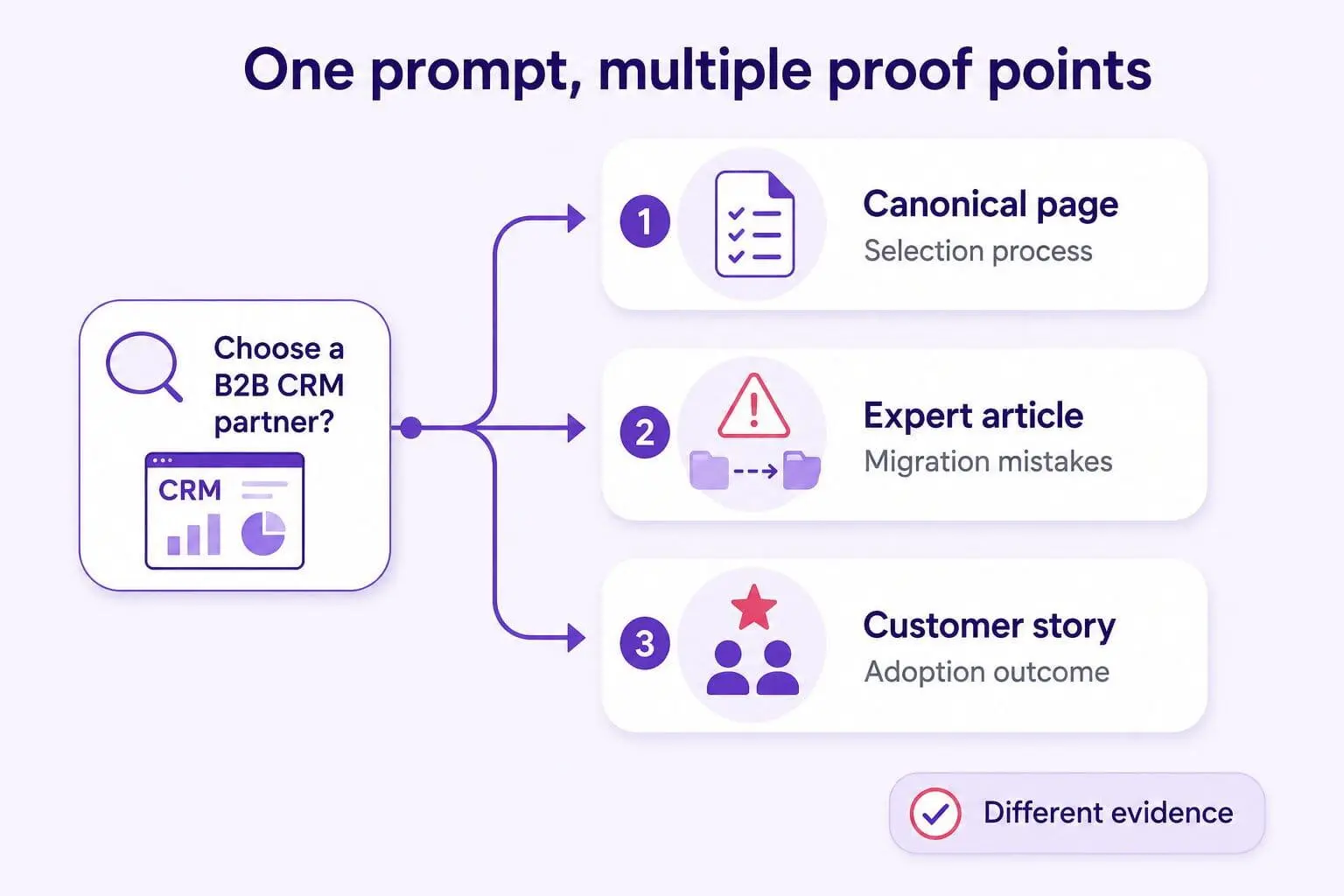
Here is a simple example. A company that sells CRM implementation may target the prompt: “How should a B2B company choose a CRM implementation partner?” Its canonical page could explain the selection process. A related expert article might focus on common data-migration mistakes. A customer story might show how the implementation team handled adoption. Each asset adds a different type of evidence.
Which content is most useful for LLM seeding?
The most useful content reduces uncertainty. It gives a reader a clear answer, then provides enough context to make the answer trustworthy. It does not need to be long for its own sake.
Definition pages are useful when a category is new or confusing. Comparison pages help buyers assess alternatives. Process guides help readers understand what will happen next. Case studies can show experience when they include enough context to be credible.
The format should match the question. Use a table for comparison, numbered steps when order matters and a short FAQ for recurring questions. Make the first paragraph under each heading answer the question directly.
How to measure LLM seeding results
LLM seeding should be measured through visibility and business value. A screenshot of one AI answer is not enough. It may be useful for diagnosis, but it does not show whether the work supports qualified demand.
Track four areas:
- Prompt coverage: How often does your brand appear for the priority questions you monitor?
- Source quality: Which of your pages or third-party sources appear in responses?
- Demand signals: Are branded searches, direct visits or relevant referrals changing over time?
- Business outcomes: Do visitors from these journeys engage, enquire or move further through the funnel?
Google includes traffic from its AI features in the Web search type in Search Console. Use Search Console and Google Analytics with prompt testing rather than treating any single metric as proof.
Common LLM seeding mistakes to avoid
The most common mistake is treating LLM seeding as a way to force citations. No legitimate strategy can guarantee that an AI answer will mention a brand. The goal is to improve the quality and availability of information that might support a relevant answer.
Other mistakes include:
- Publishing third-party content before building a strong source page
- Repeating the same brand message across every platform
- Confusing AI search visibility with model-training access
- Using schema as a shortcut instead of improving visible content
- Measuring only mentions and ignoring lead quality
A good test is simple: would the content still help a potential customer if no AI system ever cited it? If the answer is no, the content probably needs more practical value.
When should a business invest in LLM seeding?
LLM seeding is most useful for businesses with a considered buying journey. It can support brands that sell specialist services, B2B products or solutions that require explanation before a customer enquires.
It is also useful when a business has a solid SEO foundation but finds that its category is increasingly discussed through AI tools. The brand needs clear information and real proof.
Do not start with broad distribution if your website has unclear service pages, weak tracking or no evidence to share. Fix the fundamentals first. Then extend the content into the channels where your audience already looks for guidance.
Frequently Asked Questions (FAQs)
Is LLM seeding a replacement for SEO?
No. LLM seeding does not replace SEO. SEO helps people and search engines find important pages. LLM seeding helps reinforce useful information across a wider set of credible sources. The two approaches work best together because a clear, well-indexed website is usually the foundation for everything else.
What is the difference between LLM seeding, GEO and AEO?
AEO focuses on making information easy to answer directly. GEO focuses on how a brand may appear in generative-search experiences. LLM seeding supports both by publishing clear source material and earning relevant references. SEO remains the broader foundation for discoverability, technical health and organic demand.
Can LLM seeding guarantee a ChatGPT or Google AI Overview citation?
No. AI systems choose sources differently, and answers can change over time. A business can improve its eligibility by publishing useful, accessible and trustworthy information. It cannot guarantee that a particular platform will cite a page for a particular prompt.
Do I need a special schema or an AI text file for LLM seeding?
No special AI file or schema is required for Google AI features. Use structured data when it accurately matches the visible page content and helps search engines understand the page. The priority is still a crawlable, indexable page with clear text, useful structure and relevant evidence.
Is posting on Reddit, Medium or LinkedIn enough for LLM seeding?
No. These platforms can support distribution, but they should not replace your website. A business needs a controlled source of truth that explains its offering accurately. External content works best when it adds independent context, real experience or a useful perspective rather than repeating the same promotional message.
Build AI visibility on a foundation of useful information
LLM seeding for SEO is not about planting your brand name everywhere and hoping an AI tool repeats it. It is about helping people find reliable answers through clear website content, credible proof and relevant third-party context.
A stronger starting point is to improve the pages that explain your services, process and expertise. Then test the questions your audience asks, identify content gaps and build visibility with useful contributions. To connect this work with a wider organic strategy, explore AEO services with On Digitals.

NEWEST POSTS
- Advertising Industry In Vietnam: The 2026 Trends, Channels and Market-Entry Strategy
- Best SEO Company in Vietnam: Latest Shortlist For Businesses
- How To Leverage Social Media For Customer Service Like A Pro?
- Social Media Post Tips – 8 Ways To Boost Engagement
- How To Use Social Media for Sales – In-depth Beginner Guide
Read more