
Google Advanced Search Operators for SEO Research
Vincent
12/06/2024
28
Google advanced search operators are commands that help you narrow Google results with more control. They are especially useful during advanced keyword research because operators such as site:, quotes, minus, filetype:, intitle:, inurl:, before: etc. can uncover specific pages, files, topics, or SEO issues faster.
What are Google advanced search operators?
Google advanced search operators are symbols or commands added to a normal Google query. They help filter results by exact phrase, domain, file type, page title, URL, date range, excluded words etc.
For SEO teams, these operators are useful because they turn Google Search into a quick research tool. You can inspect indexed URLs, find internal link opportunities, check duplicate snippets, discover exposed files, review competitor content, or look for outreach prospects.
Google also has an official Advanced Search page, which lets users choose filters through a form instead of typing operators manually. The form supports fields such as exact words, excluded words, site or domain, file type, language, region etc.
Google Advanced Search page vs search operators
The Advanced Search page is useful when you want a visual form. Search operators are faster when you already know the command.
Use the Advanced Search page when:
- you want a beginner-friendly interface
- you need language or region filters
- you want to avoid typing syntax manually
- you are doing one-off research
Use search operators when:
- you repeat the same checks often
- you need SEO query combinations
- you want to inspect a specific domain
- you need faster research across many keywords
For example, the Advanced Search form can help someone search within a site or file type. A search operator can do the same thing directly from the search bar:
site:example.com filetype:pdf
Rules for using Google search operators
Search operators work best when the syntax is clean. Google’s help documentation explains that there should be no space between the operator and the search term. For example, site:example.com is the correct format, while site: example.com may not work as intended.
Use these rules before testing operators:
- Keep operators close to the search term.
- Put exact phrases inside quotation marks.
- Use a minus sign directly before excluded words.
- Combine operators only when the result still makes sense.
- Treat operator results as research clues, then validate important findings with Search Console, crawlers, or SEO tools.
Working, limited, and retired operators
Some operators are reliable enough for regular research. Others may return inconsistent results, especially older operators still mentioned in outdated lists. Ahrefs and SpyFu both separate operators by reliability, which makes their guides easier to trust than a flat list of commands.
|
Status |
Meaning |
Examples |
|
Working |
Reliable enough for regular research |
"phrase", site:, filetype:, before: |
|
Useful but limited |
Works, but results need manual review |
intitle:, inurl:, allintitle: |
|
Retired or unreliable |
May fail or return inconsistent results |
link:, info:, daterange: |
This distinction matters because an outdated operator can waste time during an SEO audit. If an operator fails, the issue may come from the command rather than the website being checked.
Essential Google advanced search operators
The operators below are the most useful starting point for SEO research.
Exact match: "search term"
Quotation marks tell Google to search for an exact word or phrase. Google’s search help lists quotes as the way to find exact matches.
"technical SEO audit"
SEO use case:
site:example.com "technical SEO audit"
This can help find pages on your site that already mention a target topic.
Exclude words: –
The minus sign removes results that contain a specific word or phrase. Google’s Advanced Search page uses the same idea through the “none of these words” field.
SEO audit -template
SEO use case:
"best SEO tools" -semrush
This can help review listicles that exclude a specific brand.
Site search: site:
The site: operator restricts results to a domain, URL, or URL prefix. Google Search Central describes site: as a way to request results from a specific domain or URL prefix.
site:ondigitals.com
SEO use case:
site:example.com/blog "keyword research"
This can help find internal linking opportunities inside a blog section.
Use site: as a quick inspection method, not a complete indexation audit. Search Console and crawlers are better for confirming index coverage, canonical issues, or template-level problems.
File type: filetype:
The filetype: operator searches for files in a specific format. Google Search Help lists filetype: as a supported search refinement, while the Advanced Search form also includes file type filtering.
site:example.com filetype:pdf
SEO use case:
site:example.com filetype:pdf "pricing"
This can help find public PDFs that may expose outdated, duplicate, or sensitive content.
Title search: intitle:
The intitle: operator searches for pages with a term in the title.
intitle:"write for us" SEO
SEO use case:
intitle:"guest post" "digital marketing"
This is useful for finding outreach pages, guest post opportunities, or topic-specific lists. Results still need manual review because title matching does not guarantee quality.
URL search: inurl:
The inurl: operator searches for pages with a term in the URL.
inurl:resources SEO
SEO use case:
site:competitor.com inurl:blog "technical SEO"
This can help inspect how competitors organize topic sections.
Date filters: before: and after:
Google Search Help lists before: and after: as ways to search before or after a date.
SEO trends after:2025-01-01
SEO use case:
site:competitor.com/blog after:2025-01-01 "AI SEO"
This can help find recent competitor content around a topic.
OR operator
OR asks Google to consider either term.
SEO audit OR technical audit
SEO use case:
site:example.com "SEO audit" OR "technical audit"
This can help find pages using different wording for the same topic.
Wildcard: *
The asterisk can act as a placeholder inside a phrase.
"best * tools for SEO"
This is useful for content ideation, but results can vary. Treat it as a discovery shortcut rather than a precise audit method.
Operators to use with caution
Older operator lists often include commands that no longer behave reliably. Keep these in a caution section instead of presenting them as normal working operators.
- link: — no longer useful for backlink research. Use Search Console link data or backlink tools instead.
- info: — unreliable for URL information.
- daterange: — use before: and after: instead.
- phonebook: — retired.
- blogurl: — retired or unreliable.
- cache: — availability can vary, so avoid treating it as a complete archive.
- related: — may be inconsistent, especially for smaller sites.
This cleanup is important for trust. Users searching for Google advanced search operators expect commands that still help them complete a task.
Google advanced search operator cheat sheet
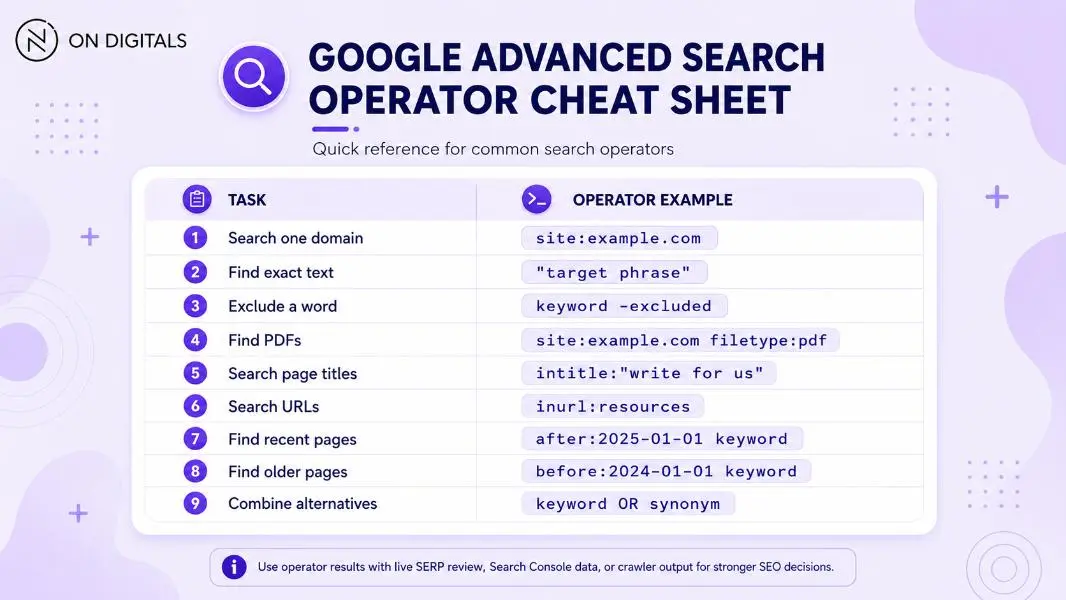 A quick reference for using Google advanced search operators to narrow results by domain, exact phrase, file type, page title, URL path, date range, and alternatives.
Use this as a quick reference. For SEO decisions, combine the operator result with live SERP review, Search Console data, or crawler output.
SEO use cases for Google advanced search operators
Google operators are most valuable when they answer a specific SEO question. Below are practical workflows that fit content audits, technical checks, competitor research, and outreach.
Find indexed pages on a domain
site:example.com
This gives a quick look at pages Google can return from a domain. To narrow the result, add a folder or keyword:
site:example.com/blog "keyword research"
Use this for fast inspection only. For a serious indexation review, confirm the issue in Search Console or with a crawl.
Find internal link opportunities
site:example.com "target keyword"
This query finds pages that already mention a topic. If the page is relevant, it may be a good place to add an internal link to a priority URL.
Example:
site:ondigitals.com "keyword strategy"
This can help content teams connect older articles to a newer hub or service page.
Find duplicate content snippets
"exact paragraph from your page"
Add site: when you want to check duplication inside one domain:
site:example.com "exact paragraph from your page"
This can help spot copied blocks, repeated descriptions, or template text that appears across too many URLs.
Find exposed files
site:example.com filetype:pdf
This query can uncover old PDFs, presentations, downloadable guides, price sheets etc. Add a keyword when the site has many files:
site:example.com filetype:pdf "case study"
Review whether those files should remain public, be updated, or be redirected to a stronger landing page.
Find non-secure pages
site:example.com inurl:http
This can help find URLs that still appear with HTTP patterns. It should be treated as a quick check, not a complete HTTPS migration audit.
Find guest post opportunities
intitle:"write for us" "digital marketing"
Other useful patterns include:
inurl:guest-post "SEO"
intitle:"contribute" "marketing"
Manual review matters because many guest post pages have low editorial quality.
Find competitor content by topic
site:competitor.com/blog "content strategy"
Add a date filter for freshness:
site:competitor.com/blog after:2025-01-01 "content strategy"
This helps identify recent competitor coverage and topic gaps. When the topic is still broad, start from a few seed keywords first, then use operators to inspect how competitors expand that topic across blog posts, resources, or landing pages.
Find brand mentions on community sites
"brand name" site:reddit.com
You can repeat the same pattern for forums, review sites, or Q&A communities. This is useful for brand research, audience language, pain points, and product feedback.
Find listicles that exclude your brand
"best SEO agencies" -ondigitals
This query can help identify commercial pages where your brand is missing. Review each result before outreach because some lists may be outdated or low quality.
How to validate operator findings
Google operators are research shortcuts. They should guide investigation, not replace validation.
Use this validation flow:
- Run the operator query.
- Save the URLs that matter.
- Check the page manually.
- Confirm SEO issues with Search Console, analytics, or crawler data.
- Decide whether the page should be updated, redirected, linked, removed, or ignored.
For example, site:example.com filetype:pdf may reveal old PDFs. The next step is not to delete every file. Review traffic, backlinks, business value, and replacement pages first.
Common mistakes when using Google advanced search operators
|
Mistake |
Why it causes problems |
Better approach |
|
Adding spaces after operators |
Google may read the query differently |
Use site:example.com, not site: example.com |
|
Treating site: as a full audit |
Results are only directional |
Confirm in Search Console |
|
Using retired operators |
Commands may fail |
Replace with current options |
|
Combining too many operators |
Results become too narrow |
Start simple, then refine |
|
Ignoring intent |
Results may not fit the SEO task |
Match the query to the use case |
A useful operator query should answer one clear question. If the result looks confusing, simplify the query and add filters one at a time.
FAQ about Google advanced search operators
Is site: accurate for checking indexed pages?
The site: operator is useful for quick inspection, but it should not be treated as a full indexation report. Use Google Search Console when the issue affects important URLs, templates, or migration checks.
What replaced daterange:?
Use before: and after: for date filtering. Google Search Help lists both operators for searching before or after a specific date.
Which operators are most useful for SEO?
The most useful SEO operators are usually site:, quotes, minus, filetype:, intitle:, inurl:, before:, and after:. They help with internal link research, file checks, competitor research, duplicate content review etc.
Can Google advanced search operators replace SEO tools?
They are useful for fast research, but they should not replace SEO tools. Use them to find clues, then validate important issues with Search Console, analytics, crawlers, or backlink tools.
Final thoughts
Google advanced search operators can uncover useful clues, but the real value comes from knowing which findings matter. On Digitals can help review indexed pages, exposed files, duplicate content, competitor topics, internal link opportunities etc. so quick search checks turn into clearer SEO actions.
If your team already uses operators but still struggles to prioritize fixes, we can connect those findings with Search Console data, content audits, and technical SEO checks to decide what should be updated, redirected, consolidated, or monitored.

NEWEST POSTS
- Advertising Industry In Vietnam: The 2026 Trends, Channels and Market-Entry Strategy
- Best SEO Company in Vietnam: Latest Shortlist For Businesses
- How To Leverage Social Media For Customer Service Like A Pro?
- Social Media Post Tips – 8 Ways To Boost Engagement
- How To Use Social Media for Sales – In-depth Beginner Guide
Read more