
Google Trends Alternatives: 7 Tools to Validate Search Demand and Content Ideas
Vincent
20/01/2026
13
Google Trends alternatives are tools that show keyword interest, audience demand, or content trends from data sources beyond Google Search. SEO teams, content marketers, and B2B strategists reach for them when Google Trends lacks absolute volume, regional depth, social signals, or competitor traffic data. Common alternatives include Ahrefs, Semrush, Exploding Topics, Glimpse, SimilarWeb, BuzzSumo, and Sparktoro.
What is a Google Trends alternative?
A Google Trends alternative is any research tool that surfaces topic, keyword, or audience demand signals from sources outside Google’s relative interest dataset. Most alternatives provide absolute search volume, social engagement, web traffic estimates, competitor channel data, or industry-specific trend signals. Marketing teams reach for alternatives when Google Trends does not show enough depth for a specific channel, niche, or commercial decision.
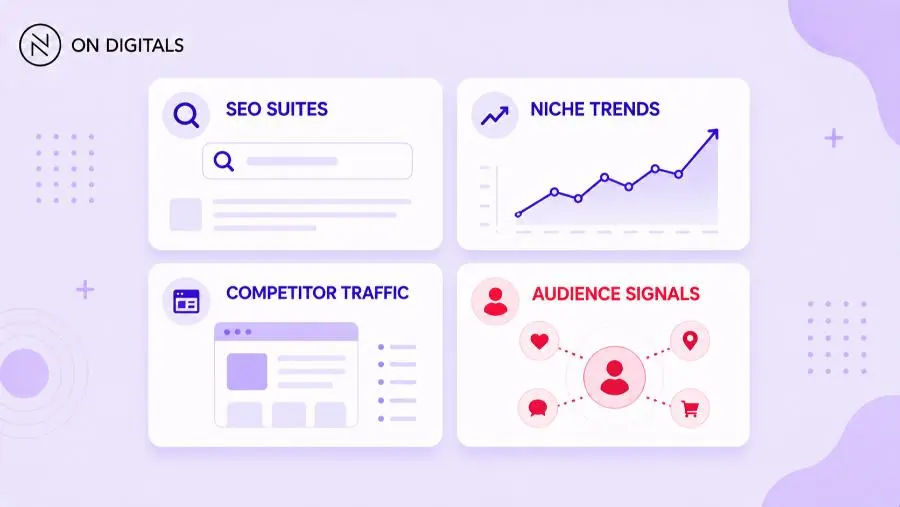
Most alternatives fall into four categories:
- SEO suites built on clickstream data such as Ahrefs and Semrush;
- Niche trend tools such as Exploding Topics and Glimpse;
- Competitor traffic intelligence platforms such as SimilarWeb;
- Audience-signal platforms such as BuzzSumo and Sparktoro.
Each category answers a different question, and few teams need all four.
When Google Trends is not enough
Google Trends becomes insufficient when:
- The topic has low absolute volume;
- A marketer needs exact search numbers;
- The trend lives outside Google Search such as on TikTok or Reddit;
- Competitor analysis is part of the research brief.
In those cases, an alternative tool with volume data, social listening, or traffic intelligence is more reliable than relative interest scores alone.
Specific limitations of Google Trends include:
- No absolute search volume since the 0 – 100 score is relative within the selected query and timeframe only.
- Low-volume queries return empty or noisy charts because the threshold for inclusion is high.
- No social media or TikTok signals since Google Trends covers Google Search, Image, News, Shopping, and YouTube only.
- No competitor traffic intelligence because Trends does not tell you who currently ranks or captures the demand.
- No SERP, ranking, or keyword difficulty context for SEO planning.
- Limited audience demographic detail. Trends shows regions but not age, role, or interest segments.
Top 7 Google Trends alternatives for 2026
| Tools | Best use case | Primary data source | Pricing |
| Ahrefs Keywords Explorer | SEO keyword volume and difficulty | Clickstream and SERP data | $249 (Pro) |
| Semrush Keyword Magic Tool | SEO and paid keyword research | Clickstream and SERP data | $139 (Pro) |
| Glimpse | Granular Trends amplification | Google Trends + proprietary | $29 (Pro) |
| BuzzSumo | Social engagement on content | Social platforms and shares | $199 (Pro) |
| Sparktoro | Audience interest mapping | Social and web profile data | $150 (Pro) |
| Exploding Topics | Emerging consumer and B2B trends | Web and social signal mining | Free / $39 (Pro) |
| SimilarWeb Trends | Competitor traffic and channel mix | Panel + ISP measurement | Free / $140 (Pro) |
1. Ahrefs Keywords Explorer
Ahrefs gives absolute monthly search volume, keyword difficulty, click distribution, and parent topic clustering for over 200 countries. SEO teams use it after Google Trends to confirm whether a rising query has enough volume to justify content investment. The main limitation is that volume estimates rely on a clickstream model, so they can disagree with Google Search Console data for branded or low-volume terms.
2. Semrush Keyword Magic Tool
Semrush provides similar SEO data to Ahrefs with stronger paid search and competitive ad intelligence layered on top. Marketers running both SEO and Google Ads often prefer Semrush because cost per click, SERP features, and competitor ad copy sit inside the same workspace. For B2B teams, the Keyword Gap and Topic Research features help map a content cluster after Google Trends surfaces the initial topic.
What makes it stand out is the competitive context. You’ll get insights on who’s ranking for those keywords and how challenging it will be to compete.
3. Exploding Topics
Exploding Topics tracks queries that are growing in volume across the web and social platforms, often before they appear on standard SEO tools. It is most useful for content marketers and product teams scanning for early signals in SaaS, finance, health, and consumer categories. The free tier surfaces broad topics, while the paid tier shows growth rate, related companies, and historical curves.
4. Glimpse
Glimpse is a Chrome extension and platform that adds estimated volume, related topics, and forecasting layers on top of the standard Google Trends interface. It is the closest direct replacement for Trends because it uses Trends as a baseline and enriches it with proprietary data. SEO and content teams that already rely on Trends usually find Glimpse the lowest-friction upgrade.
5. SimilarWeb Trends
SimilarWeb Trends measures website traffic, traffic sources, audience overlap, and channel mix for specific domains. It is the right tool when the research question is about a competitor rather than a keyword. The free tier is enough for high-level checks, and the paid tier unlocks historical traffic, app data, and audience demographics. The detailed SimilarWeb Trends and Google Trends comparison covers when each is the better choice.
6. BuzzSumo
BuzzSumo ranks content by social engagement across Facebook, X, Reddit, and other platforms. It is useful when the goal is to study which content formats and headlines win engagement, not just search demand. Content marketers use it alongside Google Trends to combine search interest with social proof before producing long-form articles, podcasts, or video.
7. Sparktoro
Sparktoro maps audience interests by analyzing the websites, podcasts, social accounts, and hashtags a defined audience engages with. Where Google Trends answers “what do people search,” Sparktoro answers “where does this audience spend attention.” B2B marketers use it for channel selection, influencer research, and audience-based media planning that goes beyond keyword demand.
How to choose the right alternative for your team?
The right alternative depends on three factors: the channel you are planning for, the level of volume precision you need, and the budget tier your team can sustain. SEO-led teams usually start with Ahrefs or Semrush. Content marketers focused on emerging topics prefer Exploding Topics or Glimpse. B2B competitive teams rely on SimilarWeb. Audience strategists tend to choose Sparktoro or BuzzSumo.
| If your priority is | Start with | Add on if needed |
| SEO keyword volume and difficulty | Ahrefs/ Semrush | Glimpse for trend layering |
| Emerging consumer or SaaS trends | Exploding Topics | Glimpse, BuzzSumo |
| Competitor traffic and channel mix | SimilarWeb | Semrush for paid ad overlap |
| Social engagement and headline data | BuzzSumo | Sparktoro for audience map |
| Audience interest and channel planning | Sparktoro | BuzzSumo for content angles |
How to combine Google Trends with alternatives?
Most strong research workflows do not replace Google Trends; they layer alternatives on top of it. Google Trends remains the fastest free signal for seasonality, regional comparison, and rising query discovery. Alternatives confirm volume, validate competitor traffic, or surface trends from platforms that Google does not index, such as TikTok or Reddit.
- Use Google Trends to surface seasonality and rising queries.
- Validate absolute volume in Ahrefs or Semrush.
- Confirm emerging signal strength in Exploding Topics or Glimpse.
- Check competitor traffic and channel mix in SimilarWeb.
- Map audience interests in Sparktoro before campaign launch.
A typical B2B content team can complete this workflow in 60 to 90 minutes per topic and exit with a clear view of demand, volume, competitor capture, and audience fit.
Common mistakes when replacing Google Trends
- Trusting paid tools as fully accurate when their volume estimates are also modeled.
- Switching tools mid-campaign without normalizing the baseline data.
- Choosing a tool by feature count rather than by primary use case.
- Ignoring free alternatives that already answer the question.
- Relying on one tool for both SEO and social trend research.
- Subscribing to multiple platforms before defining who owns the research workflow.
Frequently Asked Questions (FAQs)
What is the best free alternative to Google Trends?
For SEO volume, the free tiers of Ahrefs and Semrush provide a limited but useful starting point. For emerging trends, the free version of Exploding Topics surfaces broad topic signals at no cost. For competitor traffic, SimilarWeb’s free preview shows high-level traffic and source breakdown. No single free tool fully replaces Google Trends, so most teams combine two or three free tiers.
Does Ahrefs replace Google Trends?
Ahrefs does not fully replace Google Trends. Ahrefs provides absolute search volume, keyword difficulty, and SERP data, which Google Trends does not. Google Trends provides relative interest, seasonality curves, and rising queries with deeper historical range, which Ahrefs presents differently. Most SEO teams use both: Trends for direction and seasonality, Ahrefs for volume and difficulty.
How accurate are search volume tools?
Search volume tools rely on clickstream data, panel data, and modeling rather than direct Google API access. Estimates can vary by 20% or more between tools for the same keyword, and accuracy drops for low-volume or branded queries. The most reliable approach is to compare two tools, then validate with Google Search Console data once the page is live and indexed.
Can social listening tools replace Google Trends?
Social listening tools such as BuzzSumo or Brand24 do not replace Google Trends because they measure engagement, mentions, and conversations rather than search intent. They complement Google Trends by showing whether a topic has social momentum in addition to search demand. Strong content strategies usually weigh both signals before committing production resources.
Should B2B teams pay for a Google Trends alternative?
B2B teams benefit from a paid alternative once content output, paid media, or competitor benchmarking is a recurring workflow. A single Ahrefs or Semrush seat is usually justified when the team produces more than four articles per month or runs Google Ads. SimilarWeb is worth paying for when competitor benchmarking enters the quarterly planning cycle.

NEWEST POSTS
- Advertising Industry In Vietnam: The 2026 Trends, Channels and Market-Entry Strategy
- Best SEO Company in Vietnam: Latest Shortlist For Businesses
- How To Leverage Social Media For Customer Service Like A Pro?
- Social Media Post Tips – 8 Ways To Boost Engagement
- How To Use Social Media for Sales – In-depth Beginner Guide
Read more