
Influencer Marketing SEO: Increase Brand Search Visibility With Creator Campaigns
Vincent
24/11/2025
49
Influencer marketing SEO can support brand search visibility when creator campaigns help the right people discover your business, visit a useful resource, or reference your content publicly later. Stronger campaigns create more than short-lived reach. They can generate qualified visits, reusable content, and credible reasons for others to continue discussing the brand.
Campaigns built around expert insight, original data, or a useful story angle can also support digital PR by giving publishers a stronger reason to cover the brand. The outcome may be a referral visit, a branded search, a public review, or an earned mention from a relevant source.
How influencer marketing can support SEO
Influencer marketing does not guarantee higher Google rankings. Search performance changes for many reasons, including content quality, technical health, search demand, competition, and the relevance of a page to the query.
Creator campaigns can still contribute to search visibility through practical pathways. A creator may introduce your brand to an audience that has not encountered it before. That audience may later search for your company by name, visit your website directly, or return when they need a related product or service.
Some collaborations can create longer-lasting assets. A detailed review, video tutorial, expert interview, or specialist guide may remain discoverable after the campaign launch. When the content is public and genuinely useful, it can also become a source that writers, editors, or industry communities refer to later.
|
Contribution path |
What it can support |
|
Brand discovery |
More people recognise the business and search for it later |
|
Referral traffic |
Relevant visitors reach a landing page through creator content |
|
Public content visibility |
Reviews, tutorials, and guides remain discoverable over time |
|
Earned mentions |
Publishers or communities discover useful content worth referencing |
|
Reusable assets |
Creator material supports product pages, guides, FAQs, or campaigns |
Reach alone does not predict search value
Large follower numbers can help with awareness, while audience size alone says little about whether a creator can support lasting visibility.
A smaller creator may be more useful when they maintain a specialist website, YouTube channel, newsletter, or active community. Their content can reach a highly relevant audience, remain visible for longer, and direct visitors towards a useful destination page.
This is why influencer marketing SEO should begin with the outcome you want to improve. A campaign focused on branded discovery needs a different creator from one designed to earn expert coverage or build an evergreen resource.
Choose the search outcome before choosing the creator
Clear campaign planning starts with one primary objective. Once that objective is defined, the team can select a suitable creator, choose the right format, and build a landing page that continues the conversation.
|
Desired outcome |
Suitable creator type |
Useful content format |
|
Increase brand discovery |
Social-first creator |
Short-form video, visual demonstration, product introduction |
|
Drive qualified referral traffic |
Reviewer or YouTube educator |
Tutorial, detailed walkthrough, comparison content |
|
Earn public coverage |
Industry expert, blogger, or publisher |
Interview, quote, expert commentary, data story |
|
Create an evergreen content asset |
Educator or specialist creator |
How-to content, resource guide, product-use tutorial |
|
Understand audience language |
Community-led creator |
Q&A session, discussion, survey, live workshop |
|
Support local visibility |
Local creator or event partner |
Community guide, event coverage, local experience |
A brand entering a new category may need discovery first. In that case, a social-first creator may be suitable because they can introduce the problem, product, or category to a large relevant audience.
A B2B company may need authority and qualified demand instead. Expert interviews, webinars, contributor quotes, and specialist newsletters can be more useful because the creator already speaks to people who influence purchasing decisions.
Choose creators based on their search contribution
Creators contribute in different ways. Some can generate high attention quickly. Others publish content that remains available after the campaign ends. The second group can be especially useful when the objective involves long-term visibility.
|
Creator type |
Strongest contribution |
Suitable campaign approach |
Main consideration |
|
Social-first creator |
Awareness and branded search |
Short videos, product demonstrations, visual explainers |
Public content may have limited website-link potential |
|
Blogger or reviewer |
Evergreen content and contextual mentions |
Reviews, comparisons, specialist guides |
Commercial relationships require transparent disclosure |
|
YouTube educator |
Video discovery and referral traffic |
Tutorials, setup videos, detailed walkthroughs |
The landing page should match the video topic |
|
Industry expert |
Credibility and thought leadership |
Interviews, webinars, research commentary |
Expertise should be real and easy to verify |
|
Publisher or journalist |
Earned mentions and editorial references |
Data stories, expert sources, trend commentary |
Requires a useful angle or clear evidence |
|
Community creator |
Niche discovery and qualified visits |
Workshops, local resources, community guides |
Reach may be smaller, while relevance can be high |
Use the CREATOR search-fit check
Before approving a partnership, assess more than engagement rate or audience size. This framework helps determine whether the creator can contribute to the result you want.
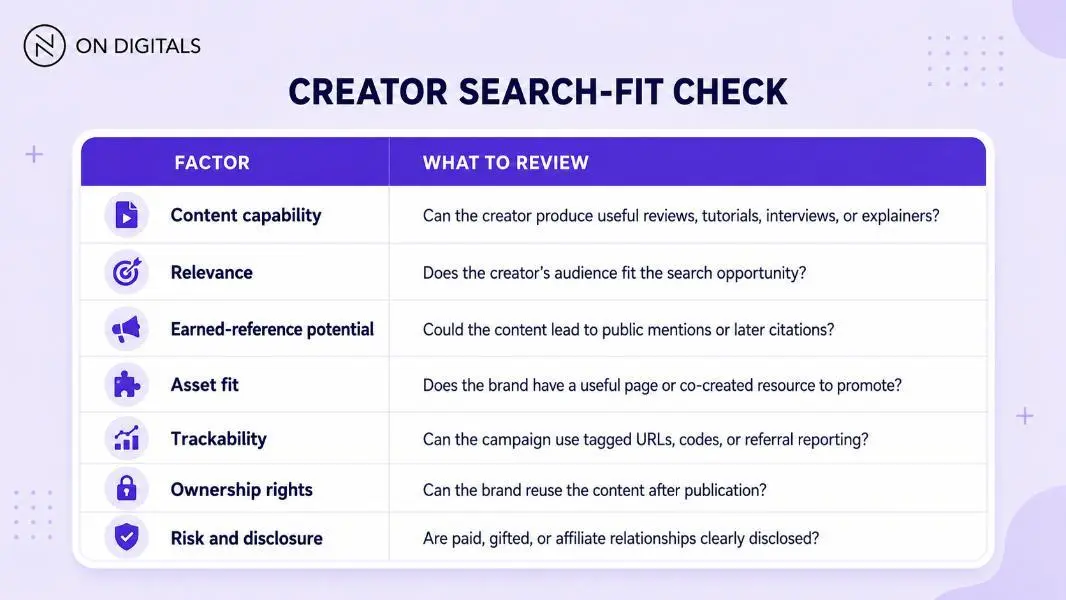 Review creator relevance, content capability, trackability, ownership rights, and disclosure before approving a partnership.
This check prevents teams from selecting a creator only because their reach looks impressive. It also makes it easier to identify campaigns that are better suited to awareness rather than long-term search visibility.
Create creator campaigns that can keep working after launch
A campaign becomes more valuable when its content remains useful after the original social post has stopped receiving attention. Reviews, tutorials, expert interviews, and co-created resources can continue helping audiences discover the brand over time.
Use transparent product reviews
Product reviews can support commercial discovery when the creator has genuine experience with the product and enough freedom to give an honest perspective. The content should help the audience understand who the product suits, what problem it addresses, and what they should consider before buying.
The destination page also matters. A creator discussing a specific product feature should direct viewers to a relevant guide, comparison page, or product resource. Sending every creator to a generic homepage often weakens the user journey.
Paid, gifted, or affiliate relationships should be disclosed clearly. Transparency helps audiences understand the context of the recommendation and protects trust in the creator’s review.
Build tutorials around real questions
Tutorial content can remain useful long after a campaign launch because it answers repeated questions. A creator may show how to use a product, explain a complex process, or compare different approaches to a common problem.
The language used in tutorials and comments can also help content planning. Viewers often ask questions in natural terms that brands may not have considered. Those questions can later inform FAQ content, supporting articles, or new product education pages.
A useful tutorial should give viewers one clear next step. That could be a checklist, a setup guide, a product-use page, or a calculator that helps them make a decision.
Collaborate with experts for deeper visibility
Industry experts can add useful perspectives without making the campaign feel like a conventional product promotion. Interviews, webinars, quote roundups, and research commentary can become durable assets for both the creator and the brand.
For example, a software company may work with an operations expert to explain a common workflow problem. The resulting webinar can support awareness during launch, while a summary guide may continue attracting relevant traffic after the event.
This model works well for B2B brands because it creates a useful reason for audiences to engage with the content beyond a product recommendation.
Co-create resources people can reference later
Some creator campaigns become more useful when they produce an original resource. This may be a specialist guide, a research-backed report, a comparison page, or a practical template.
Content becomes easier to reference when it saves publishers time or provides a clearer source to use. Detailed reports can support a claim with evidence, while calculators and comparison resources help readers complete a task or evaluate options with more confidence.
A creator may contribute experience, audience insight, or an expert perspective. The brand can provide internal data, technical knowledge, or a structured resource hub. Together, these elements can create something more useful than a standard sponsored post.
Build local partnerships around real activity
Local creators can support visibility when their work connects the brand with a genuine community need. This may involve a neighbourhood guide, specialist input for a local event, or workshop coverage that gives nearby audiences something useful to discover and share.
The opportunity should come from the usefulness of the activity. Local relevance, audience fit, and transparent relationships are more important than the number of followers attached to the creator.
Build an SEO-aligned creator brief
A creator brief should provide enough structure to protect campaign quality while leaving room for the creator’s own voice. Scripted content often feels less trustworthy, especially when the audience expects a real review or lived experience.
Rather than forcing exact-match phrases, give the creator a search theme, an accurate product explanation, and a destination that continues the topic naturally.
|
Brief component |
What to decide before launch |
|
Primary outcome |
Brand discovery, referral traffic, earned coverage, reusable content, etc. |
|
Search theme |
The audience problem or topic the campaign supports |
|
Target destination |
One landing page or co-created resource |
|
Content format |
Review, tutorial, interview, comparison, expert commentary |
|
Accuracy points |
Facts that must be represented correctly |
|
Creator freedom |
Areas where the creator can use their own voice |
|
Disclosure |
Paid, gifted, affiliate, or sponsored relationship details |
|
Content rights |
Where the brand may reuse or adapt the asset |
|
Tracking |
URL tags, campaign code, publication date, landing-page version |
|
Review window |
Baseline period, campaign period, post-campaign review |
The brief should be used to create clarity, not to control every sentence. Creators need room to communicate in the style their audience already trusts.
Extend creator content beyond the original post
Campaign content can lose value quickly when it only appears in a temporary feed. With proper permission, strong creator material can support additional pages and channels after the initial campaign period.
Useful reuse options include:
- Creator quotes on relevant product pages
- Short clips within instructional guides
- Audience questions adapted into FAQs
- Screenshots or demonstrations within resource pages
- Supporting content for email or paid campaigns
Public creator content can also support broader discovery when people search on social platforms or encounter it through community recommendations. This does not mean every social post will improve rankings. Its value may come through awareness, referral activity, or the chance that the right person discovers the resource.
Before reusing an asset, confirm content rights clearly. The agreement should cover formats, channels, duration, editing permissions, territories, and whether paid promotion is allowed.
Measure influencer marketing SEO without overclaiming
Campaign reporting should separate activity metrics from longer-term search outcomes. Views and engagement show whether the content gained attention. They do not prove that a creator caused a ranking increase.
A stronger reporting model evaluates each layer separately.
|
Measurement layer |
What to review |
|
Campaign activity |
Reach, views, saves, comments, completion rate |
|
Referral quality |
Tagged clicks, engaged sessions, landing-page interaction |
|
Brand demand |
Branded search queries, direct visits, returning users |
|
Earned visibility |
Public mentions, editor interest, citations, referring domains |
|
Business impact |
Leads, sign-ups, product actions, assisted conversions |
Use a pre-campaign baseline so that changes after launch have context. Early reporting may show referral sessions or engagement. Longer observation can reveal whether the content continues to support brand demand, public mentions, or qualified visits.
A practical attribution path may look like this:
Creator content → tagged referral visit → landing-page engagement → branded search, public mention, or conversion
Some collaborations will stop at referral traffic. That can still be valuable when the visitors are relevant and continue exploring the site. Other campaigns may create a slower effect through reusable content, public discovery, or editorial references.
Paid influencer links, disclosure, and SEO risk
Paid creator campaigns should be treated as advertising partnerships first. A sponsored post or gifted review can still generate visibility and relevant traffic, while the commercial relationship needs to remain clear.
Paid links should not be used as a shortcut for ranking gains. When a creator is compensated and includes a link, the relationship should be handled appropriately through disclosure and relevant link attributes.
Gifted products also require transparency when the creator has received something of value. The audience should be able to understand the relationship before evaluating the recommendation.
Trust improves when the campaign is clear about why the creator is featuring the product, what they experienced, and what part of the relationship was commercial.
FAQs about influencer marketing SEO
Does influencer marketing directly improve Google rankings?
Influencer marketing cannot guarantee higher rankings. It may support search visibility through discovery, referral traffic, branded search demand, public content, and earned mentions. Ranking movement should be reviewed alongside other SEO factors rather than treated as proof of direct causation.
Which influencer type is best for SEO?
The best creator depends on the campaign objective. A social-first creator may help with branded discovery, while a reviewer, educator, expert, or publisher may create content that remains public and useful for longer.
Can gifted product reviews include links?
They can, provided the relationship is disclosed clearly and the placement follows relevant advertising and platform guidelines. Brands should avoid expecting a gifted review to deliver ranking value through a paid followed link.
Can B2B brands use influencer marketing SEO?
Yes. B2B campaigns often work through expert interviews, webinars, contributor quotes, specialist newsletters, and research commentary. A smaller creator can still be valuable when their audience closely matches the people involved in buying decisions.
How long should an influencer marketing SEO campaign be measured?
Review early referral activity after launch, then monitor broader outcomes over several months. Brand searches, reusable content, public mentions, and editorial references may develop more slowly than campaign engagement.
Conclusion
Influencer marketing SEO creates more durable value when creator partnerships are built around useful content, strong audience fit, and transparent campaign design. Start with the search outcome you want to support, then choose creators who can help produce the right kind of discovery, referral activity, or public resource.
A campaign may increase brand interest, bring qualified visitors, or create content that earns references later. Measuring those paths separately gives the business a clearer view of which creator relationships are building meaningful visibility.

NEWEST POSTS
- Advertising Industry In Vietnam: The 2026 Trends, Channels and Market-Entry Strategy
- Best SEO Company in Vietnam: Latest Shortlist For Businesses
- How To Leverage Social Media For Customer Service Like A Pro?
- Social Media Post Tips – 8 Ways To Boost Engagement
- How To Use Social Media for Sales – In-depth Beginner Guide
Read more