
Digital PR for SEO: Earn Media Coverage That Supports Search Visibility
Vincent
14/08/2025
33
Digital PR for SEO helps brands earn online coverage by giving journalists, publishers, and relevant audiences something useful to reference. A strong campaign begins with credible expertise, original evidence, or a timely insight. Coverage may lead to referral traffic, brand recognition, public mentions, and contextual editorial links over time.
Search rankings cannot be guaranteed through PR activity alone. Content quality, technical performance, search demand, and competition continue to shape visibility. Within an off-page SEO approach, digital PR becomes more valuable when it supports these foundations with credible external exposure.
What is digital PR for SEO?
Digital PR for SEO combines public relations with search-focused campaign planning. Rather than pursuing media attention for visibility alone, the work connects a useful story with a relevant audience, a credible source asset, and a measurable outcome.
Digital PR gives businesses a structured way to create useful external visibility around a topic, source asset, or area of expertise. That wider exposure is one reason off-page SEO is important: relevant audiences can encounter credible information about a brand beyond its own website.
A campaign may centre on original research, expert commentary, a local initiative, a useful tool, or a timely industry perspective. The aim is to create a reason for publishers to cover the story because it helps their readers.
How digital PR differs from traditional PR and link building
Each discipline can overlap, although they begin from different priorities.
|
Area |
Traditional PR |
Link building |
Digital PR for SEO |
|
Main focus |
Reputation and media awareness |
Earning or acquiring links |
Earned visibility with search and referral value |
|
Primary asset |
Press release or announcement |
Destination page or resource |
Story, source asset, expert insight, research, etc. |
|
Typical audience |
Journalists, customers, stakeholders |
Publishers, bloggers, webmasters |
Journalists, editors, niche publishers, communities |
|
Link expectation |
May be optional |
Often central |
Valuable when editorially relevant, though never guaranteed |
|
Measurement |
Coverage, sentiment, reach |
Referring domains, placements |
Coverage quality, referrals, mentions, links, assisted outcomes |
Traditional PR may focus on a brand announcement. Link building may focus on a relevant resource page. Digital PR brings these ideas together by turning a useful brand asset into a story that media audiences can use.
What digital PR can realistically support
Digital PR can contribute to several visibility outcomes.
|
Contribution path |
What it may support |
|
Earned coverage |
Brand discovery through relevant publications |
|
Referral traffic |
Qualified visits from readers who follow the story |
|
Public mentions |
Wider awareness across editorial and community sources |
|
Editorial links |
Contextual references when the source page helps readers |
|
Brand demand |
More people searching for the business or topic later |
|
Content reuse |
A report, quote, or visual that supports future campaigns |
When coverage includes a contextual source link, review whether it has the practical qualities of a high quality backlink rather than judging the opportunity through publication metrics alone.
A placement becomes more useful when the source, story, and destination page all serve the same audience need.
Choose the digital PR outcome before choosing the campaign
Campaign ideas often fail because the team begins with a tactic rather than a business objective. A survey can attract attention, while it may be unnecessary when an expert comment would better answer the media opportunity.
Choose one primary outcome first.
|
Primary outcome |
Suitable campaign direction |
Useful source asset |
|
Earn editorial coverage |
Data story or expert commentary |
Research page, quote sheet, methodology |
|
Increase qualified referral traffic |
Practical guide or interactive tool |
Landing page with a clear next step |
|
Build recognition around expertise |
Thought leadership or bylined commentary |
Expert bio, specialist article, webinar |
|
Support a product launch |
Category education or product insight |
Feature guide, comparison page, launch hub |
|
Strengthen local relevance |
Community story or local research |
Event page, local report, partnership resource |
|
Reclaim value from existing coverage |
Source-link follow-up |
Original report, dataset, evidence page |
This step keeps the campaign proportionate to the resources available. A small business can begin with expert commentary or a local story. Meanwhile, a larger team may have the capacity to commission original research or build an interactive asset.
Use the PRESS framework to validate a PR idea
Before investing in research, creative production, or outreach, assess whether the concept has a credible route to coverage.
|
PRESS factor |
Question to answer |
|
P — Proof |
What data, experience, case material, or expert knowledge supports the story? |
|
R — Relevance |
Why would this topic matter to the publication’s audience now? |
|
E — Editorial fit |
Does the journalist or publisher cover this type of subject? |
|
S — Source asset |
Is there a useful page, quote bank, report, or visual that readers can access? |
|
S — Signal tracking |
How will the team measure coverage, referrals, mentions, links, and business contribution? |
A campaign may sound interesting internally while offering little external relevance. The PRESS check helps identify this early.
Use a story-strength scorecard
Rate each factor from 1 to 3 before committing to a campaign.
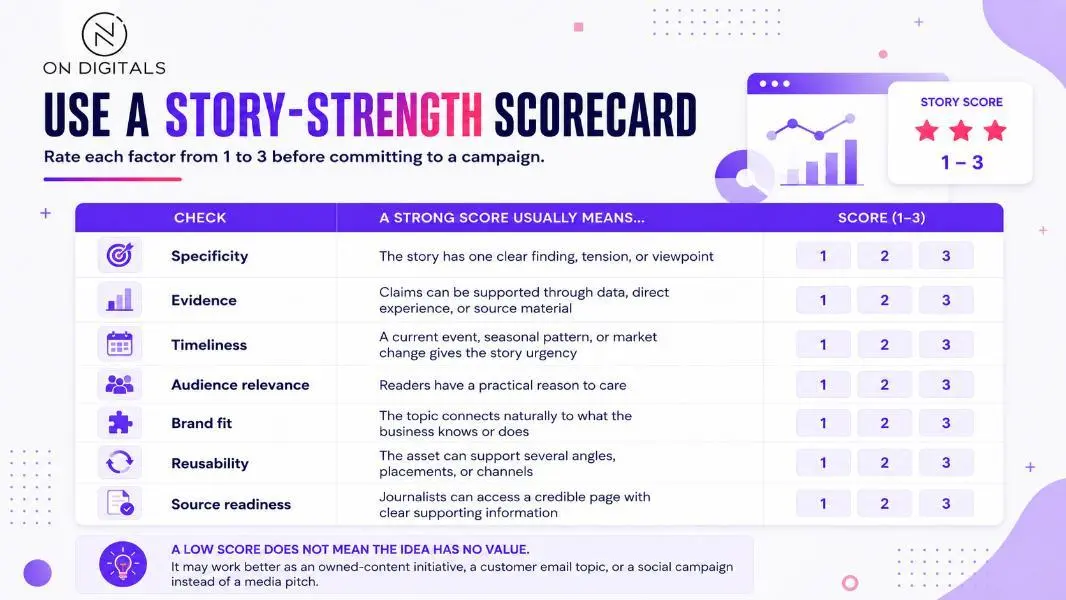 Rate each story factor before deciding whether an idea is ready for a media pitch.
A low score does not mean the idea has no value. It may work better as an owned-content initiative, a customer email topic, or a social campaign instead of a media pitch.
Digital PR campaign types that can support SEO
Data stories and original research
Original data can give journalists a source they cannot easily reproduce elsewhere. This may come from a customer survey, industry benchmark, anonymised platform data, or analysis of public information.
The strongest data stories focus on one useful finding. A large report can contain several insights, while each pitch should lead with the point that matters most to a specific audience.
Support the story with clear methodology, a concise summary, and visual elements that help readers interpret the result quickly.
Expert commentary and journalist requests
Subject-matter expertise can give businesses without a research budget a credible starting point for digital PR. A finance specialist might explain a shift in consumer behaviour, while a cybersecurity consultant can clarify the practical implications of a breach. Regional issues may also create opportunities for local business owners to add useful context for journalists and their audiences.
Prepare useful materials before a request arrives:
- Short expert biography
- Areas of expertise
- Source-backed talking points
- Past examples or case insight
- Fast-response contact details
Commentary works best when it gives the writer clarity. Broad promotional statements create little editorial value.
Reactive PR around timely developments
Reactive PR responds to a current development, trend, or news event with a relevant expert perspective. Timing matters because journalists often need sources quickly.
Useful responses explain what changed, why it matters, and what readers should understand next. Brands should avoid commenting merely because a topic is trending. A weak connection can make the response feel opportunistic rather than helpful.
Thought leadership and bylined content
A bylined article, podcast appearance, webinar, or expert interview can build recognition around a field of expertise. This approach is especially useful for B2B businesses, specialist services, and complex products that need education before purchase.
Strong thought leadership usually has one clear argument. It may challenge an outdated assumption, explain a shift in the market, or share a practical framework based on direct experience.
Creative tools and visual explainers
Interactive tools, calculators, original maps, visual explainers, or checklists can help a campaign travel further when they solve a repeated audience problem.
An insurance calculator can support a personal-finance story, while a comparison visual may help audiences understand a complex category and a local map can become useful for regional publications or community organisations.
The asset must remain useful after the campaign ends. This gives publishers a reason to link or reference it later.
Creator partnerships can also expand discovery when the content helps a relevant audience understand a topic, product, or decision. The same principle sits behind influencer marketing SEO, where the long-term value may come from qualified visits, public content, or later editorial interest rather than short-term reach alone.
Local stories and community campaigns
Local digital PR can grow from activities that genuinely matter to nearby audiences. A community project, local research finding, workshop, partnership, or charitable initiative may create a useful story for regional publications.
Coverage is more likely when the activity gives readers practical value, such as a local survey that highlights an issue residents care about or a community partnership that creates an event worth covering. Regional relevance should shape the story from the start.
Build a media asset journalists can use quickly
A journalist should be able to understand your story without searching through several pages or requesting basic information. The source asset needs to answer obvious questions quickly.
|
Asset element |
Why it matters |
|
Clear headline |
States the central finding or perspective |
|
Concise summary |
Helps readers understand the story in seconds |
|
Supporting evidence |
Adds credibility to the claim |
|
Methodology note |
Explains how data or findings were produced |
|
Expert quote bank |
Gives writers usable commentary |
|
Visual assets |
Makes complex ideas easier to scan or publish |
|
Contact information |
Supports fast follow-up |
The landing page should also work for ordinary readers. Keep the structure clear, avoid burying the main finding, and make the source easy to navigate on mobile.
Research journalists and publications with editorial fit
Media outreach improves when the prospect list is built around the story rather than assembled from broad authority metrics.
Start with three questions:
- Does this person cover the topic?
- Does their audience have a reason to care about the insight?
- Has the publication previously covered a related issue, trend, or source?
Segment outreach by role and publishing context.
|
Prospect type |
Best use case |
|
Journalist |
Timely commentary, data findings, newsworthy trends |
|
Editor |
Resource-led stories, recurring coverage themes, industry explainers |
|
Blogger or specialist publisher |
Detailed guides, niche comparison content, expert interviews |
|
Creator with public content |
Visual explainers, tutorials, audience education |
|
Local publication |
Community activity, local research, regional insight |
Domain-level metrics can help with a broad review. Editorial relevance, reader fit, and source placement should carry more weight when deciding whether a prospect belongs on the list.
Pitch stories without forcing links
A useful PR pitch leads with the story, not a request for SEO value. Journalists care about whether the material helps them produce a better article for their audience.
Digital PR is one route within a wider strategy for earning backlinks from relevant sources. Its difference lies in the story: the outreach begins with a useful insight or source asset that gives the publisher a genuine reason to cover the topic.
A concise pitch often includes:
- A specific hook
- Why the story matters now
- One useful finding or quote
- A credible source page
- A clear offer for further comment
Keep the brand mention proportionate. The story should remain useful even if the publication decides not to include a link.
When coverage goes live without a link
A media mention can still create awareness and referral value, especially when readers can find the source easily. When the article relies on your original research, quote, or data, a polite source request may be appropriate.
Use this workflow:
- Confirm that the article references your original material.
- Identify the sentence where a source link would help readers verify the claim.
- Send a concise note with the original resource.
- Explain the reader benefit rather than requesting ranking value.
- Record the outcome and preserve the relationship.
A publisher may decline or ignore the request. Respecting that decision protects future opportunities.
Align PR, SEO, and content teams before launch
Campaigns create less value when teams work in separate directions. PR may have a strong story while SEO has no suitable destination page. Content may publish a useful report after outreach has already begun.
A shared handoff process keeps the campaign coordinated.
|
PR responsibility |
SEO responsibility |
Shared output |
|
Refine story angle |
Confirm target page and search intent |
Campaign brief |
|
Build media list |
Review relevance and destination fit |
Prioritised outreach list |
|
Prepare pitch and quote bank |
QA landing page and tracking links |
Media asset pack |
|
Track coverage |
Validate referrals and link context |
Reporting view |
|
Maintain relationships |
Refresh supporting content |
Next-campaign insight |
Agree on the destination page before outreach begins. This prevents coverage from pointing to a generic homepage when a useful guide, report, or resource would better support readers.
A shared off-page SEO checklist can help the team confirm that the destination page, media asset, tracking setup, and follow-up process are ready before pitching begins.
Measure digital PR impact without vanity metrics
Digital PR measurement should distinguish between immediate campaign activity and longer-term search contribution.
|
Measurement layer |
What to review |
|
Coverage quality |
Relevance, editorial context, audience fit, publication type |
|
Referral activity |
Visits, engagement, return visits, useful next-page actions |
|
Link context |
Whether an earned link remains live, supports the surrounding article, and sends readers to a useful source page |
|
Brand discovery |
Branded searches, direct traffic, new audience queries |
|
Business contribution |
Leads, sign-ups, demo requests, assisted conversions |
|
Relationship value |
Future journalist interest, repeat coverage, collaboration opportunities |
Regular reviews with backlink audit tools can help validate live placements, spot lost references, and identify whether a campaign has attracted relevant sources over time.
A practical attribution model has three layers:
|
Layer |
What it captures |
|
Direct |
Coverage, clicks, landing-page sessions, immediate conversions |
|
Assisted |
Brand discovery, returning visitors, later enquiries, content reuse |
|
Long-term |
Ongoing referral traffic, future citations, stronger audience recognition |
Review trends across several campaigns. One placement may bring a short spike in visits, while another creates a lasting relationship with a publication that continues to reference your work.
Digital PR risks and common mistakes
Several practices can weaken both campaign credibility and SEO value.
Chasing publication metrics without audience fit
A high metric does not guarantee that a placement reaches the right people. A specialist publication can be more valuable when its readers closely match the business audience.
Building a campaign around an empty statistic
Data can attract attention, while a statistic without context often fails to create a useful story. Explain why the finding matters, how it was gathered, and what readers should take from it.
Launching outreach before the source asset is ready
A journalist may be interested in the pitch and immediately request more information. Weak methodology, missing visuals, or an unclear landing page can lose that opportunity.
Sending generic pitches at scale
Large unsegmented lists often produce low response rates because the story is not tailored to the recipient’s audience. Fewer, better-fit contacts usually generate stronger learning for the next campaign.
Treating paid coverage as an editorial-link shortcut
Paid placements can support advertising or distribution. Search value should not depend on passing ranking credit through a commercial relationship.
Google identifies links created primarily to manipulate rankings as link spam. Its guidance also recommends using rel=”sponsored” for paid or compensated links, while user-generated links may use rel=”ugc” where appropriate.
FAQs about digital PR for SEO
Is digital PR the same as link building?
Digital PR can earn links, while its scope is broader. It focuses on creating useful stories, credible coverage, referral opportunities, and public recognition. Link building may focus more directly on earning references to a destination page.
Does digital PR always create backlinks?
No. Coverage may include a link, a brand mention, a quote, or a citation without a live source URL. Each outcome can still have value depending on the audience, context, and campaign objective.
How can a small business start digital PR?
Start with assets already available. Specialist knowledge, customer questions, local activity, original observations, or analysis of public data can become useful story material. A focused expert-commentary campaign often requires less investment than a large survey.
What makes a digital PR idea newsworthy?
Strong ideas usually combine relevance with evidence. A timely topic, a sharp finding, a useful local angle, or a credible expert perspective can all make a story more useful to a publication’s readers.
How long should a digital PR campaign be measured?
Review early signals after the campaign launches, including coverage, referral activity, and journalist responses. Continue monitoring longer-term outcomes such as brand discovery, returning visitors, citations, and assisted conversions over the following months.
What should I do if coverage does not include a link?
Check whether a source link would genuinely improve the reader experience. When it would, send a concise request that points to the original evidence. Keep the message helpful and respect the publisher’s decision.
Can local businesses use digital PR for SEO?
Yes. Local research, community projects, regional events, expert input, and partnerships can create relevant stories for nearby publications and local audiences.
Are sponsored articles useful for digital PR?
Sponsored articles can support awareness, distribution, and referral traffic when they are clearly disclosed. Their value should be evaluated as advertising rather than a method for gaining ranking credit.
Conclusion
Digital PR for SEO works best when a brand has something credible to contribute and a clear reason for the right audience to care. Start with evidence, shape it into a useful story, then connect that story with journalists or publishers whose readers will benefit from it.
The strongest campaigns build more than coverage. They create usable assets, qualified referral opportunities, public recognition, and relationships that can support future visibility.

NEWEST POSTS
- Advertising Industry In Vietnam: The 2026 Trends, Channels and Market-Entry Strategy
- Best SEO Company in Vietnam: Latest Shortlist For Businesses
- How To Leverage Social Media For Customer Service Like A Pro?
- Social Media Post Tips – 8 Ways To Boost Engagement
- How To Use Social Media for Sales – In-depth Beginner Guide
Read more