
Backlink Audit Tools: A Practical Guide for SEO and Business Decisions
Vincent
24/11/2025
35
Backlink audit tools help SEO teams review which websites link to them, which pages earn useful authority, and where link-related risks or missed opportunities may exist. In 2026, the goal is not to collect backlinks at any cost. It is to build a credible, relevant, and measurable link profile that supports organic visibility, referral traffic, and qualified demand.
A backlink profile can appear healthy while hiding lost links, broken URLs with inbound links, weak referring domains, or anchor-text patterns that deserve review. The right tools make these issues easier to identify before they affect important pages or future link-building decisions.
What are backlink audit tools and when do they matter?
Backlink audit tools are platforms that help you analyse external links pointing to your domain or individual pages. They organise backlink data into useful reports, including referring domains, linking pages, anchor text, follow or nofollow status, target URLs, top-linked pages, and new or lost links.
A backlink audit matters when you need to understand:
- Which websites are contributing useful authority or referral value
- Which pages attract natural links and deserve further investment
- Whether important backlinks disappeared after a migration, redesign, or URL change
- Whether competitors earn links from relevant websites that your brand has not reached
- Whether older link-building activity created unusual anchor-text or low-quality patterns
- Which content assets could support future digital PR or outreach
For a smaller website, a basic audit may be enough to identify obvious issues and protect existing value. For an established B2B, ecommerce, or international business, backlink auditing should connect technical SEO, content strategy, internal linking, authority building, and conversion-focused pages.
Which backlink audit tools should you use?
No single tool shows every backlink or gives a complete picture of link quality. A practical approach is to use one main platform for ongoing reporting, then use other tools to validate important findings, review competitors, or investigate a specific issue.
- Google Search Console is a useful starting point for your own website. Its Links report helps you review the pages Google recognises as most linked, the domains linking to you, and common anchor text. Use it to establish a first-party backlink baseline before comparing third-party data.
- Semrush Backlink Audit is useful for ongoing monitoring and risk-focused reviews. It can help you identify unusual backlink growth, repeated commercial anchors, suspicious domains, and other patterns that deserve manual review. Treat its risk signals as prompts to investigate, not automatic reasons to disavow links.
- Ahrefs Backlink Checker is better suited to deeper referring-domain and page-level research. Use it to review top-linked pages, anchor text, estimated traffic from linking pages, lost backlinks, and broken URLs that may still receive valuable inbound links.
- SEO Review Tools’ Valuable Backlinks Checker is useful for fast checks when you need a simple view of backlinks, referring domains, follow or no follow status, anchor text, and target pages.
- SEOptimer’s Free Backlink Checker can support early stage competitor research. Use it to review a competitor’s backlink profile, referring domains, link history, and basic anchor patterns before deciding whether a deeper audit is needed.
- Galactic Fed’s backlink audit tools guide is useful as a broader reference when planning a link-building campaign. It can help teams think about tool selection, competitor research, outreach opportunities, and how backlink data supports wider SEO activity
For most businesses, Google Search Console plus Ahrefs or Semrush is enough for regular monitoring. Use lighter tools for quick checks, competitor research, or validating a specific backlink opportunity. The final decision should always consider relevance, editorial context, target-page value, and business impact, not backlink volume alone.
Why backlink audit tools affect SEO decisions
Backlink audit tools do not improve rankings by themselves. Their value comes from helping teams make better decisions about content, redirects, outreach, risk management, and SEO priorities.
For example, a B2B business may discover that its industry guides earn backlinks while its key service pages receive little external authority. That does not mean the team should force links directly to commercial pages. It may mean the business needs stronger supporting content, clearer internal linking, or a digital PR approach that creates relevant pathways toward those services.
|
Audit finding |
Why it matters |
Recommended action |
|
A high-value guide loses relevant backlinks |
It may lose authority, referral traffic, or visibility |
Check the old URL, recover the link, or add a relevant redirect |
|
A 404 page still receives backlinks |
Visitors and search engines reach a dead end |
Restore the page or redirect it to the closest relevant URL |
|
A competitor’s resource page earns many referring domains |
The market may value that type of content |
Build a more useful guide, tool, study, or framework |
|
Anchor text is heavily commercial |
The pattern may reflect old or risky link-building tactics |
Review sources and avoid repeating the same approach |
|
Priority pages have little authority |
Important commercial pages may lack support |
Improve internal links and build linkable supporting assets |
This is why backlink auditing should sit inside a wider off-page SEO strategy, not become a standalone exercise focused only on backlink totals.
See estimated organic traffic to each linking page and referring domain
Authority scores can be useful, but they are not enough to judge a backlink. A relevant industry publication, partner site, trade association, or niche resource may have modest metrics while still providing strong topical value and real referral potential.
When reviewing a linking page or referring domain, look at:
- Topic relevance to your business or audience
- Estimated organic traffic to the linking page and wider domain
- The purpose and quality of the page containing the link
- Whether the link is editorial, contextual, sitewide, sponsored, or user-generated
- The target page on your website
- Anchor text and surrounding content
- Whether the source page is indexed and accessible
- Follow, nofollow, sponsored, or UGC attributes where available
Ahrefs’ Backlink Checker is useful when you need deeper page level and referring domain research. It can help teams review linking domains, target pages, anchor text, top linked pages, broken backlinks, and estimated organic visibility around the source.
The important question is not simply, “How strong is this domain?” A better question is, “Does this link make sense for the topic, audience, and page it supports?”
See all websites linking to your target with domain-wide metrics
A backlink audit should begin with a domain-level baseline. Before reviewing individual links, understand how the wider profile looks.
Most backlink audit tools can show:
- Total backlinks
- Total referring domains
- Followed and nofollowed links
- Referring pages and referring IPs
- New and lost links
- Top linked pages
- Most common anchor text
- Authority metrics
- Country or top-level-domain distribution
These metrics are useful only when interpreted in context. For example, 10,000 backlinks from a small number of domains may be less valuable than 300 backlinks from a diverse group of relevant referring domains. Sitewide footer links can inflate totals without providing the same editorial value as contextual mentions inside useful content.
For a quick review, SEO Review Tools’ Valuable Backlinks Checker can help assess domain or page-level backlink data. Its reports are useful for reviewing referring domains, destination pages, anchor text, follow or nofollow status, top URLs, and basic traffic-related signals.
At this stage, look for patterns that need investigation:
- Sudden backlink spikes from unrelated websites
- Heavy reliance on a small number of referring domains
- Repetitive commercial anchor text
- Important content hubs with few referring domains
- Broken pages with inbound links
- Many links from thin, automated, or irrelevant pages
Not every unusual pattern is a problem. A product launch, media mention, partnership, or successful content campaign can create a legitimate spike. The audit should identify the reason before drawing conclusions.
Turn backlink audit findings into a link-building playbook
A strong backlink audit should end with actions, not just a spreadsheet. The most useful way to organise findings is around four priorities.
Protect existing value
Start with the pages that already earn authority or referral traffic.
Review lost links from high-quality domains, broken URLs with backlinks, removed resources, and pages that have changed substantially since they first earned mentions. Some links cannot be recovered, but many can be protected through better redirects, refreshed content, or outreach to key referring websites.
Avoid sending all old URLs to the homepage. Redirect users to the closest relevant page so the destination continues to match the original context.
Strengthen commercially important pages
Not every URL needs the same level of authority. Prioritise pages that support a clear business objective, such as:
- Core service pages
- Product category pages
- Comparison pages
- High-intent guides
- Industry pages
- Content that supports lead generation
Use backlink data alongside rankings, conversions, organic traffic, and internal links. A page that ranks just outside the first page for a valuable term may need stronger supporting content and better internal authority, not simply more backlinks.
This is where SEO Services can connect technical fixes, search intent, content depth, internal linking, and authority building around one growth goal.
Find content and outreach opportunities
Competitor backlink research can reveal what your market is willing to cite, share, or reference.
Look for competitor pages that attract links through:
- Original research or statistics
- Practical templates and checklists
- Industry guides
- Tools or calculators
- Product comparison resources
- Case studies
- Expert commentary
- Topic-specific explainers
SEOptimer’s Free Backlink Checker can support quick research into a competitor’s backlink profile, referring domains, anchor patterns, link history, and potential content opportunities.
The goal is not to copy competitor backlinks. It is to understand why certain assets earn attention and create a stronger version for your audience. A B2B company may need a clear implementation guide or market report. An ecommerce brand may need product education, comparison content, or a buying guide that answers real customer questions.
Review risk signals carefully
Backlink audit platforms often use toxicity, spam, or authority indicators to help prioritise review. These metrics are useful signals, but they are not final verdicts.
A low-quality-looking link may be irrelevant without causing a ranking problem. It may come from a scraper, old directory, forum, sitewide placement, or low-value page that search engines can already assess appropriately.
Semrush Backlink Audit can support ongoing monitoring, backlink-profile analysis, and the prioritisation of suspicious patterns for manual review.
Before taking action, assess:
- Whether the linking page is indexed and serves a real purpose
- Whether the link looks editorial, paid, automated, or manipulative
- Whether unusual anchor text appears repeatedly at scale
- Whether previous SEO activity may have created the links
- Whether there is evidence of a manual action or clear link-scheme risk
Disavow should be treated as an advanced action, not a routine cleanup step. In many cases, the better first move is to document the pattern, stop risky practices, and request removal when appropriate.
A step-by-step backlink audit framework
Step 1: Define the audit goal
Choose the business question before opening a tool. Common goals include investigating a ranking drop, reviewing a previous link-building campaign, finding broken URLs after a migration, identifying competitor content opportunities, strengthening a new topic cluster, or reviewing potential spam risks.
A clear goal prevents the audit from becoming a long list of metrics with no decision attached.
Step 2: Build a consistent baseline
Record the same data points each time:
- Referring domains
- Backlinks
- New and lost links
- Followed and nofollowed links
- Top-linked pages
- Most common anchor text
- Organic traffic trends
- Priority keyword performance
- Conversion data for key pages
Different tools use different crawlers and indexes, so totals will not always match. Focus on trends, context, and consistency rather than expecting identical numbers.
Step 3: Segment backlinks by value and risk
Do not review every backlink with the same level of effort.
|
Group |
Typical characteristics |
Recommended action |
|
High-value links |
Relevant, editorial, useful context, strong topic fit |
Protect and monitor |
|
Useful but limited links |
Niche source, partner, local reference, nofollow citation |
Keep and evaluate in context |
|
Low-value links |
Weak relevance, generic directory, thin content |
Usually monitor only |
|
Review-needed links |
Suspicious anchors, paid patterns, automated pages |
Investigate manually |
|
Lost-value links |
Broken targets or lost links from strong domains |
Recover, redirect, or update |
Step 4: Review top-linked and broken pages
Top-linked pages show what publishers and audiences find worth referencing. Review these pages before creating new content because they may reveal formats that already work for your business.
Then review broken URLs with backlinks. For each page, decide whether to restore it, rebuild it, redirect it, contact referring websites, or retire it permanently.
Step 5: Analyse competitor gaps
Find websites that link to relevant competitors but not to you. Then assess whether those domains are genuinely useful for your audience, not just attractive because of a high metric.
Prioritise opportunities based on topical fit, editorial standards, audience relevance, and the value of the content you can offer.
Step 6: Create an action log
Every audit should produce a simple task list.
|
Priority |
Finding |
Action |
Expected outcome |
|
High |
Valuable links point to a broken guide |
Add a relevant redirect and contact key referrers |
Recover user value and link equity |
|
High |
Priority service page has weak authority |
Build supporting content and improve internal links |
Strengthen topic relevance |
|
Medium |
Competitors earn links to practical resources |
Create a more useful guide or template |
Build long-term outreach potential |
|
Medium |
Old campaigns created commercial anchor patterns |
Review source history and stop repeating the tactic |
Reduce future risk |
Step 7: Monitor changes regularly
Monitor new and lost links on priority pages each month. Run a deeper audit every quarter, and review the profile again after a migration, major content update, ranking decline, or link-building campaign.
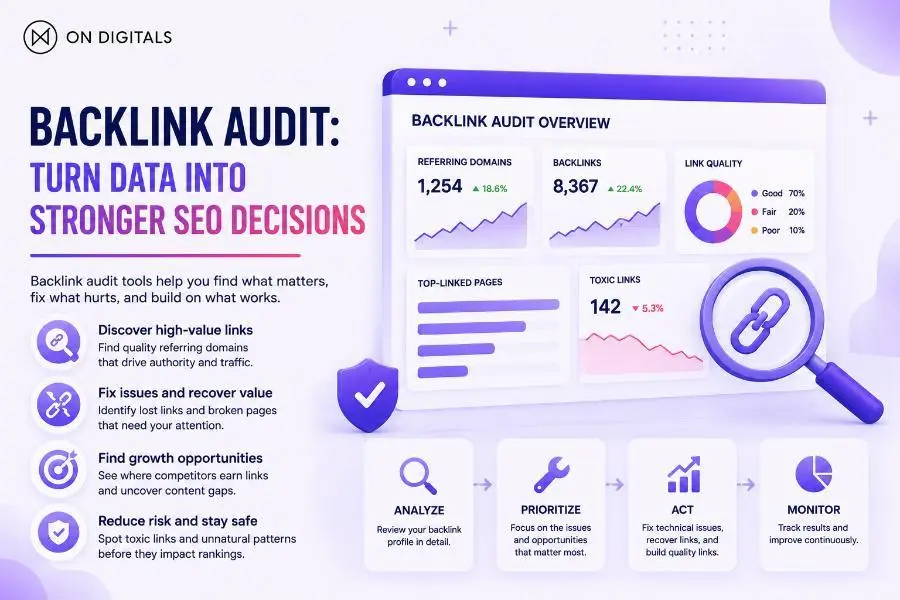
A backlink audit should turn data into a repeatable workflow: analyse link signals, prioritise actions, protect valuable authority, and monitor changes over time.
How to use backlink audit tools effectively
Start with your own backlink profile before reviewing competitors. Check referring domains, top-linked pages, anchor text, follow or nofollow links, and recent new or lost backlinks.
Use Ahrefs to investigate valuable referring domains, top-linked pages, linking-page traffic, broken backlinks, and lost link opportunities. Focus on links pointing to important service pages, guides, or category pages.
Use Semrush Backlink Audit to monitor unusual patterns, such as repeated commercial anchor text, sudden spikes, or large volumes of irrelevant links. Treat risk scores as review signals, not automatic proof that a link is harmful.
Use SEOptimer and SEO Review Tools for quick checks of referring domains, anchors, target pages, and competitor profiles. Galactic Fed’s guide can also help when comparing tool options and planning link-building research.
Turn each meaningful finding into an action: fix broken destinations, protect valuable links, improve internal links to priority pages, build stronger content assets, or investigate potential risks.
Common backlink audit mistakes
Treating every low-metric backlink as harmful
Low authority does not automatically mean a backlink is harmful. Relevant niche sites, partners, communities, and local businesses can still provide value.
Chasing backlink volume
Prioritize relevant and credible referring domains over large volumes of repetitive links. Relevance and context matter more than quantity.
Using disavow too quickly
Do not disavow links based only on tool scores. Review the source, anchor text, link patterns, and history first.
Ignoring target pages
Even valuable backlinks lose impact if they point to weak or outdated pages. Ensure the destination still meets user intent.
Reviewing links without business data
Combine backlink analysis with rankings, traffic, conversions, internal links, and content performance for better decisions.
FAQ
Are backlink audit tools free?
Some tools offer free reports or limited data. Google Search Console is a good starting point, while paid tools provide deeper analysis and monitoring.
What should I check in a backlink audit?
Review referring domains, page relevance, anchor text, target URLs, new/lost links, broken backlinks, and competitor gaps.
Can a tool tell me whether a backlink is good or bad?
Tools provide useful signals, but human review is still essential. Valuable backlinks are relevant, credible, and useful to readers.
How often should a business run a backlink audit?
Monthly monitoring and quarterly in-depth reviews are recommended. Competitive or fast-growing sites may need more frequent checks.
Should I disavow every toxic backlink?
No. Toxicity scores alone are not enough. Disavow only when there is clear evidence of spam or link manipulation.
Build a Stronger Backlink Strategy
Backlink audits are most effective when they help protect authority, recover lost value, improve key pages, and identify opportunities for quality links.
A strong backlink profile comes from valuable content, credible relationships, topical relevance, technical SEO, and consistent off-page optimization.
Talk to On Digitals about an SEO strategy that aligns authority building, content, technical SEO, and measurable business goals.

NEWEST POSTS
- Advertising Industry In Vietnam: The 2026 Trends, Channels and Market-Entry Strategy
- Best SEO Company in Vietnam: Latest Shortlist For Businesses
- How To Leverage Social Media For Customer Service Like A Pro?
- Social Media Post Tips – 8 Ways To Boost Engagement
- How To Use Social Media for Sales – In-depth Beginner Guide
Read more