
Off Page SEO for Ecommerce: A Practical Guide for SEO and Business Decisions
Vincent
22/08/2025
11
Off page SEO for ecommerce helps online stores build authority beyond their own website. It includes relevant backlinks, brand mentions, digital PR, product reviews, local citations, social distribution, partnerships, and competitor research. In 2026, the goal is not to build the most links. It is to create credible signals that support product discovery, referral traffic, trust, and qualified demand.
A strong ecommerce site can still struggle when trusted websites, reviewers, or customers do not mention its products, guides, or brand. This guide explains how ecommerce teams can use off-page activity to protect existing authority, earn relevant exposure, and make better SEO decisions.
What off page SEO for ecommerce means and when it matters
Off page SEO for ecommerce covers actions outside your store that influence how people and search engines perceive your brand. These actions may include editorial links, product reviews, influencer mentions, customer-generated content, relevant business listings, industry partnerships, and brand coverage.
Use off-page SEO when you need to:
- Build authority for product categories or commercial pages
- Improve visibility in a competitive ecommerce market
- Recover valuable links after a migration or product URL change
- Strengthen trust around a newer or lesser-known brand
- Find publishers, partners, or communities relevant to your buyers
- Support content that attracts customers before they are ready to purchase
- Improve local credibility if your business also has physical stores
An off page SEO checklist can help teams turn these goals into repeatable work. It does not replace technical SEO, product-page optimisation, site speed, or conversion improvements. It works best when your store already gives visitors a clear reason to trust and buy.
Why off page SEO for ecommerce affects visibility and conversions
Ecommerce buyers often compare brands before purchasing. They may search for product reviews, alternatives, buying guides, user experiences, comparison articles, influencer recommendations, or expert opinions. Off-page signals can help your store appear in more of these research moments.
The commercial value is not limited to rankings. Off-page activity can support referral traffic, branded search growth, stronger conversion confidence, product discovery, partnerships, and digital PR opportunities.
|
Off-page activity |
Ecommerce value |
Example action |
|
Editorial backlinks |
Supports authority and referral traffic |
Earn links from relevant buying guides, industry blogs, or partner sites |
|
Product reviews and creator coverage |
Builds trust before purchase |
Send products to credible reviewers or creators in your category |
|
Brand mentions |
Improves awareness and branded search potential |
Reclaim relevant unlinked mentions where a source link would help readers |
|
Digital PR |
Creates wider exposure and link opportunities |
Share original data, seasonal trends, or expert commentary |
|
Local citations and reviews |
Supports trust for stores with physical locations |
Keep business details consistent and respond to genuine reviews |
|
Social distribution |
Helps content reach potential customers and publishers |
Repurpose guides into short videos, visual tips, or carousels |
Quality matters more than volume. A relevant mention from a specialist publication, product reviewer, trusted partner, or industry guide can be more useful than many low-value links from unrelated websites.
Digital Commerce Partners’ guide to off-page SEO for ecommerce also highlights the relationship between backlinks, brand mentions, social engagement, and wider ecommerce visibility. These signals should support a broader store-growth strategy rather than operate as isolated tactics.
1. Audit your backlink profile before building new links
Start with existing authority. Before launching outreach, influencer campaigns, or digital PR, review what already points to your store.
Check:
- Referring domains and linking pages
- Top-linked product, category, and guide pages
- New and lost backlinks
- Broken URLs with inbound links
- Anchor-text patterns
- Followed and nofollowed link distribution
- Brand mentions without links
- Review pages and local listings, where relevant
This helps you identify quick wins. For example, a discontinued product page may still receive valuable links. Rather than losing that value, you may be able to create a relevant replacement page or redirect it to the closest category.
An ecommerce off page SEO checklist should also identify pages that deserve more authority. A high-margin category page with weak visibility may need stronger supporting content, internal linking, and a better outreach angle instead of a generic backlink campaign.
Use the On Digitals backlink audit tools guide to review referring domains, lost links, anchor patterns, broken pages, and competitor gaps before starting new authority-building work.
2. Analyze your competitors’ backlink profiles
Competitor backlink analysis helps you understand what publishers, reviewers, and buyers already consider useful in your category.
Do not compare backlink totals alone. Review which competitor pages attract referring domains, which websites link to several competitors, and what content formats generate recurring coverage.
Semrush’s off-page SEO checklist also includes competitor backlink analysis as a practical way to identify relevant domains and the content types those websites tend to reference.
|
What to analyse |
What it can reveal |
How to use the finding |
|
Top-linked competitor pages |
Which topics or formats attract references |
Create a stronger guide, comparison page, tool, or resource |
|
Referring-domain overlap |
Websites that mention competitors but not your store |
Build a targeted outreach or partnership list |
|
Anchor-text patterns |
How competitors earn links naturally |
Avoid forced commercial anchors and focus on contextual mentions |
|
Product, category, or guide links |
Which page types receive authority |
Prioritise similar high-value pages on your own store |
|
Lost competitor backlinks |
Potential content-replacement opportunities |
Offer a relevant, updated resource where appropriate |
The goal is not to copy a competitor’s backlink profile. It is to identify the real gap.
A competitor may earn links because it has a useful comparison guide, seasonal campaign, partnership, original research, or resource that publishers want to reference. Your response should be to build something clearer, more useful, or more relevant for your audience.
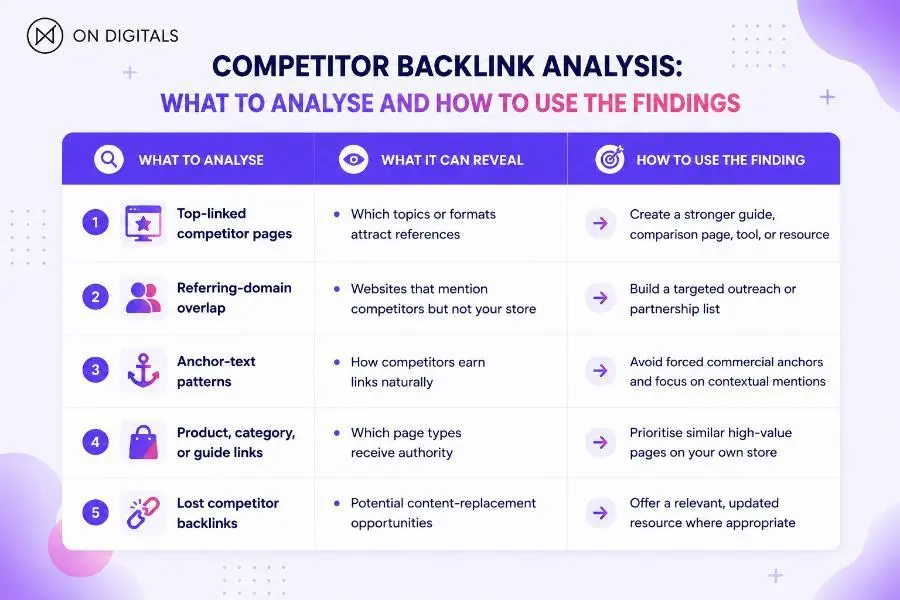
Competitor Backlink Analysis: What to Review and How to Use the Findings
3. Create content and product assets worth referencing
A store earns stronger off-page signals when it gives other websites a clear reason to link, cite, review, or share.
Product pages are important, but they are not always the best assets for earning links. Ecommerce brands often need content that helps customers research, compare, use, or understand products.
Useful assets can include:
- Product comparison guides
- Buying guides by use case or budget
- Original data from customer trends or market research
- Interactive size guides, calculators, or selectors
- Product-care resources
- Expert explainers
- Seasonal shopping guides
- Visual content that simplifies complex choices
- Verified customer stories or case studies
BlueTuskr’s ecommerce off-page SEO guide reinforces the role of content assets and ecommerce-specific backlink opportunities. The strongest assets help another website’s audience, not just your own SEO team.
Before creating a new asset, ask:
- Does it answer a real buyer question?
- Does it offer something more specific than existing content?
- Would a publisher, reviewer, or partner naturally reference it?
- Can it support priority commercial pages through internal links?
This is where SEO Services should connect content planning, technical SEO, internal linking, and authority building around measurable ecommerce goals.
4. Earn relevant editorial links through digital PR and partnerships
Ecommerce link building should focus on relevance, editorial context, and audience fit.
A useful outreach angle may come from:
- A product launch with a genuine story
- Original data or trends from your category
- A seasonal buying insight
- Expert commentary on a market issue
- A joint campaign with a complementary brand
- A useful guide, tool, or resource
- Product testing or independent review opportunities
- A local or community initiative
ConvertMate’s guide to off-page SEO for ecommerce highlights several practical approaches, including content assets, digital PR, broken-link replacement, and co-marketing with non-competing brands.
For outreach, explain why your resource improves the publisher’s page or helps its audience. Avoid generic backlink requests, mass guest-post pitches, and exact-match anchor-text demands.
Guest contributions can be useful when they add real expertise to a relevant publication. They become risky when the only purpose is to place a link on unrelated websites.
5. Use social distribution, creators, and communities for discovery
Social media is not a direct ranking shortcut. Its role in off page SEO for ecommerce is distribution, visibility, relationship building, and increasing the likelihood that useful content reaches people who may later mention or reference it.
Useful social activity may include:
- Product launches and behind-the-scenes stories
- User-generated content
- Creator collaborations
- Product demonstrations
- Short-form buying advice
- Customer education
- Seasonal campaign content
- Visual comparisons and product tips
Share content where buyers already spend time. Adapt the format to each platform instead of reposting the same message everywhere.
Relevant communities can also help you understand what customers ask before buying. Participate in industry groups, product forums, creator communities, podcasts, webinars, and niche discussions with useful input. Do not drop links into conversations unless the page directly improves the answer.
An off page SEO checklist should treat community activity as a source of insight and brand discovery, not a place to manufacture links.
6. Build trust through reviews, mentions, and local signals
For ecommerce brands, reputation often influences conversion as much as visibility. Shoppers may look for ratings, third-party reviews, delivery experiences, customer service feedback, product quality discussions, and brand credibility before purchasing.
Review:
- Google Business Profile, if you have physical locations
- Relevant ecommerce review platforms
- Marketplace feedback where applicable
- Industry directories and partner listings
- Customer review trends
- Unlinked brand mentions
- Product-review pages and creator coverage
Encourage genuine reviews after real customer interactions. Respond professionally to feedback and use recurring concerns to improve the shopping experience.
Do not buy reviews, create fake listings, or submit your store to irrelevant directories. These tactics may damage trust and rarely create long-term value.
7. Use AI and machine learning carefully in off-page SEO
AI can help ecommerce teams process larger volumes of backlink, brand-mention, competitor, and review data. It can support prioritisation, pattern detection, content ideation, and outreach research.
AI-assisted workflows may help you:
- Group referring domains by topical relevance
- Flag lost links to high-value pages
- Identify recurring competitor content patterns
- Find unlinked brand mentions at scale
- Summarise recurring review themes
- Prioritise outreach prospects by relevance and audience fit
- Generate content-angle ideas from customer questions
However, AI should support human judgement, not replace it. A tool cannot fully assess relationship quality, editorial standards, brand fit, or whether a link opportunity helps the business.
Astoundz’s off-page SEO services page provides a broader service-led perspective on authority building and advanced SEO support. Use AI to speed up research, but keep human review for final decisions, outreach quality, and risk assessment.
8. Treat link building as authority building, not link acquisition
Link building services can be useful when they focus on strategic authority growth rather than high-volume placements.
A good ecommerce link-building approach should support:
- Relevant category or informational pages
- Content that addresses buyer questions
- Product-led PR opportunities
- Partnerships with credible brands or publishers
- Links that can send referral traffic, not only SEO value
- Broader brand trust in your market
Avoid tactics that create obvious risk:
- Buying links at scale
- Automated outreach
- Irrelevant guest posts
- Repeated exact-match anchors
- Link exchanges with no business relevance
- Low-quality directories
- Spam comments or forum links
A strong off page SEO checklist should always include a quality-control question: would this mention or link make sense to a real person visiting the source page?
Step-by-step implementation framework for ecommerce teams
Step 1: Define the business goal
Clarify the priority. You may need to improve a category page, support a product launch, recover links after a migration, build trust in a new market, or strengthen seasonal visibility.
Step 2: Audit current authority
Review referring domains, top-linked pages, lost links, broken URLs, brand mentions, reviews, and competitor gaps.
Step 3: Choose pages to support
Prioritise high-value category pages, buying guides, comparison pages, seasonal pages, or content hubs. Do not try to build authority for every URL at once.
Step 4: Build one or two linkable assets
Create resources that help buyers, publishers, or partners. Focus on clarity, usefulness, and topical relevance.
Step 5: Run focused outreach
Build a small, relevant list of publishers, reviewers, partners, creators, or communities. Personalise outreach around the value of the asset or story.
Step 6: Track results and adjust
Monitor new and lost referring domains, referral traffic, branded search, review sentiment, visibility for priority pages, and leads or revenue assisted by authority-building content.
Common mistakes and quality checks
Avoid chasing backlink volume, treating social activity as a direct ranking factor, or using disavow as a default reaction to low-quality-looking links.
Also avoid sending valuable backlinks to weak destinations. A product page, category page, or guide must still load quickly, answer the user’s question, and offer a clear path toward purchase.
Use this quality check before pursuing a placement:
- Is the source relevant to our audience or category?
- Is the content editorially credible?
- Does the link or mention provide real value to readers?
- Does the target page match the context?
- Can we measure referral, visibility, or conversion impact?
- Would we still want this placement if it carried no SEO metric?
Tools and metrics to review
Use one main SEO platform for ongoing reporting, then validate important findings with first-party data.
|
Metric or signal |
Why it matters for ecommerce |
Review frequency |
|
New referring domains |
Shows whether relevant authority is growing |
Monthly |
|
Lost backlinks |
Helps protect valuable pages and referral traffic |
Monthly |
|
Top-linked pages |
Reveals which store pages or resources attract attention |
Quarterly |
|
Referral traffic |
Shows whether links send relevant visitors |
Monthly |
|
Brand mentions and reviews |
Indicates trust, awareness, and customer perception |
Monthly |
|
Branded search growth |
Suggests whether off-page visibility is increasing demand |
Quarterly |
|
Organic visibility for priority categories |
Connects authority work with commercial SEO performance |
Monthly or quarterly |
|
Assisted conversions |
Helps assess whether off-page activity supports revenue |
Quarterly |
An off page SEO checklist is most useful when it creates a repeatable reporting rhythm. Review major changes monthly, complete deeper analysis quarterly, and run additional audits after migrations, major content changes, PR campaigns, or ranking declines.
FAQ
What is off page SEO for ecommerce?
Off page SEO for ecommerce includes external signals that can strengthen a store’s authority and reputation. These may include relevant backlinks, product reviews, brand mentions, creator coverage, partnerships, local citations, and social distribution.
Are backlinks still important for ecommerce SEO?
Yes. Relevant editorial backlinks can support authority, referral traffic, and visibility. However, quality, topical relevance, and the value of the target page matter more than total link volume.
Can social media improve ecommerce SEO?
Social media can support brand discovery, content distribution, referral traffic, and future mention opportunities. It should not be treated as a direct ranking factor.
How can a new ecommerce store earn backlinks?
Start with useful content assets, relevant partnerships, product-review opportunities, original research, co-marketing, and targeted digital PR. Focus on credibility and audience fit rather than quick volume.
How long does off-page SEO for ecommerce take?
The timeline depends on competition, existing authority, content quality, and consistency. Some referral or awareness benefits may appear sooner, while stronger organic visibility often requires sustained work over several months.
Build a stronger ecommerce authority strategy
Off page SEO for ecommerce works best when it protects existing value, strengthens priority pages, and creates genuine reasons for credible websites and customers to mention your brand.
The strongest results come from useful content, relevant partnerships, trusted reviews, thoughtful outreach, and consistent measurement. Explore how On Digitals approaches Search and AI Marketing or discuss an SEO strategy that connects ecommerce visibility with measurable growth.

NEWEST POSTS
- Advertising Industry In Vietnam: The 2026 Trends, Channels and Market-Entry Strategy
- Best SEO Company in Vietnam: Latest Shortlist For Businesses
- How To Leverage Social Media For Customer Service Like A Pro?
- Social Media Post Tips – 8 Ways To Boost Engagement
- How To Use Social Media for Sales – In-depth Beginner Guide
Read more