
Off-Page SEO Checklist: A Practical Guide for SEO and Business Decisions
Vincent
25/11/2025
29
An off-page SEO checklist helps businesses improve visibility and credibility beyond their own website. It covers backlink quality, brand mentions, digital PR, reviews, local citations, social distribution, and competitor research. In 2026, the goal is not to collect the most backlinks. It is to earn relevant signals that support trust, referral traffic, qualified demand, and long-term organic visibility.
A strong off-page profile should reflect real expertise, useful content, credible relationships, and a brand that people are willing to mention. Use this checklist to identify what needs protection, what needs improvement, and where your business has a realistic opportunity to earn authority.
What does an off-page SEO checklist mean and when does it matter?
An off-page SEO checklist is a structured workflow for improving signals that happen outside your domain. These signals may include editorial backlinks, online mentions, reviews, citations, social visibility, partnerships, industry discussions, and coverage from reputable websites.
Use an off-page SEO checklist when you need to:
- Review whether your backlink profile supports priority pages
- Identify lost links or broken URLs with inbound links
- Strengthen authority for a new service, product category, or topic cluster
- Build visibility in a competitive market
- Improve local trust through accurate citations and reviews
- Find competitor content and outreach opportunities
- Check whether older SEO activity created link-related risks
Off-page SEO cannot compensate for weak content, poor technical setup, or unclear service pages. It works best when your website already provides useful information, clear conversion paths, and a reason for readers to trust your brand.
Why off-page SEO affects visibility, trust, and conversions
Off-page SEO helps search engines and potential customers understand how your brand is perceived beyond your own website. A contextual mention from an industry publication, a useful backlink from a trusted resource, or a strong review profile can all support visibility and business credibility.
The value is not limited to rankings. A practical off-page SEO checklist can also help you improve:
- Referral traffic from relevant websites
- Branded search demand
- Trust around key service or product pages
- Local visibility and customer confidence
- Opportunities for partnerships and digital PR
- Content distribution across search, social, and industry channels
Quality matters more than volume. A small number of relevant editorial mentions can be more useful than a large number of generic directory listings or automated backlinks.
For context, WooRank’s off-page SEO checklist also frames off-page work as more than link building. It includes audits, social engagement, authority building, and online promotion rather than treating backlinks as the only priority.
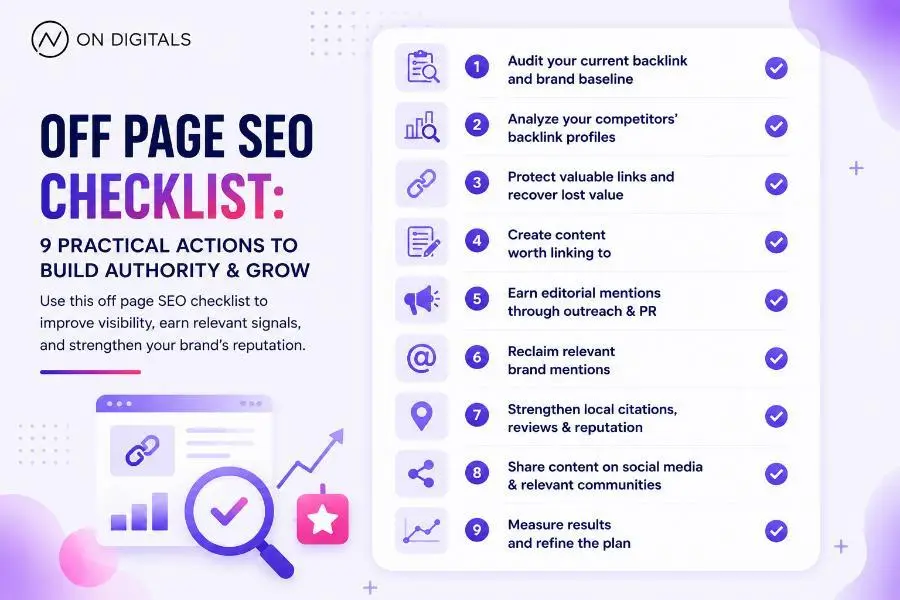
Off-page SEO checklist: 9 practical actions
1. Audit your current backlink and brand baseline
Start with what your website already has. Review the pages that earn links, the domains that refer visitors, common anchor-text patterns, recent lost links, and any pages that are no longer available.
Check:
- Referring domains and linking pages
- Top linked pages
- Followed and nofollowed links
- New and lost backlinks
- Broken URLs with inbound links
- Common anchor text
- Unlinked brand mentions
- Reviews and citations, where relevant
The purpose is not to react to every unfamiliar domain. Instead, identify the signals that already create value and the pages that need protection.
For example, a useful guide with strong inbound links may need a content refresh. A service page with weak external authority may need stronger supporting content, internal links, or a more focused outreach plan.
Use the On Digitals backlink audit tools guide to review referring domains, lost links, anchor patterns, broken pages, and audit priorities before starting new link-building activity.
2. Analyze your competitors’ backlink profiles
Competitor research can show which topics, content formats, and publishers already influence your market.
Do not compare backlink totals alone. Look for:
- Competitor pages with the most referring domains
- Websites linking to several competitors but not to you
- Resource pages, reports, tools, templates, or guides that earn links
- Industry publications and partners that repeatedly cover your topic
- Content formats that appear to support commercial visibility
Semrush’s off-page SEO checklist highlights competitor backlink analysis as a useful way to identify domains linking to competitors and the content types those websites tend to reference.
The goal is not to copy competitor backlinks. It is to understand why their pages attract attention and develop a stronger, more relevant asset for your own audience.
A B2B company may need an implementation framework, industry report, or expert guide. An ecommerce business may need comparison pages, buying guides, or product education that helps customers make better decisions.
3. Protect valuable links and recover lost value
Some of the fastest wins in an off-page SEO checklist come from protecting authority your site has already earned.
Review:
- Valuable links that now point to 404 pages
- Important URLs removed during a migration or redesign
- Older content that no longer matches its original topic
- Links lost after a URL update
- Referring sites that still use outdated destinations
For each issue, decide whether to restore the original page, update the content, add a relevant redirect, or contact the referring website with the best replacement URL.
Avoid redirecting every broken URL to the homepage. The replacement page should match the original topic and provide a useful experience for visitors arriving through the link.
4. Create content worth linking to
Good off-page SEO begins with useful content. A publisher, partner, or industry website needs a clear reason to reference your page.
Linkable content assets often include:
- Original research and market data
- Templates and checklists
- Industry benchmarks
- Calculators and tools
- Comparison pages
- Expert-led guides
- Visual explainers
- Case studies with verified lessons
Before publishing a new asset, ask:
- Does it answer a recurring question in our market?
- Can we add original data, expertise, or a practical framework?
- Would another website naturally reference this resource?
- Can it support a priority service page through internal links?
This is where SEO Services should connect content planning, technical SEO, internal linking, and authority building around the same business goal.
5. Earn editorial mentions through outreach and digital PR
Outreach is more effective when it begins with a useful angle instead of a generic backlink request.
Potential outreach angles include:
- Original research findings
- Expert commentary on industry trends
- New data or benchmarks
- A practical resource relevant to a publisher’s audience
- A case study with a useful lesson
- A partnership, event, or community initiative
Focus on relevance first. A mention on a specialist publication, professional association, local media outlet, or trusted partner page can be valuable even when the website is not large.
Make outreach specific. Explain why your resource helps the publisher’s readers and why it adds value to their existing content. Avoid mass templates, irrelevant guest-post pitches, automated outreach, and exact-match anchor-text requests.
6. Reclaim relevant brand mentions
A brand mention does not always need a backlink to be useful. It can still support reputation, awareness, and branded search. However, some unlinked mentions may create a legitimate opportunity to request a source link.
Prioritise mentions that are:
- Accurate and positive
- Relevant to your services or expertise
- Published on credible websites
- Connected to articles, partner pages, media coverage, or resource lists
- Likely to benefit readers if a source URL is added
Do not treat every mention as a link opportunity. Some pages do not need a source link, and aggressive follow-up can damage relationships. The purpose is to improve reader value and clarify the reference, not force a backlink.
7. Strengthen local citations, reviews, and reputation
For local businesses, off-page SEO should include accurate business listings and active review management.
Check that your business name, address, phone number, opening hours, website URL, and service categories are consistent across relevant platforms. Prioritise your Google Business Profile, industry directories, maps platforms, local partner listings, and trusted community resources.
Reviews also influence how people evaluate a business. Encourage genuine feedback after real customer interactions, respond professionally, and use recurring feedback to improve the customer experience.
Checkify’s off-page SEO checklist identifies inconsistent NAP details, ignored brand mentions, irrelevant links, and neglected reviews as common issues that can weaken local credibility.
Avoid buying reviews, creating fake listings, or submitting the business to irrelevant directories. These shortcuts create risk and rarely support long-term trust.
8. Share content on social media and relevant communities
Social media is not a direct ranking shortcut. Its role in an off-page SEO checklist is distribution, relationship building, brand discovery, and the chance for useful content to reach people who may later reference it.
Share content where your audience is already active. Repurpose useful resources into formats that suit each platform, such as visual summaries, short videos, founder insights, carousel posts, podcast clips, or discussion prompts.
SweetProcess’ off-page SEO checklist includes social promotion as a checklist action, with a focus on distributing content, using relevant hashtags, and engaging with the audience to improve visibility.
Relevant communities can also help your team understand customer questions and contribute useful expertise. This may include professional groups, industry forums, webinars, podcasts, and niche discussion spaces.
Contribute before promoting. Avoid dropping links into conversations unless the page genuinely improves the answer.
9. Measure results and refine the plan
Off-page SEO should be measured through business context, not one vanity metric.
Track:
- Quality and relevance of new referring domains
- Lost links to priority pages
- Referral traffic
- Branded search growth
- Top linked pages
- Review volume and sentiment
- Brand mentions from credible sources
- Organic visibility for priority topics
- Leads or conversions assisted by authority-building content
Landingi’s SEO checklist treats SEO as a structured system rather than a one-time task. Apply the same principle here: review performance consistently, assign owners, and connect each off-page action to a measurable objective.
A practical schedule is:
- Monthly monitoring of new and lost links
- Quarterly review of backlink trends and competitor opportunities
- Additional audits after migrations, major content updates, ranking declines, or digital PR campaigns
- Annual review of authority gaps, linkable content assets, and reputation priorities
Common off-page SEO mistakes to avoid
Chasing backlink volume
More backlinks do not automatically create stronger authority. Relevant editorial mentions are usually more valuable than repetitive, sitewide, or low-quality links.
Buying links or using link schemes
Paid links, large-scale reciprocal linking, automated placements, and irrelevant guest-post campaigns can create unnecessary risk. Focus on content, partnerships, PR, and useful resources that earn attention naturally.
Treating every low-metric link as harmful
A local business, specialist supplier, community site, or industry association may have modest metrics while still being relevant and credible. Review each link in context before deciding it has no value.
Using disavow too quickly
A tool score alone is not a reason to disavow a link. Review the source, context, anchor text, scale of the pattern, and link-building history first. Disavow is an advanced action for serious spam or artificial-link situations.
Treating social media as a ranking tactic
Social posts can increase reach, discovery, and the chance of natural mentions. They should not be positioned as a guaranteed ranking factor.
Ignoring the target page
A useful backlink can lose value if it points to an outdated, broken, or weak destination. Review whether linked pages still answer the original intent and offer a clear next step.
Tools and checks to review before publishing
A reliable off page SEO checklist uses first-party data, backlink tools, analytics, and reputation monitoring together.
Use:
- Google Search Console to review top linked pages and linking domains
- A backlink platform to assess referring domains, lost links, anchor patterns, and competitor gaps
- Analytics to measure referral traffic and conversion behaviour
- Brand monitoring to track mentions and sentiment
- Local listing tools to review citation accuracy and review performance
Before closing an off-page review, confirm that you can answer:
- Which pages or topics need more authority?
- Which valuable links need protection?
- Which content assets are likely to earn relevant mentions?
- Which competitors reveal a real authority or content gap?
- Which action is most likely to support business value?
- How will progress be measured next month and next quarter?
FAQ
What is included in an off page SEO checklist?
An off page SEO checklist usually includes backlink auditing, competitor analysis, link reclamation, content assets, editorial outreach, brand mentions, local citations, reviews, social distribution, community participation, and measurement.
Are backlinks still important for off-page SEO?
Yes, but relevance and editorial context matter more than raw volume. Links from credible sources connected to your topic are generally more useful than automated, repetitive, or unrelated placements.
Does social media improve SEO rankings?
Social media is best viewed as a distribution and discovery channel. It can help more people find, share, reference, or search for your content, but it should not be treated as a direct ranking lever.
How often should I review off-page SEO?
Monitor important backlinks and brand signals monthly. Run a deeper review each quarter, and complete additional audits after migrations, major content changes, link-building campaigns, or visibility drops.
Should I use directories for off-page SEO?
Use relevant local listings, professional associations, partner pages, and industry directories. Avoid bulk directory submissions or low-quality websites with no real audience.
What is the best off-page SEO tactic?
There is no single best tactic. For most businesses, the strongest approach combines useful content, relevant editorial mentions, link reclamation, digital PR, local reputation, and consistent measurement.
Build authority with a clearer off-page SEO plan
A practical off page SEO checklist helps your team protect valuable authority, improve priority pages, earn credible mentions, and create stronger reasons for others to reference your brand.
The strongest results come from useful content, credible relationships, relevant coverage, accurate business information, and consistent measurement. Talk to On Digitals about an SEO plan that connects authority building, content, technical SEO, and measurable business goals.

NEWEST POSTS
- Advertising Industry In Vietnam: The 2026 Trends, Channels and Market-Entry Strategy
- Best SEO Company in Vietnam: Latest Shortlist For Businesses
- How To Leverage Social Media For Customer Service Like A Pro?
- Social Media Post Tips – 8 Ways To Boost Engagement
- How To Use Social Media for Sales – In-depth Beginner Guide
Read more