
Why Off-Page SEO Is Important for Rankings and Trust
Vincent
15/10/2021
44
Why off-page SEO is important comes down to one idea: search engines need signals beyond your website to evaluate whether your pages deserve visibility. Strong content helps users. Technical SEO helps search engines crawl and index that content. A clear off-page SEO optimization strategy shows whether other people, publishers, communities, or customers trust your website enough to mention, link, review, or recommend it.
For competitive keywords, a well-optimized page may still struggle when the website has little authority outside its own domain. Off-page SEO helps close that gap by building reputation, referral traffic, branded search demand, and trust signals that support rankings over time.
What is off-page SEO?
Off-page SEO refers to actions outside your website that improve how search engines and users perceive your brand. These actions can include earning backlinks, gaining brand mentions, receiving customer reviews, building local citations, joining industry discussions, running digital PR campaigns, etc.
The main purpose is external validation. When reputable websites link to your content, customers review your business, or industry sources mention your brand, those signals can support visibility and trust.
Off-page SEO vs on-page SEO vs technical SEO
Off-page SEO works best when the website already has a strong foundation. It should support on-page SEO and technical SEO, rather than replace them.
|
SEO area |
Main role |
Example work |
|
On-page SEO |
Improve page relevance |
Content, headings, internal links, metadata |
|
Technical SEO |
Improve crawlability and performance |
Indexing, speed, schema, canonical tags |
|
Off-page SEO |
Build external authority |
Backlinks, mentions, reviews, citations |
Weak content rarely earns good links, while crawl issues can waste strong off-page signals. For that reason, off-page SEO works best when it strengthens a solid website instead of hiding poor foundations.
Why off-page SEO is important for rankings
Off-page SEO matters because it helps search engines assess reputation. A search engine can read your content, but external signals help it evaluate whether the wider web considers your site useful.
It builds authority beyond your website
Backlinks remain one of the most visible off-page signals. When a relevant website links to your page, the link can act like a recommendation. The value depends on quality, context, relevance, and how naturally the link was earned.
A link from a respected industry publication usually carries more value than a random directory link. A contextual link inside a useful article usually matters more than a sitewide footer link.
Use this scorecard before judging link quality:
|
Factor |
Strong signal |
Risk signal |
|
Relevance |
Related topic or industry |
Unrelated website |
|
Placement |
Main content |
Footer or sidebar |
|
Anchor text |
Natural phrase |
Repeated exact-match keyword |
|
Editorial value |
Earned because the page helps readers |
Added only for SEO |
|
Audience |
Real users may click |
No meaningful readership |
|
Source trust |
Recognized site or business |
Spammy network |
Link quantity alone is a weak metric. Ten relevant links can be more useful than hundreds of low-quality links that bring no trust, traffic, or context.
It helps strong content compete
A helpful page needs visibility before it can bring results. Off-page SEO helps that page gain traction outside the website.
For example, a guide based on original research may earn links from blogs or newsletters. Case studies can be mentioned by sales partners, while useful tools may appear in resource lists. Each external reference helps the page reach new audiences while supporting its authority.
This is why linkable assets are important. Instead of creating “link bait” that only chases backlinks, build assets people actually want to reference.
|
Linkable asset |
Why people reference it |
|
Original data |
Gives writers a source |
|
Templates |
Helps users take action |
|
Tools |
Solves a specific task |
|
Visual explainers |
Makes complex ideas easier |
|
Case studies |
Shows real-world proof |
|
Expert commentary |
Adds credibility |
It supports E-E-A-T signals
E-E-A-T stands for experience, expertise, authoritativeness, and trustworthiness. Google’s quality systems do not use E-E-A-T as one simple score, but these concepts help explain why reputation matters.
Off-page SEO can support E-E-A-T when it shows that real people and credible sources recognize your expertise.
Examples include:
- Expert quotes in industry articles
- Podcast appearances
- Webinar participation
- Guest insights on trusted websites
- Awards or industry recognition
- Positive customer reviews
- Mentions from relevant publications
These signals do not replace useful content. Instead, they help reinforce that the website has real expertise behind the content.
It can increase branded search and referral traffic
Off-page SEO does not only support rankings. It can also send qualified users directly to your website.
A relevant backlink may bring referral traffic. A podcast mention may increase branded searches. A review profile may influence local users before they visit your site. A social post from a credible partner may expose your brand to a new audience.
Track these signals because they show whether off-page work is building business value, not just SEO metrics.
Off-page SEO signals that matter most
Off-page SEO is broader than backlinks. Reputation can come from several external sources.
|
Signal |
Why it matters |
|
Backlinks |
Support authority and referral traffic |
|
Brand mentions |
Build awareness and reputation |
|
Digital PR |
Earn media coverage and trusted references |
|
Reviews |
Influence trust and local decisions |
|
Citations |
Support local business consistency |
|
Social visibility |
Helps content discovery |
|
Events or awards |
Build credibility outside search |
Brand mentions
A brand mention happens when another website references your brand. Some mentions include links, while others mention the brand without linking.
Unlinked mentions do not pass link equity like backlinks. Still, they can support awareness, reputation, and branded search demand. When a high-quality page mentions your brand without a link, outreach may be useful if a link would help readers find the original source.
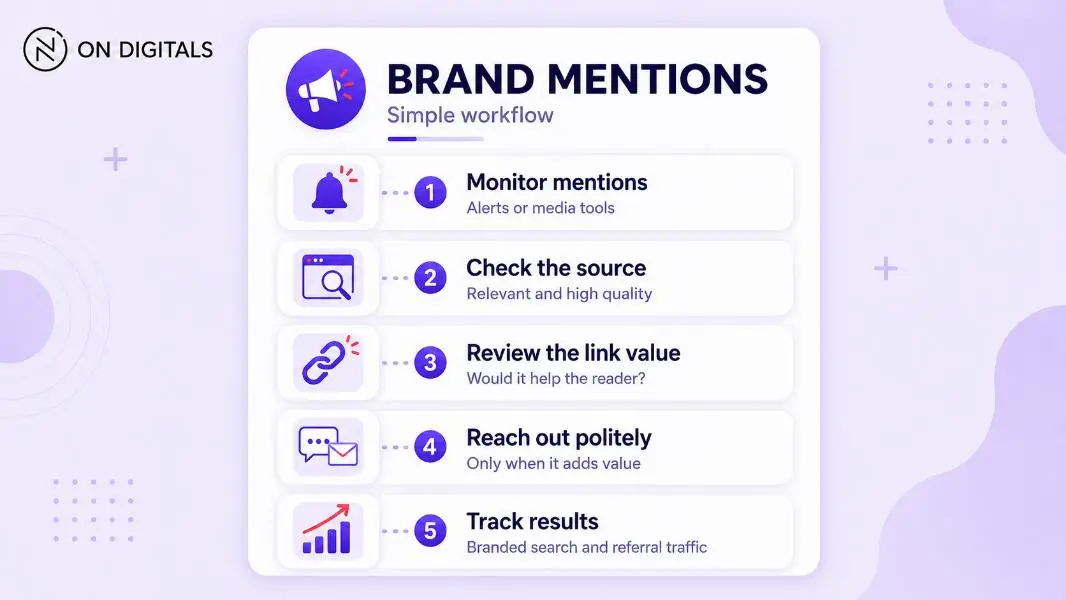 Brand mentions can create outreach opportunities when a link adds real value for readers.
Digital PR
Digital PR helps brands earn coverage through newsworthy stories, data, expert commentary, or useful resources. It works well because it builds links and visibility through editorial value.
Strong digital PR assets may include:
- Industry reports
- Surveys
- Data studies
- Expert quotes
- Trend analysis
- Timely commentary
- Useful visual resources
A digital PR campaign should start with a reason for people to care. A generic company announcement rarely earns strong links unless it connects to a wider industry trend. For teams that want to turn research, commentary, or brand stories into earned coverage, digital PR for SEO can become a safer path than chasing random link placements.
Reviews and local citations
For local businesses, off-page SEO often starts with trust signals that appear outside the website. Reviews, business listings, and local mentions can influence how people evaluate a business before visiting the site.
Important local off-page assets include:
|
Asset |
What to check |
|
Google Business Profile |
Accurate details, categories, photos |
|
Reviews |
Fresh, honest, professionally handled |
|
NAP citations |
Consistent name, address, phone |
|
Local directories |
Relevant and trustworthy listings |
|
Local PR |
Community mentions and event coverage |
Responding to reviews matters because it shows that the business is active and accountable. A consistent local presence also helps users find accurate information across the web.
Off-page SEO strategies that work
The best tactic depends on your website type, authority level, and risk tolerance. Start with tactics that are relevant to your audience.
Create linkable assets
A linkable asset gives people a reason to reference your website. It should solve a problem, support an argument, or make a topic easier to explain.
Good candidates include templates, original research, calculators, case studies, checklists, visual guides, etc.
Before creating one, ask:
- Who would reference this?
- What page would link to it?
- What makes it more useful than existing resources?
- How will it support the business?
Use guest posting carefully
Guest posting can build authority when the article helps the host audience. It becomes risky when the post exists only to insert keyword-rich links.
Safe guest posting should follow these rules:
- Choose websites with real audience relevance.
- Pitch useful ideas, not generic titles.
- Use natural anchors.
- Avoid repeated exact-match anchors.
- Disclose sponsored placements when needed.
- Link only where the reference helps readers.
Google’s spam policies warn against practices intended to manipulate Search systems, including link spam.
Try broken link building
Broken link building means finding dead links on relevant websites and suggesting a useful replacement from your site. This tactic works best when your replacement resource genuinely fits the old link.
Process:
- Find relevant pages with broken outbound links.
- Check what the dead resource used to cover.
- Create or choose a better replacement page.
- Contact the site owner with a helpful note.
- Keep the message specific and short.
This tactic should be selective. A weak replacement page rarely earns a good link.
Repurpose content for wider reach
Repurposing content can extend off-page value without starting from zero. A strong article can become a webinar, slide deck, short video, infographic, LinkedIn post, newsletter section, PR pitch angle, etc.
For example, a research-based article can turn into a data visual for journalists. A webinar may become a blog series, while a case study can support sales conversations or podcast topics.
The point is to give the same insight more paths to reach relevant audiences.
Build partnerships and expert visibility
Partnerships can support off-page SEO when they create real audience value. This may include co-created reports, event sponsorships, expert interviews, podcast appearances, webinars, industry roundups, etc.
Influencer marketing can also help when the partner has topical relevance. A large audience is less useful when the audience does not match your market.
Off-page SEO tactics by business type
Prioritization matters because every website does not need the same off-page plan.
|
Business type |
Best first tactics |
|
Local service business |
Reviews, citations, Google Business Profile, local PR |
|
B2B service company |
Expert quotes, partner content, case studies |
|
SaaS brand |
Digital PR, comparison mentions, webinars |
|
Ecommerce website |
Product reviews, buyer guides, niche publications |
|
Publisher or blog |
Data studies, linkable assets, journalist requests |
This matrix prevents scattered execution by matching tactics to the business model. Local clinics often gain more from reviews and citations, while B2B SaaS brands may prioritize digital PR and industry podcasts over local directories.
Off-page SEO mistakes to avoid
Off-page SEO can help rankings, but risky tactics can damage trust. The safest approach is to build signals that would still make sense without search engines.
|
Mistake |
Better approach |
|
Buying links that pass ranking signals |
Earn editorial links |
|
Publishing irrelevant guest posts |
Choose audience-fit websites |
|
Overusing exact-match anchors |
Use natural anchors |
|
Measuring only link count |
Measure quality and business impact |
|
Treating social media as a ranking shortcut |
Use it for discovery and distribution |
|
Ignoring reviews |
Build trust through customer feedback |
|
Joining spammy directories |
Use relevant listings only |
Social media deserves special care. Social engagement does not work like a direct ranking switch. It can still help by increasing discovery, branded search, referral traffic, and the chance that other websites notice your content.
Before launching a campaign, use an off-page SEO checklist to review link quality, outreach intent, local signals, brand mentions, and risk factors.
How to measure off-page SEO performance
Off-page SEO should be measured through authority, visibility, traffic, trust, and risk. A single backlink number cannot show the full picture.
|
Metric group |
What to track |
|
Link quality |
Referring domains, relevance, anchor text, placement |
|
Brand visibility |
Mentions, branded search, social shares |
|
Referral value |
Referral sessions, engaged visits, conversions |
|
Local trust |
Review count, rating quality, citation consistency |
|
Risk signals |
Spammy links, unnatural anchors, irrelevant placements |
Useful tools include Google Search Console, GA4, Google Alerts, review platforms, local listing tools, backlink tools, etc. When the link profile looks messy or rankings drop after aggressive outreach, backlink audit tools can help identify suspicious domains, anchor risks, and low-value links that need closer review.
Review performance monthly if off-page campaigns are active. For slower campaigns, quarterly reviews can show whether authority is moving in the right direction.
FAQs about why off-page SEO is important
Is off-page SEO only link building?
Off-page SEO includes link building, but it is broader than backlinks. It also includes digital PR, reviews, citations, social visibility, partnerships, expert mentions, events, awards, etc.
Does social media directly improve rankings?
Social media is usually an indirect off-page SEO channel. It can increase discovery, referral traffic, branded searches, and content visibility. Those outcomes can help more people find and reference your website.
Are brand mentions useful without backlinks?
Brand mentions can support awareness and reputation, but they do not pass link equity like backlinks. When a relevant mention appears on a strong website, requesting a link may be useful if the link helps readers.
What makes a backlink high quality?
A high-quality backlink usually comes from a relevant, trusted, editorial source. It appears in useful context, uses natural anchor text, and can send real visitors to the linked page.
Is guest posting safe for SEO?
Guest posting can be safe when the content is useful for the host audience and the links are natural. It becomes risky when the main purpose is to manipulate rankings with repeated keyword-rich anchors.
How long does off-page SEO take?
Off-page SEO often takes months because trust signals build gradually. Digital PR, link earning, reviews, and brand visibility need consistent effort before they influence search performance.
How to check off-page SEO?
Start with Google Search Console links, backlink reports, brand mention alerts, review profiles, referral traffic, and local citations. Review quality first, then look at growth trends.
Final thoughts
Off-page SEO is important because search visibility depends on more than what happens on your own website. Strong external signals show that other sources trust your brand, reference your content, and see value in what you publish.
Start with the safest opportunities first. Build linkable assets, earn relevant mentions, improve reviews, strengthen local citations when location matters, and measure referral value. Off-page SEO works best when it builds real authority instead of chasing shortcuts.

NEWEST POSTS
- Advertising Industry In Vietnam: The 2026 Trends, Channels and Market-Entry Strategy
- Best SEO Company in Vietnam: Latest Shortlist For Businesses
- How To Leverage Social Media For Customer Service Like A Pro?
- Social Media Post Tips – 8 Ways To Boost Engagement
- How To Use Social Media for Sales – In-depth Beginner Guide
Read more