
How to Get Backlinks That Improve Search Visibility
Vincent
12/06/2024
22
How to get backlinks starts with creating a page that another website can genuinely justify referencing. Useful research, practical templates, expert insight, and well-structured guides all give publishers a stronger reason to send readers to your website.
As part of a broader off-page SEO framework, backlinks can help useful content reach new audiences, attract qualified referral traffic, and support long-term visibility in search.
Why relevant backlinks still matter
A backlink is a link from another website to yours. Its value depends on the context around that placement, the audience it reaches, and the usefulness of the page it points to.
A relevant publisher may link to your resource because it strengthens an explanation, supports a claim, or gives readers a helpful next step. Those references can bring people directly to your site while helping search engines discover useful pages across the web.
Google’s link best practices emphasise crawlable links, descriptive anchor text, and relevant surrounding context. The same standard is useful when earning links. A publisher should immediately understand why your page belongs in the article.
Quality comes from context, not a single score
Third-party authority metrics can support prospect research, although a score alone cannot confirm that a placement is valuable.
Review the referring page itself. Does it cover a closely related subject? Would its audience find your destination useful? Is the placement likely to appear inside meaningful content rather than in an unrelated website area?
For a more detailed review, use these signals of a high quality backlink before deciding whether an opportunity deserves outreach.
| Opportunity | Potential value | What to check first |
| Large general publication | Broad reach | Topic relevance on the specific page |
| Specialist industry website | Highly focused audience | Whether the readers match your market |
| Local association resource | Community visibility | Whether the listing serves a real local need |
A smaller specialist website may create more business value than a broad publication when its audience closely matches the people you want to reach.
How to get backlinks starts with a page worth citing
Outreach becomes much harder when the destination page offers little value beyond a generic commercial message. Before you contact anyone, choose one page that can stand on its own as a genuinely useful source.
A homepage may fit company coverage or partner announcements. Educational links usually work better when they point to a detailed guide, original report, calculator, template, or comparison resource.
Run a linkability check
Use this table before promoting a target page.
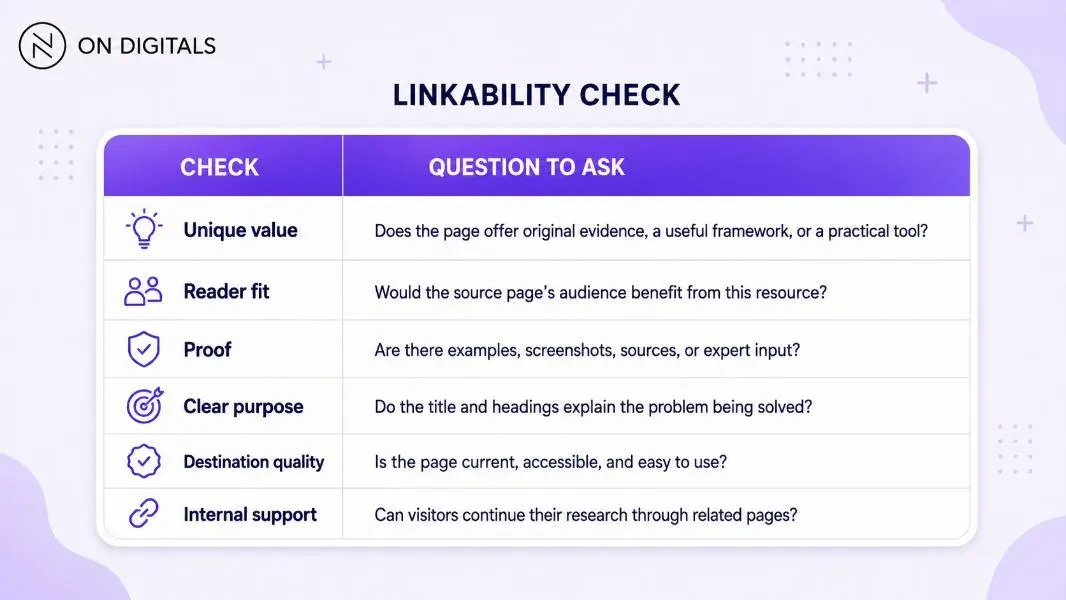 Pages with clear value, proof, audience relevance, and a strong destination experience are easier to promote and earn links to.
Pages that pass these checks are easier to pitch because their value is visible before the publisher even reads your email.
Choose a backlink route that fits the assets you have
The strongest backlink opportunities often begin with something your business already has. That could be existing visibility, specialist knowledge, local relationships, or a resource that solves a repeated audience problem.
| What you already have | Best starting point | First action |
| Existing brand mentions | Unlinked mention reclamation | Find mentions that do not reference the original source |
| Customers or partners | Relationship-based links | Identify shared content or case-study opportunities |
| Original research | Digital PR | Turn one useful finding into a story angle |
| Specialist knowledge | Expert commentary | Prepare source-backed insights for publishers |
| A practical tool | Resource page outreach | Find relevant curated lists |
| Local involvement | Community links | Document events, partnerships, or useful local activity |
| An outdated linked page | Link reclamation | Refresh the content before contacting referrers |
| A broken competitor resource | Broken-link replacement | Offer a stronger current alternative |
This structure helps you choose a tactic based on real business strengths instead of copying a strategy that only worked for another company.
Practical ways to get backlinks
Reclaim relevant unlinked mentions
An unlinked mention can be one of the most practical backlink opportunities because the publisher already knows your brand, founder, product, or research.
Begin by locating pages that reference your business without linking to the original source. Then check whether a citation would genuinely help readers. The strongest request points to a specific sentence and explains where visitors can find the supporting material.
For instance, an article may quote a finding from your research without linking to the full report. A short message can clarify where readers can access the source data, methodology, or wider analysis.
Earn references through existing relationships
Customers, suppliers, professional associations, event partners, and complementary businesses may already have relevant audiences. Their websites can create useful references when the placement helps those readers.
The placement should support the audience it serves. This may take the form of a supplier directory from a manufacturer, a customer case study published by a software partner, or a practical guide shared through an association’s member resources.
A shared audience gives the relationship a stronger editorial reason than a generic request to exchange links.
Publish assets that people want to cite
Content becomes easier to cite when it saves publishers time or gives them a clearer source to use. Detailed reports can support a claim with evidence, while calculators and comparison resources help readers complete a task or evaluate options more confidently.
Useful formats include:
- Original surveys
- Industry benchmarks
- Templates
- Calculators
- Comparison guides
- Visual explainers
- Specialist commentary
A general article may attract readers, while a research-backed benchmark can attract citations because it gives others a source they can use in their own content.
When promoting the asset, focus on one clear insight. A useful chart or practical framework can give someone an immediate reason to explore the full resource.
Use digital PR to contribute expert commentary
Digital PR creates stronger backlink opportunities when your business can add useful insight to a timely topic. Journalists and editors often need an informed quote, a clear example, or evidence that explains a trend.
Teams using digital PR methods that earn publisher attention should prepare proof points before opportunities appear.
| Element | What to prepare |
| Expertise area | A subject your team understands through direct work |
| Proof point | A relevant observation, example, or data point |
| Quote | A concise statement that can stand alone |
| Supporting source | Research, case material, or a useful guide |
| Contact person | A named expert who can respond promptly |
The best contribution improves the writer’s article even when the final piece does not include a link.
Once a journalist, editor, or publisher has a relevant reason to consider your resource, a focused email outreach process can turn that opportunity into a clearer editorial conversation.
Replace broken or outdated resources
Older articles often contain dead links, outdated reports, or tools that no longer work. These gaps can create an opportunity when your resource offers a genuine replacement.
Review the source page carefully before reaching out. Identify the affected section, confirm that your page answers the same need, then explain the reader benefit in a concise message.
A useful broken-link request usually covers four points:
- Mention the specific page and section.
- Identify the broken or outdated source.
- Share a current alternative.
- Explain why the replacement helps readers.
A loose topic match rarely earns a placement. The source and destination should answer closely related questions.
Earn placement on curated resource pages
Resource pages can be valuable when they are maintained, relevant, and built for a real audience. A guide, tool, database, or template may fit naturally when it fills an existing category.
Check whether the curator updates the page and whether the resource list has clear editorial standards. Your content should fit the existing structure rather than requiring the publisher to create an entirely new section.
A short pitch works best when it identifies the category, explains the practical use, and keeps the request focused.
Contribute useful guest content
Guest contributions can create relevant exposure when the host site has editorial standards and readers who match your audience. The article needs a distinct angle that contributes something new to the publication.
Pitch a topic supported by experience, original insight, or practical examples. A contextual source link may fit where it genuinely extends the discussion for readers.
Commercial links should remain limited. Strong guest content earns trust because the article itself provides value before directing visitors elsewhere.
Build local links through real activity
Local businesses can earn references through activity that matters within their community. Associations, events, educational sessions, and locally useful research may all create reasons for nearby websites to mention the business.
A neighbourhood publication may cover a local event, while a chamber of commerce can list useful resources for its members. In other cases, a university project may need specialist input from a local business and reference the source it draws on.
The domain location alone does not make a link valuable. Relevance, reader fit, and the quality of the placement still determine whether it is worth pursuing.
Use social media to improve content discovery
Social distribution can bring a useful asset to people who may not find it through search alone. A focused research post might catch the attention of a newsletter editor, while a visual summary can gain traction in a specialist community and lead others to explore the full resource.
Referral visits often come first. Editorial mentions may follow when the destination page offers research, a practical tool, or an insight that someone wants to cite.
A focused approach to social media link building for stronger content discovery can help resources reach writers, creators, and industry peers without treating every post as a direct ranking tactic.
Qualify each backlink opportunity before outreach
A thoughtful review can save time and reduce low-value outreach. Look beyond surface-level metrics before deciding whether to contact a publisher.
| Signal | Question to ask |
| Topical relevance | Does the source page cover a related need? |
| Editorial reason | Would the content improve with your reference? |
| Audience overlap | Could the placement reach relevant visitors? |
| Placement quality | Will the link appear in useful page content? |
| Destination fit | Does your page answer the reader’s next question? |
| Referral potential | Would people reasonably click through? |
| Link relationship | Is the placement editorial, sponsored, or user-generated? |
Paid placements can still serve a legitimate advertising purpose. Where a link is part of a commercial arrangement, Google recommends qualification such as rel=”sponsored”. User-generated content may use rel=”ugc” where appropriate. Google’s guidance on qualifying outbound links explains the distinction.
Nofollow-style links can still bring discovery and relevant referral traffic. Their value depends on the context of the placement rather than an assumption about ranking credit.
Avoid backlink tactics that create weak patterns
Some shortcuts create links with little reader value and may conflict with search quality guidance.
Google’s Spam Policies for Web Search address links created mainly to manipulate rankings. This includes paid ranking links, excessive reciprocal exchanges, automated placements, and low-value pages created mainly to carry links.
Avoid relying on:
- Paid followed links
- Large-scale link swaps
- Forum signatures used for promotion
- Comment links with commercial anchors
- Low-quality bookmark websites
- Self-published cross-linking networks
- .gov or .edu chasing based only on domain extension
A sponsorship, partnership, or community contribution can still be useful when it is transparent and relevant to the people who encounter it.
A 30-day plan for earning backlinks
Learning how to get backlinks becomes easier when the work is organised into a short, repeatable cycle.
| Week | Main focus | Practical output |
| Week 1 | Improve one target page | A stronger asset with proof and a clearer purpose |
| Week 2 | Research prospects | Relevant publishers, partners, and resource pages |
| Week 3 | Run focused outreach | Personalised messages built around one reader benefit |
| Week 4 | Review results | Replies, live references, referral sessions, and next actions |
Fifteen carefully qualified prospects can create more useful learning than a large generic list. Use a practical off-page SEO checklist to track readiness, prospect quality, outreach progress, and validation after a placement goes live.
Measure what each backlink contributes
A live backlink is an important milestone, although the evaluation should continue after publication.
| Area | What to review |
| Referral traffic | Sessions from the source and engagement on the destination page |
| Link retention | Whether the placement remains live and relevant |
| Content impact | New mentions, citations, or stronger linked-page visibility |
| Conversion quality | Enquiries, sign-ups, or assisted actions where measurable |
| Relationship value | Whether the source leads to future opportunities |
Regular reviews with backlink audit tools can help identify lost references, unusual patterns, changing anchor usage, and fresh sources worth evaluating.
A smaller industry website may send fewer visitors than a major publication, while those visitors may be more likely to explore related pages or contact your business.
FAQs about how to get backlinks
How many backlinks does a page need?
There is no fixed number. A focused page can perform well with a small group of relevant editorial references, while competitive topics may require stronger content and broader visibility across trusted sources.
Should I buy backlinks?
Paid advertising can create useful awareness when it is disclosed properly. Buying links mainly to influence rankings can create risk when the relationship is hidden or designed to pass ranking credit.
Can social media help earn backlinks?
Social media can help useful content reach people who may later reference it. A post usually creates discovery first. Editorial links become more likely when the page provides research, a useful tool, or a clear insight worth citing.
How long does it take to get backlinks?
Timing depends on the publisher, the quality of the opportunity, and the usefulness of the resource. Some updates happen quickly, while editorial placements may take several weeks.
Do .gov and .edu backlinks carry special value?
The domain extension alone does not make a backlink valuable. Page relevance, editorial purpose, surrounding context, and audience fit matter more than the ending of the domain name.
What should I do when a publisher does not reply?
Send one or two concise follow-ups that add useful context. When there is still no response, move on to better-fit opportunities instead of repeating the same request.
Conclusion
The strongest answer to how to get backlinks is to create something worth citing, then place it in front of people who have a genuine reason to reference it. Useful content, relevant relationships, and careful outreach can create more lasting value than a large number of weak placements.
Businesses that need support connecting content, outreach, digital PR, and backlink evaluation can explore off-page SEO services for sustainable authority growth.

NEWEST POSTS
- Advertising Industry In Vietnam: The 2026 Trends, Channels and Market-Entry Strategy
- Best SEO Company in Vietnam: Latest Shortlist For Businesses
- How To Leverage Social Media For Customer Service Like A Pro?
- Social Media Post Tips – 8 Ways To Boost Engagement
- How To Use Social Media for Sales – In-depth Beginner Guide
Read more