
International SEO Services for Global Market Growth
Vincent
26/02/2026
46
International SEO is the process of making a website visible, relevant, and technically clear across multiple countries, languages, and search environments. It combines market selection, localized keyword research, URL structure, hreflang, regional content, authority building, Search Console data, GA4 insights, and AI Search readiness for brands expanding beyond one market.
What is international SEO?
International SEO helps search engines understand which countries, languages, and audiences each version of your website should serve. Unlike single-market SEO, it must connect technical targeting, localized search intent, cultural relevance, and market-level reporting so the right page appears for the right user in each country.
A simple way to define it is this: international SEO turns a website from a single-market asset into a scalable global search system.
International SEO is not only a translation
A translated page can still fail if it targets the wrong keyword, uses unfamiliar phrasing, loads slowly in the target region, or lacks local trust signals. For example, an English service page for Singapore, Australia, and the United States may need different proof points, pricing cues, spelling, examples, and SERP competitors.
Google separates multilingual and multi-regional websites clearly
Google separates multilingual and multi-regional websites clearly, a multilingual site serves content in more than one language, while a multi-regional site targets users in different countries or regions. Some websites are both, such as a brand with English and French pages for Canada and separate pages for the United States.
For business teams, international SEO matters because market expansion creates more variables than normal SEO.
International SEO vs global SEO vs local SEO
International SEO, global SEO, and local SEO overlap, but they solve different search problems. To choose the right direction for your sales model, it is helpful to compare local SEO vs global SEO and understand how each impacts your technical setup and content resources.
Learn more about the difference among global SEO, local SEO, and multilingual SEO.
| SEO type | Main goal | Best fit | Common focus |
| Local SEO | Win visibility in a city, province, or local service area | Clinics, restaurants, local services, branches | Google Business Profile, local citations, reviews, map rankings |
| Global SEO | Build broad search visibility across regions | SaaS, ecommerce, B2B exporters, international brands | Scalable content, global brand visibility, market expansion |
| International SEO | Serve the right page to the right country or language | Multilingual or multi-country websites | Hreflang, URL structure, localization, market-level analytics |
| Multilingual SEO | Optimize content in multiple languages | Brands serving different language audiences | Translation QA, localized keywords, language-specific pages |
| Multi-regional SEO | Target different countries or regions | Brands with separate market offers | Country targeting, local SERPs, local authority |
The main difference between local SEO and global SEO is scope. Local SEO asks how to win demand in one defined area. Global SEO asks how to scale visibility across many regions. International SEO sits between strategy and execution by making sure each market has the right structure, language, content, and measurement.
When does a business need international SEO?
A business needs international SEO when organic demand, customer behavior, or expansion plans go beyond one country or language. The strongest signal is that specific markets can create qualified demand, conversions, or strategic growth.
You should consider an international SEO service when at least three of these signals appear:
- GA4 shows traffic or conversions from countries you do not actively target.
- Google Search Console shows impressions from international queries.
- Sales teams receive leads from overseas markets.
- Your product, service, or ecommerce offer can serve multiple countries.
- Paid campaigns show promising demand in a new region.
- Existing translated pages receive impressions but low clicks or conversions.
- Competitors have market-specific landing pages, content, or domains.
The benefits of international SEO are strongest when expansion is selective. A B2B brand entering Singapore, Australia, and the United States should not build 20 country folders at once. It should validate demand, competition, localization cost, and business readiness before scaling.
Global opportunity is large, but not evenly distributed. DataReportal’s April 2026 update estimated 6.12 billion internet users worldwide, equal to 73.8% global internet penetration, while close to 2.2 billion people remained offline. That means global SEO planning still needs market prioritization, not generic worldwide targeting.
How to choose which international market to enter first?
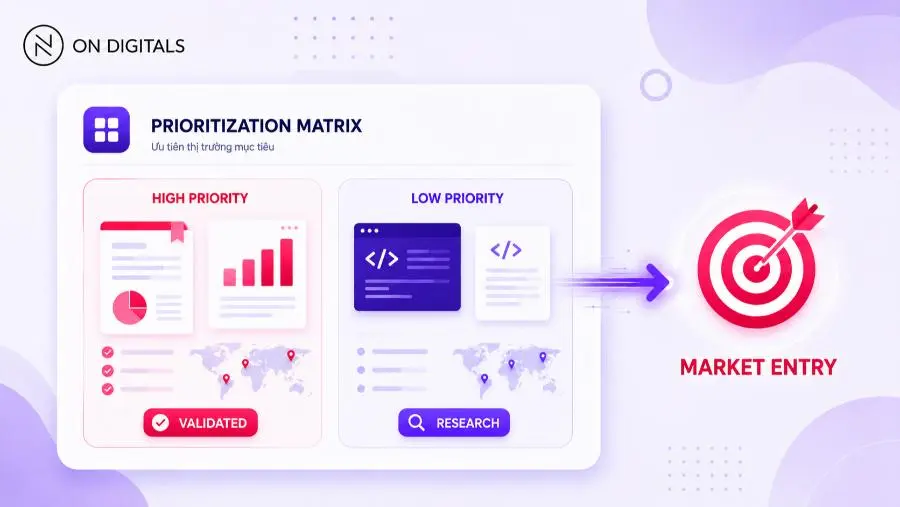
Choose your first international SEO market by scoring demand, competition, conversion potential, localization effort, and operational readiness. This prevents teams from choosing markets only because traffic looks attractive, while ignoring sales fit, language cost, regulation, shipping, support, or local competitors.
Use this simple scoring model before building new country or language pages.
| Factor | Question to answer | Score 1–5 |
| Search demand | Are target keywords searched in this country? | |
| SERP competition | Can your domain realistically compete? | |
| Business fit | Can you sell, deliver, support, or ship there? | |
| Conversion value | Are leads or orders commercially valuable? | |
| Localization effort | How much content, UX, legal, and language work is needed? | |
| Technical readiness | Can your CMS support market-specific URLs, hreflang, and tracking? | |
| Paid media signal | Have ads shown demand or conversion potential? |
A practical formula is:
Market priority = demand × conversion value × business fit ÷ competition × localization effort
This does not replace research, but it improves decision-making. A smaller market with strong conversion intent and lower localization complexity may outperform a larger market with intense competition and weak operational fit.
For On Digitals clients, this framework is especially useful for Vietnamese companies expanding outbound. Many exporters, SaaS companies, education providers, manufacturers, and B2B service firms can reach global buyers through search, but they need market selection before content production.
Which URL structure is best for international SEO?
The best international SEO URL structure depends on how much local control, authority separation, technical maintenance, and brand consistency your business needs. Most growing companies start with subdirectories because they are easier to manage, while large enterprises may use ccTLDs when each market needs strong local independence.
| Structure | Example | Strength | Risk | Best fit |
| ccTLD | example.de | Strong country signal and local trust | High cost, separate authority, more maintenance | Large brands with local teams |
| Subdomain | de.example.com | Flexible separation by market | Can dilute authority and complicate tracking | Markets with different tech stacks |
| Subdirectory | example.com/de/ | Easier authority consolidation and CMS control | Needs clean governance as markets scale | Most B2B, SaaS, and ecommerce growth teams |
| Parameter | example.com?lang=de | Easy to generate | Weak for SEO clarity, hard to manage | Usually not recommended for SEO-led expansion |
Google recommends using different URLs for different language versions, rather than relying only on cookies or browser settings. Google also notes that if a site uses different URLs for languages, hreflang annotations can help Search link users to the correct language version.
For most mid-market businesses, the safest starting point is a subdirectory model:
- example.com/us/
- example.com/sg/
- example.com/au/
- example.com/vn/
This keeps reporting cleaner, helps consolidate domain authority, and allows central SEO governance. The trade-off is that your team must maintain consistent URL rules, internal links, hreflang tags, content ownership, and redirect logic as new markets are added.
How hreflang works in international SEO?
Hreflang tells Google that different URLs are localized versions of the same or similar page. It helps Google serve the right language or regional page when multiple versions exist, but it does not replace high-quality translation, localized intent, crawlability, canonicals, or internal linking.
Google supports three equivalent methods for hreflang: HTML tags, HTTP headers, and XML sitemaps. Google also states that each language version must list itself and all other language versions, and that alternate URLs should be fully qualified.
A basic setup may look like this:
<link rel=”alternate” hreflang=”en-us” href=”https://example.com/us/” />
<link rel=”alternate” hreflang=”en-sg” href=”https://example.com/sg/” />
<link rel=”alternate” hreflang=”vi-vn” href=”https://example.com/vn/” />
<link rel=”alternate” hreflang=”x-default” href=”https://example.com/” />
Common hreflang mistakes include:
- Missing return tags between alternate pages.
- Using relative URLs instead of full URLs.
- Pointing hreflang to redirected or non-indexable pages.
- Mixing canonical tags that point to a different regional version.
- Using en when the page actually targets en-us, en-gb, or en-sg.
- Adding hreflang to pages that are not true equivalents.
- Forgetting x-default for global selectors or fallback pages.
For large websites, XML sitemap hreflang can be easier to maintain than page-level HTML tags. The right choice depends on your CMS, developer workflow, page count, and QA process.
Translation is not the same as localization
Translation changes language, while localization adapts meaning, intent, proof, examples, UX, and conversion cues for a market. International SEO needs localization because search behavior changes by country, even when people use the same language.
For example, an English page targeting “SEO services” in the United States may need different examples from an English page targeting Singapore. A Spanish keyword can also vary by country because users in Spain, Mexico, Colombia, and Argentina may prefer different terms.
A strong localization workflow should include:
- Market-specific keyword research.
- SERP review from the target country.
- Content brief written for that market.
- Translation or transcreation by a qualified language specialist.
- Local review for cultural fit and terminology.
- SEO review for headings, metadata, internal links, and schema.
- Conversion review for CTA, forms, proof, pricing, and compliance.
AI can support localization in 2026, but it should not replace human QA. Use AI to create first drafts, compare terminology, summarize SERP patterns, or scale content briefs. Then let native reviewers, SEO specialists, and business owners validate whether the page sounds credible in the market.
Google’s generative AI guidance also warns against simply recycling what others have said or producing commodity content. Its recommendation is to create unique, expert-led, helpful content that provides value beyond common knowledge.
International keyword research should start from intent
International keyword research identifies how people in each market describe the same need. Direct translation often misses search volume, commercial intent, modifiers, spelling, and SERP format, so each target market needs its own keyword set.
A practical workflow includes:
- Start with seed topics from your core services or products.
- Translate concepts, not keywords, into each target language.
- Pull keyword data by country, not only by language.
- Compare SERPs manually from the target location.
- Group keywords by funnel stage and search intent.
- Map each group to one page, not multiple overlapping pages.
- Create localized metadata, headings, body copy, FAQ, and internal links.
For B2B services, do not chase only high-volume keywords. A lower-volume query such as “international SEO consultant for B2B SaaS” may create better leads than a broad query like “global SEO.”
This is where global SEO solutions should connect SEO with sales and CRM data. Ranking is not the final KPI. Qualified enquiries, opportunity quality, and pipeline contribution matter more for high-consideration services.
Local authority building for international SEO
Local authority building helps each market version earn trust from relevant regional sources. Search engines and users both need signals that your brand is credible in the market, not only visible from a global domain.
Useful authority signals include:
- Local industry directories and associations.
- Regional PR mentions.
- Country-specific case studies.
- Local partner pages.
- Native-language thought leadership.
- Local reviews or testimonials where appropriate.
- Links from publishers, universities, trade bodies, or niche communities.
Avoid buying low-quality links in each country. That approach may create risk without improving long-term visibility. A better approach is to build genuine market presence: partnerships, local campaigns, helpful resources, and content that regional publishers can cite.
If your brand is entering Vietnam, for example, local authority may come from Vietnamese-language content, local case studies, Vietnamese business directories, event pages, industry publications, and localized social proof.
International SEO in the AI Search era
International SEO now needs AI Search readiness because users increasingly receive answers through AI Overviews, AI Mode, ChatGPT, Perplexity, and other answer engines before clicking a traditional result. The goal is not to chase AI hacks, but to make market-specific content clear, useful, crawlable, and cite-worthy.
Google announced in May 2025 that AI Overviews were available in more than 200 countries and territories and more than 40 languages. In October 2025, Google also expanded AI Mode to more than 35 new languages and over 40 new countries and territories, making it available in over 200 countries and territories total.
This changes international SEO in three ways.
- AI search experiences are not identical in every market. Language availability, user behavior, source mix, and SERP layout can differ by country.
- Zero-click behavior makes brand visibility more important. SparkToro and Datos reported that in 2024, just under 60% of U.S. mobile and desktop Google searches in their panel ended without a click, while only 360 clicks per 1,000 U.S. Google searches went to the open web.
- Google’s guide says SEO still matters, because AI Overviews and AI Mode are rooted in Google’s core Search ranking and quality systems. From Google Search’s perspective, optimizing for generative AI search is still optimizing for the search experience.
For international SEO, this means each market page should include:
- A direct answer after the H1.
- Clear H2 answers that stand alone.
- Local entities, examples, and proof points.
- Crawlable text, not only image-based content.
- Original insights, not generic summaries.
- Author and reviewer signals.
- Updated dates and credible sources.
- Structured data where relevant.
The strongest AI Search strategy is still a strong search strategy: useful content, technical clarity, market-specific expertise, and real authority.
Global SEO analytics: How to measure performance by market?
Global SEO analytics should measure each country, language, and URL group separately. A single organic traffic number can hide market-level problems such as wrong-page ranking, hreflang conflicts, weak localization, poor conversion quality, or demand from countries the business cannot serve.
A useful international SEO dashboard should include:
| Metric | Why it matters | Tool |
| Organic clicks by country | Shows where search demand is becoming traffic | Google Search Console |
| Impressions by country and query | Reveals market opportunities before traffic grows | Google Search Console |
| Landing pages by country | Detects whether the right regional pages are ranking | Google Search Console / GA4 |
| Conversion rate by country | Connects visibility to business value | GA4 / CRM |
| Indexed pages by market folder | Finds indexation gaps | Search Console |
| Hreflang error checks | Prevents wrong-page ranking | Crawling tool / QA script |
| Branded vs non-branded demand | Separates awareness from acquisition | Search Console |
| AI Overview visibility checks | Tracks citation and visibility changes manually or via rank tools | Rank tracker / manual SERP checks |
Google Search Console and Google Analytics can be combined for a clearer SEO view, especially when teams need to understand how audiences discover and experience a website. Google’s Search Console documentation also emphasizes using Search Console performance data to understand queries, traffic changes, and search performance.
For reporting, separate your dashboards by market stage:
- Discovery markets: impressions, keyword growth, early landing pages.
- Validation markets: clicks, engagement, assisted conversions.
- Growth markets: qualified leads, revenue contribution, market share.
- Mature markets: content decay, technical health, authority growth, AI Search visibility.
This prevents teams from judging a new market with the same KPI model as an established market.
What should global SEO services include?
Global SEO services should include market research, international technical SEO, localized content strategy, hreflang implementation, authority building, analytics, and ongoing optimization. A good international SEO service does not sell translation alone; it connects global visibility to business readiness and measurable growth.
A practical scope should cover:
- Market opportunity audit
Review organic demand, competitors, SERP features, paid data, business fit, and localization cost.
- International technical SEO audit
Check URL structure, crawlability, indexation, canonicals, hreflang, redirects, sitemap logic, speed, and duplicate content.
- Localized keyword research
Build keyword sets by country, language, funnel stage, and search intent.
- Content localization strategy
Plan landing pages, blog clusters, service pages, FAQs, proof points, and internal links for each market.
- Hreflang and metadata implementation
Create accurate language and country signals across pages or XML sitemaps.
- Market-specific authority building
Develop local links, citations, PR opportunities, and partner signals.
- Global SEO analytics setup
Build reporting by country, language, URL folder, query group, conversion, and lead quality.
- AI Search and GEO readiness
Improve direct answers, structured sections, entity clarity, author signals, and non-commodity insights.
How global SEO packages should be structured?
Global SEO packages should be structured by market complexity, not only by page count. A website targeting two English-speaking countries needs a different plan from an ecommerce site targeting ten languages, local currencies, product feeds, and regional legal requirements.
| Package type | Best for | Core deliverables |
| Market validation package | Brands exploring 1–3 markets | Demand audit, competitor review, keyword snapshot, market priority score |
| Technical setup package | Sites launching new country/language folders | URL structure, hreflang map, sitemap logic, redirects, QA checklist |
| Localization growth package | Brands scaling content by market | Localized briefs, metadata, landing pages, blog clusters, FAQ, internal links |
| Full international SEO package | Multi-market growth teams | Technical SEO, content, authority, analytics, AI Search, ongoing optimization |
| Migration package | Brands changing domains or structures | Redirect map, hreflang migration, indexation monitoring, traffic recovery plan |
The right package should also define what is not included. For example, legal translation, native copywriting, developer implementation, CRM integration, and regional PR may require separate scopes. Transparent packaging prevents confusion and protects performance expectations.
How to choose an international SEO expert?
Choose an international SEO expert by evaluating technical accuracy, market research quality, localization process, analytics setup, and ability to explain trade-offs. The right partner should help you decide where to expand, what to build, how to measure, and when not to enter a market yet.
Ask these questions before choosing a partner:
- How do you choose target markets before creating pages?
- Do you audit both multilingual and multi-regional SEO issues?
- How do you handle hreflang, canonical conflicts, and duplicate content?
- Can you build keyword research by country, not only by language?
- How do you QA AI-assisted localization?
- What does your market-level reporting include?
- How do you connect SEO performance to qualified leads or revenue?
- Can you work with local reviewers, developers, and internal marketing teams?
A reliable international SEO expert should not promise guaranteed rankings. Search outcomes depend on competition, technical readiness, content quality, market fit, authority, and ongoing investment.
At On Digitals, the stronger approach is to connect Search and AI Marketing with content, technical SEO, analytics, paid media signals, and website experience. That creates a growth system, not a disconnected set of SEO tasks.
Common international SEO mistakes
International SEO often fails when teams scale pages faster than they scale research, quality control, and measurement. The result is a large website with weak localization, wrong-page ranking, duplicate content, and unclear business impact.
Avoid these mistakes:
- Translating pages without market-specific keyword research.
- Creating country folders before confirming business readiness.
- Using hreflang while canonicals point to another market version.
- Redirecting users by IP without giving search engines crawlable URLs.
- Copying the same case studies and CTAs across every country.
- Measuring total organic traffic instead of performance by market.
- Ignoring local competitors and regional SERP features.
- Launching AI-translated pages without native or expert review.
- Building pages for every keyword variation instead of user intent.
- Treating global SEO as a one-time setup instead of an ongoing system.
The best prevention is governance. Define who owns technical QA, content localization, analytics, local review, publishing, and performance decisions before launching new markets.
Conclusion
International SEO helps brands grow across countries and languages by aligning search demand, technical structure, localized content, authority, and market-level analytics. In 2026, it also needs AI Search readiness because discovery increasingly happens through AI Overviews, AI Mode, answer engines, and zero-click search behavior.
For growing businesses, the practical next step is not to target every country. Start with market validation, choose the right URL structure, localize content properly, implement hreflang carefully, measure each market separately, and build authority where customers actually search.
Frequently asked questions (FAQs)
What is global SEO?
Global SEO is the practice of improving a website’s organic visibility across multiple countries, regions, or languages. It usually includes international keyword research, localized content, technical targeting, hreflang, regional authority building, and analytics by market. For businesses, the goal is not only more traffic, but more qualified demand from markets they can actually serve.
What is the difference between local SEO and global SEO?
Local SEO focuses on visibility in a specific city, area, or service region, while global SEO targets search visibility across several countries or languages. Local SEO often relies on map rankings, reviews, and local citations. Global SEO needs scalable content, international URL structure, hreflang, localization, and market-level performance tracking.
How much do international SEO services cost?
International SEO service cost depends on the number of markets, languages, pages, technical issues, content needs, and reporting complexity. A market validation project may be smaller, while a full global SEO package with technical implementation, localization, authority building, and analytics requires a larger ongoing scope. Pricing should follow complexity, not only keyword count.
How long does international SEO take?
International SEO usually takes several months because each market needs research, technical setup, localized content, crawling, indexing, ranking signals, and conversion data. Early gains may come from fixing hreflang, indexation, metadata, or wrong-page ranking. Competitive markets usually need sustained content, links, UX improvements, and analytics refinement.
Should we use AI for international SEO localization?
AI can support international SEO localization by drafting briefs, comparing terminology, summarizing SERPs, and scaling first drafts. It should not publish pages without human QA. Native reviewers, SEO specialists, and market owners should verify search intent, tone, cultural fit, legal claims, examples, and conversion messaging before pages go live.

NEWEST POSTS
- Advertising Industry In Vietnam: The 2026 Trends, Channels and Market-Entry Strategy
- Best SEO Company in Vietnam: Latest Shortlist For Businesses
- How To Leverage Social Media For Customer Service Like A Pro?
- Social Media Post Tips – 8 Ways To Boost Engagement
- How To Use Social Media for Sales – In-depth Beginner Guide
Read more