
Local SEO vs Global SEO: Which Strategy Fits Your Business Growth?
Vincent
23/01/2026
43
Local SEO helps businesses win search visibility in a specific city, service area, or physical market. In contrast, building a robust international SEO framework is essential for brands looking to reach audiences across different countries, regions, and languages. The right choice depends on your audience location, sales model, technical setup, and how you plan to scale your international structure.
Local SEO vs global SEO vs national SEO vs international SEO
Local, national, global, and international SEO differ by market scope, technical complexity, and how search intent is handled. Local SEO targets nearby customers, national SEO targets one country, global SEO targets broad multi-market visibility, and international SEO manages country or language targeting in detail.
| SEO type | Scope | Best fit | Main SEO focus |
| Local SEO | City, district, province, service area | Local services, branches, clinics, restaurants, stores | Google Business Profile, maps, reviews, local pages |
| National SEO | One country | Ecommerce, SaaS, nationwide services | National keywords, content hubs, authority, product/service pages |
| Global SEO | Multiple regions or countries | International brands, exporters, SaaS, global ecommerce | Scalable content, international visibility, market prioritization |
| International SEO | Specific country/language targeting | Multilingual or multi-regional websites | Hreflang, localized URLs, country pages, language strategy |
The missing middle layer is national SEO. Many businesses are not ready for global SEO yet, but they have already outgrown local SEO. For example, a logistics company serving all of Vietnam needs national SEO first. A software company selling to Vietnam, Singapore, Australia, and the United States needs global or international SEO.
A simple scope ladder looks like this:
Local SEO → National SEO → Global SEO → International SEO
Each step increases content complexity, technical requirements, reporting needs, and operational risk.
Local SEO vs global SEO
Local SEO and global SEO differ in audience size, keyword strategy, technical setup, trust signals, content planning, backlinks, and measurement. Local SEO is built around proximity and local intent, while global SEO is built around market selection, localization, scalability, and cross-border visibility.
| Criteria | Local SEO | Global SEO |
| Main goal | Attract customers in one area | Grow visibility across markets |
| Search intent | “Near me”, city, service area, local provider | Country, language, product, service, solution |
| Core asset | Google Business Profile and local pages | Website architecture and localized content |
| Technical focus | NAP consistency, map visibility, local schema | Hreflang, URL structure, crawlability, indexation |
| Content focus | Local services, branch pages, reviews, local proof | Market-specific pages, guides, localization, authority |
| Link building | Local directories, partners, community, local PR | Regional publishers, global PR, industry sources |
| Main KPIs | Calls, directions, map views, local rankings, reviews | Country traffic, rankings by market, conversions, hreflang health |
| Best for | Local services and physical locations | Scalable brands and multi-market businesses |
| Main risk | Attracting nearby users without converting | Scaling pages without localization or market fit |
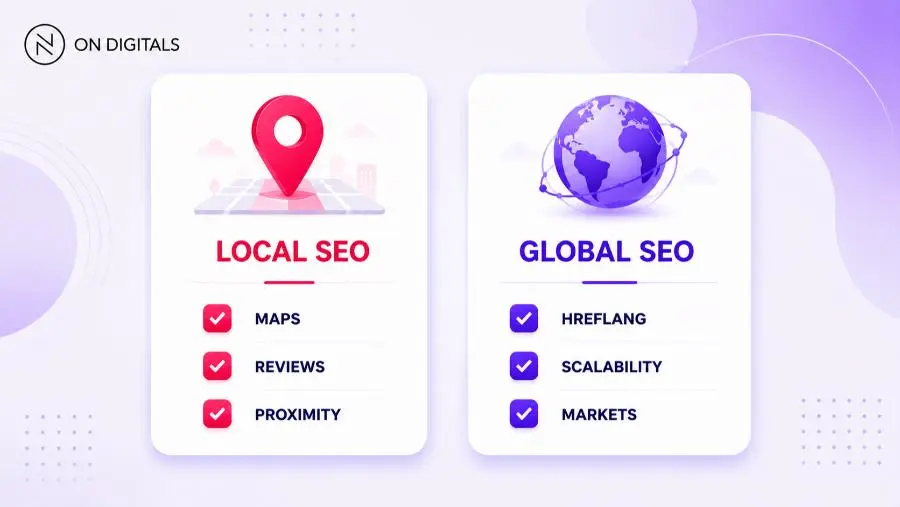
Search engine behavior also matters. StatCounter reported that Google held 90.02% worldwide search engine market share in April 2026, but global SEO teams still need to review each target market because search engine preference can vary by country.
A decision framework: Local, national, global, or hybrid?
The right SEO strategy depends on business model, customer location, sales capacity, budget, and operational readiness. A business should not move into global SEO only because international traffic appears in analytics; it should validate whether that traffic can become qualified demand.
Use this scoring table before choosing your strategy.
| Question | If the answer is yes | Recommended direction |
| Do customers need to visit or contact a nearby location? | Yes | Local SEO |
| Do you serve one city or service area? | Yes | Local SEO |
| Do you serve one whole country? | Yes | National SEO |
| Do you sell to multiple countries in one language? | Yes | Global SEO |
| Do you need different languages or country pages? | Yes | International SEO |
| Do you have branches in several countries? | Yes | Hybrid / glocal SEO |
| Do you have enough resources for localization and support? | No | Start local or national first |
| Do you have search demand but weak delivery capacity? | Yes | Validate market before scaling |
A practical decision flow:
- Start with the customer location. Are customers local, national, or international?
- Check business readiness. Can you serve, ship, sell, and support the market?
- Validate search demand. Use keyword research, Search Console, GA4, and paid data.
- Estimate effort. Include content, technical setup, localization, links, and reporting.
- Choose the smallest strategy that can create measurable growth.
This prevents a common mistake: building global pages before the business can convert global users.
How do local SEO and global SEO use keywords differently?
Local SEO uses location-based keywords, while global SEO uses market-specific keywords. Local SEO often combines service terms with cities or “near me” intent. Global SEO requires keyword research by country, language, and buyer stage because direct translation can miss real demand.
Examples of local SEO keywords:
- “SEO agency in Ho Chi Minh City”
- “dental clinic near me”
- “best logistics company in Hanoi”
- “international school in District 2”
- “B2B marketing agency Vietnam”
Examples of global SEO keywords:
- “SEO services Vietnam”
- “manufacturing company Vietnam export”
- “SaaS marketing agency Southeast Asia”
- “international SEO consultant”
- “Vietnam software outsourcing company”
For global SEO, translating a keyword is not enough. Searchers in Singapore, Australia, the United States, and Vietnam may use different modifiers even when they search in English. The SERP can also differ by country, which means content format, examples, proof points, and competitors must be reviewed market by market.
A strong SEO strategy should map each keyword group to one search intent. This reduces cannibalization and helps each page answer a specific business question.
How to measure local SEO vs global SEO?
Local SEO should be measured by local visibility and actions, while global SEO should be measured by market-level technical health and conversions. Using a comprehensive local SEO checklist can help track branch page rankings and map views.
| Measurement area | Local SEO KPIs | Global SEO KPIs |
| Visibility | Local pack rankings, map views, branch page rankings | Rankings by country, impressions by market, indexed regional pages |
| Engagement | Calls, direction requests, bookings, website clicks | Sessions by country, engagement by market, content performance |
| Trust | Review quantity, rating trend, review response rate | Regional backlinks, local mentions, market-specific proof |
| Technical health | Profile accuracy, local schema, NAP consistency | Hreflang errors, canonical issues, sitemap coverage |
| Business impact | Qualified local enquiries, appointments, store visits | Leads by country, ecommerce revenue, pipeline by market |
Google Business Profile performance reporting lets businesses check profile performance on Search and Maps by selecting a time period. That makes it useful for tracking local actions and visibility changes over time.
For global SEO, Google Search Console is essential because the Performance report shows how a site performs in Google Search, including search traffic trends, queries, and where traffic comes from.
A practical On Digitals-style dashboard should separate:
- Local branch performance
- Organic landing page performance
- Country-level organic traffic
- Search Console queries by market
- Conversion quality by source and region
- CRM-qualified leads by SEO page
- AI Search visibility checks where relevant
The goal is not reporting for reporting’s sake. The goal is to know which market, page, or location deserves the next investment.
Local SEO vs global SEO in the AI search era
AI Search changes both local and global SEO because users increasingly receive summarized answers before they click. Local businesses need stronger entity, review, and profile signals. Global brands need clear, localized, sourceable content that can be understood across languages and markets.
Google announced in May 2025 that AI Overviews were available in more than 200 countries and territories and more than 40 languages. In October 2025, Google also expanded AI Mode to more than 35 new languages and over 40 new countries and territories, bringing AI Mode availability to over 200 countries and territories total.
For local SEO, AI Search may influence how users ask for recommendations. Instead of typing “restaurant near me,” a user may ask an assistant for “a quiet Vietnamese restaurant nearby for a client lunch.” That means local visibility depends on more than keywords. Business categories, reviews, photos, attributes, service descriptions, local content, and reputation all become easier for AI systems to interpret.
For global SEO, AI Search increases the need for passage-level clarity. Market pages should define who they serve, where they operate, what makes the offer relevant, and what proof supports the claim. Google’s 2026 AI optimization guide states that SEO best practices remain relevant for generative AI features because AI Overviews and AI Mode are rooted in Google’s core Search ranking and quality systems.
Practical AI Search updates for both strategies:
- Write direct answers under H2s.
- Use clear entity names and service descriptions.
- Keep key information in crawlable text.
- Add FAQ answers that stand alone.
- Use original examples, not generic definitions.
- Update pages when market conditions change.
- Add author, reviewer, and date information.
- Support important claims with credible sources.
This is about making your business easier to trust and cite.
How hybrid “glocal SEO” works?
Hybrid or glocal SEO combines global structure with local execution. It is useful for brands that operate across countries but still need city, branch, or service-area visibility inside each market.
A glocal SEO setup may look like this:
- Global domain: example.com
- Country folder: example.com/vn/
- City page: example.com/vn/ho-chi-minh-city/
- Service page: example.com/vn/seo-services/
- Branch profile: Google Business Profile for each verified location
- Hreflang: language and country signals for equivalent pages
- Analytics: country, city, branch, and conversion dashboards
This model works for:
- Hotel groups
- Education providers
- Clinics and healthcare groups
- Franchises
- International agencies
- Logistics companies
- Multi-country retailers
- B2B service firms with regional offices
The risk is complexity. Teams need rules for page ownership, content localization, profile management, review response, internal linking, schema, and reporting. Without governance, hybrid SEO can create duplicate pages, inconsistent business information, weak local trust, and unclear market performance.
Which SEO strategy is right for your business?
Choose local SEO if customers buy based on proximity, trust, maps, reviews, and direct contact. Choose global SEO if your business can serve multiple markets and needs scalable visibility across countries or languages. Choose hybrid SEO if you have both international reach and local locations.
A simple recommendation:
| Business situation | Best SEO direction |
| One clinic, branch, restaurant, or local service area | Local SEO |
| Multiple branches in one country | Local + national SEO |
| Ecommerce serving one country | National SEO |
| SaaS serving multiple countries in English | Global SEO |
| Website serving multiple languages or regions | International SEO |
| Franchise or hotel group across countries | Hybrid / glocal SEO |
| B2B firm entering Vietnam or Southeast Asia | Global + localized market strategy |
The best SEO strategy follows the business model. A local business does not need global content to win nearby demand. A global brand cannot rely on one generic homepage to compete in different markets.
For On Digitals, the practical approach is to connect SEO Services, website structure, content, and measurement into one growth system. That helps businesses choose the market they can actually serve, not just the keyword with the highest volume.
Conclusion
Local SEO and global SEO serve different growth goals. Local SEO helps businesses win nearby customers through local search visibility, Google Business Profile, reviews, map results, and location pages. Global SEO helps brands expand across countries, regions, or languages through market research, technical structure, localization, authority, and analytics.
In 2026, the decision also needs AI search readiness. Local businesses should strengthen entity, profile, review, and location signals. Global brands should create clear, localized, source-backed content that search engines and AI systems can understand.
Frequently Asked Questions (FAQs)
Is local SEO better than global SEO?
Local SEO is better when customers need a nearby provider, physical location, or service area. Global SEO is better when the business can serve multiple countries or languages. The stronger option depends on audience location, business model, operational readiness, and how the company measures qualified demand.
Can a business use local SEO and global SEO together?
Yes. A business can use local SEO and global SEO together when it has international reach and local locations. For example, a hotel group may need country folders, hreflang, and global content, while each hotel also needs Google Business Profile optimization, reviews, local pages, and map visibility.
What is the difference between global SEO and international SEO?
Global SEO is a broad strategy for building search visibility across multiple markets. International SEO is the technical and content practice of targeting specific countries or languages. International SEO often includes hreflang, country folders, localized keyword research, translated content, and country-level analytics.
How long does local SEO take compared with global SEO?
Local SEO can show early movement after profile fixes, review improvements, local page updates, and citation cleanup, but competitive areas still need ongoing work. Global SEO usually takes longer because it requires market research, technical setup, localization, content production, authority building, and performance tracking by country.
What KPIs should local SEO track?
Local SEO should track Google Business Profile views, calls, website clicks, direction requests, bookings, local rankings, review growth, rating trend, location page traffic, and qualified enquiries. The best dashboard connects visibility metrics with business outcomes such as appointments, store visits, leads, and revenue contribution.
What KPIs should global SEO track?
Global SEO should track all metrics related to technical, on-page, off-page, and even revenue by country or language. Teams should also compare branded and non-branded demand, because global traffic growth does not always mean new market acquisition.

NEWEST POSTS
- Advertising Industry In Vietnam: The 2026 Trends, Channels and Market-Entry Strategy
- Best SEO Company in Vietnam: Latest Shortlist For Businesses
- How To Leverage Social Media For Customer Service Like A Pro?
- Social Media Post Tips – 8 Ways To Boost Engagement
- How To Use Social Media for Sales – In-depth Beginner Guide
Read more