
Is SEO Worth It for Small Businesses In The Era Of AI?
Vincent
24/07/2025
28
SEO is worth it for small businesses when customers already search for what you sell and the website can turn that attention into leads. For brands looking to scale in competitive markets, partnering with a professional SEO company in Vietnam is often the most cost-effective way to build a reliable search foundation. By connecting search intent to business outcomes, small businesses can ensure their digital investment pays back in the form of qualified demand and long-term growth.
Start with a decision framework
Small businesses should judge SEO by budget, waiting time, and market difficulty. A business with search demand and six to twelve months of patience can often benefit. A business with short runway may need paid ads or outreach first.
Decision guide:
- Customers search often and the niche is moderate: start SEO-first because organic visibility can compound and reduce dependence on paid clicks.
- Customers search often, but leads are needed this quarter: use a hybrid SEO and paid ads plan. Ads create short-term feedback while SEO builds durable coverage.
- The niche is very competitive and budget is limited: keep the SEO scope narrow. Local, long-tail, or service-specific searches are more realistic.
- The offer is unproven or search demand is weak: start with paid ads or outreach because SEO may not validate demand quickly enough.
- Runway is under six months: skip large SEO projects for now because cash flow matters more than compounding visibility.
The strongest small business SEO plan usually starts narrow. Choose the few pages that can influence leads or product sales.
Calculate the break-even point before investing
SEO ROI is not only about traffic. A small business should estimate how many qualified leads or sales SEO must create to pay for the work. This does not need a complex finance model. It needs a realistic view of cost, timing, lead value, and conversion rate.
Use this simple break-even formula:
SEO cost per month × months until traction ÷ estimated value per converted lead = customers needed to break even
For a local service provider, assume SEO costs $1,000 per month and traction takes six months. The early investment is $6,000. If one new customer is worth $1,500 in gross profit, the campaign needs four new customers to break even.
For a small ecommerce store, the math depends on margin and repeat purchases. If SEO costs $1,500 per month for six months, the early investment is $9,000. A store with $75 gross profit per order needs 120 extra orders to break even. That can work when category pages can rank, but it is risky for products with thin margins.
For a niche B2B service, one closed deal may justify the campaign. If SEO costs $2,000 per month and traction takes eight months, the investment is $16,000. A business with a $20,000 average deal value may only need one qualified organic customer, as long as sales conversion is strong.
Compare SEO with the channels you could use instead
Small businesses rarely compare SEO in isolation. The real trade-off is where the same budget should go first. Google Ads and Meta Ads solve different problems from outreach or partnerships.
Channel comparison:
- SEO: slower to start, but high compounding value. Best for search-driven products, local services, and B2B topics.
- Google Ads: fast to launch, with lower compounding value. Best for testing high-intent keywords and landing pages.
- Meta Ads: fast to medium speed. Best for visual offers, ecommerce, and retargeting.
- Cold outreach: fast when targeting is clear. Best for B2B offers with a defined buyer list.
- Referrals and partnerships: medium speed with strong trust value. Best for local businesses and trust-heavy services.
SEO is strongest when people already search for the problem. Paid ads are better for immediate testing, while outreach works when the buyer list is clear. Referrals are powerful when trust carries the decision.
Use paid ads or outreach for short-term learning, then use SEO to build coverage around offers that already convert.
When is SEO worth it for small businesses?
SEO is usually worth it when the business has a clear offer and enough patience. The website also needs to convert visitors. It becomes more valuable when search demand repeats every month instead of depending on one short campaign.
For a solo service provider, SEO can work when people search by service need or location. Start with one strong service page, basic local SEO, and helpful FAQs. Broad thought leadership can wait.
For a local brick-and-mortar business, local SEO is often worth it because Google Business Profile and reviews influence calls or visits. Website traffic still matters, but calls and bookings are closer to revenue. Branded search is another useful signal.
For a small ecommerce store, SEO is worth testing when products have search demand and healthy margins. Start with category pages and product templates. Fix crawlability and product data before producing large volumes of blog content. Internal links should support the buying journey.
For an early-stage B2B SaaS company, SEO can support education and lead quality. It may not be the first growth channel if positioning is still changing. Build a few high-intent pages while sales conversations clarify how buyers describe the problem.
For a creator or content-led business, SEO helps when topics have stable search demand. It works best when content supports a product, newsletter, course, or service. Traffic without a conversion path rarely proves ROI.
When SEO is not worth it yet?
SEO is not always the right move. Saying no can be the most cost-effective decision when the business needs faster validation or has no clear search opportunity. A small business should avoid large retainers when the channel cannot realistically pay back.
SEO may not be worth it yet if:
- The business has less than six months of cash runway.
- The offer, pricing, or target customer is still changing often.
- The niche is extremely competitive and the business has no differentiation.
- The audience finds vendors through referrals, marketplaces, or direct sales.
- The website cannot convert visitors because the offer, proof, or contact path is unclear.
- The owner cannot support implementation, approvals, content review, or tracking setup.
In these cases, SEO can still have a place later. Start with customer research or paid testing first. Sales conversations and referral systems can also validate demand faster. SEO works better after the business understands what customers want and which offers convert.
How AI search changes the SEO equation?
AI search makes SEO more complex, but it does not make SEO irrelevant for small businesses. Google AI Overviews and AI Mode can reduce clicks for some informational searches. ChatGPT and Perplexity can change discovery behavior as well.
At the same time, they can surface niche experts when the content gives a specific and useful answer.
The old SEO goal was simple, rank higher and win more clicks.
Now, small businesses should also think about being cited or recommended in AI-generated answers. Clear definitions and decision frameworks make that easier. Practical examples and credible proof help even more.
There is still risk. Some searches may become zero-click journeys because users get enough information without visiting the website. That means traffic alone is not enough. Branded searches and direct inquiries deserve more attention. Google Business Profile actions and assisted conversions matter as well.
Should you do SEO yourself, hire a freelancer, or work with an agency?
The right execution model depends on budget and complexity. DIY SEO can work for a small website, but it is not free. Four to six hours per week spent learning and publishing has an opportunity cost.
The same things might not also happen to other SEO services providers. Therefore, which is the best SEO provider between freelance, agency and in-houses is a question you should clarify before choosing between a SEO company or a freelancer.
What should happen in the first 12 months when SEO is implemented?
SEO takes time, but it should not feel vague. A small business needs milestones before expecting full ROI.
Month 1
Set up Google Search Console and Google Analytics 4. Add conversion tracking and Google Business Profile if relevant. Audit the website and map keywords to priority pages. Then fix obvious technical blockers.
Month 3
Priority pages should be improved and internal links should be clearer. Early impressions should start moving. For local businesses, Google Business Profile actions and branded searches are useful signals.
Month 6
The business should see better rankings for some long-tail or local queries. Organic leads may still be inconsistent, but the direction should be visible in Search Console and conversion data.
Month 12
SEO should show whether it can become a repeatable acquisition channel. Review organic leads, lead quality, assisted conversions, and revenue contribution. If the site has traffic but no inquiries, the issue may be conversion rather than visibility.
How to measure whether SEO was worth it?
Small businesses should measure SEO by business outcomes, not only keyword rankings. Rankings are useful diagnostics, but they do not prove value by themselves. A campaign is worth continuing when organic visibility starts supporting qualified demand.
Review SEO performance monthly, but do not change the decision every week. SEO needs enough time to compound. Still, the work must show a clear link between visibility and business value.
Frequently Asked Questions (FAQs)
How much should a small business spend on SEO?
A small business should spend enough to cover work that affects priority pages and technical health. Tracking, local visibility, and content needs should shape the rest of the budget. The right amount depends on competition and revenue potential.
How long does SEO take for a small business?
Most small businesses need several months to see meaningful traction. Early signs may appear through impressions or technical improvements. Better page performance is another signal. Leads and revenue usually need more time, especially in competitive markets.
Is SEO better than Google Ads for small businesses?
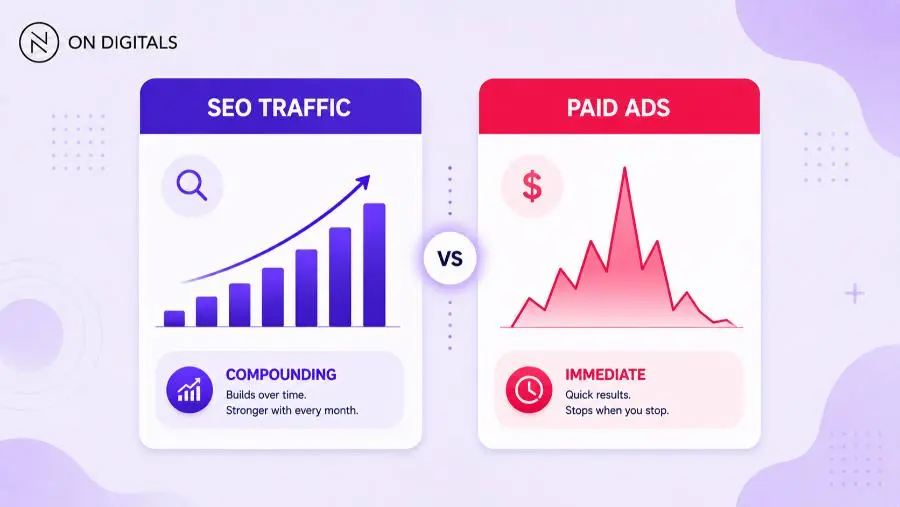
SEO is better for long-term compounding visibility. Google Ads is better for fast testing and immediate demand capture. Many small businesses should use both: ads for short-term learning and SEO for durable search coverage.
Key takeaways
SEO is worth it for small businesses when search demand exists and the website can convert visitors into leads or customers. The business also needs enough patience for compounding results.
Before investing, calculate the break-even point and compare SEO with faster channels. If SEO wins the decision, start narrow. For small businesses, the best SEO strategy is the one that fits the budget and stage of the business. The customer journey and patience level matter too.

NEWEST POSTS
- Advertising Industry In Vietnam: The 2026 Trends, Channels and Market-Entry Strategy
- Best SEO Company in Vietnam: Latest Shortlist For Businesses
- How To Leverage Social Media For Customer Service Like A Pro?
- Social Media Post Tips – 8 Ways To Boost Engagement
- How To Use Social Media for Sales – In-depth Beginner Guide
Read more