
SEO Performance: How to Measure SEO in Vietnam?
Vincent
11/08/2023
50
SEO performance is the measurement of how organic search supports visibility, AI search presence, and conversions contribution. For rising businesses, it should combine tracking tools, signals, technical elements, and AI citation.
Why has SEO performance measurement changed?
SEO performance can no longer be measured by rankings and organic traffic alone.
AI Overviews, Google AI Mode, zero-click behavior, local SERP features, and multi-touch buying journeys can increase visibility while reducing clicks, making old funnel reporting incomplete.
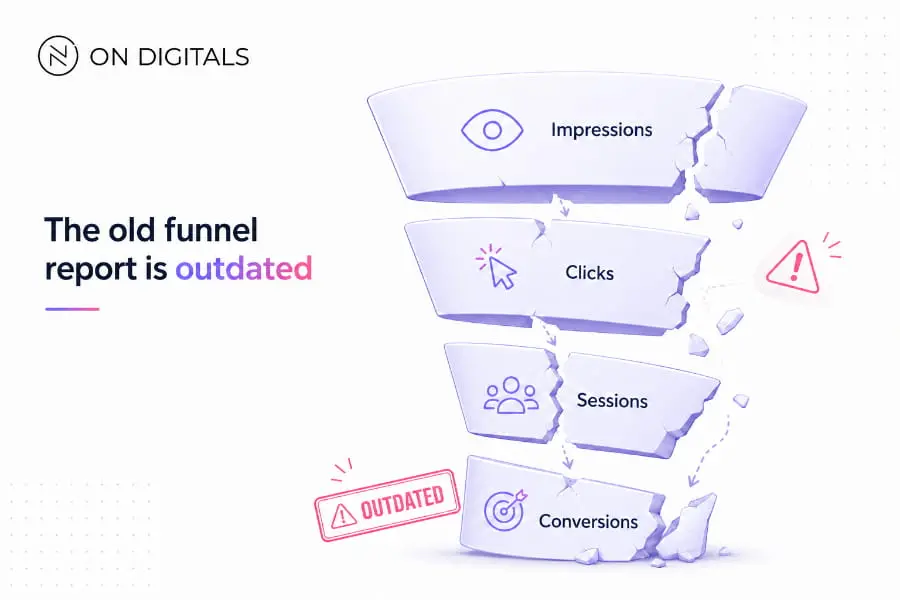
The old funnel based report is no longer enough
This matters for Vietnam market entry because foreign businesses need proof that search creates qualified demand, supports local trust, and helps buyers move from discovery to enquiry.
The measurement challenge is that search visibility does not always become a click. Pew Research Center found that users clicked a traditional result in 8% of visits when a Google AI summary appeared, compared with 15% when no AI summary appeared.
This requires more type metrics than only visibility figures.
SEO metric vs. SEO KPI: What is the difference?
An SEO metric is a number you can track, while an SEO KPI is a metric tied to a business goal. This distinction matters because many SEO reports look busy but do not help decision-making.
| Type | Example | What it tells you |
| Metric | Organic impressions | Whether visibility is growing? |
| Metric | Average position | Whether rankings are moving? |
| Metric | Organic sessions | Whether search brings visits? |
| KPI | Organic qualified leads | Whether SEO attracts useful demand? |
| KPI | Organic-assisted pipeline | Whether SEO supports revenue? |
| KPI | Branded search growth in Vietnam | Whether awareness is growing locally? |
For firms, a KPI should connect to one business goal: demand generation, sales, or brand awareness, etc.
Leading vs. lagging SEO performance indicators
Leading SEO indicators show whether SEO work is moving in the right direction before revenue appears. Lagging indicators show the business result after users have searched, clicked, evaluated, converted, and moved through the sales process.
A brand should not expect revenue metrics to move first. Early signals often appear in technical and on-page elements.
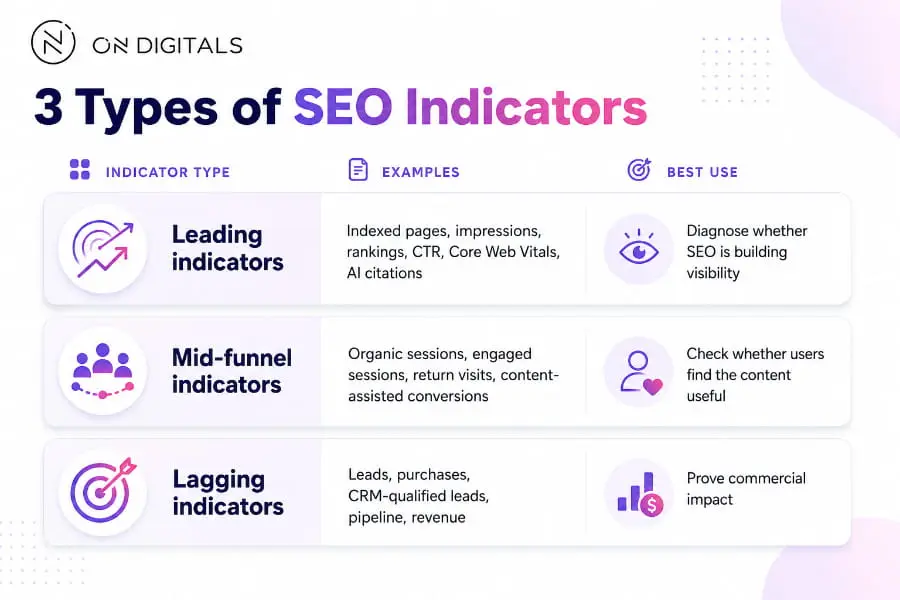
3 main types of SEO indicators
At On Digitals, we use leading indicators in the first 90 days, while lagging indicators should be used once pages have enough data.
Core SEO performance metrics to track
We believe the best SEO performance framework groups metrics by business purpose. Therefore, every single metric will be grouped by its contribution.
1. Visibility metrics
Visibility metrics show whether your brand appears in search before users click.
| Metric | Definition | What good looks like |
| Impressions | How often your result appears in Google Search | Growing for priority topics and queries |
| Average position | Average ranking position of your top result | Improving for target clusters |
| Keyword rankings | Position for tracked keywords | Movement across English and other language terms |
| Search visibility | Estimated share of SERP visibility | Growth against local competitors |
| Branded queries | Searches containing your brand | Growth after PR, paid, social, or SEO activity |
| Non-branded queries | Searches without your brand | Growth in category demand capture |
2. Traffic metrics
Traffic metrics show whether search visibility becomes visits. They should be measured by page type (blog traffic, landing page traffic), country, device, language, and channel source.
| Metric | Definition | Business use |
| Organic sessions | Visits from organic search | Measures search-driven site visits |
| Organic users | Users from organic search | Shows audience reach |
| New vs returning users | First-time vs repeat visitors | Helps evaluate awareness and remarketing |
| Landing page sessions | Organic sessions by entry page | Identifies pages that attract demand |
| Country traffic | Organic users by market | Confirms Vietnam relevance |
Traffic should not be judged alone. In the zero-click era, a page can gain visibility but lose clicks because AI Overviews or other SERP features answer part of the query before the click.
3. Engagement metrics
Engagement metrics show whether organic visitors find the website useful after they arrive. In GA4, these metrics are more useful than legacy bounce rate obsession because they connect behavior to conversion paths.
| Metric | Definition | How to use it |
| Engagement rate | Share of engaged sessions | Check whether visitors interact meaningfully |
| Average engagement time | Active time users spend on site | Compare landing page usefulness |
| Scroll or content events | User interaction with page depth | Check whether long content is consumed |
| Internal click events | Clicks to service, contact, or product pages | Measure content-assisted journeys |
| Bounce Rate | Where users leave | Detect weak CTAs or page mismatch |
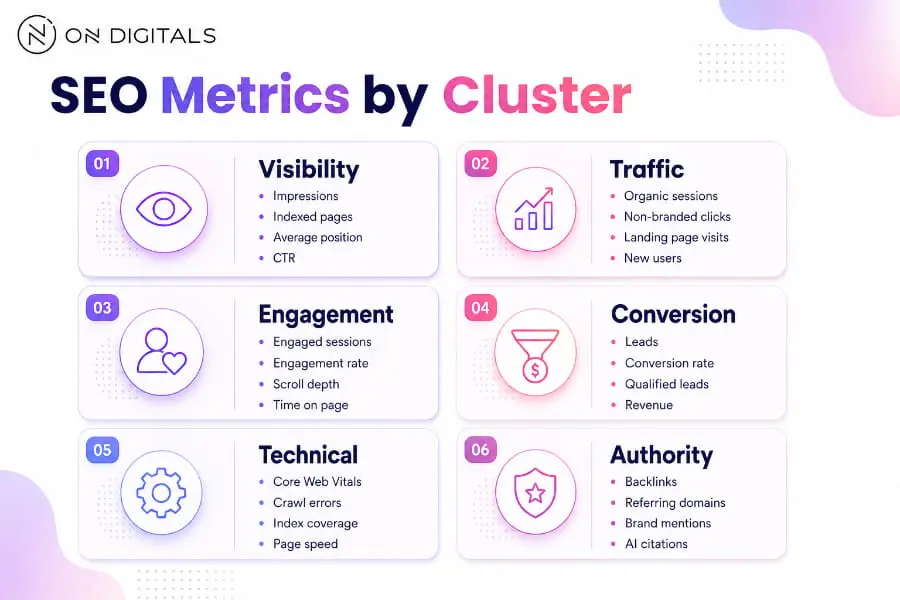
SEO metrics by groups
4. Conversion and revenue metrics
Conversion metrics show whether SEO supports business outcomes. For businesses, these should be tied to conversion-driven actions.
| Metric | Definition | Best for |
| Organic key events | Important actions from organic users | Lead or ecommerce tracking |
| Session key event rate | Sessions that trigger key events | Conversion quality |
| Organic conversion rate | Organic conversions divided by organic sessions | Landing page effectiveness |
| Assisted conversions | SEO’s role before final conversion | Long B2B buying journeys |
| Organic qualified leads | SEO leads that match sales criteria | B2B and high-consideration services |
| Organic revenue | Revenue attributed to organic journeys | Ecommerce or closed-won sales |
Google Ads conversions can be created from GA4 key events, helping report conversions across non-Google and organic channels.
For B2B, do not stop at form submissions. Connect organic leads to CRM stages such as marketing-qualified lead, sales-qualified lead, opportunity, and closed-won revenue.
5. Technical and website health metrics
Technical metrics show whether the website can support search visibility and conversion.
They matter more for businesses using multilingual pages, regional folders, local landing pages, ecommerce catalogs, or JavaScript-heavy websites.
| Metric | Why it matters |
| Indexed pages | Confirms important URLs are in Google |
| Crawl errors | Finds access and discovery issues |
| XML sitemap coverage | Checks whether submitted URLs are valid |
| Core Web Vitals | Measures user experience thresholds |
| Mobile usability | Important for Vietnam mobile journeys |
| Hreflang accuracy | Critical for EN/VI or multi-region sites |
| Schema validation | Helps clarify entities and page type |
Google’s Core Web Vitals thresholds are LCP within 2.5 seconds, INP under 200 milliseconds, and CLS under 0.1 for good user experience.
6. Authority and off-page metrics
Authority metrics show whether other sites or communities recognize your brand.
For businesses entering a new geographic market, local relevance matters more than a high third-party score alone.
| Metric | Definition | Warning |
| Backlinks | Links pointing to your site | Quality matters more than volume |
| Referring domains | Unique sites linking to you | Local relevance matters |
| Brand mentions | Mentions with or without links | Useful for PR and AI visibility |
| Local citations | Business mentions in directories/maps | Important for local businesses |
| Authority score/ DA/ DR | Third-party authority estimates | Not Google ranking metrics |
Do not report DA or DR as if they were Google metrics. Use them as directional benchmarks, not as business KPIs.
AI search and GEO/AEO metrics to add
AI search metrics measure whether your brand or content appears inside AI-generated answers
This is the biggest missing layer in most SEO performance reports because AI Overviews and answer engines can influence discovery before a user visits your website.
Google announces pages appearing in AI features are included in overall Search Console traffic under the web search type. You can track these AI search metrics separately:
| Metric | Definition | How to measure |
| AI Overview presence | Whether AI Overview appears for target queries | Manual SERP checks/ AI tracking tools |
| AI citation rate | Share of tracked queries where your URL is cited | Manual tracking/ AI visibility tools |
| Brand mention rate | Share of AI answers that mention your brand | Prompt tracking |
| Share of model voice | Your mentions vs competitor mentions | Prompt set monitoring |
| Answer inclusion rate | How often your content is included in answers | AI monitoring tools |
| Prompt coverage | How many buyer questions your brand appears for | Topic/ prompt matrix |
| Sentiment and accuracy | Whether AI describes your brand correctly | Manual QA |
| AI referral traffic | Sessions from ChatGPT, Perplexity, Gemini, etc. | GA4 source/ medium reports |
At On Digitals, we use a fixed prompt set. For example, a foreign B2B company entering Vietnam might track:
- “Best [service] providers in Vietnam”
- “How to choose a [service] agency in Vietnam”
- “What should foreign companies know before entering Vietnam?”
- “Compare [category] options in Vietnam”
- “Which companies help with [service] in Vietnam?”
AI Search reporting is still directional. Results can vary by model, query wording, location, language, logged-in state, and date.
How to choose SEO KPIs by business goal?
SEO KPIs should match the business goal. A business may need awareness first, leads later, and revenue attribution only after enough CRM data exists.
| Goal | Primary KPI | Supporting metrics |
| Build local awareness | Vietnam impressions, branded search growth | AI mentions, social-assisted traffic |
| Generate B2B leads | Organic qualified leads | Service-page sessions, key event rate |
| Support ecommerce | Organic revenue | Category traffic, product clicks, add-to-cart |
| Improve lead quality | Sales-qualified organic leads | CRM stage, form quality, enquiry source |
| Grow AI visibility | AI citation rate | Brand mention rate, prompt coverage |
| Improve technical performance | Indexed pages, Core Web Vitals | Crawl errors, page speed, mobile UX |
| Reduce paid dependency | Organic-assisted revenue | Paid + organic overlap, CAC trend |

Choose SEO KPI by business goals
A practical SEO dashboard should show three layers:
- Visibility: impressions, rankings, AI citations.
- Behavior: sessions, engagement, internal clicks.
- Business outcome: leads, qualified leads, revenue, pipeline.
SEO performance dashboard for Vietnam market entry
A useful SEO dashboard should separate Vietnam data from global data. It should also separate English and Vietnamese content when both markets matter.
| Dashboard section | Metrics |
| Vietnam visibility | GSC impressions, clicks, CTR, position filtered by Vietnam |
| Branded vs non-branded | Brand queries, category queries, service queries |
| Landing pages | Organic sessions, key events, conversion rate by page |
| Content clusters | Impressions, clicks, rankings, internal clicks by cluster |
| AI Search | AI Overview presence, citation rate, brand mentions |
| Technical health | Indexed pages, crawl errors, Core Web Vitals |
| CRM quality | MQL, SQL, opportunity, closed-won from organic |
| Local SEO | Google Business Profile actions, reviews, local rankings |
For B2B, CRM alignment is essential. A page that creates 20 enquiries but only one qualified lead may be weaker than a page that creates five enquiries and three qualified opportunities.
Measurement cadence
| Cadence | What to check | Purpose |
| Weekly | Indexing issues, traffic drops, crawl errors, key event tracking | Catch problems early |
| Monthly | Impressions, clicks, CTR, rankings, landing page conversions | Understand SEO movement |
| Quarterly | Leads, revenue, topic clusters, AI visibility, content roadmap | Reallocate investment |
| After major updates | Rankings, traffic, SERP features, AI Overview changes | Separate algorithm impact from execution issues |
Use annotations in GA4, dashboards, or reporting notes for major events: site launch, tracking changes, redirects, content refreshes, PR campaigns, core updates, migration, or market-entry campaign launch.
Common SEO performance measurement mistakes
Most SEO measurement mistakes come from treating tool metrics as business outcomes. A strong report should explain what changed, why it changed, and what decision should follow.
| Mistake | Why it causes problems | Better approach |
| Reporting only traffic | Ignores zero-click and lead quality | Include visibility, conversion, CRM data |
| Treating DA/DR as KPIs | These are third-party metrics | Use as benchmarks only |
| Mixing global and Vietnam data | Hides local performance | Segment by country and language |
| Ignoring branded vs non-branded | Overstates SEO demand capture | Split brand and category queries |
| Measuring only last-click conversions | Undervalues long B2B journeys | Use assisted conversion and CRM data |
| Ignoring AI visibility | Misses new discovery surfaces | Track AI citations and mentions |
| Trusting GA4 defaults blindly | Channel/source rules may need cleanup | Audit source/medium and UTM logic |
| Not checking GSC data anomalies | Misreads reporting changes as SEO changes | Review Search Console anomaly notes |
Google maintains a Search Console data anomalies page. For example, it notes that from May 7, 2026, FAQ rich results no longer appear in Google Search, which can reduce reported FAQ impressions without meaning your content quality declined.
SEO performance marketing stack
SEO performance marketing needs a stack that connects organic visibility to business outcomes. For foreign businesses entering Vietnam, start simple, then add paid SEO tools like Ahref or Semrush, when decisions require scale.
Do not buy tools before defining KPIs. A clean Search Console + GA4 + CRM setup is more valuable than an expensive dashboard that cannot answer whether SEO creates qualified demand. Just buy tools when your team already knows how to use it for.
Frequently Asked Questions (FAQs)
What is SEO performance?
SEO performance is the measurement of how organic search contributes to visibility, traffic, user engagement, conversions, and business outcomes. In 2026, it should also include AI Search visibility, branded search growth, zero-click context, technical health, and CRM-qualified lead quality.
How do you measure SEO performance?
Measure SEO performance with Google Search Console for impressions, clicks, CTR, and position; GA4 for sessions, engagement, and key events; CRM data for lead quality and revenue; SEO tools for rankings and backlinks; and AI monitoring for citations, mentions, prompt coverage, and answer accuracy.
What are the most important SEO KPIs?
The most important SEO KPIs depend on the business goal. For B2B market entry, track organic qualified leads, service-page conversions, non-branded visibility, branded search growth, and organic-assisted pipeline. For ecommerce, track organic revenue, category-page sessions, product clicks, add-to-cart, and conversion rate.
How should SEO performance be measured in the AI Search era?
SEO performance in the AI Search era should include AI Overview presence, AI citation rate, brand mention rate, share of model voice, prompt coverage, AI referral traffic, and accuracy of AI-generated descriptions. These metrics should sit beside classic Search Console and GA4 reporting, not replace them.
Is organic traffic still a good SEO metric?
Organic traffic is still useful, but it is no longer enough. Zero-click results and AI Overviews can reduce clicks even when visibility increases. Use traffic together with impressions, CTR, rankings, AI citations, engaged sessions, conversions, branded search, and CRM-qualified lead quality.
How often should SEO performance be reported?
Check technical issues weekly, report SEO movement monthly, and review business impact quarterly. For a foreign business entering Vietnam, quarterly reviews should include Vietnam-specific visibility, local language performance, AI Search visibility, lead quality, and whether SEO investment still matches the market-entry goal.
Final takeaway
SEO performance measurement is no longer a traffic report. For businesses, it should show how organic search builds visibility, earns trust, supports AI Search presence, and contributes to measurable business outcomes.
The strongest SEO reports now connect different tools. That gives leadership a clearer view to make the most valuable decision. To deliver high-performance digital measurement reports, our SEO services can help you accelerate the process with an integrated approach.

NEWEST POSTS
- Advertising Industry In Vietnam: The 2026 Trends, Channels and Market-Entry Strategy
- Best SEO Company in Vietnam: Latest Shortlist For Businesses
- How To Leverage Social Media For Customer Service Like A Pro?
- Social Media Post Tips – 8 Ways To Boost Engagement
- How To Use Social Media for Sales – In-depth Beginner Guide
Read more