
SEO Content Optimization Process for Search-Ready Copy
Vincent
16/09/2021
22
SEO content optimization is the process of improving copy so it matches search intent, answers user questions, supports SEO copywriting and encourages action. It includes SERP analysis, content structure, keyword placement, internal links, metadata, AEO-ready answers, CTA quality and performance updates after publishing.
Many websites already have content. The problem is that the content does not always perform. A blog post may get impressions but few clicks. A service page may attract traffic but no enquiries. Two articles may target the same keyword and compete with each other.
What is SEO content optimization?
SEO content optimization is the process of improving a new or existing page so it can perform better in search. It focuses on search intent, page structure, keyword use, metadata, internal links, answer quality and conversion flow.
It is different from simply writing content. Writing creates the first draft. Optimization improves the draft so it has a clearer role.
For example, a writer may create a blog about SEO copy. The optimization process checks whether the page answers the right query, uses the right headings, links to related pages and includes a strong enough CTA.
SEO copywriting and SEO content optimization are connected, but they are not the same.
- SEO copywriting focuses on writing persuasive, search-ready copy.
- SEO content optimization focuses on improving that copy before and after publishing.
This distinction is important for websites with many similar articles. Without a clear page role, two URLs can compete for the same keyword. That can weaken both pages.
SEO copywriting vs SEO content optimization
SEO copywriting and SEO content optimization support the same goal, but they happen at different stages. One focuses on writing. The other focuses on performance improvement.
|
Criteria |
SEO copywriting |
SEO content optimization |
|
Main job |
Write persuasive SEO copy |
Improve content performance |
|
Timing |
Before or during writing |
Before and after publishing |
|
Focus |
Reader engagement and search relevance |
Intent, structure, metadata, links and refresh |
|
Best use |
Blog posts, landing pages and service pages |
Audits, updates and ranking improvements |
|
Main question |
How should this copy be written? |
How can this page perform better? |
When should you optimize SEO content?
You should optimize SEO content when a page has potential but is not performing as well as it should. This often happens when the page ranks on page one or page two, but cannot move higher.
Optimization is also useful when traffic does not create business value. A page may bring visitors, but those visitors may not take the next step.
Common signs include:
- High impressions but low CTR
- Average position between 4 and 20
- Traffic with weak engagement
- Old examples or outdated data
- Missing internal links
- Weak title or meta description
- No clear CTA
- Similar content across multiple URLs
An old page does not always need a full rewrite. Sometimes, the page only needs a stronger opening, better headings, updated examples and clearer internal links.
The goal is to improve what already has value. This is often faster than creating a new article from zero.
The SEO content optimization process
A strong SEO content optimization process starts before editing. You need to understand the SERP, the page role and the user intent first.
If you skip this step, you may rewrite the content without solving the real problem.
Step 1. Analyze the SERP before editing
SERP analysis shows what Google already rewards for the target query. It helps you understand the format, depth and angle users expect.
Open the top-ranking pages and check the pattern. Do they use guides, checklists, examples or comparison tables? Do they answer basic questions first? Do they include FAQs? Do they target beginners or advanced readers?
You should also check what the top pages are missing. A better page does not only repeat the same headings. It adds clearer answers, stronger examples or a more useful workflow.
Focus on these points:
|
SERP element |
What to check |
|
Search intent |
What does the user want to know or do? |
|
Content format |
Guide, checklist, comparison or landing page |
|
Common sections |
Topics most competitors cover |
|
Content gaps |
Useful points competitors miss |
|
SERP features |
Featured snippets, PAA or video results |
|
Business angle |
Whether users need advice, tools or a service |
SERP analysis prevents blind rewriting. It shows what the page must satisfy before it can compete.
Step 2. Check the current page role
Every page needs one clear role. A page can be a broad guide, a service-supporting article, a checklist, a comparison or a landing page.
If the role is unclear, the content becomes scattered. It may define a topic, give tips, sell a service and explain tools at the same time. That makes the page harder to rank.
Before editing, ask one question: what should this URL be responsible for? A clear page role helps you decide what to keep, remove and rewrite.
Step 3. Match the page with search intent
Search intent is the reason behind a query. A user may want to learn, compare, buy or fix a problem.
For SEO content, the most common intent types are:
|
Intent |
User need |
Content approach |
|
Informational |
Understand a topic |
Definition, guide and examples |
|
Commercial |
Compare options |
Criteria, benefits and use cases |
|
Transactional |
Take action |
Service details, trust signals and CTA |
|
Problem-solving |
Fix performance |
Checklist, audit steps and examples |
Step 4. Rewrite the opening for direct answers
The opening paragraph is important for users, search engines and answer engines. It should explain the topic quickly without a long introduction.
A strong opening should answer four points:
- What the topic means
- Why it matters
- What the process includes
- Who the page is useful for
Avoid vague openings such as “In today’s digital world” or “In this article, we will explore.” These lines do not help the reader.
A better opening starts with a direct answer. For example:
“SEO content optimization is the process of improving a page so it matches search intent, answers user questions and supports organic visibility.”
This type of opening is easier to understand. It is also easier for AI search systems to extract.
Step 5. Improve headings and content flow
Headings should guide the reader through the page. Each H2 should answer one clear question or decision point.
A weak heading says “Benefits.” A stronger heading says “When should you optimize SEO content?” The second version tells the reader what the section will answer.
Good content flow also matters. A page should move from basic understanding to practical action.
For this topic, the flow should be:
- Define SEO content optimization.
- Separate it from SEO copywriting.
- Explain when optimization is needed.
- Show the step-by-step process.
- Provide a checklist.
- Give examples.
- Explain mistakes and tools.
- End with FAQs and CTA.
This flow helps beginners follow the topic without feeling lost.
Step 6. Optimize keywords, entities and related terms naturally
Keyword optimization is still important, but it should not depend on keyword density. Search engines are better at understanding context than before.
Use the primary keyword in important places when it fits naturally. These include the title, H1, opening paragraph, H2s and body copy.
Then support the topic with related entities. For this page, useful entities include search intent, SERP analysis, title tag, meta description, internal links, FAQ, AEO, Google Search Console and content refresh.
Avoid repeating the same phrase in every paragraph. Repetition can make the copy sound forced.
A simple rule works better: use the keyword where it helps the reader understand the page.
Step 7. Optimize title tag and meta description
The title tag affects whether users click your result. The meta description helps them understand the value of the page.
A good title should include the main topic and a clear benefit. It should not be too vague.
For example:
SEO Content Optimization: Process for Better Copy
This title is clear. It targets the right topic and tells readers what they will get.
A good meta description should explain the page value in one short statement. It can mention the problem, the process and the next step.
Avoid using the same title or meta across similar pages. Duplicate metadata can confuse search engines and reduce CTR.
Step 8. Add internal and external links
Internal links help users move through related resources. They also help search engines understand page relationships.
The anchor text should describe the destination page. Avoid generic anchors such as “click here” or “read more.”
External links can also help when they point to trusted sources. Use them for official documentation, research or platform guidance. Do not add external links only to look authoritative.
Each link should help the reader understand the topic better.
Step 9. Make the copy AEO-ready
AEO stands for Answer Engine Optimization. It means structuring content so answer engines can understand and extract clear responses.
AEO-ready content does not replace SEO. It supports SEO by making the page more direct and useful.
To make a page AEO-ready, use concise answers near the start of each section. Add FAQs for common questions. Use tables when comparing concepts. Use short lists for checklists.
AEO-friendly pages also use clear entity names. Instead of writing “this process,” repeat the topic when needed. For example, write “SEO content optimization helps improve outdated pages” when the context matters.
This makes each section easier to understand on its own.
Step 10. Improve CTA and conversion path
Content should not end without a next step. The CTA should match the reader’s intent.
A beginner reading an informational guide may not be ready to book a call immediately. A soft CTA may work better. For example, invite the reader to explore related SEO resources or request a content audit.
A service-supporting page can use a stronger CTA. It can invite readers to discuss their SEO content structure, ranking issues or organic growth plan.
A strong CTA is specific. “Contact us” is too broad. “Talk to On Digitals about improving your SEO content structure” is clearer. The CTA should feel like a natural continuation of the article.
Step 11. Refresh and measure after publishing
Publishing is not the end of SEO content optimization. Search behavior, competitors and business priorities can change.
Track the page after it is updated. Use Google Search Console to monitor impressions, clicks, CTR and average position. Use Google Analytics 4 to check engagement and conversions.
Review these metrics:
|
Metric |
What it tells you |
|
Impressions |
Whether the page appears for relevant searches |
|
CTR |
Whether the title and meta attract clicks |
|
Average position |
Whether ranking is improving |
|
Engagement |
Whether users find the page useful |
|
Assisted conversions |
Whether the page supports business goals |
|
Internal link coverage |
Whether the page supports the wider content system |
SEO content optimization checklist
A checklist helps make optimization repeatable. Use it before publishing a new page or refreshing an existing one.
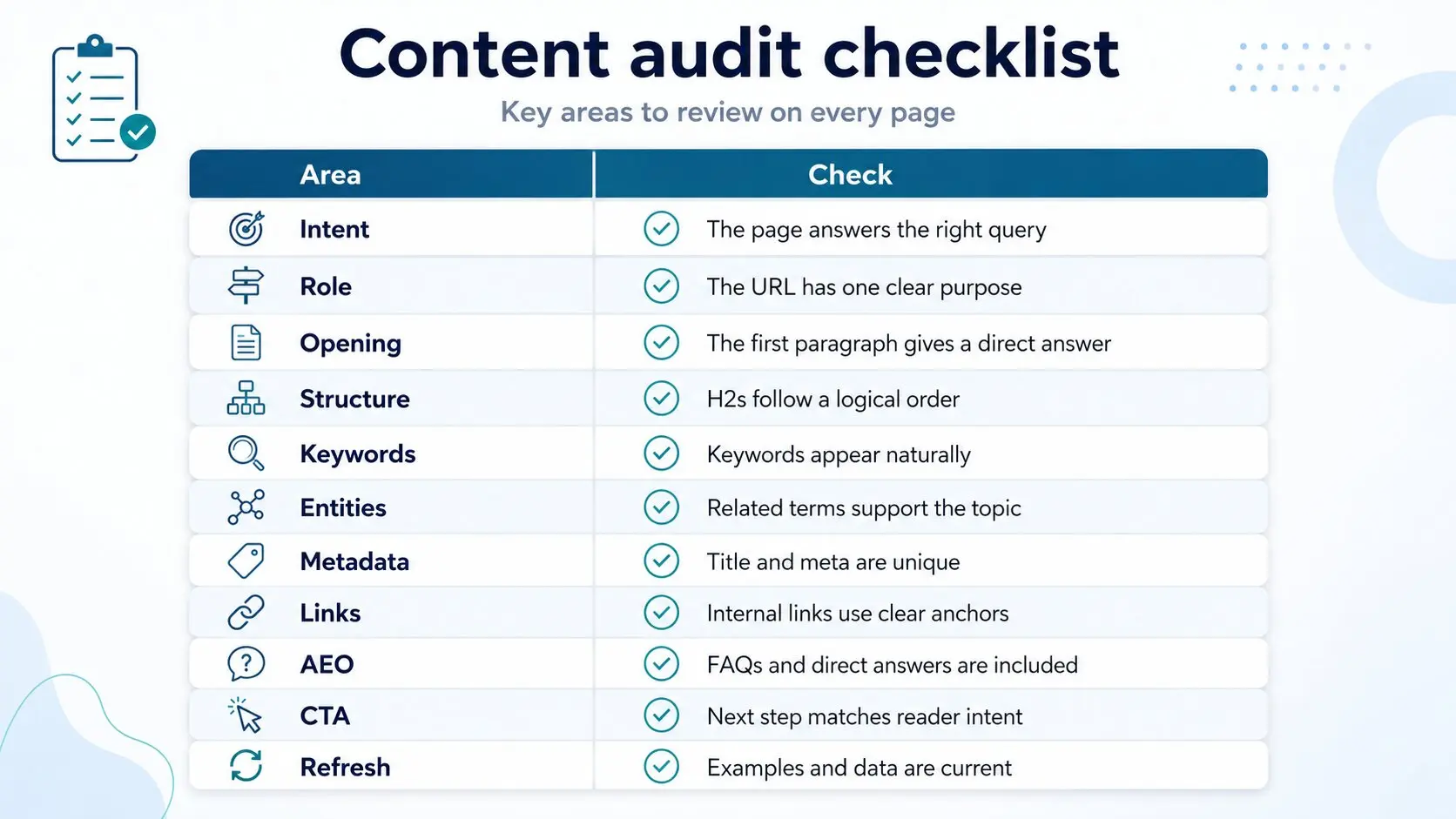
This checklist should not be used mechanically. It should guide better decisions. If a section does not help the reader, remove it. If a keyword does not fit naturally, do not force it.
SEO content optimization examples
Examples make the optimization process easier to understand. Here are three common situations.
Example 1. Blog post with ranking but low CTR
A blog post ranks in position 6, but the CTR is low. This means users see the result but do not click it often.
The first fix should be the title and meta description. The title may be too vague. The meta may not explain the value clearly.
The page may also need a better opening. If users click and leave quickly, the first section may not answer the query fast enough.
Useful fixes include:
- Rewrite the title for clearer value
- Improve the meta description
- Add a direct answer below the H1
- Add FAQ questions from the SERP
- Update internal links to related pages
This type of update can improve both CTR and user satisfaction.
Example 2. Service page with traffic but few leads
A service page may attract organic traffic but fail to generate enquiries. This usually means the page has a conversion problem.
The content may explain the service, but not the business value. It may also lack trust signals, process details or a clear CTA.
Useful fixes include:
- Clarify the pain point
- Explain the service process
- Add proof logic or examples
- Improve CTA placement
- Link to case studies or related services
- Remove vague claims
Traffic alone is not the goal. The page should help the right visitor take the next step.
Example 3. Two blog posts target the same keyword
Two pages may compete for the same keyword when their titles, H1s and content angles are too similar.
The fix is not always to delete one page. First, check whether the two pages can serve different intents.
One page may become a broad guide. The other may become a checklist, comparison or optimization workflow.
Then update the title, H1, intro and internal links. Each URL should have a distinct primary keyword. Each should link to the other only when useful.
This reduces keyword cannibalization and helps search engines understand the purpose of each page.
Common SEO content optimization mistakes
SEO content optimization can fail when the process becomes too mechanical. The goal is not to satisfy a checklist. The goal is to improve usefulness and clarity.
One common mistake is focusing on keyword density. Repeating a keyword does not make a page better if the answer is weak.
Another mistake is copying competitor headings without adding value. A page can match the SERP format and still fail if it does not bring a stronger explanation.
Avoid these mistakes:
- Optimizing only for keyword density
- Copying competitors too closely
- Adding long sections with little value
- Ignoring search intent
- Using the same primary keyword across several URLs
- Adding internal links only at the end
- Forgetting CTA and conversion path
- Updating content without tracking results
- Treating AI tools as the final editor
Good optimization requires judgment. Tools can help, but the page still needs a clear human strategy.
Best tools for SEO content optimization
SEO content optimization works best when tools support a clear process. You do not need every tool. You need the right tool for each job.
|
Use case |
Useful tools |
|
Search performance |
Google Search Console |
|
User behavior |
Google Analytics 4 |
|
SERP and competitors |
Ahrefs, Semrush |
|
Technical checks |
Screaming Frog |
|
On-page SEO |
Yoast SEO, Rank Math |
|
Content planning |
Google Sheets, Notion |
|
Writing support |
Grammarly, Hemingway |
|
AI support |
ChatGPT, Jasper |
Google Search Console is often the best starting point. It shows which queries bring impressions and where the page ranks.
SEO tools help compare competitors and keyword opportunities. Analytics tools show whether users engage with the page after landing on it.
AI tools can support outlining, rewriting and FAQ creation. They should not replace SERP review or editorial judgment.
Frequently Asked Questions (FAQs)
What is SEO content optimization?
SEO content optimization is the process of improving a page so it better matches search intent, user needs and search engine expectations. It includes structure, keyword use, metadata, internal links, FAQs, CTA quality and content refresh.
How is SEO content optimization different from SEO copywriting?
SEO copywriting focuses on writing persuasive content that can rank and convert. SEO content optimization focuses on improving that content before or after publishing. It checks whether the page structure, intent, metadata, links and answers support better performance.
How often should SEO content be updated?
Important SEO pages should be reviewed every few months. Update them sooner if rankings drop, competitors improve their content, search intent changes or business information becomes outdated.
What should I optimize first on an old blog post?
Start with search intent, title tag, meta description, opening paragraph and heading structure. These elements shape how users and search engines understand the page. Then update examples, internal links, FAQs and CTA.
Does keyword density still matter?
Keyword density is less useful than natural keyword placement. The primary keyword should appear in important areas when it fits. The page should also include related entities and clear answers. Repeating a keyword too often can make the copy weaker.
How does AEO change SEO content optimization?
AEO makes direct answers more important. AEO-ready content uses clear definitions, concise H2 openings, FAQ sections, tables and structured explanations. This helps answer engines understand and reuse the content more easily.
Can AI tools optimize SEO copywriting?
AI tools can help with outlines, summaries, keyword grouping and draft improvements. However, they still need human review. The final content should be checked against SERP intent, brand voice, accuracy, internal links and business goals.
Final thoughts
SEO content optimization is the process of improving content so it matches intent, answers clearly, links properly and supports a useful next step.
The strongest pages are easy to understand. They have a clear role, a logical structure, helpful examples and measurable business value.
If your website has many articles but weak rankings or low lead quality, On Digitals can help review your content structure through on-page SEO services. A focused optimization process can turn scattered pages into a clearer search system that supports qualified organic growth.

NEWEST POSTS
- Advertising Industry In Vietnam: The 2026 Trends, Channels and Market-Entry Strategy
- Best SEO Company in Vietnam: Latest Shortlist For Businesses
- How To Leverage Social Media For Customer Service Like A Pro?
- Social Media Post Tips – 8 Ways To Boost Engagement
- How To Use Social Media for Sales – In-depth Beginner Guide
Read more