
SEO Copywriting Guide: Write for Search, Readers and Conversions
Vincent
17/04/2023
36
SEO copywriting is the practice of writing content that helps search engines understand a page while keeping human readers engaged. It combines keyword research, search intent, clear structure, persuasive messaging and conversion-focused calls to action so content can attract traffic and support business goals.
Good SEO copy does more than include keywords. It answers the user’s question, consolidates on-page elements and gives audiences a reason to continue. It also helps the right audience move from search result to page visit, then from page visit to a useful next step.
What is SEO copywriting?
SEO copywriting is writing content that is useful for readers and understandable for search engines. It uses keywords, structure and clear messaging to help a page rank for relevant searches while encouraging users to read, trust and act.
It is not keyword stuffing. It is not writing for algorithms first. It is also not limited to blog posts.
SEO copywriting can apply to:
- Blog articles
- Landing pages
- Service pages
- Product pages
- Category pages
- Case studies
- Homepage sections
A blog article may use SEO copywriting to explain a topic clearly. A service page may use it to show value, build trust and invite enquiries. A product page may use it to describe features, answer buyer concerns and support purchase decisions.
The best SEO copy balances three jobs. It helps search engines understand the topic. It helps readers solve a problem. It helps the business guide qualified users toward action.
Why is SEO copywriting important?
SEO copywriting is important because ranking is only useful when the page also satisfies the reader. A page can appear in search results and still fail if the copy is unclear, generic or disconnected from user intent.
Good SEO copy improves the full search journey. It can make the title more clickable, the introduction more useful and the page more persuasive. It can also help users stay longer because the content matches what they expected to find.
| Without SEO copywriting | With SEO copywriting |
| The page sounds robotic | The page feels clear and useful |
| Keywords feel forced | Keywords appear naturally |
| Traffic comes from the wrong intent | Traffic matches user needs |
| Users leave without action | Users understand the next step |
| Claims sound generic | Benefits connect to real problems |
For business websites, SEO copywriting also supports trust. Readers need to understand what you offer, why it matters and what they should do next. This matters for service businesses, B2B companies, ecommerce brands and agencies. If the content gets traffic but does not help readers make a decision, the SEO value is limited.
SEO copywriting vs SEO content optimization
SEO copywriting and SEO content optimization are related, but they should not be treated as the same topic.
SEO copywriting focuses on writing new copy that can rank, engage and convert. SEO content optimization focuses on improving an existing page or draft so it performs better.
| Criteria | SEO copywriting | SEO content optimization |
| Main purpose | Write search-friendly copy | Improve page performance |
| Timing | Before and during writing | Before and after publishing |
| Main focus | Message, structure, readability and persuasion | CTR, metadata, links, refresh and measurement |
| Best question | How do I write SEO-friendly copy? | How do I improve this page’s SEO performance? |
For example, a writer creating a new service page needs SEO copywriting. The page needs a clear message, strong structure and persuasive CTA. A marketer improving an old blog with low CTR needs an SEO content optimization process. The page may need better metadata, stronger internal links, updated examples or clearer answers.
This distinction helps prevent keyword cannibalization. Each URL should have one primary job.
How SEO copywriting works
SEO copywriting works best when it follows a clear process. Instead of starting with a blank page and adding keywords later, start with the search problem first.
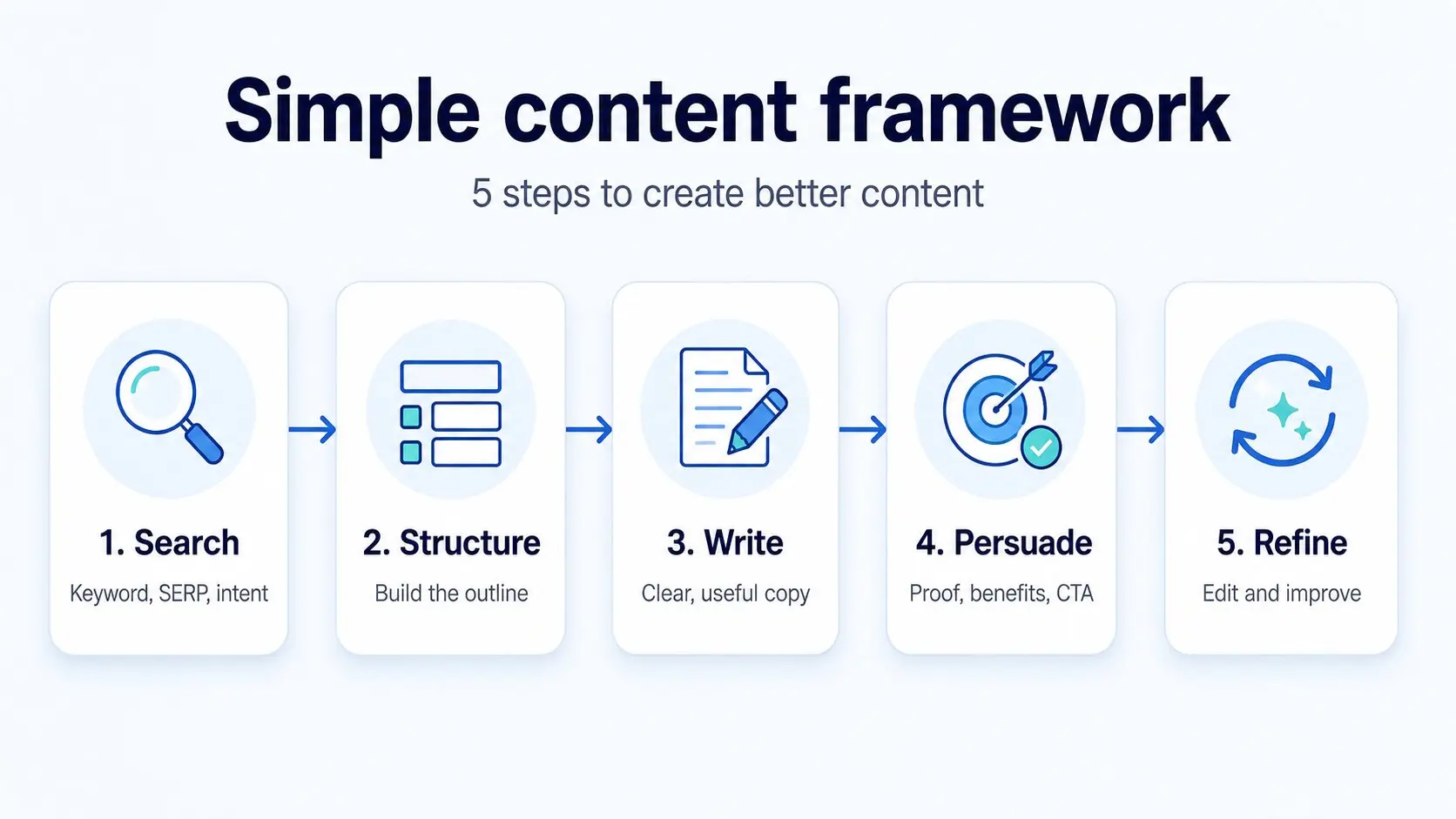
This framework keeps the writing focused. It also helps avoid random tips that do not support the page goal. Each step answers a different question. What is the user searching for? What does the page need to cover? How can the copy explain it clearly? Why should the reader trust it? What should be improved before publishing?
Step 1. Research the keyword, SERP and audience
SEO copywriting starts with research. Before writing, you need to know what the target keyword means, what the search results show and who the reader is.
Choose one primary keyword for the page. This keyword should represent the main intent. Then check related terms and questions to understand the topic more fully.
For example, the keyword “SEO copywriting” may include related questions such as what it means, how to do it, why it matters and what makes SEO copy convert.
Next, review the SERP. Look at the top-ranking pages and identify the content format. Are they complete guides, listicles, service pages or beginner tutorials? Check the headings, examples, FAQs and depth.
This does not mean copying competitors. It means understanding the standard users already expect.
Audience research is also important. A beginner needs definitions and examples. A marketing manager may need process, business value and decision criteria. A copywriter may need writing techniques.
Strong SEO copy starts when the keyword, SERP and audience match.
Step 2. Match the copy with search intent
Search intent is the reason behind a query. If the copy does not match intent, it will struggle even if the writing is polished.
A user searching “what is SEO copywriting” wants a definition and explanation. A user searching “SEO copywriting services” may want a provider. A user searching “SEO copywriting tips” wants practical advice.
| Search intent | User wants | SEO copy should |
| Informational | Learn a topic | Explain clearly |
| Commercial | Compare options | Give criteria and examples |
| Transactional | Take action | Show offer, trust and CTA |
| Navigational | Find a brand or page | Make the destination clear |
Intent affects everything. It shapes the title, H1, intro, examples, CTA and internal links.
For this page, the intent is mainly informational. The reader wants to understand SEO copywriting and learn how to write better copy. A hard sales page would not fit this query.
However, informational content can still support business goals. It can show expertise, build trust and guide readers to related services when the timing is right.
Step 3. Build an outline before writing
A good outline makes SEO copy easier to read. It also helps search engines understand the page structure.
The outline should follow the reader’s journey. Start with the basic answer. Then explain why it matters. After that, show the process, examples, mistakes and FAQs.
A weak outline may look like this:
| Weak outline | Problem |
| Definition | Too basic |
| Benefits | Too broad |
| Tips | No clear order |
| Tools | Added too early |
| Conclusion | Generic ending |
A stronger outline creates a learning path:
| Better outline | Purpose |
| Definition | Answer the main query |
| Importance | Explain business value |
| Intent | Connect search to user needs |
| Research | Prepare before writing |
| Structure | Organize the page |
| Writing | Draft clear copy |
| Persuasion | Add trust and CTA |
| Examples | Show practical use |
| FAQ | Answer related questions |
Each H2 should answer one clear question. Do not force many ideas into one heading. If a section becomes too long, split it into smaller parts. A strong outline also reduces repetition. When every section has a job, the copy becomes sharper.
Step 4. Write an answer-first introduction
The introduction should answer the topic quickly. Readers do not want a long build-up before the main point.
For SEO copywriting, the first paragraph should define the topic and explain why it matters. It should also show the page is relevant to the user’s problem.
Two useful intro formulas are the inverted pyramid and PAS.
| Formula | Best for | Structure |
| Inverted pyramid | Informational guides | Answer first, explain later |
| PAS | Persuasive pages | Problem, agitate, solution |
For a guide, the inverted pyramid works well. Give the direct answer first. Then add context.
Example:
“SEO copywriting helps a page rank and convert by combining search intent, useful information and persuasive writing. Good SEO copy answers the query quickly, keeps readers engaged and guides them to a relevant next step.”
This opening is clear. It does not waste space. It also gives search engines and answer engines a concise definition.
Avoid generic openings such as “In today’s digital world” or “Every business needs online visibility.” They sound familiar, but they do not add value.
Step 5. Write clear, useful and natural copy
Clear writing is a major part of SEO copywriting. If readers cannot understand the page quickly, they are less likely to stay or act.
Use short sentences when explaining technical ideas. Keep one main idea in each sentence. Break long paragraphs into smaller blocks.
Good SEO copy should also explain terms. A beginner may not know what search intent, CTR, metadata or internal links mean. A short explanation can make the page more useful.
Use examples when advice feels abstract. Instead of saying “write better headings,” show what a better heading looks like.
| Weak copy | Better SEO copy |
| Our solution maximizes online success. | Our SEO content helps priority pages answer search intent and attract qualified traffic. |
| Keywords must be repeated many times. | Keywords should appear naturally where they help clarify the topic. |
| We provide professional services. | Our SEO Services connect content planning, technical fixes and performance tracking. |
Natural copy does not sound like a keyword list. It sounds like a useful explanation written for a real reader. This is especially important for B2B content. Buyers need clarity before they trust the brand.
Step 6. Use keywords without keyword stuffing
Keywords still matter, but keyword stuffing weakens the copy. Search engines can understand context better than before, and readers can quickly notice unnatural repetition.
Use the primary keyword in important places when it fits. These include the title, H1, opening paragraph and at least one relevant heading.
Then support the topic with related terms. For SEO copywriting, related terms may include search intent, title tag, meta description, internal links, conversion copy, content structure, CTA and readability.
Do not force exact-match phrases into awkward sentences. If the phrase sounds unnatural, rewrite it.
A good keyword approach follows three rules:
- Use the primary keyword where it clarifies the topic.
- Use related terms to cover the subject naturally.
- Prioritize readability over repetition.
Keyword density should not be the main goal. A page can repeat a keyword many times and still fail if it does not answer the query well.
Step 7. Make the copy persuasive without overclaiming
SEO copywriting should persuade, but it should not overpromise. Persuasive copy connects the reader’s problem with a clear solution.
Start with the pain point. What is the reader trying to fix? It may be low traffic, weak enquiries, poor ranking, unclear messaging or low conversion.
Then explain the value. Do not just say a service is effective. Explain how it helps.
For On Digitals, this means connecting SEO copy to business outcomes such as search visibility, qualified traffic, clearer messaging and measurable growth.
| Overclaim | Better copy |
| We guarantee top rankings. | We structure SEO copy around intent, clarity and conversion signals. |
| We are the best agency for SEO. | We help businesses build SEO content systems tied to measurable goals. |
| Contact us now for instant results. | Talk to On Digitals about search-friendly content for your growth plan. |
Trust comes from specificity. Use clear process, practical examples and realistic language.
A CTA should also match the page intent. Informational articles need a soft CTA. Service pages can use a stronger consultation CTA.
Step 8. Improve readability and engagement
Readable content keeps users moving through the page. It also makes complex topics easier to understand.
Good readability does not mean oversimplifying. It means organizing information so the reader does not have to work too hard.
Use short paragraphs. Add descriptive subheadings. Use tables when comparing ideas. Add visuals when they explain a process. Use internal links when a related topic needs more detail.
A table of contents can help long guides. It lets readers jump to the section they need.
Transitions also matter. Each section should connect to the next. Avoid stacking unrelated tips without a clear path.
A simple editing test is to read the copy aloud. If a sentence feels too long, split it. If a paragraph has too many ideas, rewrite it.
Clear structure supports both readers and answer engines. It makes the page easier to scan, quote and summarize.
Step 9. Add AEO-ready answers and FAQ
AEO stands for Answer Engine Optimization. It focuses on making content easy for answer engines and AI search systems to understand.
SEO copywriting can support AEO by placing direct answers near key headings. A section should answer the heading first, then explain with detail.
For example, under “What is SEO copywriting?” the first sentence should define the term. Do not make readers wait until the third paragraph.
AEO-ready copy often uses:
- Clear definitions
- Concise H2 openings
- FAQ sections
- Comparison tables
- Short examples
- Specific entity names
FAQs are especially useful because they answer related questions in a direct format. They can also help capture long-tail searches.
Important information should stay in text, not only in images. Search engines and AI systems need selectable content to understand the page.
SEO copywriting examples
Examples make SEO copywriting easier to apply. The same principles work across blog posts, service pages and product pages.
Blog article example
Weak version:
“SEO is important for businesses today.”
Better version:
“SEO helps businesses reach people when they are already searching for a problem, product or service. Good SEO copy explains the answer clearly and guides the reader to a useful next step.”
The better version is more specific. It explains why SEO matters and what the copy should do.
Service page example
Weak version:
“We provide professional SEO services.”
Better version:
“Our SEO Services help businesses improve search visibility through technical fixes, content planning, internal links and performance tracking.”
The better version explains the service components. It also connects the service to a business outcome.
Product or category page example
Weak version:
“High-quality running shoes for everyone.”
Better version:
“Lightweight running shoes for daily training, designed for comfort, road grip and long-distance support.”
The better version gives useful product details. It helps users understand fit and purpose.
SEO copywriting should make the page more helpful, not only more keyword-rich.
SEO copywriting tips and best practices
SEO copywriting works best when the writing process stays simple and focused.
Start with one primary intent. Do not try to serve every possible keyword on one page.
Study the SERP before writing. The search results show what users expect and what content format Google prefers.
Write the answer early. A strong first paragraph helps both readers and answer engines.
Use headings as a logical path. Each heading should move the reader forward.
Add examples where possible. Examples make advice more practical.
Use keywords naturally. The copy should sound human, not mechanical.
Write for readers before algorithms. Search visibility matters, but users decide whether the page is useful.
Add a specific CTA. Tell the reader what next step makes sense.
Include FAQ for related questions. Keep each answer direct and standalone.
Edit for clarity before publishing. Remove filler, repeated ideas and vague claims.
These best practices are not tricks. They are habits that make content easier to find, read and trust.
Common SEO copywriting mistakes
SEO copywriting often fails when the writer focuses on keywords before users. A page may include the right phrases but still feel empty.
Another common mistake is ignoring search intent. If users want a beginner guide, a sales page will not satisfy them. If users want a service provider, a generic blog may not convert.
Avoid these mistakes:
- Writing for keywords before readers
- Ignoring search intent
- Using awkward exact-match phrases
- Copying competitor outlines without adding value
- Writing long introductions
- Making unsupported claims
- Forgetting examples
- Adding weak CTAs
- Treating AI output as final copy
AI tools can help with drafting, but they should not replace editorial judgment. The final copy still needs accurate information, brand voice and a clear user journey.
Good SEO copy should feel useful even if the reader does not know anything about SEO.
SEO copywriting tools
Tools can support SEO copywriting, but they cannot make the strategy for you. Use tools to collect data, check structure and improve drafts.
| Use case | Tools |
| Keyword research | Ahrefs, Semrush, Google Search Console |
| SERP research | Google Search, Ahrefs, Semrush |
| Writing and editing | Grammarly, Hemingway |
| SEO checks | Yoast SEO, Rank Math |
| Content planning | Google Sheets, Notion |
| AI support | ChatGPT, Jasper |
Google Search Console helps you understand real search queries. Ahrefs and Semrush help with keyword and competitor research. Grammarly and Hemingway can support editing.
AI tools can help generate outlines, rewrite rough sections and create FAQ ideas. Still, the writer should check search intent, accuracy and brand fit.
The best tool is useful only when the page strategy is already clear.
Frequently Asked Questions (FAQs)
What is SEO copywriting?
SEO copywriting is writing content that helps a page appear for relevant searches while keeping human readers engaged. It combines keyword research, search intent, clear structure, helpful information and persuasive messaging.
Is SEO copywriting the same as content writing?
SEO copywriting is not exactly the same as general content writing. Content writing may focus on education or brand awareness. SEO copywriting also considers search intent, keywords, page structure, metadata and conversion goals.
Does SEO copywriting still matter?
Yes, SEO copywriting still matters because search engines and users both need clear content. Search engines need topic clarity. Readers need useful answers. Businesses need content that supports trust, enquiries or sales.
How do you write SEO copy for beginners?
Start with one keyword and one search intent. Study the SERP, build a clear outline, answer the query early and write in simple language. Add examples, internal links, FAQ and a relevant CTA.
How many keywords should SEO copy include?
SEO copy should focus on one primary keyword and a small group of related terms. The exact number depends on the topic. Natural use is more important than keyword count.
What is the difference between SEO copywriting and SEO content optimization?
SEO copywriting focuses on writing new copy that can rank and convert. SEO content optimization focuses on improving existing or drafted content through better structure, metadata, links, answers and performance tracking.
Can AI write SEO copywriting?
AI can help draft SEO copy, suggest headings and generate ideas. However, human review is still needed for search intent, accuracy, examples, brand voice and conversion logic.
What makes SEO copy convert better?
SEO copy converts better when it matches the reader’s intent, explains the value clearly and provides a relevant next step. Strong CTAs, trust signals and specific benefits also help users act with more confidence.
Final thoughts
SEO copywriting is not about forcing keywords into a page. It is about writing content that search engines can understand and people want to read.
Strong SEO copy starts with intent. It uses clear structure, natural keywords, useful examples and persuasive messaging. It also guides readers toward a next step that fits their needs.
If your business needs a clearer SEO content strategy or search-friendly copy built around measurable goals, On Digitals can help with our on-page plan to improve content that supports qualified organic growth.

NEWEST POSTS
- Advertising Industry In Vietnam: The 2026 Trends, Channels and Market-Entry Strategy
- Best SEO Company in Vietnam: Latest Shortlist For Businesses
- How To Leverage Social Media For Customer Service Like A Pro?
- Social Media Post Tips – 8 Ways To Boost Engagement
- How To Use Social Media for Sales – In-depth Beginner Guide
Read more