
Why Backlinks Are Important for SEO: Improve Search Visibility
Vincent
23/09/2021
37
Why backlinks are important for SEO becomes clearer when you see links as external references. Search engines can assess the content on your website, while relevant links from other pages show whether the wider web sees that content as worth citing.
High-quality backlinks can support search visibility. They can also bring referral visits from people who are already interested in the topic. Their value depends on the source, the context, and the reason the link exists. For a closer look at the signals behind stronger editorial links, see this guide to high-quality backlinks.
Why backlinks are important: The fundamentals
Backlinks support SEO because they connect your pages with relevant sources across the web. These references can help search engines discover content, assess topical relevance, and understand whether other publishers consider a resource worth sharing.
The value of a backlink depends on context. A relevant editorial mention in a trusted industry article can support visibility, while a weak link from an unrelated website may add little value.
What are backlinks?
Backlinks, also called inbound links, are hyperlinks from another website to a page on your website. Each backlink creates a connection between a source page and a destination page.
For example, an industry publication may link to a research report because the report supports a point in its article. Readers can follow the link to access the original data. Search engines can also use the connection as one signal when evaluating relevance and authority.
Backlinks come in several forms:
|
Backlink type |
Main value |
Key consideration |
|
Editorial backlink |
Contextual trust signal |
Should be earned because the resource is useful |
|
Guest post backlink |
Expertise and referral exposure |
Avoid scaled posting on low-quality sites |
|
Directory or resource link |
Discovery or local relevance |
Use reputable listings with a clear audience fit |
|
Nofollow link |
Referral traffic and visibility |
It can still create value beyond rankings |
|
Sponsored link |
Advertising and disclosure |
The source site should qualify it correctly |
|
UGC link |
Community visibility |
Common in forums or comments |
A healthy backlink profile usually contains different types of references. The strongest links often appear naturally in useful content, where readers have a clear reason to click.
Are backlinks a part of SEO?
Yes. Backlinks are part of off-page SEO because they happen outside your website. They work alongside on-page SEO, which improves page relevance, and technical SEO, which helps search engines crawl and understand the site.
Google can use links to discover pages and understand relationships between content. That does not make backlinks a shortcut to rankings. Search performance depends on the page itself, its technical condition, its search-intent match, and the quality of external references.
Do backlinks still matter for SEO today?
Backlinks still matter, although their role is more nuanced than the old idea that more links always lead to better rankings. Google can use links to discover pages and assess signals around relevance. Link quality matters far more than raw volume.
A useful page with no external references may struggle in a competitive SERP. Meanwhile, a large backlink profile cannot rescue weak content or unresolved technical issues. Search performance improves when useful pages, sound technical foundations, and credible external references reinforce one another.
Why do businesses need backlinks?
Businesses need backlinks because relevant references can support several outcomes:
- Greater search visibility for priority pages
- Referral traffic from trusted sources
- Stronger brand credibility within an industry
- More opportunities for content discovery
- Better competitor research through link profiles
Consider a B2B software company that publishes an original benchmark report. Once an industry publication cites the report, the company may gain a relevant backlink and qualified visitors from that publication’s audience. That same reference can also make the report more visible to writers researching the topic later.
What makes a high-quality backlink?
A high-quality backlink should make sense to the reader before it makes sense to an SEO tool. Relevance, placement, context, and referral potential all influence the value of a link.
|
Signal |
Stronger backlink |
Weaker or riskier backlink |
|
Topic relevance |
Same topic or adjacent industry |
Unrelated topic |
|
Editorial reason |
Added because it helps readers |
Added mainly to influence rankings |
|
Placement |
Main body content |
Footer, sidebar, or sitewide block |
|
Anchor text |
Descriptive and natural |
Repeated exact-match phrase |
|
Referring domain |
New trusted source |
Repeated low-value source |
|
Referral potential |
Relevant users may click |
Little meaningful readership |
|
Link relationship |
Editorial or correctly qualified |
Paid placement passing ranking credit |
None of these signals should be judged alone. A high-authority domain may offer little value when the source page has no topical connection to your business. A smaller niche publication, by contrast, may send highly qualified visitors when its audience closely matches your target market.
What happens if a site does not gain backlinks for some time?
A period without new backlinks does not automatically mean a website lacks trust. Instead, it can reveal a gap worth investigating.
Review these questions before reacting:
- Does the site publish resources worth referencing?
- Are priority pages visible to the right audience?
- Has the topic become outdated or less useful?
- Do competitors offer stronger data or clearer tools?
- Is outreach focused on relevant publications?
Sometimes the answer is to improve the content asset before doing more outreach. A guide with original data, a practical template, or a clearer visual may have a better chance of earning editorial references.
Why backlinks are important: The strategies
Backlinks are rarely earned from one action. Sustainable link building grows from useful content, relevant relationships, and consistent visibility.
Reclaim unlinked mentions
Other websites may already mention your company, research, or resources without linking back to the original page. These references can be a useful starting point because the publisher already knows your brand.
Review each mention before contacting the site owner. A link request should only be made when it helps the reader find the original source, supporting resource, or fuller context.
Get featured on comparison websites or articles
Comparison pages can influence users who are actively evaluating options. Getting featured in a relevant “best tools,” “top agencies,” or “recommended providers” article may create referral traffic alongside visibility.
Start with publications that genuinely serve your audience. A placement on a trusted niche website is usually more valuable than a generic list that covers unrelated businesses.
Publish linkable content assets
Linkable assets give people a reason to cite your website. They can simplify a difficult task, provide original evidence, or explain a topic more clearly than existing resources.
Useful formats include:
- Original research
- Industry benchmarks
- Templates
- Calculators
- Case studies
- Visual explainers
- Expert commentary
The format should match a real information need. A generic blog post may help readers, while a benchmark report can become useful for journalists, analysts, and industry writers.
Find broken link opportunities
Broken link building involves finding a dead resource on a relevant website, then suggesting a useful replacement. This approach works best when the replacement page genuinely fits the original context.
A simple process looks like this:
- Find relevant pages with broken outbound links.
- Review what the missing resource originally covered.
- Select or create a suitable replacement.
- Send a short message explaining the broken-link issue.
- Show why your resource helps the publisher’s readers.
Treat this as a helpful correction rather than a request for a favour. Outreach becomes more credible when the replacement gives the publisher a real improvement.
Earn mentions through relevant partnerships
Partnerships can create links when they produce something valuable for both audiences. A co-created report, webinar, event page, or expert interview may lead to natural references from partners and participants.
Choose collaborators based on topical fit. A smaller audience with direct relevance can create stronger referral value than a large audience that has little connection to your service or product.
Why backlinks are important: The metrics
Metrics can help you evaluate a backlink profile, although they should support judgment rather than replace it.
Review authority metrics with context
Domain Authority and Page Authority are third-party metrics created by Moz. They can help compare websites, identify possible outreach opportunities, and track broad changes in a link profile.
Google does not use proprietary SEO-tool scores as direct ranking factors. Treat DA or PA as one data point, then review the actual source page, its audience, and the placement of the link. A Domain Authority score can be useful for competitor benchmarking, while it cannot explain the ranking potential of every individual page.
Check link diversity and referral value
A healthy profile usually earns links from a range of relevant websites. Ten links from one weak source rarely offer the same value as references from several trusted publications.
Referral traffic also matters. A backlink that sends engaged visitors can support business goals even when it does not look impressive in a third-party tool.
Use this checklist when reviewing a backlink:
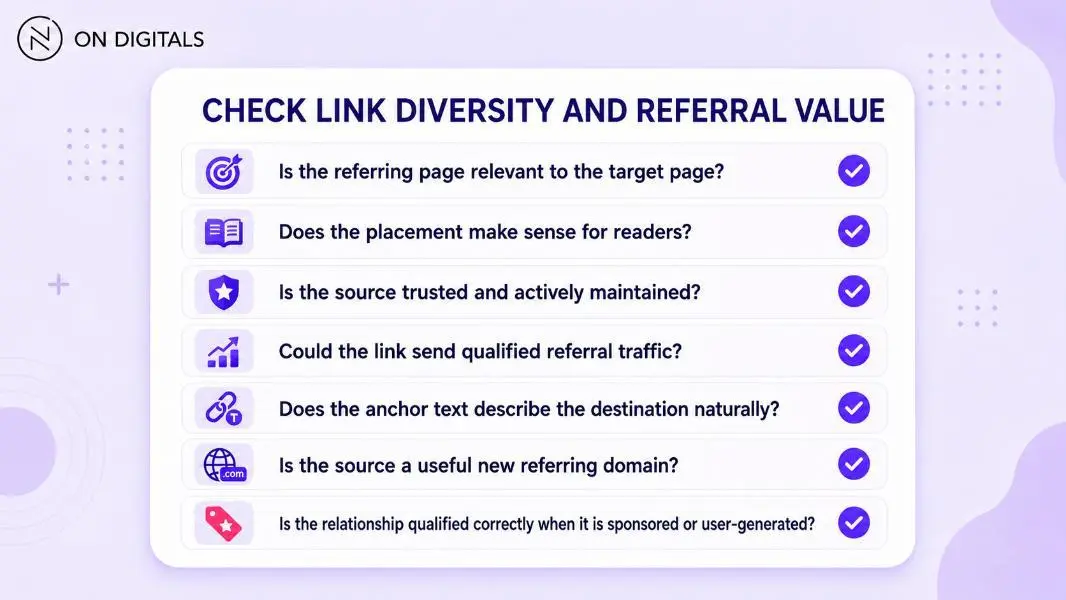 Review backlink relevance, placement, trust, referral potential, anchor text, domain diversity, and link qualification before treating a new link as valuable.
Use descriptive anchor text
Anchor text is the visible text people click. It should give readers a clear idea of what they will find on the linked page.
Descriptive anchors can improve usability because they provide context before the click. Repeated keyword-heavy anchors may look unnatural when they appear across unrelated pages.
For instance, “backlink quality checklist” gives users more context than “click here.” The words around the link also matter because they explain why the resource is relevant.
Maintain a healthy backlink profile
Backlink work does not end once a link appears. Review the profile regularly to understand what is helping, what has been lost, and where risk may be developing.
Use a simple maintenance workflow:
- Export recent backlink data from your preferred tool.
- Review new referring domains for relevance.
- Confirm that high-value links still point to live URLs.
- Check anchor patterns for over-optimization.
- Compare referral sessions with links that look strong on paper.
- Flag unusual patterns for manual review.
This process helps teams focus on quality trends instead of chasing a larger total number of links.
Why backlinks are important: The caution
Link building can support SEO, but shortcuts create avoidable risk. Google treats links created mainly to manipulate rankings as link spam.
Good backlinks vs risky backlinks
|
Good backlink signals |
Risky backlink signals |
|
Relevant source page |
Unrelated source page |
|
Natural editorial placement |
Link added only for ranking manipulation |
|
Descriptive anchor text |
Repeated keyword-heavy anchor text |
|
Real audience potential |
No meaningful readership |
|
Useful contextual reference |
Footer, sidebar, or sitewide placement |
|
Diverse referring domains |
Scaled links from similar low-value sites |
|
Clear relationship disclosure |
Paid placement passing ranking credit |
Treat paid links with care
Advertising, sponsorships, and paid placements can have legitimate business value. Their purpose should be transparent.
When a link is part of a paid relationship, the source website should use the appropriate link attribute, such as rel=”sponsored”. User-generated links can be marked with rel=”ugc” where appropriate.
Buying links to influence rankings creates policy risk. The same applies to excessive exchanges, automated link creation, and scaled placements that exist mainly to manipulate search visibility. Google lists these patterns in its Spam Policies for Google Web Search.
Avoid private blog networks and scaled link schemes
Private blog networks, often called PBNs, are groups of websites created mainly to place links and influence search rankings. They may look attractive because they offer control over anchor text and link placement, yet that control also makes the pattern easier to manipulate at scale.
A backlink profile becomes more sustainable when links come from pages with genuine editorial purpose and relevant audiences. Before pursuing any network-based tactic, review what is Private Blog Network rather than treating link volume as a shortcut to better rankings.
Keep link exchanges selective
A relevant reciprocal mention can make sense when two resources genuinely help the same audience. Problems arise when cross-linking becomes the main purpose of a partnership page or outreach campaign.
Ask one practical question before accepting a reciprocal link: would this connection still be useful if search engines did not exist? If the answer is unclear, the placement may not be worth pursuing.
FAQs about why backlinks are important for SEO
Do backlinks still matter for SEO?
Yes. Backlinks can support discovery, authority, relevance, and referral traffic. Their impact depends on source quality, editorial context, and how naturally the reference was earned.
How many backlinks does a page need to rank?
There is no fixed number. A page may compete with a small number of strong, relevant links, while another topic may require more external support because the SERP is highly competitive.
Can paid backlinks hurt SEO?
Paid links intended to influence rankings can create risk under Google’s spam policies. Paid placements used for advertising should be disclosed and qualified correctly.
How often should you review a backlink profile?
Review active link-building campaigns monthly. For established websites with slower link growth, a quarterly review can be enough to spot lost links, unusual anchor patterns, or missed opportunities.
Conclusion
Backlinks matter because external references can make useful pages easier to discover and assess. The strongest links are relevant, contextual, and earned for a genuine editorial reason.
On Digitals can help businesses build a more sustainable off-page SEO approach by connecting link opportunities with content quality, search intent, referral value, and long-term organic visibility.

NEWEST POSTS
- Advertising Industry In Vietnam: The 2026 Trends, Channels and Market-Entry Strategy
- Best SEO Company in Vietnam: Latest Shortlist For Businesses
- How To Leverage Social Media For Customer Service Like A Pro?
- Social Media Post Tips – 8 Ways To Boost Engagement
- How To Use Social Media for Sales – In-depth Beginner Guide
Read more