
Advanced Keyword Research: Find Higher-Value SEO Opportunities
Vincent
11/08/2023
11
Advanced keyword research helps SEO teams find opportunities that basic keyword lists usually miss. It supports on-page SEO planning by turning owned data, SERP evidence, competitor gaps etc. into clear page decisions, so each keyword can be mapped to a new page, refresh, consolidation, or waitlist.
What is advanced keyword research?
Advanced keyword research is the process of finding, validating, and prioritizing keyword opportunities based on search intent, business value, SERP difficulty, and page ownership. It goes beyond collecting search volume or exporting keywords from a tool.
Basic keyword research usually answers, “What do people search for?” Advanced keyword research asks a more useful question: “Which opportunity deserves a page, refresh, cluster, or waitlist?”
|
Research level |
Main focus |
Output |
|
Basic keyword research |
Keyword ideas and volume |
Keyword list |
|
Advanced keyword research |
Intent, SERP fit, business value etc. |
Page decision |
|
Keyword strategy |
Priority, ownership, and roadmap |
SEO execution plan |
This difference matters because many websites already have more keyword ideas than they can use. The real challenge is deciding which opportunities deserve content, technical, design, or subject-matter expert resources.
Why advanced keyword research matters
Advanced keyword research matters because SEO resources are limited. Content teams cannot create a strong page for every keyword, while business teams need to know which opportunities can support traffic quality, leads, revenue, or authority.
A keyword with high volume may still be weak if the SERP expects a different page type. Meanwhile, a smaller keyword can become valuable when the intent is specific and the page supports a key service, product category, or conversion path.
This is where advanced research improves SEO planning. It helps the team:
- find realistic opportunities competitors missed
- connect keyword demand with page priority
- avoid creating pages for the wrong intent
- refresh existing URLs before building duplicates
- group low-volume keywords into stronger clusters
- assign the right owner for the next action
The best output is not a longer keyword export. It is a set of decisions the team can act on.
Advanced keyword research framework
Use this workflow before production starts:
Seed topic or existing URL
↓
Keyword and query discovery
↓
SERP intent validation
↓
Competitor and weak-SERP review
↓
Business-value scoring
↓
Create, refresh, consolidate, or monitor
The workflow can start with seed keywords or an existing URL. Seed terms help define the starting topic, while existing pages reveal queries that already have impressions, clicks, or ranking signals. From there, the SEO team can validate intent, review the SERP, and decide what action makes sense.
Advanced keyword research techniques
Mine Search Console for uncovered queries
Google Search Console is one of the strongest places to find keyword opportunities because it shows query data from your own site. Search Console reports can include queries, clicks, impressions, CTR, and average position for Google Search performance.
Start with pages that already matter to the business. Filter queries by a priority URL, then look for patterns such as:
- high impressions with weak clicks
- relevant queries where the page ranks outside top positions
- queries that do not match the current title or H1
- repeated terms across several URLs
- commercial queries landing on informational content
For example, a service page may receive impressions for a pricing-related query, but the page does not answer scope or cost expectations. In that case, the next step may be a content refresh, not a new blog post. During that refresh, visible keyword placement should also be reviewed. If the high-impression query does not appear clearly in the title, H1, opening paragraph, or key section heading, users may miss the relevance before they reach the useful part of the page.
Use GA4 and site search to find internal demand
Internal search data can show what users try to find after they land on your website. For ecommerce, SaaS, education, and support-heavy websites, those searches can reveal long-tail demand that external tools miss.
Google’s Search Central documentation also explains how Search Console and Google Analytics data can support SEO analysis, especially when teams compare performance trends and user behavior.
Look for internal searches that show friction:
- users search for a product filter that does not exist
- support users search for a feature name repeatedly
- blog readers search for a deeper workflow
- prospects search for pricing, comparison, or case studies
These terms can become new pages, FAQ sections, product filters, or internal links depending on the affected template.
Analyze partial competitors and weak SERPs
Direct competitors are not the only useful keyword source. Partial competitors can reveal opportunities because they solve the same user problem with a different business model. For example, an SEO agency, a SaaS SEO tool, and an independent SEO blog may all rank for “technical SEO audit checklist.” Their offers are different, but the user problem overlaps.
To narrow this review, advanced Google search commands can surface competitor pages by domain, exact phrase, title keyword, or file type. This is useful when a niche has many partial competitors and the SEO team needs faster SERP evidence before scoring an opportunity.
When reviewing competitors, check:
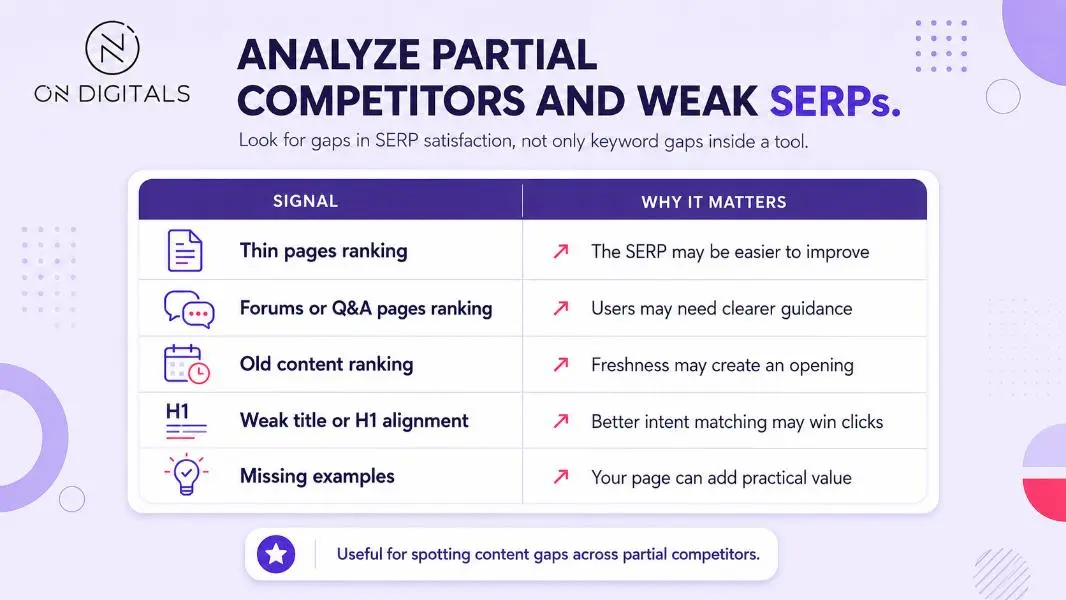 Reviewing weak SERP signals such as thin pages, old content, weak title alignment, and missing examples helps SEO teams find content opportunities beyond direct competitors.
This method is useful because it looks for gaps in SERP satisfaction, not only keyword gaps inside a tool.
Find newly emerging topics with Google Trends
Google Trends can help validate interest over time and compare search interest by region. It is especially useful for seasonal topics, new product categories, and emerging language.
Use Trends when timing matters. A seasonal keyword may need content published before the demand spike. A new term may need monitoring before a full page is created.
A practical workflow:
- Compare the main keyword with close variations.
- Check whether interest is rising or seasonal.
- Review regional differences.
- Decide whether to publish, refresh, or monitor.
- Recheck the SERP before production.
For local SEO, this prevents teams from choosing national wording that does not match regional search behavior.
Group low-volume keywords into clusters
Low-volume keywords should not be rejected automatically. Some terms look small in isolation but become useful when grouped by shared intent.
For example, several queries around “SEO audit checklist for ecommerce,” “technical SEO audit for product pages,” and “crawl issues ecommerce SEO” may support one focused ecommerce SEO audit guide. The combined cluster can justify a page if the business value is strong. This is why a structured long-tail research workflow matters. Instead of judging each query alone, the SEO team can group related phrases by intent and decide whether the cluster supports one focused page.
Use low-volume clusters when:
- terms share one clear intent
- the topic supports a high-value service or product
- the SERP is weak or underserved
- existing pages do not satisfy the user path
- the cluster supports topical authority
A cluster should still have one owner URL. When several URLs target the same intent, consolidation may be better than creating another page.
Use Keyword Planner with clear limits
Google Keyword Planner can discover keyword ideas related to a business and show search estimates. It is built for Google Ads, but SEO teams can still use it for discovery when they understand its limits.
Use Keyword Planner to expand seed topics and compare demand direction. Then validate the final choice with SERP analysis, Search Console data, or business-value scoring. Tool exports may also include related terms that look useful but do not fit the page intent. Before adding those terms to a brief, review their semantic keyword context so the content supports meaning instead of simply expanding the keyword list.
Do not let volume decide the roadmap alone. Keyword Planner can show demand, while the SEO team still needs to judge intent, page type, ranking difficulty, and business fit.
Review communities for long-tail language
Forums, communities, reviews, and support threads can reveal how users describe problems before those phrases appear clearly in keyword tools. Many of these phrases become specific long-tail opportunities because they reflect a clear situation, pain point, or comparison need.
This source is useful for:
- niche B2B topics
- new product categories
- pain-point language
- comparison questions
- troubleshooting queries
Turn repeated language into keyword candidates, then validate with SERP review. If the phrase shows a clear need but little tool volume, consider adding it to a cluster rather than ignoring it.
Use SERPs to validate page type
Every keyword should be checked against the live SERP before production. The SERP shows what Google currently rewards for that query, including page type, format, intent, and competing content depth.
Use this checklist:
- Are results mostly guides, service pages, tools, or product categories?
- Do SERP features suggest local, video, image, or comparison intent?
- Are the top results fresh or outdated?
- Do weaker sites rank with thin content?
- Does your existing page already fit the intent?
- Would the keyword need a new page or a refresh?
This step prevents a common problem: creating an article for a keyword where users actually want a service page, category page, calculator, or comparison resource.
How to prioritize keyword opportunities
Advanced keyword research becomes valuable when it creates priority. Use a scorecard before assigning work.
|
Factor |
What to check |
Why it matters |
|
Intent fit |
Does the SERP match your page type? |
Prevents wrong-page targeting |
|
Business value |
Does the keyword support revenue, leads, retention etc.? |
Protects resources |
|
SERP weakness |
Are thin or outdated pages ranking? |
Shows realistic entry points |
|
Existing asset |
Is there a close URL already? |
Supports refresh decisions |
|
Cluster value |
Can the keyword support related pages? |
Builds topic depth |
|
Timing |
Is demand seasonal or rising? |
Improves launch timing |
|
Effort |
Which owner must act? |
Helps assign next steps |
A keyword with strong business value and weak SERP competition deserves attention even if volume looks modest. A broad keyword with unclear intent may need supporting content first.
Create, refresh, consolidate, or monitor
After scoring, assign one action.
|
Keyword situation |
Best action |
|
New intent with clear demand |
Create a new page |
|
Existing page has impressions but weak clicks |
Refresh title, intro, sections, and CTA path |
|
Several URLs serve the same intent |
Consolidate or clarify ownership |
|
Trend is emerging but unstable |
Monitor and prepare draft assets |
|
Low-volume terms share one intent |
Build a focused cluster |
|
Keyword is broad and competitive |
Support with cluster content first |
This table keeps keyword research from becoming disconnected from production. Each opportunity should leave the meeting with an owner, a URL decision, and a next step.
Advanced keyword research examples by website type
Service business example
A digital marketing agency may find that a service page ranks for “SEO audit service” but also receives impressions for “technical SEO audit checklist.” The first query may belong on the service page, while the checklist query may need a supporting blog article.
The internal link path should move users from education toward the service page only when the next step makes sense.
Ecommerce category example
An ecommerce site may find internal searches for “waterproof hiking backpack” while the current category only targets “hiking backpack.” The keyword may justify a filter, category copy update, or buying guide depending on product depth.
If several product attributes repeat across searches, the category template may need SEO input and product-owner support.
SaaS example
A SaaS company may find comparison queries such as “CRM for small business” or “CRM with email automation.” These queries often require use-case pages, comparison pages, or feature-led landing pages.
The decision depends on intent. A how-to query may need a guide, while a software-comparison query usually needs stronger proof and conversion paths.
Content hub example
A content hub targeting “keyword research” may split the topic into beginner, advanced, and commercial-support pages. Advanced keyword research can sit deeper in the cluster, while beginner pages explain seed keywords, search intent, long-tail research etc.
Clear page ownership prevents all articles from competing for the same broad phrase.
Common advanced keyword research mistakes
|
Mistake |
Why it hurts |
Better approach |
|
Chasing volume first |
High traffic may not support business value |
Score intent and page value |
|
Trusting tools mechanically |
Tool data can miss context |
Validate with SERP and owned data |
|
Ignoring existing URLs |
Teams create overlap |
Review refresh potential first |
|
Missing partial competitors |
Useful SERP gaps stay hidden |
Study problem-based competitors |
|
Treating low volume as low value |
Niche demand may convert well |
Group terms into intent clusters |
|
Skipping ownership |
Research does not become action |
Assign URL and owner |
Good advanced research creates fewer random tasks. It gives the team a sharper list of opportunities that deserve action.
Advanced keyword research FAQ
What makes keyword research advanced?
Keyword research becomes advanced when it moves beyond keyword collection. It uses intent validation, SERP weakness, first-party data, business value, and page ownership to decide what the team should create, refresh, consolidate, or monitor.
Which tools are best for advanced keyword research?
The best tool depends on the job. Search Console is useful for owned query data. Keyword Planner can support discovery. Google Trends helps with timing and regional interest. Paid tools can support competitor gaps and SERP analysis.
Should low-volume keywords be ignored?
Low-volume keywords should be reviewed by intent and business value. A small query can be valuable when it supports a high-intent service, product category, or grouped cluster.
How do I use Search Console for keyword research?
Start with priority pages, then review queries with impressions, clicks, CTR, and position. Queries with impressions but weak clicks can reveal title, intent, or snippet issues. Queries that do not fit the current page may need a separate URL.
How often should advanced keyword research be updated?
High-priority pages can be reviewed monthly or quarterly. Full keyword research cycles may happen twice a year, especially when services, products, SERPs, or business priorities change.
What should I do after finding keyword opportunities?
Group keywords by intent, score them by business value, assign target URLs, and decide whether each opportunity needs a new page, refresh, consolidation, or monitoring.
Final thoughts
Advanced keyword research should help teams find higher-value SEO opportunities, then decide what action each keyword deserves. A useful process does not stop at search volume. It connects queries with user intent, existing pages, business value, and the owner responsible for the next step.
If your team has keyword data but still struggles to decide which pages to create, refresh, consolidate, or monitor, On Digitals can help turn scattered research into a practical SEO roadmap. We review Search Console data, SERP gaps, content clusters, and page ownership so each keyword opportunity supports clearer priorities instead of adding more noise to the backlog.

NEWEST POSTS
- Advertising Industry In Vietnam: The 2026 Trends, Channels and Market-Entry Strategy
- Best SEO Company in Vietnam: Latest Shortlist For Businesses
- How To Leverage Social Media For Customer Service Like A Pro?
- Social Media Post Tips – 8 Ways To Boost Engagement
- How To Use Social Media for Sales – In-depth Beginner Guide
Read more