
Cost-Effective SEO Services: How to Balance Budget, Scope, and ROI
Vincent
18/11/2024
46
Cost-effective SEO services match the SEO work to the business case. The plan should show the first fixes and the pages that matter most. It should also explain tracking and when the scope should expand. This matters most when businesses are comparing SEO agency options in Vietnam.
What makes SEO services cost-effective?
Cost-effective SEO services put budget behind the SEO work most likely to move the business forward. The plan should protect technical health and improve the right pages. From there, rankings need to connect with qualified traffic or leads.
A low-price package can still become expensive when it creates thin content or poor targeting. Risky backlinks can make the damage worse. In practice, value comes from a clear method and realistic priorities.
Google notes that hiring an SEO can improve a site and save time, while irresponsible SEO can damage the site and its reputation. Use that as a buying filter. Judge the provider by process, accountability, and the work they can explain.
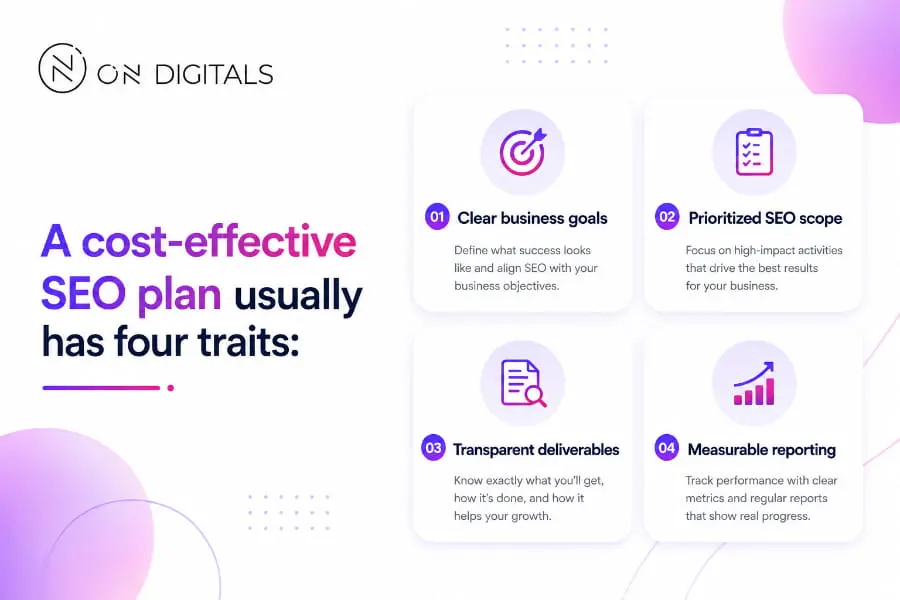
4 traits of a cost-effective SEO plan
The stronger buying question is “Which SEO activities are worth paying for at this stage?” That question is more useful than asking only “How much does SEO cost?”
SEO cost vs. SEO value: What is the difference?
SEO cost covers the work needed to plan, execute, and measure the campaign. SEO value is the business return from that work. For some companies, the return is lower dependence on paid ads; for others, it is stronger visibility or more qualified leads.
This distinction matters because a low-cost SEO package can still be expensive if it targets the wrong keywords. For example, ranking for broad informational keywords may increase traffic, but it may not generate leads if users are not close to a purchase or inquiry decision.
Review SEO value through two lenses. Search metrics show whether Google is understanding and surfacing the site. Business metrics show whether that visibility turns into inquiries or bookings. For B2B teams, pipeline and revenue contribution matter as well.
Useful SEO value indicators include:
- Search visibility indicators
- Organic impressions
- Organic clicks
- Keyword movement
- CTR from Google Search Console
- Organic sessions in GA4
- Business impact indicators
- Form submissions or calls
- Assisted conversions
- Qualified leads
- Revenue influenced by organic search
For B2B companies, lead quality often matters more than traffic volume. A cost-effective SEO campaign may target fewer keywords but drive more qualified inquiries from decision-makers.
Main pricing factors behind SEO services
SEO pricing changes with website size and market difficulty. Technical condition, content needs, and reporting depth also affect the fee. Two companies can pay different fees because the actual work behind their websites is different.
The biggest pricing factors include:
| Pricing factor | Why it affects cost |
| Website size | More pages require more crawling, auditing, and optimization |
| Technical condition | Indexing, speed, redirects, schema, and structure issues need specialist time |
| Competition level | Competitive keywords require stronger content and authority |
| Content volume | More landing pages, blogs, briefs, and refreshes increase workload |
| Market scope | Local, national, regional, or international SEO require different research depth |
| Language scope | Multilingual SEO needs localized keyword research and metadata |
| Link requirements | Authority building takes outreach, evaluation, and quality control |
| Reporting depth | CRM, GA4, GSC, and lead quality reporting need more setup |
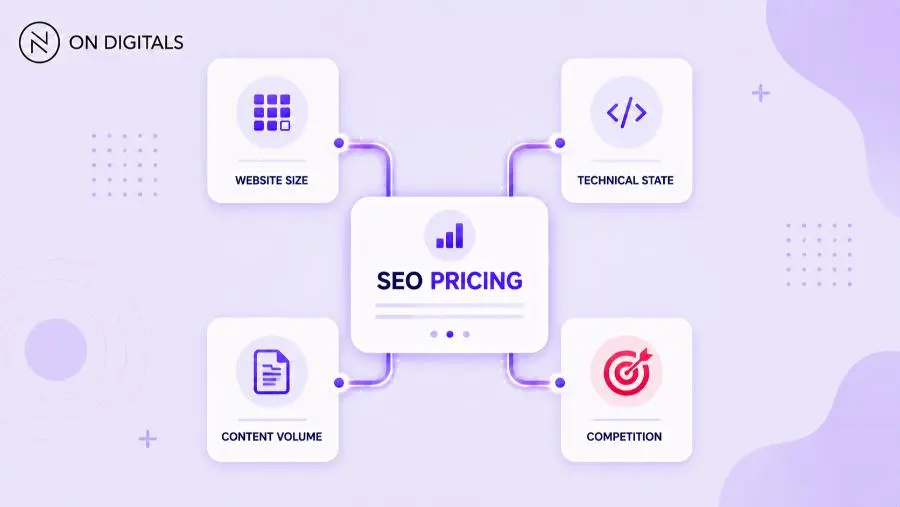
A small service website may only need foundational SEO and local page improvements. An ecommerce or B2B website usually needs deeper work across templates and technical fixes. Topic clusters and conversion tracking become more important as the site grows.
Cost-effective SEO starts with prioritization. Not every issue should be fixed in month one. The agency should identify which actions create the fastest improvement and which require long-term investment.
What should be included in a cost-effective SEO scope?
A cost-effective SEO scope should focus on work that improves discoverability and conversion potential. It should not add random tasks just to make the package look larger.
A practical SEO scope usually includes these workstreams:
- SEO audit: Check whether Google can crawl and index the important pages. Then review page speed, metadata, internal links, and obvious technical risks.
- Keyword research and mapping: Assign one primary keyword to one page to avoid keyword cannibalization.
- On-page optimization: Improve the elements that help priority pages communicate intent. Focus on titles, headings, descriptions, schema, and internal links.
- Content strategy: Plan the page types that support search intent, from service pages to content refreshes.
- Technical SEO: Fix crawl and indexation issues first. Then review redirects, canonical tags, structured data, mobile usability, and speed.
- Authority building: Strengthen internal links and look for credible mentions or backlink opportunities where they fit the strategy.
- Performance reporting: Track visibility and traffic, then connect the data to conversions and lead quality.
A smaller budget should reduce volume, not strategy. A lean plan might optimize five priority pages instead of twenty. It should still keep keyword mapping, tracking, and reporting in place.
Affordable SEO services vs cost-effective SEO services
Affordable SEO services focus on lower upfront cost. Cost-effective SEO services focus on whether the investment produces useful outcomes. Affordable can be good, but only when the scope is realistic and the execution quality is strong.
| Criteria | Affordable SEO | Cost-effective SEO |
| Main focus | Lower monthly cost | Better value per SEO activity |
| Risk | Thin scope or generic work | Requires sharper prioritization |
| Best use case | Small websites, early-stage SEO | Businesses that need measurable growth |
| Success metric | Budget fit | ROI, visibility, quality traffic, conversions |
| Common mistake | Choosing the cheapest package | Overbuilding scope before priorities are clear |
A cost-effective plan can cost more than a basic package and still be the better buy. It prevents wasted content and duplicated pages. It also reduces the risk of poor targeting or low-quality link building.
The most cost-effective option is often a phased plan. Start with audit, technical fixes, and keyword mapping. After the foundation is stable, move into high-value pages and content clusters. Authority building and conversion optimization can come later.
How to calculate SEO ROI?
SEO ROI compares the value generated from organic search against the cost of SEO investment. A practical SEO ROI calculation can use this structure:
SEO ROI = (Organic revenue or lead value – SEO investment) / SEO investment × 100
For lead-generation businesses, the formula needs lead value instead of direct ecommerce revenue. That means the business should know:
- Number of organic leads
- Lead-to-qualified-lead rate
- Qualified-lead-to-sale rate
- Average deal value
- Gross margin, if available
- SEO monthly investment
Example:
If organic search generates 40 leads and 10 become qualified, the next step is to check sales conversion. When 2 leads become customers at an average deal value of $5,000, the estimated organic revenue is $10,000. If SEO costs $3,000 that month, the campaign shows a positive return.
However, SEO ROI should not be judged only month by month. SEO compounds over time. A page optimized today may continue bringing traffic and leads for months or years if it stays relevant and technically healthy.
When is a higher SEO budget justified?
A higher SEO budget makes sense when the website has real business potential but needs deeper work to compete. That may mean technical cleanup and stronger content depth. Some websites also need more authority or broader market coverage. Higher cost is reasonable only when the scope supports higher-value outcomes.
A business may need a larger SEO budget when:
- The website has many technical issues.
- The industry is highly competitive.
- Multiple service or location pages need optimization.
- The company targets several markets or languages.
- E-commerce categories and product pages need SEO.
- The website needs content refreshes and new topic clusters.
- SEO must connect with GA4, CRM, and lead quality reporting.
A higher budget is not justified when the agency cannot explain the scope. If a proposal only says search engine optimization, ask for more detail. A serious proposal should show page count and content volume. It should also define technical tasks, reporting metrics, and the expected timeline.
- A strong SEO proposal should show four things:
- What will be done
- Why it matters
- When it will happen
- How performance will be reviewed
Hidden SEO costs businesses should check
Hidden SEO costs usually appear outside the monthly retainer. They often come from implementation gaps or content production. Tool access, tracking setup, and slow approval cycles can add more cost. These costs still affect the real cost of SEO.
Common hidden costs include:
- Implementation costs:
- Developer time for technical fixes
- Website design or landing page updates
- GA4 and conversion tracking setup
- CRM integration for lead quality tracking
- Content and localization costs
- Copywriting or content editing fees
- Translation or localization
- Operational costs
- SEO tool subscriptions
- Backlink review and cleanup
- Internal approval time
A cost-effective SEO plan should clarify who owns each task. For example, if the agency recommends technical fixes but the client has no developer, the work may stall. If the agency provides content briefs but no writing, the client needs internal or external writers.
Before signing, clarify what is included and excluded. Also confirm what support your team must provide.
How to choose the right SEO scope for your budget?
Match the SEO scope to the website stage. New websites need foundations. Growing websites need content depth and authority. Mature websites often need technical refinement and cannibalization fixes. Conversion-focused optimization usually becomes more important at that stage.
| Website stage | Recommended cost-effective scope |
| New website | Technical setup, keyword map, core service pages, tracking |
| Small business site | Local SEO, service page optimization, FAQ, basic content |
| Growing B2B site | Pillar-spoke content, lead tracking, technical audit, reporting |
| Ecommerce site | Category SEO, product templates, schema, duplicate content checks |
| Mature website | Content pruning, cannibalization fixes, CRO, authority building |
| International site | Multilingual SEO, hreflang, market-specific keyword research |
For businesses comparing external partners, the SEO agency Vietnam guide can help check whether an agency fits your market. Use it to review reporting needs and growth priorities before shortlisting providers.
Cost-effective SEO is not static. The scope should change as the website grows. A simple phased structure can look like this:
- Month one: audit and fixes.
- Months two to four: high-value pages and content clusters.
- Later stages: authority, conversion, and expansion.
Questions to ask before buying SEO services
Ask detailed questions before choosing an SEO package. The right questions show whether the provider understands priorities and measurement. They also reveal how the provider defines business value.
Ask these questions:
- Scope and priority
- Which pages will be optimized first, and why?
- How do you choose target keywords?
- How do you prevent keyword cannibalization?
- What technical SEO tasks are included?
- How many content briefs or articles are included?
- Are content writing and editing included?
- Reporting and responsibility
- What reporting tools will be used?
- Will you track conversions, not only rankings?
- What support do you need from our team?
- Which results are realistic in the first 3, 6, and 12 months?
Avoid providers that promise instant rankings or guaranteed traffic. SEO performance still depends on competition and authority. Content quality, technical implementation, and search changes also affect results.
Frequently Asked Questions (FAQs)
Are cost-effective SEO services the same as cheap SEO?
No. Cheap SEO focuses mainly on low price. Cost-effective SEO focuses on value, scope, and measurable outcomes. A cost-effective plan may still require a serious budget. The difference is that the work supports rankings and qualified traffic. It should also improve conversion potential and long-term website health.
What should a basic SEO package include?
A basic SEO package should cover audit work and keyword research. It should also define priority page optimization and technical checks. Metadata and internal link recommendations should be named clearly. Monthly reporting should be part of the package as well. If content is included, the package should state the number of briefs or pages covered. Article volume should be listed separately when relevant.
How long does SEO take to show ROI?
SEO usually needs several months because search engines must crawl and index changes before evaluating them. Early ROI may come from technical fixes or existing page optimization. Competitive keywords often take longer because they need deeper content and stronger internal links. Authority and consistent improvement also matter.
What makes an SEO package overpriced?
An SEO package may be overpriced when the scope is vague or deliverables are unclear. Shallow reporting is another warning sign. Cost is easier to justify when technical SEO and content strategy are tied to implementation support. Tracking should also connect the work to business impact.
Should small businesses invest in SEO?
Small businesses should invest in SEO when customers actively search for their services and the website can convert visitors. They also need patience for compounding results. A lean plan should start with service pages and local SEO. Technical basics can come next. FAQs and high-intent content should follow before the scope scales.
Key Takeaways
Cost-effective SEO services are built on smart prioritization. The right plan should explain what the business needs now and what can wait. It should also show how performance will be measured and how SEO supports revenue or qualified leads.
For companies comparing SEO partners, price should never be the only decision factor. A lower-cost package becomes expensive when it creates irrelevant content or technical errors. Weak reporting makes the problem harder to catch. A higher-cost plan can be efficient when it solves the right problems and builds long-term organic growth.
On Digitals helps businesses plan SEO around technical foundations and content quality. To compare agency capabilities before choosing a partner, start with the SEO agency Vietnam buyer guide, then use this cost framework to evaluate scope and ROI.

NEWEST POSTS
- Advertising Industry In Vietnam: The 2026 Trends, Channels and Market-Entry Strategy
- Best SEO Company in Vietnam: Latest Shortlist For Businesses
- How To Leverage Social Media For Customer Service Like A Pro?
- Social Media Post Tips – 8 Ways To Boost Engagement
- How To Use Social Media for Sales – In-depth Beginner Guide
Read more