
Keyword Strategy: How to Build a Smarter SEO Plan
Vincent
07/06/2023
12
Keyword strategy is the plan that turns keyword research into SEO decisions. It defines which keywords matter, which pages should target them, and how priorities will be reviewed. Within an on-page SEO workflow, this strategy helps each target page stay aligned with search intent, page ownership, and content updates.
What is a keyword strategy?
A keyword strategy is a structured plan for choosing, prioritizing, and using keywords across a website. It helps SEO teams decide which keyword opportunities deserve attention, which URL should own each topic, and how content should support business goals.
Keyword research matters for SEO because it reveals real search demand and user language. Keyword strategy turns that research into direction, so the team can decide which pages to create, update, merge etc.
Keyword strategy vs keyword research
These two concepts are connected, but they do different jobs.
| Element | Keyword research | Keyword strategy |
| Main role | Finds keyword opportunities | Decides what to do with them |
| Output | Keyword list, volume, difficulty etc. | Priorities, target URLs, briefs etc. |
| Focus | Search data | Business and page decisions |
| Timing | Before strategy | After initial research |
| Risk when missing | Weak keyword discovery | Random content production |
A keyword list can show that people search for “SEO audit checklist,” “technical SEO audit,” and “SEO audit service.” Strategy decides whether those terms belong to one page, separate pages, or a larger content cluster.
Why keyword strategy matters for SEO
Keyword strategy matters because SEO work needs prioritization. Search volume alone cannot show which page deserves investment, which keyword supports revenue, or which topic needs supporting content before it can rank.
A strong strategy helps teams avoid scattered content. It also gives writers, SEO specialists, and business owners the same logic for choosing topics. Instead of creating pages based on tool exports, the team can make decisions based on intent, page fit, ranking potential, and business value.
| SEO problem | How keyword strategy helps |
| Too many keyword ideas | Sorts them by priority |
| Several pages target one intent | Assigns one owner URL |
| Content gets traffic but no leads | Checks intent and business fit |
| New pages compete with old pages | Builds a keyword map first |
| Team cannot explain priorities | Uses a scoring framework |
| Rankings drop after publishing | Adds review triggers |
It connects SEO to business goals
SEO keywords should support a business outcome. For some sites, the priority is qualified leads. For others, the focus may be product discovery, local visibility, content authority, or retention.
Keyword strategy makes the business connection easier to see because each model needs a different priority. For service businesses, commercial terms often matter most because they bring prospects closer to inquiry. Ecommerce teams may focus on category keywords with purchase intent, while content hubs usually build informational clusters first because authority is needed before competitive terms become realistic.
It improves page-type decisions
Every keyword has a page expectation. Some terms need educational guides, while others need service pages, category pages, comparison pages etc.
For example, “what is keyword strategy” usually needs an explanatory article. “Keyword strategy service” needs a service page. “Best keyword strategy tools” is closer to commercial comparison content. When one page tries to serve all of these needs, the result often becomes unfocused.
It prevents keyword overlap
Keyword overlap happens when multiple URLs target the same search need. This can divide internal links, confuse content ownership, and make future updates harder.
A keyword strategy prevents that issue by assigning one primary URL to each cluster. Supporting pages can still exist, but their job should be clear. Some pages educate, while others compare, convert, or support navigation.
What should a keyword strategy include?
A useful keyword strategy should include the decisions needed for execution. It should be easy enough for a content team to follow, but detailed enough for on-page SEO review.
| Strategy component | What it decides |
| Business goal | Why the keyword matters |
| Target audience | Who the page serves |
| Search intent | What the user wants |
| Keyword cluster | Which terms belong together |
| Target URL | Which page owns the topic |
| Page type | What format should be built |
| Priority score | When to act |
| Resource check | What the team must produce |
| Review cadence | How results will be monitored |
Business goal
Start with the business reason behind the strategy. A keyword can be attractive in a tool, but weak for the company. Another term may have modest volume yet strong lead potential.
Use business goals to filter the keyword list before content production starts.
| Goal | Keyword strategy focus |
| Generate leads | Commercial and transactional terms |
| Build authority | Informational clusters |
| Support ecommerce growth | Category and product-led terms |
| Improve local visibility | Location-based searches |
| Refresh old content | Existing pages with visibility gaps |
Search intent
Search intent shows what users expect from the result. Before assigning a page type, the team should run a keyword search intent check for each important cluster.
Informational terms usually need clear explanations, while commercial terms need comparison context. For transactional terms, the page should make the next action easy to find. Mixed-intent keywords need extra care because the SERP may show guides, product pages, tools etc.
Target URL ownership
Each important keyword cluster needs one owner URL. This is the page that should rank for the main topic. Other pages can support it through internal links or related coverage.
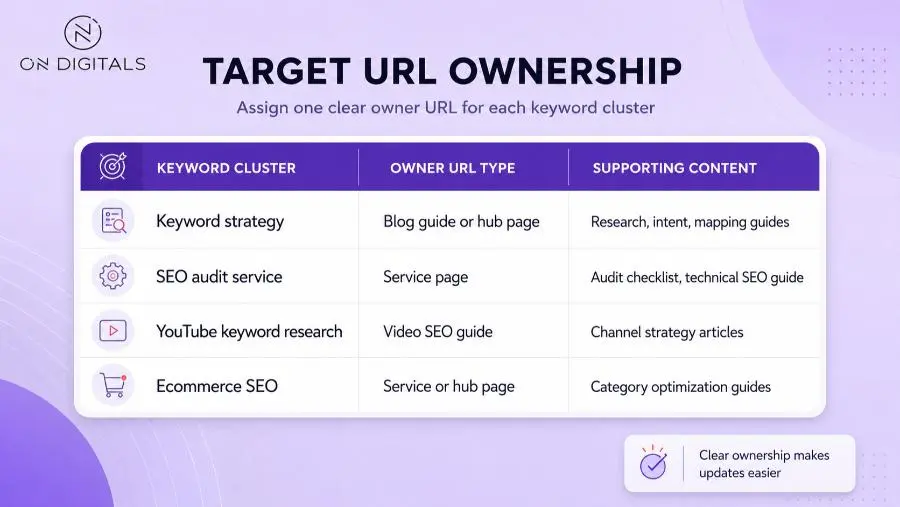
Clear ownership keeps the website easier to manage. When performance changes, the team knows which page to update first.
How to build a keyword strategy
A keyword strategy should move from performance review to prioritization, then into page planning. The workflow below keeps the process strategic instead of turning it into a tool export.
1. Review current SEO performance
Begin with the pages already live. Existing data can show which topics have visibility, which URLs need refresh work, and where keyword overlap may exist.
Review:
- pages with impressions but low clicks
- terms ranking near page one
- URLs losing traffic over time
- pages competing for similar queries
- high-value pages with weak keyword coverage
This review protects the team from creating unnecessary new content. Sometimes the best keyword strategy is to update, merge, or reposition an existing page.
2. Define the SEO goal
Different goals need different keyword choices. A new website may need easier informational clusters. A mature site can compete for stronger commercial terms. Local businesses often need location-based keywords because user intent changes by market.
| SEO goal | Better keyword focus |
| Short-term traffic | Reachable informational topics |
| Lead generation | Commercial and service terms |
| Brand authority | Topic clusters and expert guides |
| Local growth | Service plus location modifiers |
| Content cleanup | Refresh and consolidation targets |
This step also helps stakeholders understand why the team is not always choosing the highest-volume term.
3. Build keyword clusters
A keyword cluster is a group of related keywords that share the same topic and intent. Clustering helps the team avoid creating one page per variation.
For example, these terms can belong in one cluster if the SERP intent is similar:
| Cluster | Example terms |
| Keyword strategy | keyword strategy, SEO keyword strategy, what is keyword strategy |
| Keyword research | keyword research importance, why keyword research matters |
| Search intent | keyword search intent, search intent SEO |
| Keyword metrics | search volume, keyword difficulty, keyword value |
Some clusters need one strong page. Others need a pillar page with supporting articles. The decision depends on intent, competition, and business value.
4. Map keywords to page types
Keyword-to-page mapping turns strategy into website structure. This is where many SEO plans become clearer.
| Intent | Better page type | Example topic |
| Informational | Blog guide | What is a keyword strategy? |
| Commercial | Comparison guide | Best SEO tools for keyword strategy |
| Transactional | Service page | SEO keyword strategy service |
| Local | Local landing page | SEO agency in Vietnam |
| Mixed | Hub page | SEO strategy guide |
A keyword strategy should also define the next user step. An informational article may lead to a related guide. A commercial page may lead to a service page. A transactional page should make contact or purchase simple.
5. Score keyword opportunities
A scoring model helps teams make decisions consistently. It reduces debate because each keyword is judged by the same criteria.
| Score factor | Key question |
| Relevance | Does the keyword match the business? |
| Intent fit | Does the user need match the page type? |
| Business value | Can the traffic support leads or revenue? |
| Ranking potential | Can the site compete realistically? |
| Content requirement | Can the team produce the needed format? |
| Existing asset | Can an old page be improved? |
A simple 1–5 score for each factor is enough for most teams. The result does not need to be perfect. It only needs to make prioritization easier and more transparent.
6. Prioritize what to create or update
After scoring, place each opportunity into a priority bucket.
| Priority bucket | When to use it |
| Act now | Strong value and realistic ranking path |
| Build toward | Strong value but needs supporting content |
| Support only | Useful topic with lower business impact |
| Refresh | Existing page has visibility but weak results |
| Consolidate | Several URLs target the same intent |
| Deprioritize | Weak fit or unrealistic SERP |
This stage keeps the content plan realistic. A small team may need to focus on refreshes and reachable clusters first, while a larger team can build new hubs and supporting assets at the same time.
7. Turn the strategy into a content plan
A keyword strategy becomes useful when it guides production. Each priority cluster should move into a clear content plan with page ownership and review details.
Include:
| Field | Example |
| Primary keyword | keyword strategy |
| Search intent | Informational |
| Target URL | Existing blog article |
| Page type | Strategic guide |
| Main audience | Business owners and SEO beginners |
| Content action | Rewrite and expand |
| Supporting assets | Scoring table, keyword map, FAQ |
| Review owner | SEO lead |
| Review date | Quarterly |
This kind of planning helps editors write better briefs and helps SEO teams review pages more consistently.
Keyword strategy examples by business type
Examples make keyword strategy easier to apply. The same framework can work across industries, but the page choices will change.
| Business type | Keyword strategy example |
| Service business | Use commercial terms for service pages and educational terms for blog support |
| Ecommerce site | Map category terms to category pages and comparison terms to buying guides |
| Local business | Combine service intent with location modifiers |
| SaaS company | Build product-led clusters around use cases and pain points |
| Content publisher | Prioritize clusters that build topical authority |
For a service business, “technical SEO audit service” should likely belong to a service page. “Technical SEO audit checklist” can support that page as an educational guide. When both pages exist, internal links should show which one is for learning and which one is for inquiry.
Common keyword strategy mistakes
Keyword strategy problems often appear as messy content libraries, weak conversions, or ranking plateaus. The table below shows common issues and better fixes.
| Mistake | Why it hurts | Better fix |
| Treating research as strategy | Data does not equal direction | Add page ownership and priority scoring |
| Choosing by volume only | Traffic may be too broad | Include intent and business value |
| Ignoring SERP format | Page type may be wrong | Check what already ranks |
| Creating duplicate pages | URLs compete for the same need | Assign one owner URL |
| Skipping resource checks | Team cannot match the SERP | Choose feasible formats |
| Forgetting review cycles | Strategy becomes outdated | Add cadence and triggers |
A strong keyword strategy should also account for resources. If the SERP favors videos, tools, or original data, another basic blog post may not be enough. The team should either invest in the required asset or choose a more realistic opportunity.
How often should you update a keyword strategy?
Keyword strategy should be reviewed regularly because search behavior, business priorities, and SERPs change. A quarterly review works for many websites, while fast-moving industries may need more frequent checks.
Use these triggers:
- rankings drop for an important cluster
- impressions rise but clicks stay weak
- a new product or service launches
- competitors publish stronger content
- several pages overlap on one intent
- seasonal demand is approaching
- the SERP starts showing a different format
During each review, decide whether to update, merge, split, create, or pause. This keeps the strategy active after publishing.
Keyword strategy FAQ
How many keywords should a keyword strategy include?
The number depends on website size and resources. A small service site may start with a few priority clusters, while a larger ecommerce site may need hundreds of mapped terms.
Should a new website target high-volume keywords?
A new website can target high-volume topics as long-term goals, but early strategy usually needs more reachable terms. Lower-competition keywords can help build relevance before the site competes for broader queries.
How do I map keywords to pages?
Start by grouping keywords with the same intent. Then choose the page type that best matches the SERP. Assign one owner URL to each cluster and use supporting pages only when they serve a separate need.
What tools help with keyword strategy?
Keyword research tools can help collect data, while Search Console helps review existing performance. The strategy still needs human judgment around business value, page fit, SERP format, and resources.
How do I know whether to create a new page or update an old one?
Update an old page when it already has visibility and matches the keyword intent. Create a new page when no existing URL fits the search need, page type, or business goal.
Final thoughts
If your team already has keyword data but still struggles to decide which pages to create, refresh, or consolidate, On Digitals can help turn that research into a practical keyword strategy. We review search intent, page ownership, content gaps, priority clusters etc. so each keyword supports a clearer business role.
For websites with scattered content or overlapping topics, this process helps the team focus on the pages that matter most instead of producing more content without a clear direction.

NEWEST POSTS
- Advertising Industry In Vietnam: The 2026 Trends, Channels and Market-Entry Strategy
- Best SEO Company in Vietnam: Latest Shortlist For Businesses
- How To Leverage Social Media For Customer Service Like A Pro?
- Social Media Post Tips – 8 Ways To Boost Engagement
- How To Use Social Media for Sales – In-depth Beginner Guide
Read more