
Email Outreach for Backlinks: Earn More Relevant Replies and Links
Vincent
21/11/2025
45
Email outreach for backlinks works best when every message gives the recipient a clear reason to care. A useful outreach email identifies a specific page, explains what is missing or outdated, then offers a resource that genuinely improves the reader’s experience.
For businesses learning how to get backlinks through useful content, outreach can create more relevant opportunities than sending the same request to a large list of websites. The right message can open a conversation with a publisher, while a generic request often gets ignored because it adds little value to their content.
What is email outreach for backlinks?
Email outreach for backlinks is the process of contacting website owners, editors, journalists, or content managers to suggest a relevant resource, provide expert input, or correct an issue on a published page.
The email should connect your request to a clear benefit for the recipient’s audience. A broken-link replacement, an original data source, or an unlinked brand mention can all provide a reasonable reason to reach out.
Backlinks can support discovery and external credibility when they appear in relevant editorial context. Google’s guidance on crawlable links and anchor text reinforces the same principle: readers and search engines should understand where a link leads before clicking it.
Why email outreach matters for backlink quality
Outreach gives you more control over relevance. Instead of placing links wherever a listing is available, you can focus on websites that serve a related audience and publish content connected to your topic.
A well-qualified placement can bring referral visitors alongside search value. This matters because a backlink from a smaller industry publication may be more useful than a high-metric website with no meaningful connection to your market.
How outreach helps you earn better backlinks
The strongest outreach begins with a specific reason to contact the publisher. That reason may be a broken resource, an unlinked brand mention, outdated research, or a topic where a specialist quote would add useful context.
Your resource needs to fit the gap. Sending a general service page as a replacement for a data source rarely works. Therefore, a focused guide, benchmark, template, or tool gives the recipient a clearer reason to consider your request.
Choose the right outreach template before writing
Different situations require different outreach angles. Pick the template that matches the page, the recipient, and the asset you can offer.
|
Situation |
Best outreach angle |
What you need before sending |
|
A relevant page has a broken link |
Broken-link replacement |
Broken URL, target page, replacement resource |
|
Your brand appears without a link |
Unlinked mention request |
Exact mention, useful destination URL |
|
A resource page lacks a relevant tool |
Resource suggestion |
Clear reader benefit and target asset |
|
A publisher needs specialist input |
Expert quote request |
Named expert, short insight, proof of experience |
|
You have original research |
Data contribution |
Unique finding, chart, or benchmark |
|
A publication accepts contributors |
Guest contribution |
One original topic matched to its audience |
|
A page needs an updated source |
Outdated-resource update |
Current replacement and reason it improves the article |
Keep each email focused on one page and one request. The recipient should understand the benefit without having to interpret several options.
7 email outreach templates for backlinks
Template 1: Resource suggestion email
Use when: A published guide or educational article would benefit from one supporting resource in a specific section.
Avoid when: The article is already comprehensive, or your page only promotes a commercial service.
Subject: A resource for your section on [topic]
Hi [Name],
I was reading your article on [topic], especially the section about [specific section].
We published [resource name], which helps readers [specific outcome]. It may add useful context for the point you make about [relevant issue].
Here is the resource: [URL]
Would it be useful to include as a supporting reference?
Best,
[Name]
Template 2: Broken-link replacement email
Use when: A relevant page links to a resource that no longer works, and your page answers the same need.
Subject: Broken link in your [article title]
Hi [Name],
I found your article on [topic] while researching [specific subject].
The link to [broken resource or page title] in the section about [section name] appears to return an error.
We published a current resource on the same topic: [URL]
It covers [short benefit], so it may be a useful replacement for readers who need that information.
Thanks for maintaining such a helpful page.
Best,
[Name]
Template 3: Guest contribution email
Use when: The publication accepts contributor content and you have one original idea that fits its audience.
Subject: Article idea for [publication name]
Hi [Name],
I enjoy your coverage of [topic], especially your recent article on [specific article].
I would like to contribute a practical article for your readers: “[proposed title].”
The piece would show [main takeaway] through [example, framework, or data source]. It would be written specifically for your audience and would not repeat content already on the site.
Would this topic fit your editorial calendar?
Best,
[Name]
Template 4: Unlinked brand mention email
Use when: A publisher already mentions your business, research, product, or original resource without linking to the source.
Subject: Small update for your [article title]
Hi [Name],
Thank you for mentioning [brand or resource] in your article about [topic].
Readers who want more detail may find the original source helpful: [URL]
The page includes [specific information, data, or tool], which adds context to the point you made about [relevant section].
Would you consider linking the mention to the original resource?
Best,
[Name]
Template 5: Resource-page or tool-list inclusion email
Use when: The target page is a maintained list of tools, templates, platforms, or curated resources.
Avoid when: The page is a standard blog article rather than a resource hub or list.
Subject: Suggestion for your [topic] resource list
Hi [Name],
I found your list of [topic] resources and noticed the section on [specific category].
[Resource name] may be a useful fit because it helps users [specific outcome]. It includes [tool, template, calculator, guide, etc.] for people working on [relevant task].
Here is the page: [URL]
Would it suit the [specific category] section?
Best,
[Name]
Template 6: Expert quote request email
Use when: A publication has recently covered a topic that could benefit from an expert perspective, an update, or added context.
Avoid when: You only want a backlink and cannot offer a specific insight, example, or source-backed comment.
Subject: Expert insight for your article on [topic]
Hi [Name],
I enjoyed your recent article on [topic], particularly the section on [specific point].
Our [role or expert name] has direct experience with [specific issue] and can provide a short, source-backed comment that may add useful context for readers.
One relevant insight is:
“[Short quote or data point.]”
Would this be useful for a future update or related coverage?
Best,
[Name]
Template 7: Research or data contribution email
Use when: You have original data, a benchmark, or a clear research finding that can strengthen a published article or future coverage.
Avoid when: The “data” is a broad claim without a clear source, sample, or method.
Subject: New data for your coverage of [topic]
Hi [Name],
I noticed your article on [topic] discusses [specific point].
Our team recently analysed [dataset, sample, or trend] and found that [one specific finding].
The full resource is here: [URL]
Would this finding be useful for a future update to the article or your wider coverage of [topic]?
Best,
Key elements of an effective backlink outreach email
A template gives you a structure. The final message should always be shaped around the specific page and the person receiving it.
Research the page before personalising the email
Personalisation is more than adding a first name. Read the target page closely enough to identify its audience, current purpose, and a meaningful outreach trigger.
Use this outreach brief before drafting:
|
Field |
What to document |
|
Target page |
The exact URL you are contacting them about |
|
Audience |
What readers of that page need |
|
Trigger |
Broken link, outdated source, missing data, mention, etc. |
|
Your asset |
The page, quote, tool, or research you can offer |
|
Reader benefit |
Why the source improves with your suggestion |
|
CTA |
One simple question that is easy to answer |
This process helps prevent generic outreach. It also makes it easier to identify when your resource does not truly fit the source page.
Find the right person to contact
The author of the article is often the strongest first contact because they understand the original purpose of the page. When author details are unavailable, look for an editor, content manager, or marketing lead.
Avoid sending the same message to several people in the same organisation at once. It can create confusion and make the outreach feel automated.
Make the proposal easy to understand
A useful email explains three things quickly:
- Why you are contacting this person
- What specific resource you are suggesting
- How it helps their reader
Keep the message concise. Around 70 to 100 words is usually enough for a straightforward request. Expert quotes or data contributions may need a little more context, although the value should still be clear within the opening lines.
Give the recipient one clear request
Several asks in one email can reduce clarity. A message that requests a guest post, partnership, and backlink at the same time creates unnecessary work for the recipient.
Instead, give them one decision to make. Ask whether a broken link should be updated. Ask whether a tool belongs on a resource page. Ask whether an expert quote supports the article.
A clear request makes it easier for the recipient to respond, even when the answer is no.
Use a friendly close without overexplaining
A brief thank-you is enough. The recipient does not need a long explanation of your SEO objectives or a repeated claim that your resource is “high quality.”
Professional tone usually works best:
Thanks for considering it.
I appreciate the work that goes into keeping this resource current.
Follow up without becoming a nuisance
A polite follow-up can be useful because editors often have full inboxes. Keep the sequence short and stop after two follow-ups when there is no engagement.
|
Touch |
Timing |
Purpose |
|
Initial email |
Day 0 |
Explain the trigger and reader benefit |
|
Follow-up 1 |
Day 3–5 |
Add one useful detail or clarify the resource |
|
Follow-up 2 |
Day 7–10 |
Close the loop respectfully |
|
Stop |
After follow-up 2 |
Avoid repeated contact without interest |
Follow-up example:
Hi [Name],
Just following up on the broken link in your [article title].
The replacement resource covers [specific point] and is available here: [URL].
Would it be useful for the section on [topic]?
Best,
[Name]
Track outcomes beyond open rates
Open rates can be unreliable because privacy settings affect how email activity is recorded. Focus on outcomes that show whether the campaign created real value.
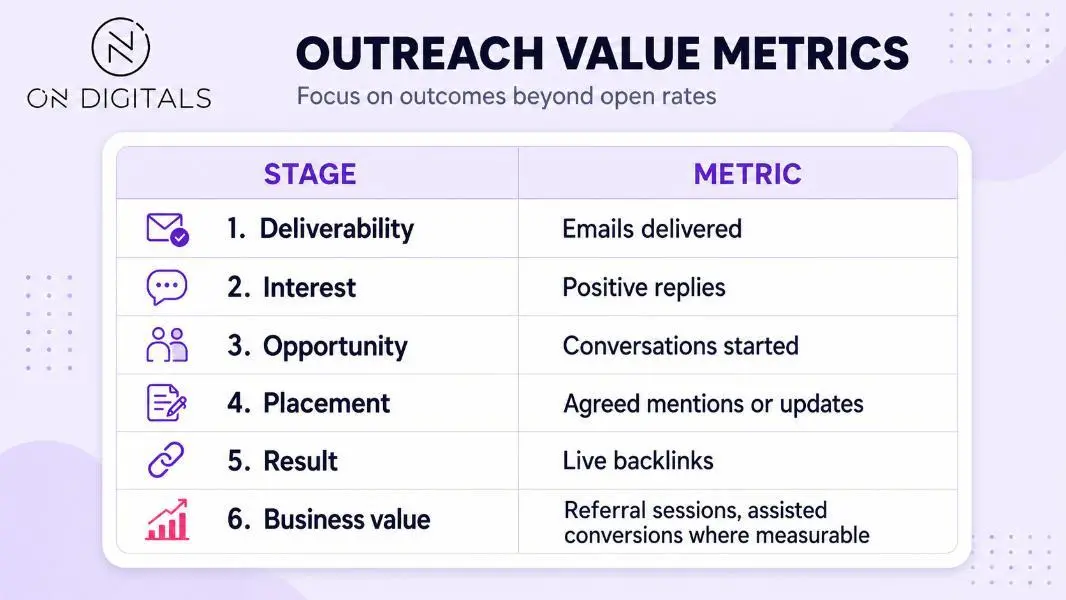 Track outreach from delivered emails and positive replies through to live backlinks, referral traffic, and measurable business value.
A live backlink is useful, but it should not be treated as the end of the workflow. Review whether the link remains active, sends relevant visitors, and points to the page you intended to strengthen.
Build relationships where your audience already spends time
Outreach works more effectively when it is supported by visibility before the first email arrives. Industry communities, specialist groups, and relevant social channels can help your research, data, or expert viewpoints reach people who may later reference them.
This is where social media link building can support outreach. Sharing a useful asset may create awareness among writers, editors, and industry peers, while the eventual backlink should still be earned through editorial relevance rather than direct link requests in social comments.
Backlink outreach practices to avoid
Relevant outreach can support editorial link earning. Some approaches create unnecessary risk because the link exists mainly to influence rankings rather than help readers.
Paid placements can still serve an advertising purpose. When a link is part of a paid relationship, the publisher should use the appropriate attribute, such as rel=”sponsored”. User-generated placements may use rel=”ugc” where appropriate. Google explains these relationships in its guidance on qualifying outbound links.
Avoid requesting paid followed links, scaled exchanges, or placements on unrelated pages. Google’s Spam Policies for Web Search describe patterns created mainly to manipulate rankings.
FAQs about email outreach for backlinks
What is the difference between email outreach and cold emailing?
Cold emailing covers many business purposes, such as sales, partnerships, recruitment, or media relations. Email outreach for backlinks is more specific. It focuses on offering a relevant resource, quote, correction, or update that can improve a publisher’s content.
How can I measure backlink outreach success?
Track the full path from delivery to live placement. Positive replies, agreed placements, live links, referral sessions, and assisted conversions offer more useful insight than open rate alone.
Is email outreach effective for every industry?
It can work across many industries when there is a real reason to contact the publisher. B2B teams may offer research or specialist insight. Local businesses may contribute useful community resources. Technical brands may provide tools, data, or expert commentary.
How often should I follow up?
One or two follow-ups are usually enough. Send the first message, wait several days, then provide a short reminder with additional value. End the sequence when there is no sign of interest.
How long should a link-building email be?
A straightforward email can usually stay within 70 to 100 words. Keep the message short enough to scan quickly, while including enough context for the recipient to understand why your resource belongs on the page.
Should I ask for a backlink directly?
A direct request can work when the reader benefit is clear. Mention the exact page, explain how the resource improves the content, and avoid treating the link as the only reason for the conversation.
What should I do after no reply?
Send up to two polite follow-ups. After that, move the prospect out of the active sequence and focus on better-fit opportunities. Repeated messages without engagement can damage future relationships.
Conclusion
Email outreach for backlinks becomes more effective when the message begins with the publisher’s page rather than your own SEO target. Choose a relevant prospect, offer one useful resource, and make the next step easy to understand.
On Digitals helps businesses build outreach plans around editorial value, relevant audiences, and measurable referral outcomes. This keeps link earning connected to content quality instead of sending more emails for the sake of volume.

NEWEST POSTS
- Advertising Industry In Vietnam: The 2026 Trends, Channels and Market-Entry Strategy
- Best SEO Company in Vietnam: Latest Shortlist For Businesses
- How To Leverage Social Media For Customer Service Like A Pro?
- Social Media Post Tips – 8 Ways To Boost Engagement
- How To Use Social Media for Sales – In-depth Beginner Guide
Read more