
Social Media Link Building: Turn Content Reach Into Earned Links
Vincent
21/11/2025
16
Social media link building helps useful content reach people who may share it, reference it, or cite it in their own work. Profile links, post links, video descriptions, and relevant community contributions can all support discovery. Their strongest value usually comes through referral traffic, brand visibility, and opportunities for third-party editorial links.
Used alongside a broader plan for earning backlinks from relevant websites, social media can give a useful guide, report, tool, or visual a better chance of reaching the right audience. A social post may introduce the asset, while the resource itself needs enough value to earn a future citation.
What are social media links?
Social media links connect users from a social platform to a website, resource, profile, or another destination. They may appear in a profile bio, a featured post, a video description, a community reply, or a shared content asset.
Some social links are controlled by your brand. Others appear when customers, creators, journalists, or industry peers choose to share your work. These categories serve different purposes.
A profile link can help people find your website. A post link can bring visitors to a useful guide. An editorial backlink from another website may strengthen the broader visibility of that resource when it appears in relevant content.
The social link value ladder
Social media link building becomes easier to manage when you separate the role each link can play.
|
Layer |
What it includes |
Main value |
|
Owned social links |
Profile links, bio links, featured resources, YouTube descriptions |
Brand navigation and referral traffic |
|
Distributed links |
Posts that promote guides, research, tools, etc. |
Content discovery |
|
Community references |
Helpful replies in groups, forums, or specialist discussions |
Qualified visits and credibility |
|
Earned editorial links |
References from publishers, bloggers, journalists, or partners |
Long-term visibility and external trust |
The first three layers are usually within your control. The final layer depends on whether the content gives another publisher a genuine reason to cite it.
Social links support discovery rather than guaranteed ranking gains
Social activity can expose a resource to more people. That visibility may lead to referral visits, branded searches, mentions, or editorial backlinks from relevant websites.
This is more realistic than assuming a high number of likes or shares will directly improve organic rankings. A popular post can still create limited SEO value when it sends visitors to a weak page or reaches people with little reason to reference the content later.
Focus on the asset behind the post. A useful destination gives people something worth sharing after they click through.
Top social media link building mistakes to avoid
Some businesses treat social media links as a fast way to increase backlink volume. That approach often creates low-value placements, weak referral traffic, or unnecessary risk.
Creating low-quality content just to add links
A social post with a link is easy to publish. Earning attention takes more effort because people need a clear reason to save, share, or reference the destination page.
Content becomes more share-worthy when it offers a specific takeaway. This may be an original statistic, a comparison table, a checklist, a framework, or a tool that solves a repeated problem.
Before promoting a page, check whether it has:
- A clear point that can be explained quickly
- A useful data point, visual, or framework
- A specific audience problem it solves
- A landing page that continues the topic properly
- A reason for a creator or publisher to cite it later
For example, a general article about B2B marketing may be useful. A benchmark showing how B2B teams allocate budget across channels gives people a more concrete reason to share the page.
Buying or exchanging links unnaturally
Paid promotion can have a legitimate advertising purpose. Risk appears when a placement exists mainly to influence search rankings instead of reaching a relevant audience.
Google advises publishers to qualify paid links with rel=”sponsored”. User-generated links may use rel=”ugc”, while nofollow remains available when other values do not apply. Google’s guidance on qualifying outbound links explains these relationships in more detail.
Avoid paid followed links, scaled link exchanges, or placements on unrelated pages. Google’s Spam Policies for Web Search describe link patterns created mainly to manipulate rankings.
A relevant sponsorship may still bring awareness or referral visits. Its value should be assessed as a marketing placement instead of a shortcut to authority.
Spamming links in comments or direct messages
Repeatedly dropping links into comments, inboxes, or community threads can damage trust quickly. Readers often recognise when a reply exists only to promote a destination.
A stronger approach begins with the answer itself. Explain the issue, add a practical step, then include a resource only when it genuinely extends the discussion.
Use this checklist before sharing a link in a community:
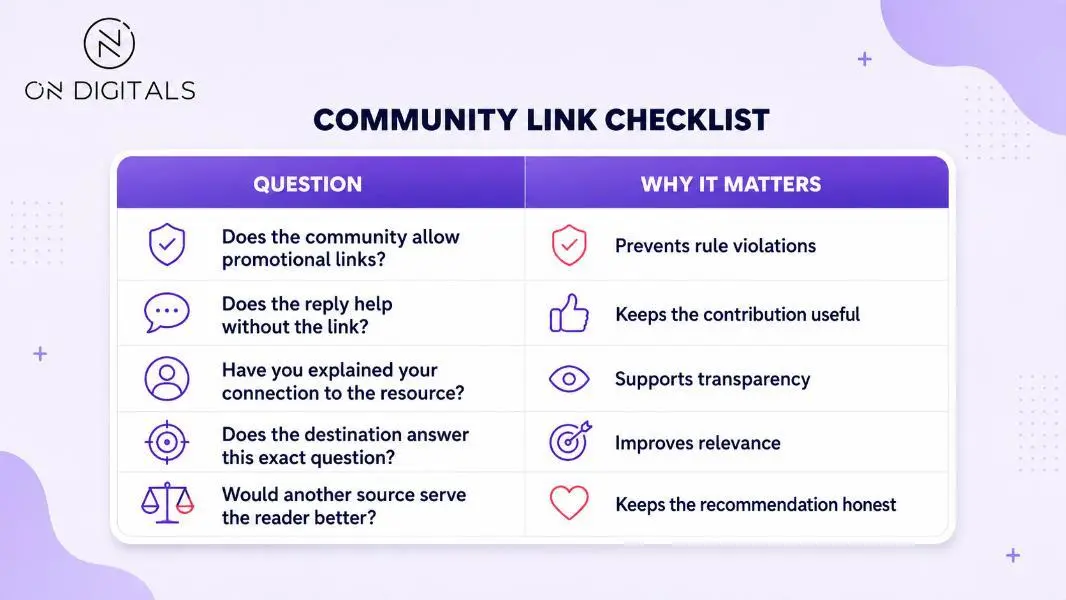 Check community rules, relevance, transparency, and reader value before sharing a link.
Community participation works best when it happens consistently. A helpful presence can create recognition before any link is shared.
Ignoring profile and bio optimisation
Profiles are often the simplest social links to maintain, yet many businesses leave them outdated or send visitors to generic pages that do not match the audience.
Choose one primary destination for each profile based on why people visit it. LinkedIn company pages often work better when they lead to a thought-leadership hub, while YouTube viewers may benefit more from a resource library. For local community profiles, a location-specific page usually provides the clearest next step.
Add UTM parameters when you need to track campaign-level performance. For example:
?utm_source=linkedin&utm_medium=organic_social&utm_campaign=industry_report
This makes it easier to compare traffic quality across posts, campaigns, or social platforms.
Not measuring link performance
Clicks alone do not show whether a social media link created meaningful value. One post may attract traffic that leaves immediately, while a smaller campaign can bring fewer visitors who explore deeper pages or submit an inquiry.
Use a measurement funnel that connects distribution with outcomes:
|
Stage |
What to measure |
|
Visibility |
Post reach, profile visits, video views |
|
Interest |
Link clicks, saves, shares, meaningful comments |
|
Referral quality |
Engaged sessions, scroll depth, return visitors |
|
Conversion value |
Enquiries, sign-ups, assisted conversions |
|
Editorial outcome |
New brand mentions, referring domains, cited resources |
GA4, native platform analytics, and backlink monitoring tools can reveal different parts of this journey. Review the destination URL as well. A popular post cannot compensate for a page that fails to answer the reader’s next question.
Focusing only on one platform
A business does not need an account on every social network. It does need to understand where its audience, industry peers, and potential publishers spend time.
Choose channels based on the asset you can promote.
|
Channel type |
Strong content fit |
Useful outcome |
|
|
Research, B2B insights, case examples |
Qualified comments and referral visits |
|
YouTube |
Tutorials, walkthroughs, demonstrations |
Description clicks and engaged sessions |
|
Community forums |
Practical answers, checklists, specialist guidance |
Discussion visibility and relevant traffic |
|
Visual platforms |
Original charts, carousels, explainer graphics |
Saves, shares, profile visits |
|
Partner channels |
Interviews, webinars, co-created content |
Mentions, referrals, editorial discovery |
Audience fit matters more than spreading links across a large number of platforms. A well-placed LinkedIn post may produce stronger results for a B2B report than a broad campaign across channels with little audience overlap.
How social media supports SEO
Social media can support SEO by improving content discovery. When the right people encounter a useful asset, they may return to it later, mention it in a newsletter, quote a statistic, or use it as a source in a relevant article.
That indirect route matters because editorial references often have stronger long-term value than profile links alone.
Help publishers discover content worth citing
Useful social distribution can put your best resources in front of writers, newsletter editors, podcast hosts, or industry commentators.
For example, original research can gain a wider audience through a focused LinkedIn post that highlights one useful finding and links to the full report. When that insight reaches the right industry audience, an editor may use the statistic as a source in a later article and cite the original research.
The social post did not create the editorial link by itself. It made discovery easier. The report earned the citation because it added something useful to the editor’s work.
This is where social media can support stronger editorial link opportunities over time. The resource needs to deserve the reference before distribution can make a difference.
Build qualified referral traffic
Referral visits can show whether a social audience matches the content you are promoting. Strong signals may include engaged sessions, multiple page views, newsletter sign-ups, or visits to related resources.
A lower-volume platform can still be valuable when its visitors are highly relevant. For example, a specialist community may bring fewer sessions than a broad social network, while its audience may be more likely to request a demo, save a checklist, or share a guide internally.
Support brand recognition before outreach
Social visibility can make later outreach more effective. A publisher who has already seen your research, expert commentary, or useful visual may better understand the context behind a relevant email.
This does not replace outreach. Instead, it can reduce the “unknown sender” problem by making the brand more visible before the first conversation begins.
Once a publisher has shown interest in your content, a focused backlink outreach email can help turn that opening into a clear editorial request. The message should still point to a specific page, explain the reader benefit, and keep the ask simple.
Tips to do social media link building effectively
The strongest approach combines useful assets, audience-fit distribution, and consistent measurement.
Share assets that can earn future citations
A strong social post usually begins with a stronger source asset. Research reports, specialist templates, calculators, visual explainers, and practical comparison guides often create clearer reasons to share.
Extract one useful insight from the destination page rather than posting a vague headline. A single chart, an unexpected statistic, or a clear framework can make the content easier to understand quickly.
Keep the social post focused. The landing page can provide the deeper explanation.
Use platform-native link placements
Each platform has different places where links can fit naturally. Profile sections, featured content areas, post captions, video descriptions, and community replies serve different purposes.
Match the placement to the reason someone is engaging with that platform. A profile link can guide first-time visitors toward a useful starting point, while post links should extend the topic already being discussed. Video descriptions work best when they lead viewers to an accompanying guide, checklist, or tool.
Avoid forcing every social post to point to a service page. Educational content often works better as an early interaction because it gives readers a lower-friction reason to engage.
Contribute to communities before sharing your own links
Community participation should build credibility before promotion. Answer questions, clarify misconceptions, share practical experience, and respond to other contributors.
Over time, people may begin to recognise your expertise. That makes a later resource link feel more useful because it appears within an established pattern of helpful contributions.
A simple rule can guide the process: contribute something useful first, then add a link only when it extends the answer.
Review social links and destinations quarterly
Social profiles change. Campaign pages expire. A once-relevant destination can become outdated after a content refresh or service change.
Review your key profiles every quarter:
- Check that each primary link still works
- Confirm that UTM parameters are consistent
- Update featured resources when campaigns change
- Review whether the destination matches the current audience
- Remove links to outdated pages or inactive campaigns
This keeps social media link building connected to current business priorities rather than leaving old pathways across the web.
Track distribution from click to editorial mention
Social campaigns become more useful when reporting includes more than reach and clicks.
Start with a tagged URL. Monitor the traffic in GA4. Review engagement on the destination page. Track later mentions through backlink tools, brand monitoring, or manual searches.
The reporting path can look like this:
Social post → referral visit → resource engagement → brand mention or editorial citation
Many campaigns will stop at referral traffic. That is still useful when the visits are qualified. The longer path becomes more likely when the promoted asset provides a source that creators and publishers can reuse.
FAQs about social media link building
Are social media backlinks usually nofollow?
Many social platforms use qualified links or platform-specific link handling. Their main value often comes from visibility, referral traffic, and discovery rather than a guaranteed transfer of ranking value. Review the platform’s own documentation when a specific implementation matters.
Can social posts lead to editorial backlinks?
Yes, although the result usually depends on the strength of the resource behind the post. A social post can help a journalist, creator, or publisher discover useful research, a tool, or an expert source. Editorial links may follow when the asset improves their content.
Which social platform works best for B2B link building?
LinkedIn is often useful for B2B research, specialist commentary, and thought-leadership assets. The best platform still depends on where your audience and industry publishers spend time. A niche community can be more valuable than a broad network with limited relevance.
Should a social post link directly to a service page?
A direct service-page link can work when the post discusses a highly specific solution. Educational content usually performs better as an early interaction because it helps readers understand the topic before they consider a commercial option.
How often should social media backlinks be updated?
Review important profile links every quarter. Update them sooner when a campaign changes, a resource is replaced, or a destination page becomes outdated.
What is the difference between social media link building and digital PR?
Social media link building focuses on distribution through owned profiles, posts, communities, and partner channels. Digital PR focuses on earning coverage from publications or media outlets. Both can support discovery, while digital PR usually aims more directly at editorial mentions.
Can influencer marketing improve social media link building results?
It can help when the creator’s audience overlaps with the people who would benefit from the resource. Review audience fit, disclosure requirements, content ownership, and the quality of the destination page before investing in a partnership.
Conclusion
Social media link building is most valuable when it helps useful content reach an audience with a genuine reason to engage. Profile links can provide a clear starting point, while consistent distribution and thoughtful community contributions can expand discovery and build trust. The strongest outcome comes when an independent publisher later chooses to reference the resource in relevant content.
On Digitals helps businesses connect content distribution with relevant audiences, clearer measurement, and sustainable off-page opportunities. This keeps social media activity tied to useful resources instead of treating every post as a shortcut to rankings.

NEWEST POSTS
- Advertising Industry In Vietnam: The 2026 Trends, Channels and Market-Entry Strategy
- Best SEO Company in Vietnam: Latest Shortlist For Businesses
- How To Leverage Social Media For Customer Service Like A Pro?
- Social Media Post Tips – 8 Ways To Boost Engagement
- How To Use Social Media for Sales – In-depth Beginner Guide
Read more