
Google Ads Examples: What Search, Shopping, Display and Video Ads Get Right
Vincent
15/10/2025
36
Effective Google Ads examples do more than use clever headlines or polished visuals. They match a user’s intent with a clear offer, credible proof and a landing page that continues the same message. The strongest campaigns make the next action easy to understand, whether that action is comparing a product, booking a service or returning to a cart.
Google Ads examples in 60 seconds
A useful Google Ads example shows how the full conversion path works. The ad earns attention because it addresses a real need. The landing page then gives the visitor enough information to decide what to do next.
An ad can look strong in a screenshot and still be ineffective if the offer is vague or the page after the click does not deliver on the promise. For that reason, it is better to study the reason behind an ad than to copy its headline, visual or discount.
|
Format |
What a strong example should demonstrate |
|
Search |
Clear intent match, differentiation and useful ad assets |
|
Shopping |
Product clarity, pricing, reviews and accurate feed information |
|
Display |
One visual idea with a relevant benefit |
|
YouTube or Demand Gen |
Fast understanding, product proof and an appropriate next step |
|
Remarketing |
A message that reflects what the visitor did before |
|
Performance Max |
Consistent assets, reliable data and a clear conversion goal |
The examples below focus on visible strategy, not reported ROAS or conversion volume. Ads can change by market, time and user context. A message worth learning from is one that makes a promise the business can actually prove.
What makes a Google Ads example worth studying?
The strongest Google Ads examples answer a few simple questions.
What is the person likely trying to solve?
Search ads usually respond to an active question. Display, video and Demand Gen ads may create interest before the customer searches.
What is the offer?
The ad should not make people guess what the business sells, who it is for or why it is different.
What proof supports the offer?
This may be a specific feature, a verified rating, a clear price, a recognised credential or a product demonstration. Proof does not need to be dramatic. It needs to be relevant and truthful.
Does the landing page continue the same message?
A paid campaign has two connected phases: the experience before a click and the experience after it. If the page switches to a different offer, the visitor has a reason to leave.
What is the next action?
A first-time visitor may need to explore products or learn more. A high-intent buyer may be ready to compare options, request a quote or complete a purchase.
Google Ads formats at a glance
Google Ads examples look different because each format supports a different stage of the customer journey.
|
Campaign environment |
Main role |
Often suitable for |
|
Search |
Capture active demand |
Services, B2B, local needs and high-intent products |
|
Shopping |
Help buyers compare products |
Ecommerce with accurate product data |
|
Display |
Build awareness or reconnect with visitors |
Visual products, broad reach and remarketing |
|
YouTube video |
Demonstrate a product or explain a problem |
Product education, launches and brand storytelling |
|
Demand Gen |
Reach people while they browse visual content |
Consumer offers, creator-style creative and discovery campaigns |
|
Performance Max |
Optimise towards a goal across Google inventory |
Businesses with reliable conversion tracking and useful assets |
Search ads remain the clearest example of intent-led advertising. Shopping ads reduce uncertainty around product choice. Display and video can make an unfamiliar offer easier to understand. Demand Gen is useful when visual discovery matters, while Performance Max brings multiple Google surfaces together around a defined conversion goal.
The campaign type should follow the customer journey. A local repair service may rely on Search because people need help now. A new consumer product may need video and discovery activity before people know what to search for.
1. Specialist positioning makes a general query feel specific
A well-known Search ad example from King Swing Sets used the message, “We Do Swing Sets, Nothing Else.” It stood out because it did not claim to be the cheapest or the best. It positioned the brand as a specialist.
This approach works when a business has genuine depth in one category. A specialist message can reduce uncertainty for customers making a high-consideration purchase. Someone searching for a swing set may feel more confident with a retailer focused entirely on that product than with a broad store selling hundreds of unrelated items.
The lesson is not to copy the wording. It is to identify the narrow expertise that customers actually value. A commercial cleaning firm may focus on regulated facilities. A manufacturer may focus on one technical process. A software company may serve one operational team particularly well.
The landing page has to support the claim. It should show relevant expertise, useful buying guidance and proof that the business is genuinely specialised.
2. A differentiator is stronger than a vague superlative
A Kustomer ad for customer-service software used a “this, not that” contrast: a platform based on customers rather than tickets. The phrase gave readers a clear distinction without explaining every product feature.
Many ads use generic language such as “trusted solution,” “quality service” or “best value.” These phrases may sound positive, but they rarely help a customer choose between similar advertisers. A differentiator gives the visitor a reason to compare one business with another.
A useful differentiator can be a feature, process, delivery standard, audience focus or commercial model. It should answer a buyer question that matters. A payroll provider may lead with local compliance support. A web design agency may lead with conversion-focused pages rather than generic design.
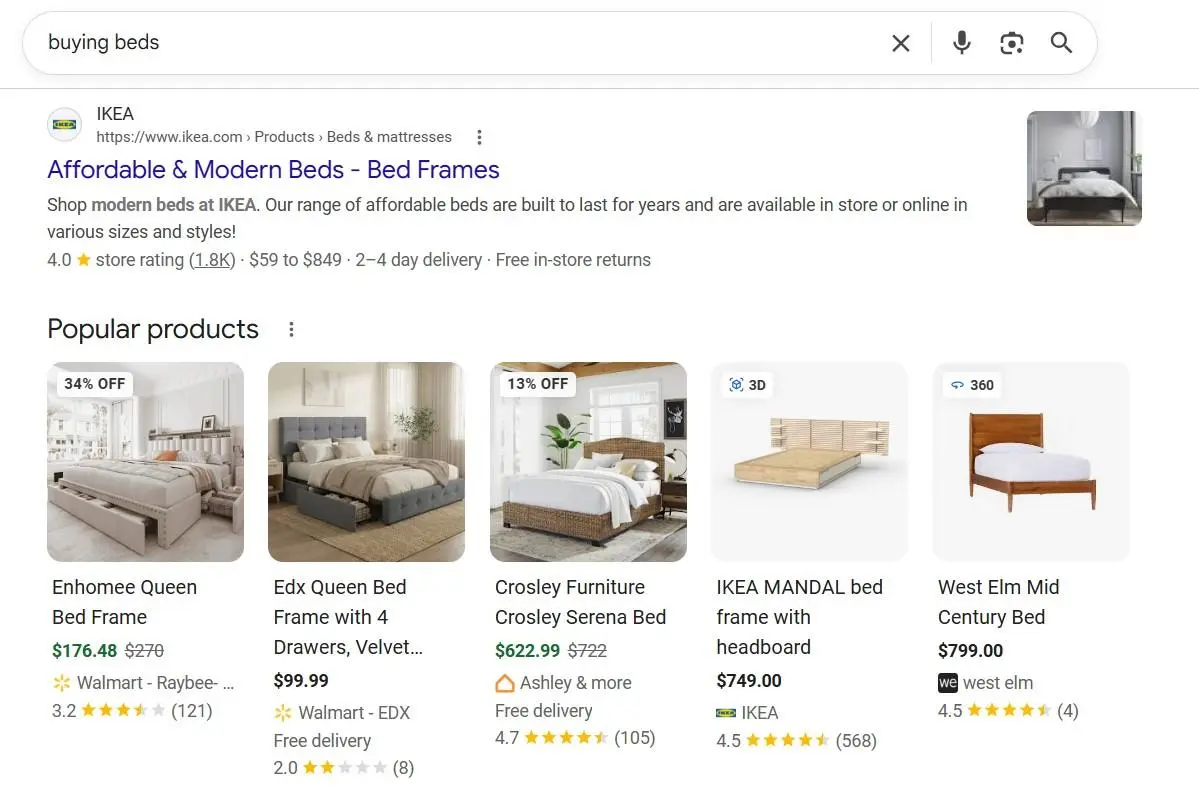
Avoid creating a contrast just to sound different. The message must be provable on the landing page, ideally with a product explanation, service process, customer example or relevant evidence.
3. Use a specific feature to create relevance
Another customer-service software ad highlighted a specific capability: AI-assisted sentiment analysis. The feature was more memorable than a broad claim about being innovative.
A feature-led ad works when the feature clearly solves a customer problem. It is less useful when the feature is technical jargon or a long list of functions. The reader should understand why it matters without having to decode the product.
For example, an accounting platform might lead with automated VAT reconciliation when the target customer manages complex tax reporting. A logistics provider might lead with a same-day dispatch cutoff when delivery speed is a real buying trigger.
The feature should also connect to a benefit. The ad can mention the capability, while the description or landing page explains what the customer gains: less manual work, fewer errors, faster delivery or clearer reporting.
4. Qualifying the click can protect lead quality
A BlueVine loan ad stated a minimum annual-revenue requirement. That may appear restrictive, but it helps the advertiser avoid clicks from people who are unlikely to qualify.
Not every campaign should attempt to maximise click volume. Some businesses need fewer but better leads. A qualification message can be useful when pricing, location, eligibility, minimum order size or service scope has a major impact on whether a sale can happen.
A B2B software provider might state that its plan is designed for teams above a certain size. A local service business might show its service area. A manufacturer might disclose its minimum order quantity.
These details can reduce wasted clicks and make sales follow-up more efficient. The key is to balance transparency with clarity. Do not hide important requirements until a visitor fills in a form. At the same time, do not overload the ad with every condition.
Put the most decision-relevant qualifier in the ad, then make the full terms easy to find on the landing page.
5. Proof is more credible than extra adjectives
A Thrive Market ad used numbers to communicate scale, product range and customer trust. Specific figures can make a claim more believable when they are accurate and easy to understand.
Proof can take several forms:
- A verified rating or review volume
- A relevant certification
- A clear delivery standard
- A service coverage area
- A product count
- A case-study statistic with context
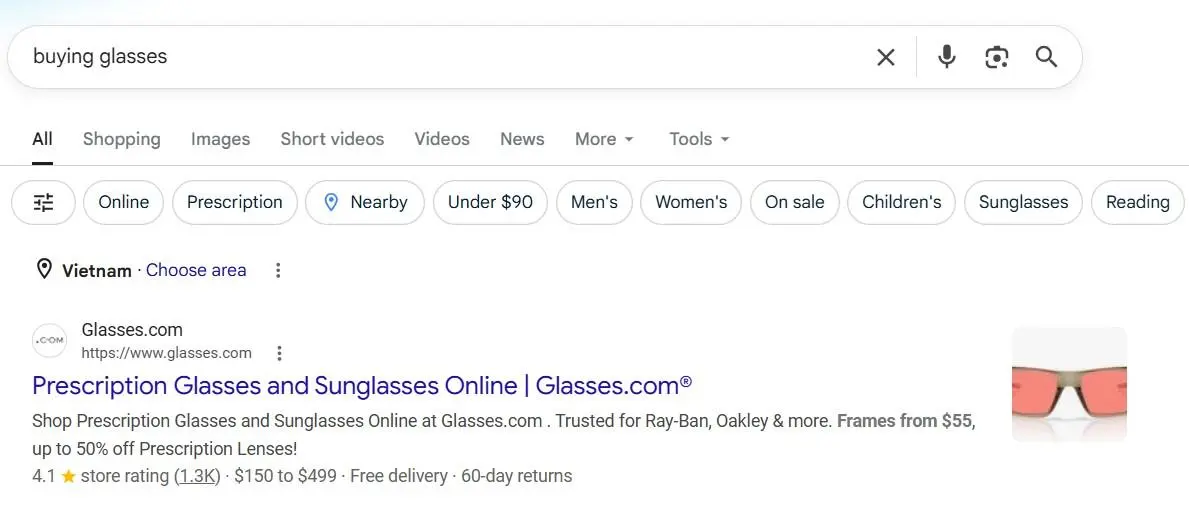
The important point is verification. A number should not appear simply because it looks impressive. It should be current, supported by evidence and relevant to the customer’s decision.
For service businesses, proof is most useful when it reflects the actual buying risk. An enterprise buyer may care about security certification. A homeowner may care about warranty terms, licensed technicians or a clear response window. Match the proof to the question that could stop someone from acting.
6. Google Shopping example
Shopping ads are often judged in seconds. The shopper sees a product image, title, price, seller and sometimes ratings or promotions alongside competing listings. This makes product clarity more important than clever copy.
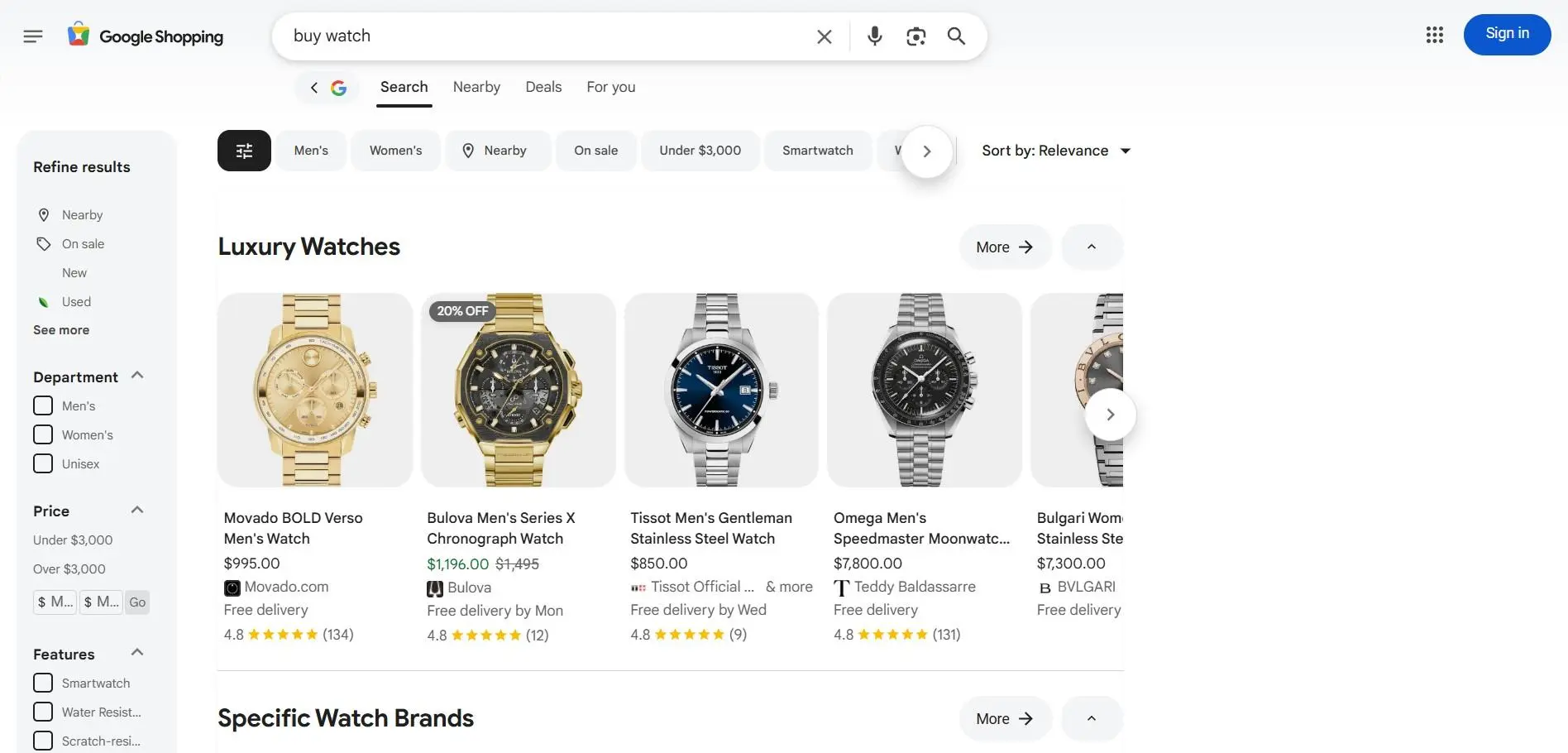
A strong Shopping example gives the buyer enough information to decide whether it is worth clicking. The product image should show the item clearly. The title should identify the right variation. The price should match the landing page. Availability, shipping details and ratings should also be accurate.
A vague title can attract the wrong click. So can an image that hides the material, model or size. The same problem appears when an ad promotes a discount that disappears after the click.
Shopping campaigns depend on feed quality as much as bid strategy. Product titles, images, pricing, GTINs, availability and landing pages must work together. A polished creative concept cannot compensate for unreliable product data.
7. Display and Demand Gen example
A Grammarly display example used a concise, relatable customer statement instead of a dense feature list. The creative worked because it made one benefit easy to understand.
Display and Demand Gen ads are usually seen while a person is browsing content, watching video or scrolling a feed. The audience may not be actively looking for the product. The ad therefore needs to create relevance quickly.
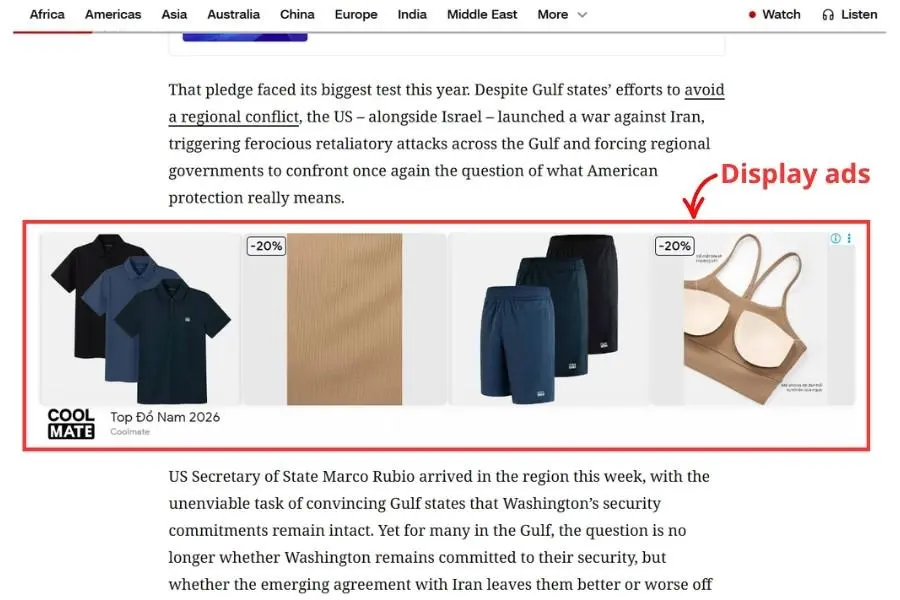
A single visual idea is often more effective than a crowded design. It may show the product in use, a common problem, a customer outcome or a distinctive offer. The headline should support the image rather than repeat every product detail.
This does not mean every display ad needs minimal copy. Complex products may need more explanation. The principle is that every element should serve the same message. A person should understand the offer before they need to read a second line.
Demand Gen is most useful when visual discovery, creative testing and audience control matter to the campaign. It should be chosen because the customer needs to see or understand something, not because the business has a spare image asset.
8. Video and remarketing example
Video is most useful when it demonstrates something static text cannot explain. This may be a product in use, a service process, a customer story or a clear workflow improvement. The first moments should establish the topic quickly, but there is no universal six-second formula for every campaign.
The same principle applies to remarketing. A returning visitor should not always receive the first ad again. Someone who viewed a product may need reviews or product proof. A cart abandoner may need delivery information, return-policy clarity or a genuine offer. A pricing-page visitor may need a case study, comparison or consultation invitation.
The message should reflect the previous action without making uncomfortable assumptions about the user. It should also exclude people who have already converted from first-purchase or first-lead campaigns.
For a deeper explanation of audience stages, exclusions and follow-up messages, see our guide to Google Ads audience targeting.
What effective Google Ads examples have in common
|
Pattern |
Why it matters |
|
Intent match |
The message answers a need the user is likely to have |
|
Specific offer |
The ad gives a reason to choose this business |
|
Relevant proof |
The claim is easier to trust |
|
Useful assets |
Sitelinks, ratings, prices or product information reduce uncertainty |
|
Landing-page continuity |
The visitor sees the same promise after the click |
|
Clear action |
The next step feels appropriate for the buying stage |
A campaign does not need every pattern at once. A simple Search ad may need only a relevant headline, a clear differentiator and a useful landing page. A Shopping listing may depend more on product data. A video campaign may need stronger product demonstration.
The common requirement is consistency. The query, ad, audience, landing page and conversion action should point in the same direction.
How to use Google Ads examples without copying competitors
Google Ads examples are useful when they reveal a decision principle. They become risky when advertisers copy another brand’s exact copy, creative or claim.
A practical way to study competitors is to look at their search message, assets, landing-page destination and call to action. Then ask what the campaign is trying to make easier for the buyer.
Google’s Ads Transparency Center can help advertisers review public ads. It is useful for understanding visible creative and positioning, but it does not reveal lead quality, conversion rate or return on ad spend. A public ad should be treated as inspiration, not evidence that a competitor has found a profitable strategy.
Common mistakes when using Google Ads examples
Copying copy without understanding the query
A headline may work because it matches a specific search, location or audience. Used elsewhere, the same words can feel irrelevant or misleading.
Using urgency without a genuine deadline
A countdown, promotion or stock message should be real. False urgency may create clicks, but it can reduce trust and create policy risk.
Sending every ad to the homepage
A homepage can be useful for broad brand searches. It is often too general for a product, service or offer-specific ad. The landing page should answer the question raised by the ad.
Treating Performance Max as one ad format
Performance Max is a goal-based campaign that can run across Google inventory. Its performance depends on conversion tracking, assets, feed quality and campaign goal. It is not a single creative format to copy from a screenshot.
Judging an ad by click-through rate alone
An ad with a high click-through rate may attract the wrong people. Review qualified leads, purchase value, margin or sales feedback before calling a message successful.
For a deeper look at the relationship between search relevance, landing pages and campaign quality, read our guide to Google Ads Quality Score.
Frequently asked questions (FAQs)
What makes a Google Ads example effective?
A useful Google Ads example matches the customer’s intent with a clear offer, credible proof and a landing page that supports the next step. The goal is not to make the ad look creative in isolation. It is to make the customer journey easier to understand and complete.
Which Google Ads examples should a business study first?
Start with examples closest to the business goal. Service businesses should study Search ads and landing pages. Ecommerce brands should study Shopping, Search and remarketing. Brands creating awareness should study video, Display and Demand Gen creative.
Are Google Ads examples enough to improve campaign performance?
No. Examples can improve messaging and creative decisions, but they do not replace keyword research, product data, audience strategy, conversion tracking or landing-page optimisation. A tactic that works for another business may not work for a different product, market or sales cycle.
Should I copy competitors’ Google Ads?
Do not copy competitors’ wording, design or claims. Study why the ad may work instead. Look at how it positions the offer, reduces uncertainty or directs traffic to a relevant landing page. Then create an original version using your own customer insight and proof.
Is Performance Max a type of Google Ad?
Performance Max is a goal-based Google Ads campaign type, not one standalone ad format. It can run across Google inventory, so it needs reliable conversion tracking, useful assets and a clear commercial objective.
Turn examples into a stronger conversion path
Google Ads examples are more than copywriting inspiration. They show how intent, offer, proof, ad assets and landing-page experience can work together.
Start with the customer question. Make one clear promise. Support it with evidence. Then send the visitor to a page that makes the next action simple. This approach gives businesses a stronger foundation than simply copying an eye-catching ad.
On Digitals helps businesses connect Google Ads campaign structure, landing pages and measurement through our Google Ads services.

NEWEST POSTS
- Advertising Industry In Vietnam: The 2026 Trends, Channels and Market-Entry Strategy
- Best SEO Company in Vietnam: Latest Shortlist For Businesses
- How To Leverage Social Media For Customer Service Like A Pro?
- Social Media Post Tips – 8 Ways To Boost Engagement
- How To Use Social Media for Sales – In-depth Beginner Guide
Read more