
Google Ads Quality Score: How to Diagnose and Improve It
Vincent
24/07/2025
19
Google Ads Quality Score is a 1–10 keyword-level diagnostic used in Google Ads Search campaigns. It evaluates expected click-through rate, ad relevance, and landing page experience to estimate how relevant your ads are to a specific search query.
It is not a bidding factor and it is not a performance KPI. It exists to help advertisers understand where relevance is strong or weak across keywords and ad experiences.
In practice, Google Ads Quality Score should always be interpreted as a diagnostic signal, not a target metric. Its value lies in identifying friction inside the keyword-to-ad-to-landing-page system, not in optimizing the number itself.
What is Google Ads Quality Score?
Google Ads Quality Score is a keyword-level diagnostic metric shown in Search campaigns. It is measured from 1 to 10 and reflects how relevant your ad experience is to a specific search query.
According to Google’s official documentation, Quality Score is based on three components: expected CTR, ad relevance, and landing page experience
Google Ads Quality Score official documentation
Each keyword receives a score that reflects its relative performance compared to other advertisers competing in similar search auctions.
However, what matters more than the number itself is what it represents. Quality Score is not static and not absolute. It is a contextual evaluation that changes depending on:
- search intent
- auction environment
- historical engagement
- ad competitiveness
This is why two identical keywords can show different Quality Scores depending on how they perform in different campaign structures or intent contexts.
From a system perspective, Google Ads Quality Score is best understood as a relevance feedback loop rather than a ranking metric.
Where to find Google Ads Quality Score
Quality Score is available inside the Keywords section of Google Ads Search campaigns.
It can be viewed by customizing columns and adding:
- Quality Score
- Expected CTR
- Ad Relevance
- Landing Page Experience
- Historical Quality Score
When there is not enough data, Google may display a dash instead of a score. This is common for low-volume or newly added keywords.
The key mistake many advertisers make is evaluating Quality Score at an individual keyword level without grouping by intent clusters. This leads to misleading conclusions because Quality Score only becomes meaningful when viewed across patterns of similar search behavior.
Quality Score vs Optimization Score
Google Ads Quality Score and Optimization Score operate at different layers of the system.
Quality Score is a keyword-level diagnostic signal. It reflects relevance between keyword, ad, and landing page inside Search campaigns.
Optimization Score is a broader system-level recommendation engine that suggests account improvements such as bidding strategies, keyword expansion, or automation adoption.
The difference is structural:
- Quality Score = diagnostic (what is happening)
- Optimization Score = prescriptive (what Google suggests)
Confusing the two leads to incorrect optimization behavior, especially when advertisers apply automated recommendations without understanding relevance signals.
Google Ads Quality Score vs Ad Rank: What is the difference?
Quality Score does not determine ad position directly. Instead, it is one of several signals used inside the Ad Rank system.
Ad Rank is a real-time auction calculation that determines whether an ad appears and where it is shown.
It includes:
- bid amount
- auction-time quality signals
- search context
- competition level
- expected impact of assets
Quality Score is a historical and diagnostic representation of relevance, while Ad Rank is a real-time decision system.
A stronger Quality Score trend may improve efficiency signals, but it does not guarantee higher placement or lower CPC.
SEMrush explains Quality Score as a relevance indicator that helps advertisers understand auction efficiency rather than a direct ranking factor
SEMrush Google Ads Quality Score guide
This distinction is critical because it prevents one of the most common PPC mistakes: optimizing toward score improvement instead of performance improvement.
Why the distinction matters
Understanding the difference between Quality Score and Ad Rank changes how optimization decisions are made.
When advertisers focus only on improving Google Ads Quality Score, they often restructure campaigns in ways that improve relevance signals but reduce traffic volume or conversion quality.
This happens because the system rewards alignment, not business value.
A keyword with low Quality Score may still:
- generate high-value conversions
- deliver strong revenue
- perform well in niche intent segments
At the same time, a high Quality Score keyword may:
- attract informational traffic
- generate low-intent clicks
- produce weak conversion outcomes
This is why Quality Score should never be used as a standalone KPI.
Business outcomes such as revenue, profit, and conversion quality must always take priority.
Why Google Ads Quality Score still matters
Even though it is not a KPI, Google Ads Quality Score is still one of the most useful diagnostic systems in Search campaigns.
It helps identify where relevance breaks inside your structure:
- keyword mismatch
- unclear ad messaging
- weak landing page alignment
- broad intent grouping
When multiple keywords in a cluster show low scores, it usually indicates structural issues rather than isolated keyword problems.
However, Quality Score does not capture full performance reality. Auction dynamics, competitor strength, and conversion behavior still play major roles.
Adalysis emphasizes that Quality Score should always be treated as a diagnostic signal rather than a performance target because over-optimization often leads to misleading decisions
Adalysis Google Ads Quality Score analysis
What Google Ads Quality Score does not tell you
Quality Score has clear limitations that must be understood before using it for decision-making.
It does not measure:
- profit
- revenue
- conversion value
- customer lifetime value
- sales quality
It also does not reflect:
- device-level variation
- audience segmentation
- time-of-day differences
- full funnel behavior
- multi-channel attribution
Because of these limitations, relying on Google Ads Quality Score alone leads to incomplete optimization strategies.
The three components of Google Ads Quality Score
Expected CTR
Expected CTR measures how likely users are to click your ad for a specific keyword.
It is based on historical performance and contextual auction signals.
A low Expected CTR usually indicates:
- weak message clarity
- poor intent alignment
- strong competitor ads
- unclear value proposition
Ad Relevance
Ad Relevance measures how closely your ad matches user intent.
It evaluates whether the keyword and ad messaging align with the search query meaning.
Low relevance typically comes from:
- generic ad copy
- broad keyword grouping
- unclear positioning
- mixed intent targeting
Landing Page Experience
Landing Page Experience evaluates post-click relevance.
It focuses on whether users find the page useful after clicking the ad.
Key signals include:
- clarity of content
- relevance to search intent
- usability and navigation
- conversion accessibility
If users do not find what they expect, relevance signals weaken over time.
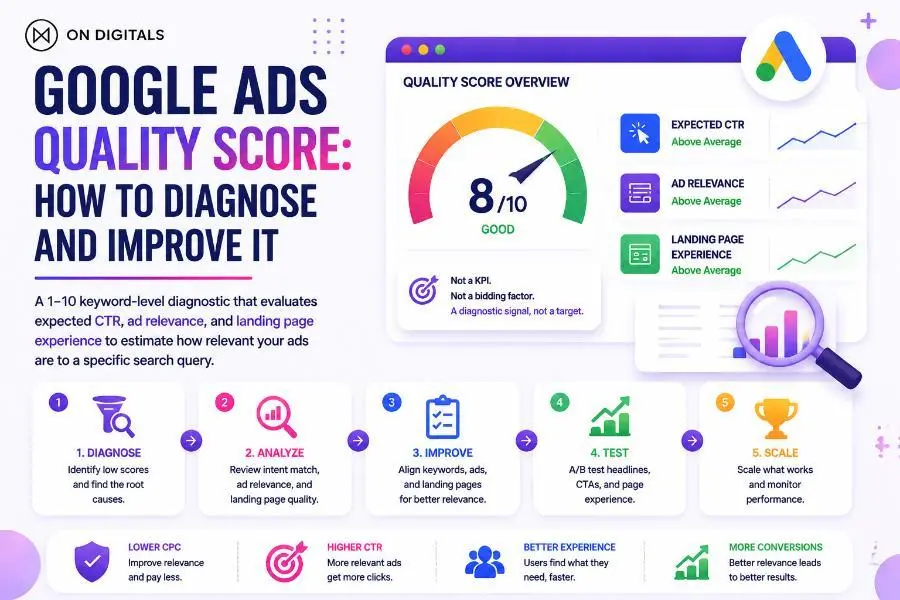
Quality Score isn’t a KPI — it’s a breakdown of how relevance is measured across CTR, ad messaging, and landing page experience.
How to diagnose a low Google Ads Quality Score
Diagnosis should always begin with business value, not score interpretation.
Not every low Google Ads Quality Score keyword is worth fixing.
The first step is determining whether the keyword contributes to:
- revenue
- qualified leads
- strategic growth
Next is analyzing search terms. This reveals real user intent behind each keyword. Many low scores are caused by intent fragmentation, where a single keyword matches multiple unrelated search behaviors.
You can analyze search term filtering behavior in Google Ads through official reporting tools
Google Ads search terms guide
Finally, diagnosis must connect all three components together instead of treating them separately. In most cases, low Quality Score reflects system misalignment, not isolated keyword issues.
Which low-Quality-Score keywords should you fix first?
Not all low-scoring keywords require action.
Prioritize keywords that:
- generate meaningful revenue or leads
- support core business services
- have enough data for evaluation
- show clear relevance issues
Avoid prioritizing keywords that:
- lack commercial value
- generate irrelevant traffic
- do not align with business objectives
How to improve Expected CTR without chasing irrelevant clicks
Improving Expected CTR is not about increasing clicks. It is about improving relevance between query and message.
CTR improves when:
- intent is clearly understood
- messaging is specific
- offer clarity is strong
CTR decreases when:
- messaging is generic
- intent is unclear
- SERP competition is strong
SERP context also matters. Ads compete with maps, shopping results, AI answers, and organic listings, all of which influence engagement behavior.
How to improve Ad Relevance
Ad Relevance improves when messaging aligns tightly with intent.
Different intent types require different messaging approaches. Mixing them reduces relevance.
Keyword usage should improve clarity, not create repetition.
Over-optimized ads often reduce readability and performance instead of improving relevance signals.
How to improve Landing Page Experience
Landing page experience improves when post-click content matches pre-click expectations.
The page must continue the message promised in the ad.
Strong landing pages:
- clearly explain the offer
- provide relevant information
- reduce friction in conversion
- maintain message consistency
Technical performance supports experience, but relevance is more important than speed alone.
Practical ways to improve Google Ads Quality Score without harming performance
Improvement starts with analyzing search term data to understand what users are actually typing before clicking your ads. This step helps identify irrelevant queries, low-intent traffic patterns, and mismatches between keywords and real user intent, which often explain weak performance more accurately than the keyword itself.
Irrelevant queries should only be removed or excluded once there is enough consistent data showing they do not contribute to conversions or meaningful engagement. Making changes too early can remove potentially valuable long-tail intent.
The core system behind Quality Score improvement is alignment between query, ad message, and landing page experience. When these three elements consistently match in intent and expectation, relevance signals strengthen naturally over time as Google observes better engagement patterns.
Testing should therefore be guided by clear hypotheses about intent, messaging, or conversion behavior, rather than focusing on improving the score itself, since Quality Score changes are usually a result of improved alignment rather than the goal of optimization.
What to monitor alongside Google Ads Quality Score
Quality Score must be evaluated alongside:
- CTR
- CPC
- conversion rate
- CPA
- ROAS
- revenue
At business level:
- lead quality
- sales performance
- profit margin
- customer value
Common Google Ads Quality Score mistakes
- Treating Quality Score as KPI instead of a diagnostic signal, which leads advertisers to optimize for the number itself rather than improving real outcomes like conversions, revenue, or lead quality, causing misaligned decisions across campaigns.
- Chasing 10/10 Quality Score across all keywords, even when some terms naturally operate in competitive or informational intent environments where lower scores are normal but still commercially valuable.
- Ignoring search terms data, which results in weak intent control, irrelevant traffic leakage, and unclear understanding of what users actually searched before clicking ads.
- Over-segmenting campaigns or ad groups, which can reduce data efficiency and make it harder to learn meaningful performance patterns across related intent clusters.
- Keyword stuffing in ad copy, which reduces readability and weakens message clarity instead of improving relevance or user engagement signals.
- Optimizing without business context, leading to improvements in Quality Score that do not translate into better ROI, conversion quality, or actual revenue performance.
FAQ
What is Google Ads Quality Score?
It is a keyword-level diagnostic metric that evaluates how relevant your ads, keywords, and landing pages are to user search intent, helping advertisers understand where alignment is strong or weak without directly acting as a KPI or auction input inside Google Ads system.
Does Quality Score affect CPC?
It indirectly influences auction efficiency by signaling relevance strength, which can improve how competitively your ads perform in relation to bids and competitors, but CPC is ultimately determined in real time by auction dynamics, not by Quality Score as a direct pricing factor.
Is Quality Score the same as Ad Rank?
No, because Quality Score is a diagnostic relevance indicator while Ad Rank is a real-time auction calculation that determines ad position using bid, context, and competition factors, meaning a strong Quality Score does not guarantee higher placement without sufficient auction competitiveness.
Why does Quality Score change?
Because it is continuously adjusted based on shifting user intent, competitor activity, and auction behavior patterns, meaning even without campaign changes your Google Ads Quality Score can fluctuate as Google recalibrates relevance signals across different search contexts and performance histories.
What is Google Ads Quality Score?
It is a keyword-level diagnostic metric that measures relevance across ads, keywords, and landing pages.
Does Quality Score affect CPC?
It influences auction efficiency by signaling relevance strength between keyword, ad, and landing page, which can improve how competitively your ads perform in the auction, but CPC itself is still determined in real time by bid level, competition, and auction context.
Is Quality Score the same as Ad Rank?
No, because Quality Score is a diagnostic relevance indicator while Ad Rank is a real-time auction calculation that determines ad position using multiple signals including bid, context, and competition, meaning they operate on different layers of the Google Ads system.
Why does Quality Score change?
Because it continuously adjusts based on evolving user intent, competitor activity, and auction conditions, so even without campaign changes your Google Ads Quality Score can fluctuate as Google recalibrates relevance signals across different search environments.
Improve campaign quality beyond the score
Google Ads Quality Score is most useful when it highlights relevance gaps across your campaign structure. It becomes misleading when treated as a performance goal instead of a diagnostic system that explains alignment issues between keyword intent, ad messaging, and landing page experience.
On Digitals helps businesses build structured Google Ads systems focused on intent alignment, conversion quality, and revenue efficiency rather than metric chasing, ensuring campaign decisions are driven by business outcomes rather than isolated diagnostic signals.

NEWEST POSTS
- Advertising Industry In Vietnam: The 2026 Trends, Channels and Market-Entry Strategy
- Best SEO Company in Vietnam: Latest Shortlist For Businesses
- How To Leverage Social Media For Customer Service Like A Pro?
- Social Media Post Tips – 8 Ways To Boost Engagement
- How To Use Social Media for Sales – In-depth Beginner Guide
Read more