
Broad Match vs Phrase Match: Similarities, Differences & How to Choose in 2026
Vincent
07/06/2023
46
Broad match vs phrase match is one of the most important decisions in Google Ads campaign structure, especially as Google’s AI-driven matching system continues to evolve. Choosing the wrong match type can lead to wasted ad spend, irrelevant traffic, or limited scale. On the other hand, choosing the right combination can significantly improve conversion efficiency and campaign growth.
In 2025, this decision is even more critical due to Smart Bidding, intent-based matching, and Google’s expanded use of contextual signals. This guide breaks down broad match vs phrase match in a practical, strategy-first way to help advertisers make better decisions based on real campaign goals.
What are Keyword Match Types in Google Ads?
Keyword match types in Google Ads determine how closely a user’s search query must align with your selected keyword before your ad is triggered. In other words, they act as a filtering system that controls how Google interprets user intent and decides when to show your ads.
Instead of matching keywords in a rigid way, Google now uses match types as intent signals to balance reach, relevance, and control. This means advertisers are no longer just targeting exact words, but also variations of meaning, context, and user behavior patterns.
In simple terms, match types control three core performance factors:
- Reach: how many searches your ads are eligible to appear for
- Relevance: how closely those searches align with user intent
- Control: how predictable and structured your traffic is
The three main match types in Google Ads are:
- Broad match – maximum reach with AI-driven intent expansion
- Phrase match – balanced control with contextual matching
- Exact match – highest precision with strict intent alignment
Each match type plays a different role in the customer journey, from discovery (broad match), to evaluation (phrase match), to high-intent conversion (exact match). Understanding how these match types interact is essential for building scalable, efficient, and profitable Google Ads campaigns in 2026.
What is Broad Match?
road match is the most flexible keyword match type in Google Ads, designed to maximize reach by allowing your ads to appear for a wide range of search queries related to your keyword. Instead of relying on exact wording, Google uses AI-driven intent signals to understand the meaning behind a search and decide whether your ad is relevant.
This means your ads can be triggered not only by your exact keyword but also by:
- Synonyms
- Related search queries
- Misspellings and spelling variations
- Contextual or semantic variations
- AI-interpreted user intent
For example, if your keyword is “running shoes,” your ad may also appear for searches like:
- best shoes for jogging
- buy sports sneakers online
- comfortable footwear for running
In 2026, broad match is heavily powered by Google’s machine learning systems, making it less about keyword matching and more about intent prediction and contextual relevance. This allows advertisers to discover new search opportunities they may not have directly targeted.
However, this increased reach comes with trade-offs. Because Google expands targeting beyond exact keywords, traffic quality can become less predictable. That is why broad match performs best when combined with Smart Bidding strategies, strong conversion tracking, and active negative keyword management to filter irrelevant traffic and maintain efficiency.
What is Phrase Match?
Phrase match is a more controlled keyword match type that shows your ads when users search for queries that include the meaning of your keyword phrase.
Unlike broad match, phrase match maintains stronger alignment with user intent while still allowing variations.
For example, if your keyword is “running shoes,” your ad may appear for:
- best running shoes for beginners
- running shoes for marathon training
But it will not trigger unrelated intent searches like broad match might.
Phrase match strikes a balance between reach and precision, making it ideal for advertisers who want controlled scaling without excessive traffic noise.
Broad Match vs Phrase Match: Key Similarities
Despite their differences, broad match vs phrase match share several important similarities:
- Both rely on Google’s intent-matching system
- Both capture variations of user search behavior
- Both require continuous optimization
- Both influence ad visibility and traffic volume
Most importantly, both match types are not static. Their performance depends heavily on:
- Smart Bidding strategy
- Conversion data quality
- Negative keyword structure
- Campaign setup and intent grouping
This means success is not determined by match type alone, but by how well the entire campaign is structured.
Broad Match vs Phrase Match: Key Differences
The main differences between broad match vs phrase match come down to control, reach, and precision, but in 2026, the gap between them is even more influenced by Google’s AI-driven intent interpretation and Smart Bidding behavior.
Broad match is designed for maximum reach and discovery. It allows Google’s algorithm to expand beyond your exact keyword and match your ads to a wide range of semantically related searches. This includes variations in wording, user intent, and contextual signals. As a result, broad match provides the highest visibility but the lowest level of manual control. Because of this expanded reach, it also carries a higher risk of irrelevant traffic if not properly managed with negative keywords and conversion-based bidding strategies. Broad match is typically best suited for scaling campaigns, exploring new search demand, and feeding Google’s machine learning system with broader data signals.
Phrase match, on the other hand, offers a more balanced approach. It still allows variation in search queries, but maintains a stronger connection to the original keyword meaning. This creates more predictable traffic quality and better alignment between user intent and ad messaging. While phrase match does not offer the same level of scale as broad match, it significantly improves control and reduces wasted spend, making it ideal for structured campaigns, niche targeting, and early-stage testing.
In summary:
- Broad match prioritizes scale, discovery, and AI-driven expansion
- Phrase match prioritizes relevance, stability, and intent control
Choosing between them depends not on which is “better,” but on whether your campaign goal is growth or precision at a given stage.
Broad Match vs Phrase Match Comparison Table
|
Factor |
Broad Match |
Phrase Match |
|
Reach |
Very High |
Medium |
|
Control |
Low |
Medium-High |
|
Intent Accuracy |
AI-driven |
Phrase-based |
|
Traffic Quality |
Variable |
More stable |
|
Scaling Ability |
Strong |
Moderate |
|
Risk Level |
Higher |
Lower |
|
Best Use Case |
Expansion & discovery |
Controlled targeting |
When to Use Broad Match Use Case Scenarios
Broad match should be used when your campaign is in a growth or scaling phase and has enough conversion data for Google’s AI systems to optimize performance effectively. In 2026, broad match performs best when paired with Smart Bidding strategies like tCPA or tROAS, allowing Google’s machine learning to identify high-intent users beyond exact keyword definitions.
This match type is especially effective when your goal is to discover new search demand, expand into adjacent audiences, or uncover converting queries that may not be obvious through manual keyword research. It works well for mature accounts where historical conversion data helps guide AI decision-making and reduce irrelevant traffic over time.
However, broad match should be avoided in early-stage campaigns where data is limited or unstable. It is not suitable when conversion tracking is incomplete, as the algorithm relies heavily on accurate signals to optimize delivery. It also performs poorly without a strong negative keyword structure, since irrelevant queries can quickly drain budget. Additionally, if your campaign requires strict control over traffic sources or highly specific intent targeting, broad match may introduce too much variability in performance.
When to Use Phrase Match Use Case Scenarios
Phrase match is best suited for advertisers who want a balance between controlled targeting and consistent performance. It provides more predictability than broad match while still allowing enough flexibility to capture relevant variations of user intent. In 2026, phrase match remains a strong option for campaigns that prioritize efficiency over aggressive scaling.
This match type is especially effective for new campaign launches, where advertisers need to validate keyword performance before expanding reach. It is also ideal for high-value service targeting, where traffic quality matters more than volume. Businesses operating with limited or fixed budgets often rely on phrase match to reduce wasted spend while maintaining steady visibility.
Phrase match also works well for local or niche businesses, where search intent is more specific and competitive. Additionally, it is useful when testing different keyword intent groups, allowing advertisers to understand which messaging and search patterns drive better engagement.
Overall, phrase match is particularly valuable when the goal is to maintain relevance, control, and stable traffic quality, while still capturing meaningful search variations without unnecessary budget leakage.
Decision Framework: How to Choose Between Broad vs Phrase Match
Choosing between broad match vs phrase match in 2026 should not be based on preference, but on a structured evaluation of your campaign conditions, data maturity, and risk tolerance. Since Google Ads now relies heavily on AI-driven intent interpretation and Smart Bidding, the right match type depends on how much control versus scalability your campaign requires.
To make the right decision, evaluate the following factors:
- Campaign maturity: New campaigns typically require phrase match for controlled testing, while established campaigns can leverage broad match for scaling.
- Conversion volume: High conversion data supports broad match optimization, while low data environments benefit from phrase match stability.
- Budget flexibility: Tight budgets require controlled spending with phrase match, while scalable budgets allow broader exploration.
- Intent clarity: If user intent is highly specific, phrase match is more reliable. If demand is broad or exploratory, broad match performs better.
- Risk tolerance: Conservative strategies favor phrase match, while aggressive growth strategies align with broad match usage.
Rule of thumb: use phrase match when your goal is control, validation, and predictable performance, and use broad match when your goal is scaling, expansion, and discovering new demand through AI-driven matching.
In modern Google Ads strategy, the best results often come from a hybrid approach, where both match types are used at different stages of the funnel and campaign lifecycle.
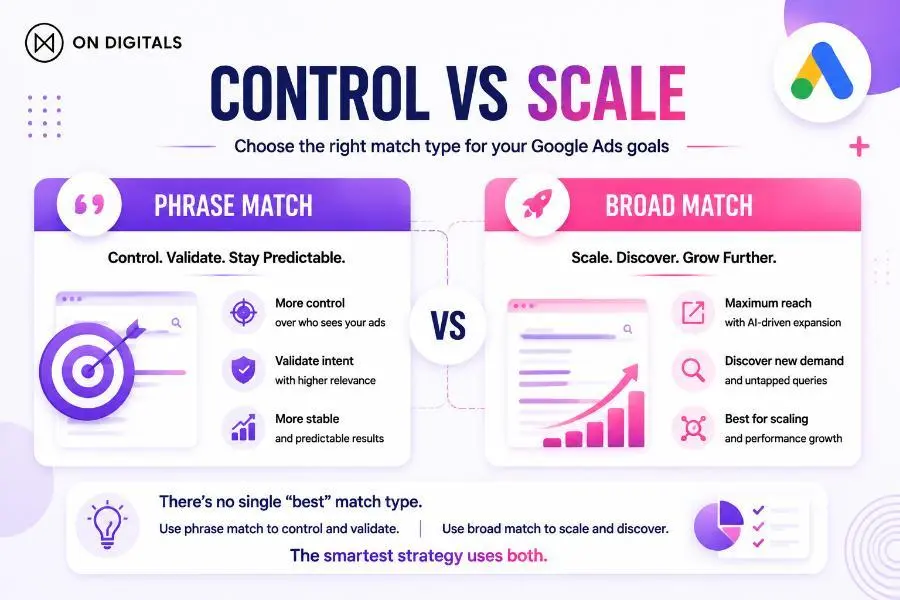 Control vs Scale: Choosing the Right Match Type Strategy
Campaign Strategy by Stage (Start – Growth – Scale)
Start stage:
Focus on phrase match + exact match to validate search intent, understand user behavior, and ensure conversion quality before scaling.
Growth stage:
Use a mix of phrase match and limited broad match to expand reach while still maintaining control over traffic quality and budget efficiency.
Scale stage:
Increase broad match usage and rely heavily on Smart Bidding to maximize conversion volume, unlock new search demand, and optimize at scale through Google’s AI systems.
Common Mistakes When Using Match Types
- Using broad match too early without data
- Ignoring negative keyword lists
- Treating phrase match as completely safe
- Not reviewing search terms regularly
- Mixing unrelated intents in one ad group
- Optimizing match types without conversion context
These mistakes often lead to wasted ad spend and misleading performance signals.
How to Optimize Performance Using Match Types
To improve performance in Google Ads, optimization should focus on managing intent flow rather than just keyword selection. Start by regularly analyzing search terms to understand how users are actually interacting with your ads in real-world queries. This helps you identify patterns of high-intent traffic as well as irrelevant searches that drain budget.
Once identified, add irrelevant or low-quality queries as negative keywords to prevent wasted spend and improve traffic quality. At the same time, separate different intent groups into structured ad groups so that each message aligns closely with user search behavior.
Another key step is aligning ad copy with the intent behind each match type, ensuring that broad match, phrase match, or exact match all deliver consistent messaging relevance. Finally, only use Smart Bidding when there is enough conversion data to support machine learning optimization.
Overall, performance improvement is not about choosing a single match type, but about systematically controlling how intent flows across your entire account structure.
FAQ: Broad Match vs Phrase Match
What is better: broad match or phrase match?
It depends on your goal. Broad match is better for scaling because it expands reach and helps discover new search demand, while phrase match is better for control and stable performance. Most accounts in 2026 use both depending on campaign stage.
Is broad match risky in Google Ads?
It can be risky if used without Smart Bidding, conversion tracking, or negative keywords. With proper setup, Google’s AI reduces irrelevant traffic and improves efficiency.
Does phrase match limit traffic?
Yes, but it improves relevance and conversion quality. It filters out low-intent searches, making traffic more predictable and often more cost-efficient.
Can I use both together?
Yes. A hybrid setup is common, using phrase match for control and broad match for scaling and discovery within the same account.
Does Google AI change match behavior?
Yes. Google AI now focuses on intent rather than exact keywords, making both match types more flexible and heavily dependent on conversion signals.
Final Strategic Conclusion & Key Takeaways
Broad match vs phrase match is not about choosing a “better” option, but about selecting the right strategy for the right stage of your campaign.
Broad match helps you scale and discover new demand, while phrase match gives you precision and control over intent. The most effective Google Ads strategies in 2025 use both, guided by conversion data, Smart Bidding, and structured campaign design. When used correctly, both match types work together to balance reach, efficiency, and profitability.

NEWEST POSTS
- Advertising Industry In Vietnam: The 2026 Trends, Channels and Market-Entry Strategy
- Best SEO Company in Vietnam: Latest Shortlist For Businesses
- How To Leverage Social Media For Customer Service Like A Pro?
- Social Media Post Tips – 8 Ways To Boost Engagement
- How To Use Social Media for Sales – In-depth Beginner Guide
Read more